


Texas Doctor Malpractice Lawyer
Physician negligence can leave families facing serious health setbacks, financial strain, and lasting uncertainty about what went wrong. Texas medical malpractice law adds extra pressure through strict procedural hurdles and limits on certain damages, which can affect whether a claim is heard and what compensation is available. Proving a case often depends on showing a breach of the standard of care, connecting that breach to the injury, and documenting losses with medical records and qualified expert support. If you or a loved one were harmed or worse due to doctor malpractice in Texas, contact Hastings Law Firm for a free, confidential case review.

Last Updated: October 22, 2026
Trusted Legal Representation for Physician Negligence in Texas
When a doctor’s error changes your life or the life of someone you love, the path forward can feel overwhelming. You may be dealing with worsening health, unexpected medical bills, and unanswered questions about what went wrong. These are valid concerns, and you deserve clear answers.
Texas has some of the most restrictive medical malpractice laws in the country. Holding a negligent physician accountable here requires more than just evidence of harm. It requires a legal team that understands the medical science behind your injury and the procedural rules designed to protect healthcare providers. That includes everything from missed diagnoses to medication contraindications, where a doctor prescribes a drug that should never have been given based on your existing conditions or other medications.
As a Texas doctor malpractice lawyer, Hastings Law Firm focuses exclusively on medical malpractice. Founded by Tommy Hastings, who is board-certified in Personal Injury Trial Law by the Texas Board of Legal Specialization, we offer a high level of expertise to every case. If you believe a physician’s error caused serious harm to you or your family, we can review what happened and explain your options in a free, confidential consultation.

Why You Need a Trial-Tested Texas Doctor Malpractice Lawyer
A specialized lawyer is essential because Texas medical malpractice claims are governed by the Texas Civil Practice and Remedies Code, Chapter 74, a set of tort reform laws that create significant procedural hurdles for injured patients. These laws require mandatory expert reports from qualified physicians, impose strict filing deadlines, and cap certain categories of damages. Without experienced legal guidance, a valid claim can be dismissed on a technicality before the facts are ever heard.
Legislators designed Texas tort reform to limit medical liability litigation. In practice, it raised the bar for every malpractice claim, including legitimate ones involving severe injury or gross negligence. A Texas doctor malpractice lawyer must be prepared to retain credible expert witnesses, reconstruct medical timelines, and build a case strong enough to withstand aggressive defense tactics from the start.
At Hastings Law Firm, our approach is built on this reality. We focus on being trial-ready from day one, investigating every case as if it will go before a jury. Our legal team includes former defense attorneys who previously represented hospitals, giving us direct insight into the strategies used against injured patients. We also employ in-house nurse consultants who analyze medical records and identify where the care went wrong, whether the error involved a surgical complication, an anesthesia error (a preventable mistake involving the administration of anesthesia during a procedure), or a failure to act on critical test results.
Our malpractice attorneys in Texas also recognize that physician negligence affects families across every community. Our team serves clients in English, Spanish, Creole, French, Russian, and Ukrainian, so that language is never a barrier to justice. If you need an attorney for physician negligence, the strength of your legal team can make the difference between a dismissed case and a meaningful recovery.
Common Types of Doctor Malpractice in Texas
Doctor malpractice occurs when a physician deviates from the accepted standard of care, leading to injuries through errors such as misdiagnosis, surgical mistakes, or improper medication management. These categories represent the most frequent ways medical professionals fail to meet safety standards. Cases span nearly every medical specialty, and issues can range from lack of informed consent to catastrophic surgical mistakes.
The Texas Healthcare Safety Network Annual Reports document recurring patterns of preventable medical errors across the state. Some of the most common forms of medical negligence by a doctor include:
- Misdiagnosis or delayed diagnosis: A misdiagnosis occurs when a physician identifies the wrong condition, while a delayed diagnosis means the correct condition was identified too late to prevent harm. Cancers, heart attacks, and strokes are among the most frequently missed or delayed diagnoses, and even a short delay can dramatically change outcomes.
- Surgical errors: These include wrong-site surgery, nerve damage caused by improper technique, instruments or sponges left inside the body, and anesthesia-related complications. Many surgical errors are entirely preventable with proper protocols.
- Medication errors: A doctor may prescribe the wrong drug, the wrong dosage, or a medication that dangerously interacts with something the patient is already taking. These physician errors can cause organ damage, allergic reactions, or worse.
- Birth injuries: A birth injury is harm to a mother or infant caused by negligent medical care during pregnancy, labor, or delivery. Errors by obstetricians, such as failing to monitor fetal distress or delaying a necessary C-section, can result in conditions like cerebral palsy or hypoxic brain injury.
Each of these categories involves distinct medical evidence and requires a legal team with the clinical knowledge to identify exactly where the care fell short.
The Hastings Law Firm Difference
Results matter, but what truly sets us apart is how we achieve them. Every verdict, every settlement, and every Texas courtroom victory comes from one guiding promise: To treat each client’s fight for justice as if it were our own.
This balance of skill, experience, and empathy reflects our core philosophy that justice should not only compensate the injured, but also make health care safer nationwide.

Understanding the Standard of Care in Texas Medical Negligence
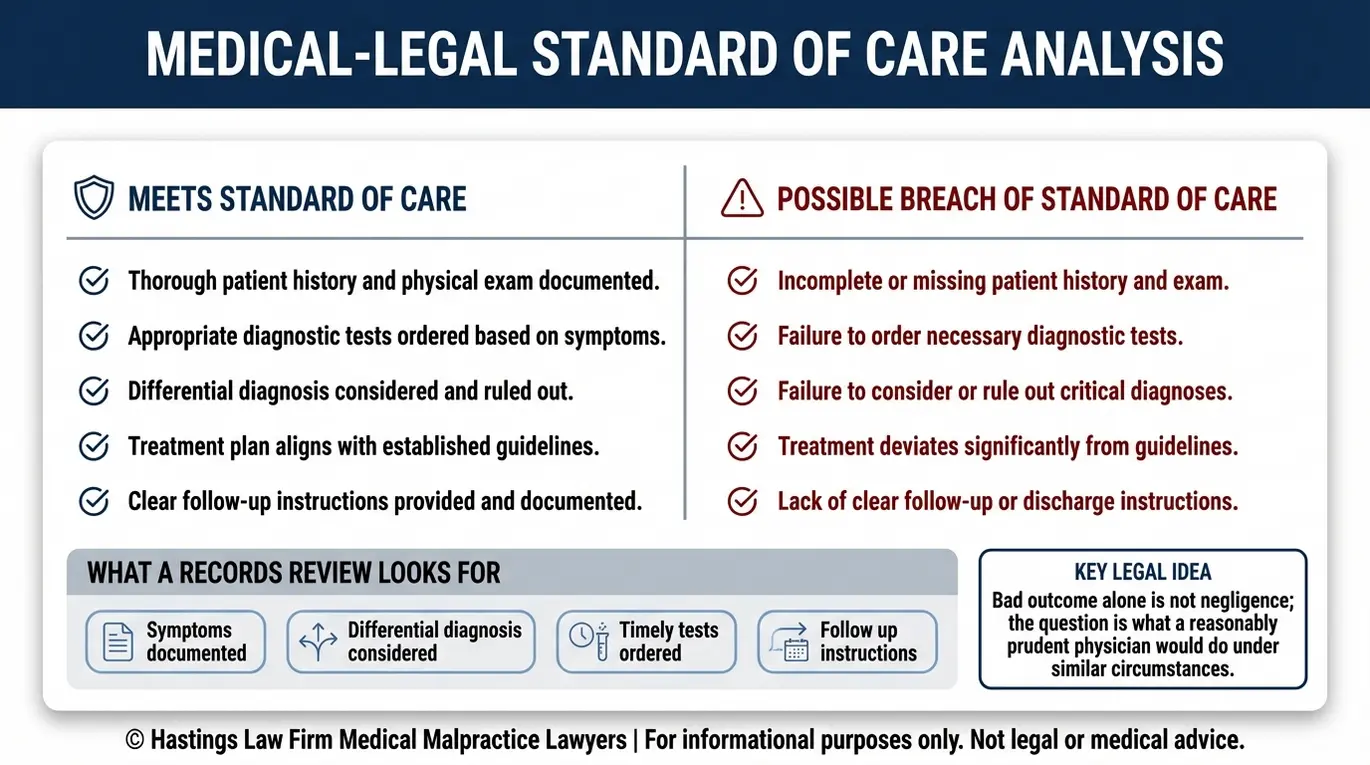
The standard of care in Texas is the level of care and skill that a reasonably prudent physician with similar training would provide under the same or similar circumstances. In Texas, this benchmark is central to all negligence claims. Without proving that a doctor fell below this standard, there is no case.
A bad medical outcome alone does not mean malpractice occurred. Medicine involves inherent risks, and not every complication is caused by negligence. The question is whether the physician’s decisions and actions met the expectations of their profession. A Texas medical malpractice lawyer must distinguish between an unfortunate result and a genuine breach of the duty of care, where the doctor failed to do what a competent peer would have done.
This analysis starts with a thorough medical records review. Our team examines clinical notes, lab results, imaging studies, and treatment timelines to identify where care may have fallen short. In cases involving a potential missed diagnosis, we evaluate whether the physician performed a differential diagnosis, a systematic process of ruling out possible conditions based on a patient’s symptoms and test results, as explained by MedlinePlus. This analysis helps identify care failures.
Informed consent is another important piece of the standard of care. Informed consent means the doctor explained the risks, benefits, and alternatives of a treatment, and the patient agreed to proceed. When a physician fails to disclose known risks, and those risks cause harm, it can form the basis of a separate negligence claim.
Willful and Wanton: Emergency Room Liability
Emergency room malpractice cases carry an even higher burden of proof in Texas. Emergency care in Texas is governed by a specific legal standard. Under state law, a patient treated in an ER must prove that the physician’s conduct was “willful and wanton,” meaning the doctor acted with conscious indifference or a deliberate disregard for the patient’s safety. Simple negligence is not enough.
This standard makes ER cases more difficult, but not impossible. Our team evaluates whether the emergency physician ignored obvious signs, failed to order basic diagnostic tests, or discharged a patient despite clear indicators of a serious condition. When the evidence supports it, we work with qualified experts to establish that the care crossed the line from a judgment call into gross negligence.
How to Prove a Doctor Was Negligent (Elements of Malpractice)
To prove a doctor was negligent in Texas, a plaintiff must demonstrate four elements: the existence of a doctor-patient relationship, a breach of the standard of care, proximate cause linking the breach to the injury, and quantifiable damages. Proving negligence requires meeting specific legal criteria to show that a doctor’s mistake caused your harm. Each element must be supported by evidence and, in most cases, confirmed through expert testimony.
The four elements of a malpractice claim are:
- Duty: A doctor-patient relationship existed, creating a legal obligation to provide competent care. You typically establish this by showing the physician agreed to treat you or was assigned to your care.
- Breach: The physician deviated from accepted medical practices. Expert testimony helps establish this element. The expert must explain what a competent doctor would have done and how the defendant’s actions fell short. Errors can include anything from performing wrong-site surgery (operating on the wrong body part) to failing to identify a retained surgical item (RSI), an instrument, sponge, or device accidentally left inside a patient after a procedure.
- Causation: The breach must be the proximate cause of your injury, meaning there is a direct link between the doctor’s error and the harm you suffered. It is not enough to show the doctor made a mistake; you must show that the mistake led to a specific, identifiable injury.
- Damages: You must have experienced real, quantifiable harm. This includes physical injury, emotional suffering, financial losses, or a combination. Without documented damages, there is no basis for recovery.
Physician Status: Independent Contractor vs. Employee
One challenge in suing a doctor in Texas involves determining whether the physician was an employee of the hospital or an independent contractor. An independent contractor is a doctor who works at a hospital but is not a direct employee of the facility. This distinction affects who can be held legally responsible for your injuries. Hospitals may argue they are not liable for an independent contractor’s negligence.
Vicarious liability relates to this issue. Vicarious liability is a legal theory that holds an employer responsible for the actions of its employees. When a doctor is an independent contractor, the hospital may try to avoid responsibility entirely. An experienced malpractice attorney knows how to investigate employment agreements, hospital bylaws, and the degree of control the facility exercised over the physician to determine whether hospital negligence can still be established.
Texas Medical Malpractice Damage Caps Explained
Texas law imposes a cap on non-economic damages (pain and suffering) in medical malpractice cases, generally limited to $250,000 against all individual healthcare providers and a total cumulative cap of $750,000 if healthcare institutions are also involved. Damage caps are legal limits on how much a patient can recover for non-financial losses. Under Chapter 74, non-economic damages cover pain and suffering, mental anguish, disfigurement, and physical impairment.
Understanding Texas malpractice damage caps is essential for evaluating the potential recovery in a case. Economic damages, on the other hand, have no limit on damages. These include past and future medical expenses, lost wages, and diminished earning capacity. When injuries are catastrophic, economic damages often represent the largest portion of a recovery.
In wrongful death cases, a separate statutory cap under Section 74.303 limits all damages (including economic and exemplary damages) to an amount that is adjusted for inflation from its original 1977 baseline and currently exceeds $2 million. Punitive damages, meant to punish particularly egregious conduct, are only available in rare cases involving fraud, malice, or gross negligence, and are subject to their own statutory limits.
| Damage Type | Cap in Texas |
|---|---|
| Non-economic (all individual providers) | $250,000 per claimant |
| Non-economic (institutional, total) | $500,000 combined |
| Non-economic (maximum combined) | $750,000 |
| Economic (medical bills, lost wages) | No cap |
| Punitive damages | Limited; requires fraud, malice, or gross negligence |
Understanding these limits is essential for evaluating what compensation for medical errors may realistically look like. Our team works to maximize recovery within these constraints by thoroughly documenting every category of economic loss.
The Chapter 74 Expert Report Requirement
Under Chapter 74, Section 74.351 of the Texas Civil Practice and Remedies Code, a plaintiff must serve a written expert report on each defendant within 120 days after the defendant files an original answer in the case. An expert report is a formal document written by a medical professional that explains how a doctor failed their patient. If this deadline is missed, the court must dismiss the case and may order the plaintiff to pay the defendant’s attorney fees. There is very little room for error.
This Texas medical expert requirement is the single most consequential procedural rule in Texas malpractice law. A qualified medical expert witness who practices or has practiced in the same field as the defendant physician must author the report. The report must identify the applicable standard of care, explain how the defendant breached that standard, and describe how the breach caused the patient’s injury.
A vague or poorly supported report will not survive a legal challenge. Defense attorneys routinely file motions to strike expert reports that lack specificity, and Texas courts have dismissed otherwise strong cases because the report failed to meet the statutory requirements. This is why choosing the right expert early in the case matters so much.
At Hastings Law Firm, we maintain a national network of top-tier medical experts across dozens of specialties. When we accept a Texas medical malpractice case, we begin the expert review process immediately, ensuring that the Chapter 74 expert report is thorough, defensible, and filed well within the 120-day deadline. A malpractice claim dismissal due to a missed deadline is preventable, and it is something our clients never have to worry about.

Statute of Limitations for Claims Against Texas Physicians
The statute of limitations for Texas malpractice is generally two years from the date of the negligent act or omission. A statute of limitations is a law that sets a deadline for how long you have to file a legal claim. If the exact date cannot be determined, the clock starts from the last date of treatment by the physician involved. Missing this deadline almost always means losing the right to file a claim.
Texas also enforces a statute of repose, which sets an absolute outer boundary of 10 years. Even if an injury was not discovered until years later, no claim can be filed more than 10 years after the date of the negligent act. This 10-year limit applies regardless of when the patient learned about the harm.
Texas courts apply the discovery rule, which in some states extends the filing deadline when an injury is not immediately apparent, very narrowly. Courts have limited its use in medical malpractice cases, making it unreliable as a fallback strategy. Strictly following the Notice of Claim procedures is necessary to managing these deadlines.
These deadlines are defined under Texas Civil Practice and Remedies Code, Section 74.251. If you believe you or a loved one was harmed by a physician’s error, the time limit to sue a doctor should be one of the first things you discuss with an attorney. Filing a medical claim even one day late can permanently bar your recovery.
Damages You Can Recover in a Texas Doctor Malpractice Case
Patients harmed by malpractice may recover economic damages for medical costs and lost income, as well as non-economic damages for pain, suffering, and physical impairment, subject to the state caps discussed earlier. Damages are the legal term for the financial and personal losses you can recover in a lawsuit. Patients seeking to recover damages for malpractice may pursue:
Economic damages cover the measurable financial losses caused by the physician’s negligence:
- Past and future medical expenses, including surgeries, rehabilitation, and ongoing treatment
- Lost wages and diminished future earning capacity
- Costs of home care, adaptive equipment, or long-term assistance
Non-economic damages address the personal and emotional toll:
- Physical pain and suffering
- Mental anguish and emotional distress
- Disfigurement or physical impairment
- Loss of consortium, which compensates a spouse or family for the loss of companionship and support
Punitive damages are not available in most malpractice cases. Texas law reserves them for situations involving fraud, malice, or gross negligence. Securing full compensation for doctor negligence requires proving these elements clearly. While malpractice settlement amounts vary based on damage caps, they are heavily influenced by economic losses.
In cases where a patient dies due to physician negligence, the family may pursue both a wrongful death claim and a survival action. The wrongful death claim compensates surviving family members for their own losses. The survival action allows the estate to recover damages the patient experienced before passing, including pain and medical expenses.
The Legal Process of a Texas Medical Malpractice Lawsuit
The medical malpractice lawsuit process involves an initial investigation and records review, serving a Notice of Claim, filing the lawsuit, engaging in discovery and expert deposition, mediation, and potentially proceeding to trial if a fair settlement is not reached. The legal process involves several stages, from the first investigation to reaching a final resolution. Here are the key steps to suing a doctor in Texas:
- Investigation and records review: Our medical and legal team obtains and analyzes your complete medical records, identifies potential breaches in the standard of care, and consults with qualified experts to assess the strength of the claim.
- Pre-suit notice of claim: Under Texas Civil Practice and Remedies Code, Section 74.051, you must send a written notice of claim to each healthcare provider at least 60 days before filing the lawsuit. This notice triggers a period during which early resolution may be explored.
- Filing suit and expert reports: Once the lawsuit is filed, the 120-day clock for serving the Chapter 74 expert report begins when the defendant files an original answer. Meeting this deadline with a well-supported report is essential to keeping the case alive.
- Discovery and depositions: Both sides exchange evidence, take sworn testimony from treating physicians and expert witnesses, and build their respective cases. This phase often reveals key documents and testimony that shape the outcome.
- Mediation or trial: Many medical malpractice cases reach resolution through mediation or settlement negotiation. If a fair settlement cannot be reached, we are prepared to take the case to a jury. Every case we accept is built with trial readiness in mind.
Each step in this medical malpractice lawsuit process has deadlines and procedural requirements that, if missed, can end a claim. Having an experienced legal team manage this timeline protects both your rights and your recovery.

Contact the Texas Doctor Malpractice Attorneys at Hastings Law Firm Today for Help
Texas malpractice laws are designed to make it difficult to hold physicians accountable. Strict expert report requirements, damage caps, and short filing deadlines create real obstacles for injured patients. But these obstacles are not insurmountable when you have the right legal team. We handle doctor malpractice cases all across Texas from our Houston, Dallas, and Austin offices.
Hastings Law Firm was built for exactly these cases. Our attorneys, nurse consultants, and medical experts work together to investigate physician negligence, build strong claims, and prepare every case for trial. We operate on a contingency fee basis, which means you pay no fees or costs unless we recover compensation on your behalf.
If you or a loved one was harmed by a doctor’s error, we are ready to listen. Please contact a malpractice attorney at Hastings Law Firm for a free, confidential case evaluation. Let us help you find the answers you deserve.
Frequently Asked Questions About Doctor Malpractice in Texas


This content was researched and written by the Hastings Law Firm editorial team, which includes attorneys, medical professionals, and experienced researchers. Our writing is informed by internal knowledge and practical experience, and we cross-check critical details against authoritative sources cited throughout. Every piece undergoes human-led fact-checking and legal review. Because legal and medical information can change, if you spot an error, please contact us. Learn more about our content standards and review process on our editorial policy page.

Tommy Hastings, founder of Hastings Law Firm, is a board-certified personal injury trial lawyer (by the Texas Board of Legal Specialization) dedicated exclusively to healthcare injury cases. Since 2001, he has represented injured patients and families in litigation against major hospital systems, pharmaceutical companies, and negligent healthcare providers nationwide. He has handled numerous high-profile cases that have drawn national media attention and resulted in multi-million dollar recoveries.
