


Texas Intensivist Malpractice Lawyer
Intensive care mistakes can leave families facing sudden, life changing harm and unanswered concerns about what went wrong. This topic focuses on intensivist negligence in the ICU, including breakdowns in monitoring, ventilator management, medication oversight, infection control, and delayed response to clinical deterioration. It also addresses why proving responsibility can be difficult when patients are already critically ill and why records and device data matter in understanding the timeline of care. If you or a loved one were harmed or worse due to intensivist malpractice in Texas, contact Hastings Law Firm for a free, confidential case review.

Last Updated: July 27, 2026
Trial-Ready Legal Representation for Critical Care Negligence in Texas
When a loved one is admitted to an intensive care unit, you trust that the physicians overseeing their care will act with the highest level of skill and urgency. If that trust was broken by a critical care doctor’s error, the confusion and grief that follow can feel overwhelming. You may know something went wrong but have no clear way to confirm it or hold anyone accountable.
A Texas Intensivist Malpractice Lawyer at Hastings Law Firm can help you understand what happened and why. Our team of trial attorneys, former defense lawyers, and in-house medical professionals focuses exclusively on medical malpractice. We investigate ICU cases from the inside out, using the same clinical knowledge the defense relies on.
If you believe your family member was harmed by negligent critical care, contact us for a free, confidential case evaluation. We can review the facts and explain your options.

Common Critical Care Errors Committed by Texas Intensivists
Intensivist negligence occurs when a critical care doctor deviates from the accepted standard of care, leading to preventable harm such as failure to monitor vital signs, improper ventilator management, medication mistakes, misdiagnosis, or failure to diagnose escalating conditions like sepsis. An intensivist, a physician who specializes in managing critically ill patients in the ICU, bears direct responsibility for the complex, life-sustaining decisions that keep patients stable. When those decisions fall short, the consequences can be catastrophic.
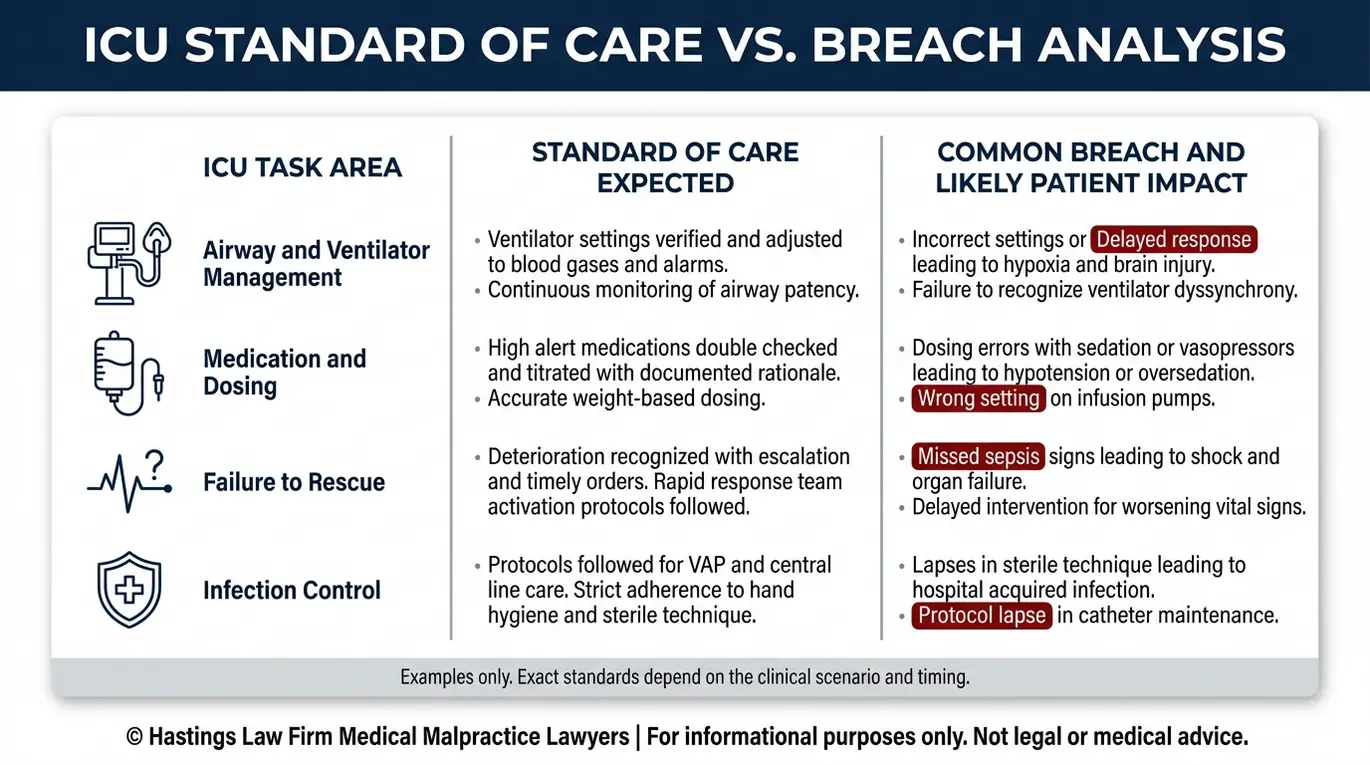
Airway and Ventilator Management
In the intensive care unit, breathing assistance is often a lifeline. Errors involving mechanical ventilation, the use of a machine to assist or replace a patient’s breathing, are among the most serious forms of ICU doctor error. These can include incorrect ventilator settings that cause lung injury, delayed intubation when a patient’s airway is compromised, or premature extubation before the patient can breathe independently. Any of these failures can lead to hypoxia, a dangerous drop in oxygen to the brain, and permanent brain injury.
Medication and Dosing Errors
ICU patients frequently receive high-alert medications such as sedatives and vasopressors. Even small dosing errors with these drugs can cause organ damage, dangerous drops in blood pressure, or cardiac arrest. The Institute for Safe Medication Practices (ISMP) maintains a High-Alert Medication List for Acute Care Settings that identifies many of the drugs commonly used in critical care. The intensivist is responsible for overseeing these orders and adjusting them based on the patient’s evolving condition. Medication errors by an intensivist can form the basis of a malpractice claim when proper protocols are not followed.
Failure to Rescue
In clinical terms, rescue refers to the medical team’s ability to identify and reverse a life-threatening decline. One of the most common forms of critical care malpractice involves the failure to recognize and respond to signs of clinical deterioration. Sepsis, for example, can progress rapidly from an infection to organ failure and death if not identified and treated promptly. When an intensivist misses or delays acting on clear warning signs, such as rising lactate levels or falling blood pressure, the window to save the patient narrows quickly.
Infection Control Failures
Hospital-acquired infections are a known and preventable risk in the ICU. Strict hygiene protocols are the standard defense against these infections. Central line-associated bloodstream infections and ventilator-associated pneumonia can develop when sterile protocols are not followed. According to the Centers for Disease Control and Prevention (CDC), central line-associated bloodstream infections (CLABSIs) are largely preventable with proper insertion and maintenance techniques. When an intensivist fails to enforce or follow these protocols, the resulting infection may constitute malpractice.
A Texas intensivist malpractice lawyer evaluates these errors by reconstructing the clinical timeline and identifying where the standard of care was breached.
| Error Type | How It Occurs | Potential Impact on Patient |
|---|---|---|
| Ventilator Mismanagement | Incorrect settings, delayed intubation, premature extubation | Hypoxia, lung injury, brain damage |
| Medication/Dosing Error | Wrong drug, wrong dose, or failure to adjust high-alert medications | Organ failure, cardiac arrest, death |
| Failure to Rescue | Delayed response to sepsis, declining vitals, or clinical deterioration | Septic shock, multi-organ failure, death |
| Infection Control Failure | Non-sterile catheter insertion, failure to follow hygiene protocols | CLABSI, ventilator-associated pneumonia, sepsis |
Proving Intensivist Malpractice Through Standard of Care and Evidence
Proving malpractice requires establishing that the intensivist owed a duty of care, breached that duty by deviating from medical standards, and directly caused the patient’s injury or death through that breach, as confirmed by expert testimony. Each of these elements must be supported by evidence. The burden of proof falls on the patient’s legal team.
The Role of Expert Testimony
Under the Texas Civil Practice and Remedies Code, Chapter 74, a qualified medical expert must define the medical standards and explain how the intensivist deviated from them. In a malpractice claim against an ICU doctor, this expert is typically a physician with similar training and experience in critical care medicine. Both sides present expert opinions, which means the credibility and qualifications of your expert can significantly influence the outcome. We work with a national network of critical care specialists who can provide authoritative, independent analysis.
Causation Challenges
ICU patients are already critically ill, which gives the defense a built-in argument: the patient’s condition, not the doctor’s error, caused the outcome. Proving intensivist negligence requires demonstrating that the breach of duty was a direct cause of the harm, separate from the underlying illness. Our medical and legal teams work together to isolate the specific act or omission that changed the patient’s trajectory. This is often the most contested element in an intensivist liability case.
Medical Record Analysis
A detailed forensic review of the medical records is the foundation of every ICU malpractice case. This process helps pinpoint the specific timing of medical errors by examining physician orders, nursing notes, medication records, and lab results. We build a minute-by-minute timeline of the patient’s care to see exactly when the standard was missed. You have the right to obtain your medical records, and the Texas Medical Board outlines the process for requesting copies of medical records.
An ICU malpractice lawyer in Texas uses all of this evidence to build a case that can withstand the scrutiny of both defense experts and the court.
Evidence we gather and review in these cases includes:
- Complete ICU medical charts and physician orders
- Nursing flowsheets and shift-change documentation
- Medication administration records, including vasopressors, drugs used to raise dangerously low blood pressure, and sedatives
- Lab results, imaging, and culture reports
- Central line insertion logs to evaluate for central line-associated bloodstream infection (CLABSI), a preventable infection caused by bacteria entering the bloodstream through a central venous catheter
- Electronic monitoring data and device audit trails
- Staffing records and communication logs
Analyzing Electronic Monitoring Logs and Device Data
Modern ICUs generate a continuous stream of ICU device data and electronic monitoring logs from bedside monitors, ventilators, and infusion pumps. This digital evidence provides a neutral record of exactly how a patient was monitored. This data includes an audit trail, a digital record that captures the patient’s vital signs history, every change in condition, and every adjustment made to a device, along with exact timestamps. These logs can show precisely when a patient’s oxygen levels dropped, when an alarm was triggered, and how long it took for a response.
Securing this data early is essential because some systems overwrite records after a set period. Hypoxia, a state where the body or brain does not receive enough oxygen, is a common and devastating consequence of delayed intervention. Electronic logs can reveal whether the care team responded appropriately. We move quickly to preserve this evidence before it is lost.

The Hastings Law Firm Difference
Results matter, but what truly sets us apart is how we achieve them. Every verdict, every settlement, and every Texas courtroom victory comes from one guiding promise: To treat each client’s fight for justice as if it were our own.
This balance of skill, experience, and empathy reflects our core philosophy that justice should not only compensate the injured, but also make health care safer nationwide.

Liability and Accountability in Texas Critical Care Cases
Liability often falls on the individual intensivist, but it may extend to the hospital if the doctor is an employee or if the facility failed to enforce safety protocols or maintain adequate staffing levels. Determining physician liability versus hospital liability is one of the first questions a Texas intensivist malpractice lawyer must answer.
Independent Contractor vs. Employee
Hospitals frequently argue that their intensivists are independent contractors rather than employees. This distinction is important because it affects who can be held responsible for a medical error. Under Texas Civil Practice and Remedies Code § 74.001, the definitions of health care providers and their relationships to institutions affect how vicarious liability is assigned. If the hospital controls how and when the doctor works, the independent contractor status label may not hold up. We examine contracts, scheduling records, and hospital bylaws to determine the nature of the relationship.
Corporate Negligence
Corporate negligence is an institutional claim rather than one against a single doctor. This legal theory holds hospitals accountable for their own administrative errors, such as failing to maintain safe staffing levels. Even when the intensivist is not a direct hospital employee, the facility may bear liability for institutional failure. If inadequate staffing, broken equipment, or poor credentialing contributed to the patient’s harm, the hospital can be held accountable through a corporate negligence theory. An intensivist malpractice lawsuit may name both the physician and the institution as defendants.
Staffing and Communication Breakdowns
Communication failures between nurses and intensivists are a recurring factor in ICU injury cases. These lapses often occur during shift changes or when doctors are overloaded with patients. When critical changes in a patient’s condition are not escalated promptly, or when a physician is covering too many patients to respond in time, the resulting harm may involve shared liability. We evaluate staffing ratios, call schedules, and internal communication records to identify communication failures that contributed to the error.
Internal Case Review by On-Staff Doctors
Before we ever file a claim, our in-house medical team, which includes nurse practitioners and board-certified patient advocates, conducts a thorough internal medical review. This merit screening process ensures that the medical theory behind each case is sound from day one. By having medical professionals evaluate the records alongside our attorneys, we identify breaches in the standard of care early and build a stronger foundation for litigation. Only cases with clear medical and legal merit move forward.
Recognizing the Warning Signs of Negligence in the ICU
Warning signs of negligence include unexplained changes in the patient’s condition, lack of response to alarms, conflicting information from staff, or a sudden decline shortly after a procedure or medication change. Families are often the first to notice that something is not right, even if they cannot pinpoint the clinical cause.
If your loved one was in the ICU and you observed any of the following, it may be worth discussing the situation with a Texas intensivist malpractice lawyer:
- Lapses in patient monitoring, such as monitoring alarms that go unanswered or are repeatedly silenced by staff
- A stable patient who suddenly and unexpectedly deteriorates without a clear medical explanation
- The intensivist is rarely present or avoids answering your questions directly
- Communication breakdown, such as conflicting or vague explanations from different members of the care team about what happened
- Development of sepsis, a life-threatening condition where the body’s response to an infection causes widespread organ damage, that was not identified or treated promptly
- A diagnosis of ventilator-associated pneumonia (VAP), a lung infection that develops in patients on mechanical ventilation, particularly when hygiene protocols may not have been followed
- Signs of a new infection or worsening condition that staff attributes solely to the patient’s underlying illness without further investigation
These patterns do not automatically prove medical negligence, but they can indicate that the standard of care was not met. The Agency for Healthcare Research and Quality (AHRQ) National Healthcare Safety Dashboard tracks patient safety events that reflect many of the same concerns families raise in ICU cases. Documenting what you observe, including dates, times, and names of staff, can be valuable for a legal review. When these errors result in wrongful death or severe injury, families may be entitled to damages to cover their losses.

Contact the Texas Doctor Malpractice Attorneys at Hastings Law Firm Today for Help
Losing a loved one or watching them suffer because of a critical care doctor’s error is something no family should endure. At Hastings Law Firm, we exist to help families find answers and hold the responsible parties accountable. Our team, founded by board-certified trial lawyer Tommy Hastings in 2005, includes former defense lawyers and in-house medical professionals.
Tommy is board-certified in personal injury trial law by the Texas Board of Legal Specialization, a distinction achieved by less than 2% of attorneys in the state. He has dedicated his career to representing patients silenced by medical error, including securing a $10 million verdict against operators of a pill mill, a national first for such a case. We understand the emotional weight of what you are going through, and we are here to help you take the next step with clarity. Every consultation is free and confidential, and you pay no fees unless we recover compensation on your behalf.
If you believe an intensivist’s negligence harmed your family member in a Texas ICU, contact us today for a risk-free case evaluation. Let us review what happened and help you understand your legal options.
Frequently Asked Questions About Intensivist Malpractice in Texas


This content was researched and written by the Hastings Law Firm editorial team, which includes attorneys, medical professionals, and experienced researchers. Our writing is informed by internal knowledge and practical experience, and we cross-check critical details against authoritative sources cited throughout. Every piece undergoes human-led fact-checking and legal review. Because legal and medical information can change, if you spot an error, please contact us. Learn more about our content standards and review process on our editorial policy page.

Brady D. Williams is a nationally recognized medical malpractice attorney who has spent his career handling high-stakes litigation for injured patients and families across the country. Licensed in both Texas and California, Brady draws on experience from hundreds of resolved medical cases to break down complex legal and medical topics for the people who need that information most. His writing reflects the same attention to detail and commitment to clarity that he brings to every case he handles.
