


Texas Nursing Home Abuse Lawyer
Nursing home abuse and neglect can leave families feeling shocked and unsure who to trust. Harm in a care facility often shows up through injuries, unsafe conditions, or sudden changes in behavior, and it may be tied to problems like understaffing or improper use of restraints. Texas law can treat many nursing home claims as medical malpractice, which can affect what must be proven and what compensation is available. If you or a loved one were harmed or worse due to nursing home abuse or neglect in Texas, contact Hastings Law Firm for a free, confidential case review.
Last Updated: July 27, 2026
Trusted Legal Representation for Nursing Home Negligence and Abuse in Texas
When a loved one is harmed in a place that was supposed to keep them safe, the mix of anger, guilt, and confusion can feel overwhelming. You trusted a facility with someone you love, and now you suspect that trust was broken. Those instincts matter, and you deserve honest answers about what happened and what you can do about it.
At Hastings Law Firm, our medical-legal team, which includes in-house nurse consultants and former defense attorneys, focuses on investigating exactly these situations. Led by Tommy Hastings, a board-certified trial lawyer with over 20 years of experience, we focus on restoring trust for families who have been betrayed by the healthcare system.
If you believe your family member has been harmed by nursing home abuse or neglect, our team can help. A Texas nursing home abuse lawyer at our firm will review what happened and explain your legal options at no cost.

Identifying Common Signs of Abuse and Neglect in Care Facilities
Nursing home abuse manifests through physical injuries like unexplained bruises or bedsores, behavioral changes such as withdrawal or fear of staff, and signs of neglect like malnutrition, poor hygiene, or soiled bedding. Some indicators are obvious. Others are easy to miss, especially when families are told that a loved one’s decline is “just part of aging.” Identifying these signs early is often the key to preventing further injury.
Understanding the difference between active abuse and passive neglect is an important first step. Active abuse involves physical harm, such as hitting, rough handling, or the improper use of chemical restraints. These restraints are psychotropic or sedating medications given without a clinical need to manage a resident’s behavior.
Passive neglect, on the other hand, often stems from systemic problems like understaffing. A resident who isn’t repositioned regularly, isn’t given enough fluids, or isn’t helped with basic hygiene is experiencing neglect, even if no one intended direct harm.
Some of the most dangerous injuries are also the most “silent.” Pressure ulcers, commonly known as bedsores, develop when a resident is left in the same position for too long. According to AHRQ’s On-Time Pressure Ulcer Prevention program, these injuries are largely preventable with proper repositioning and skin assessments. A Stage 4 pressure ulcer can expose muscle or bone and lead to life-threatening infections. Dehydration, another common indicator, can cause confusion, kidney failure, and rapid decline in elderly residents, yet it is entirely preventable with adequate monitoring.
Behavioral changes can be just as telling as physical evidence. Lawyers often hear from families who noticed a parent or grandparent becoming withdrawn, unusually anxious, or visibly afraid when certain staff members entered the room. These shifts in behavior should not be dismissed.
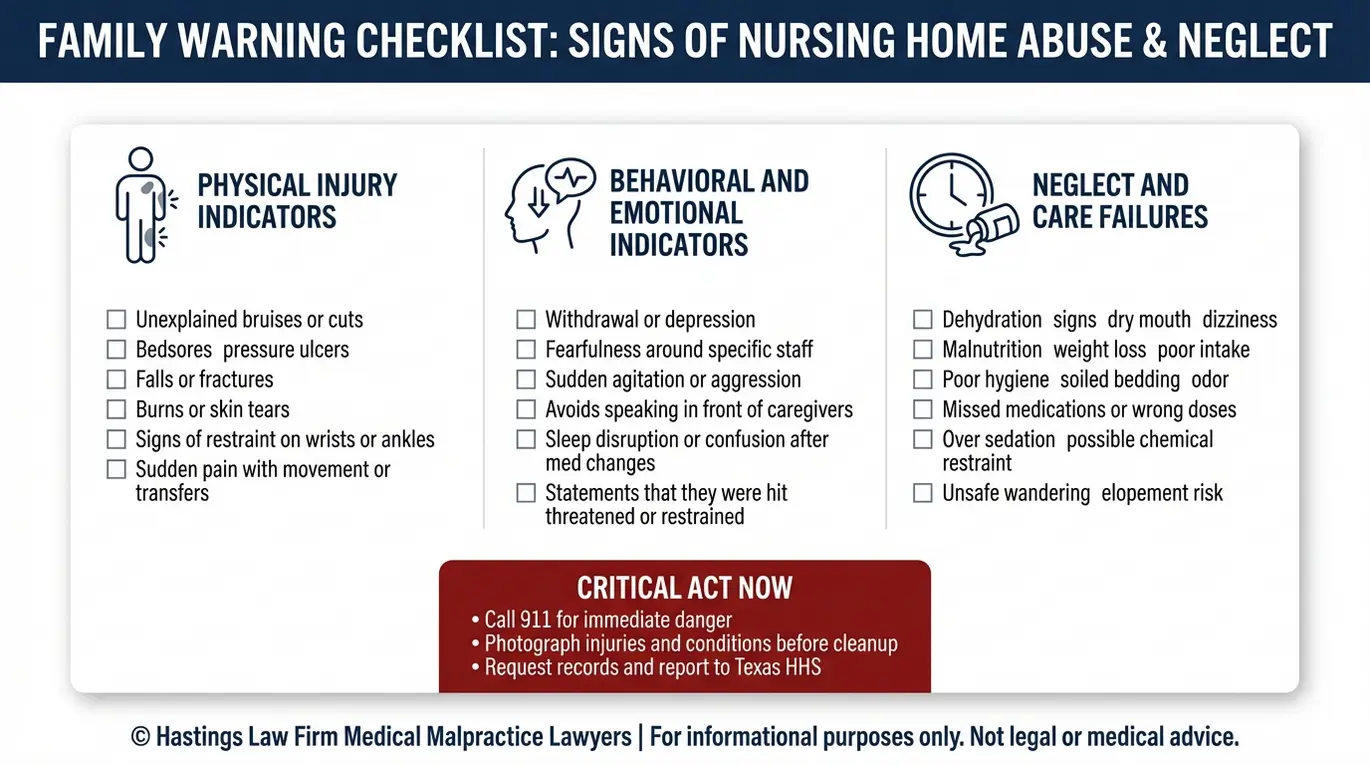
Here is a checklist of warning signs organized by category:
Physical Indicators
- Unexplained bruises, welts, or cuts, especially in various stages of healing
- Pressure ulcers (bedsores) on the back, hips, or heels
- Sudden weight loss or signs of malnutrition
- Evidence of physical restraints, such as marks on wrists or ankles
- Frequent infections or untreated medical conditions
Emotional and Behavioral Indicators
- Withdrawal from normal activities or social interaction
- Fearfulness or flinching around specific staff members
- Unusual agitation, rocking, or non-communicative behavior
- Reluctance to speak openly when staff are present
Neglect Indicators
- Soiled clothing or bedding left unchanged
- Dehydration symptoms, including dry mouth, sunken eyes, or dark urine
- Unattended hygiene needs such as unbrushed teeth, long or dirty nails
- Medication errors or missed doses
- Unsafe or unsanitary living conditions
If you recognize any of these signs, your concern is valid, and it warrants immediate attention.
Immediate Steps to Take After Suspecting Senior Care Negligence
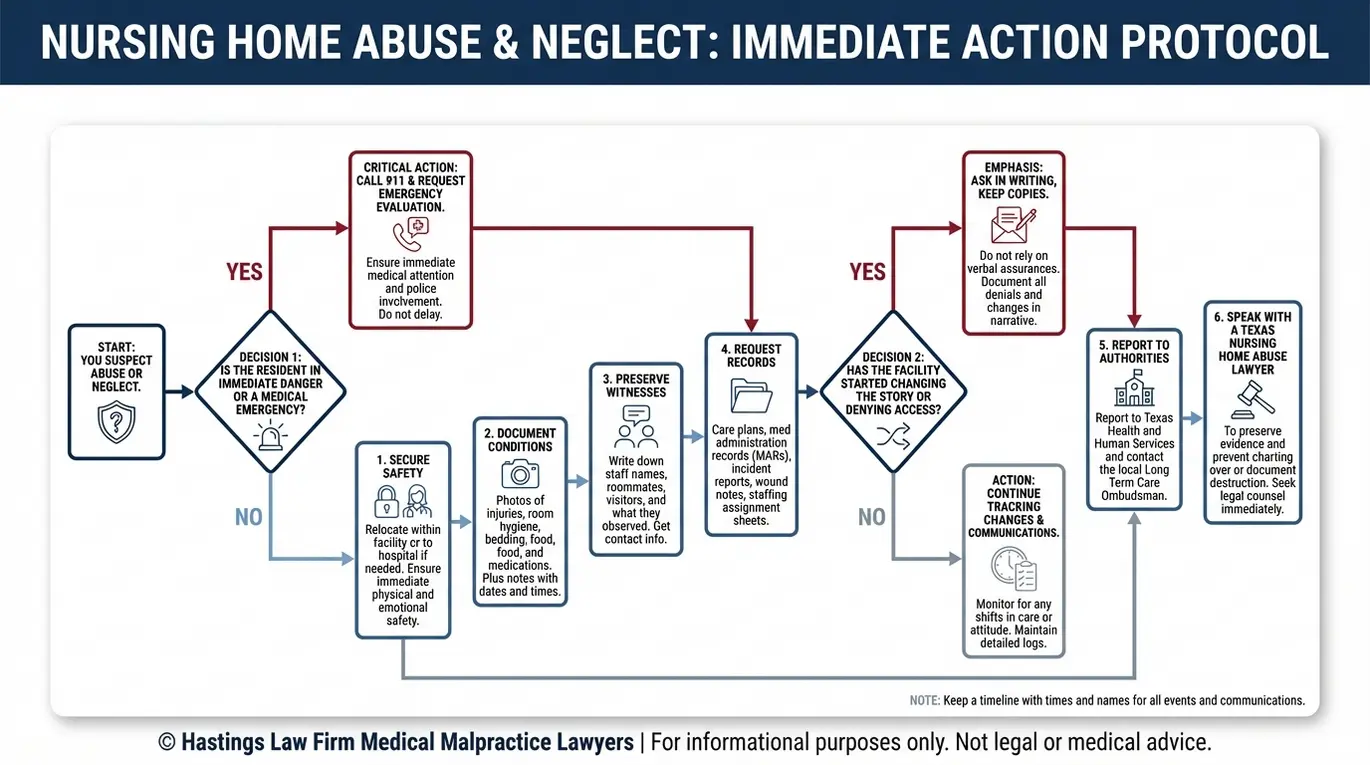
If you suspect abuse, immediately ensure the resident’s safety by calling 911 if the danger is imminent, document all injuries with photos and notes, report the incident to Texas Health and Human Services (HHS), and consult with a specialist attorney to preserve evidence. Taking these steps helps preserve the facts of the case before evidence is lost. From there, a series of deliberate steps can protect both your loved one and your ability to pursue a legal claim.
1. Secure the Resident’s Safety If injuries are serious or ongoing, request emergency medical evaluation or hospitalization. Removing your loved one from harm is the most urgent step.
2. Document Everything You Can See Before the facility has a chance to clean up or alter conditions, take photographs. Capture injuries, the condition of the room, soiled linens, uneaten food trays, and anything else that looks wrong. Write down dates, times, and the names of staff present. These records can become critical evidence later.
3. Report the Situation Reporting abuse to the proper authorities creates an official government record. File a formal complaint with Texas Health and Human Services and contact the Long-Term Care Ombudsman in your region. The Ombudsman program assigns advocates who investigate complaints and help protect residents’ rights. Filing these reports strengthens any future legal action.
4. Contact a Texas Nursing Home Abuse Lawyer Reaching out to a lawyer early is one of the most protective steps you can take. Facilities can alter records, retrain staff, or change protocols once they know a complaint has been filed. A lawyer for nursing home abuse can issue preservation demands to prevent evidence from being lost or destroyed. At Hastings Law Firm, our team includes former defense attorneys who understand the tactics facilities use to avoid accountability.
Malnutrition, the state of not receiving adequate nutrition for the body’s needs, and dehydration, a dangerous loss of fluids and electrolytes, are both conditions that develop over time and often point to a pattern of neglect rather than a single incident. Documenting these conditions early helps establish that pattern.
The Hastings Law Firm Difference
Results matter, but what truly sets us apart is how we achieve them. Every verdict, every settlement, and every Texas courtroom victory comes from one guiding promise: To treat each client’s fight for justice as if it were our own.
This balance of skill, experience, and empathy reflects our core philosophy that justice should not only compensate the injured, but also make health care safer nationwide.

Proving Liability Under Texas Medical Malpractice Laws
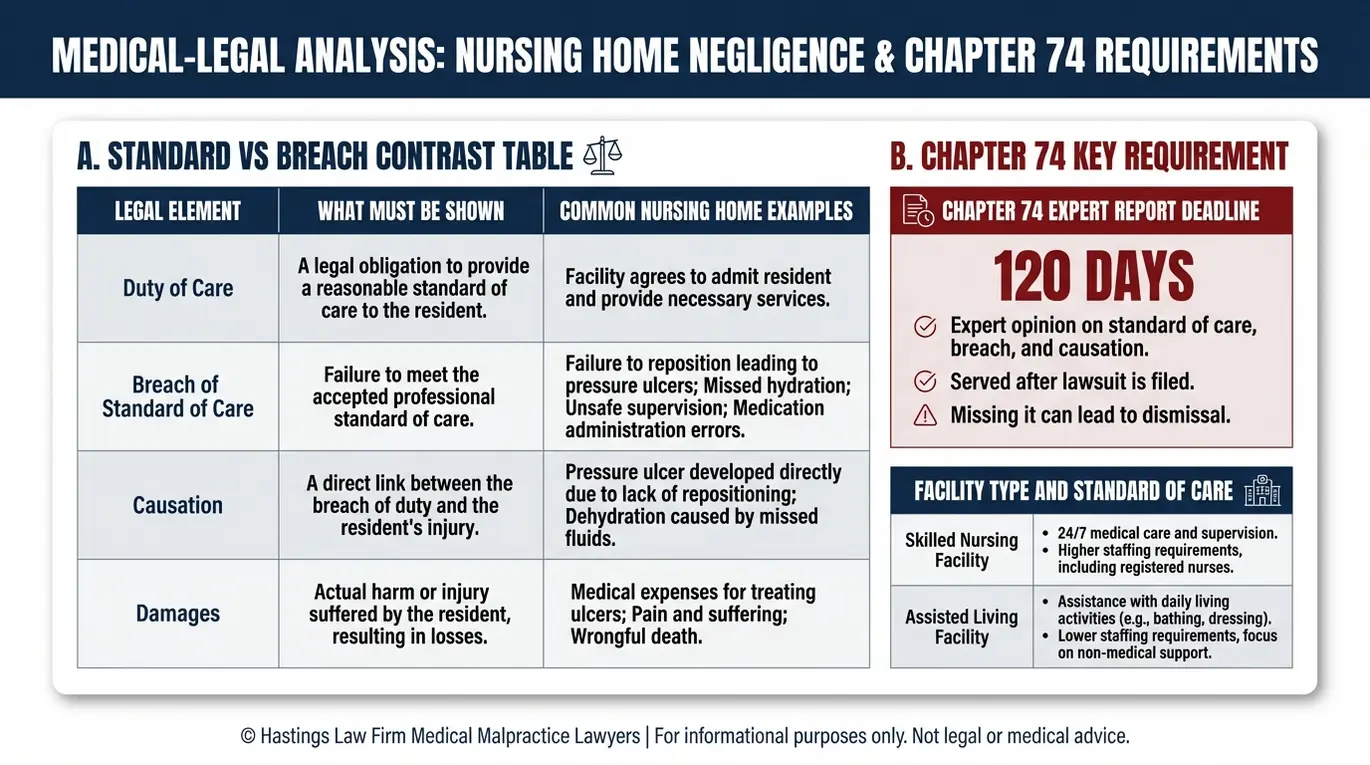
Proving liability in a Texas nursing home case requires showing that the facility owed a duty of care to the resident, breached that duty through negligent action or inaction, and that the breach directly caused the resident’s injury or death. Liability in a legal sense means responsibility for harm caused by a failure to meet professional standards. In Texas, nursing home claims are often treated as medical malpractice cases, requiring specific legal steps that differ from standard personal injury claims.
One of the most important things families should know is that many nursing home cases in Texas fall under the Texas Medical Liability Act, specifically Chapter 74.351 of the Civil Practice and Remedies Code. This statute requires that the plaintiff serve a qualified expert report within 120 days after each defendant’s original answer is filed. The report must identify the applicable standard of care, explain how the facility fell short, and connect that failure to the resident’s harm. If the report is missing or insufficient, the court can dismiss the entire case.
Our founder, Tommy Hastings, is board-certified in Personal Injury Trial Law by the Texas Board of Legal Specialization, a credential held by less than 2% of attorneys in the state. This level of expertise is necessary because proving these elements often relies on medical experts to clarify complex issues for a jury. General personal injury firms may lack the medical resources to produce a compliant expert report on time. Our team works with in-house nurse consultants and a national network of medical experts to build these reports from the ground up.
The type of facility also affects the legal analysis. A skilled nursing facility (SNF), which provides around-the-clock medical care, is held to different regulations than an assisted living facility (ALF), which primarily assists with daily tasks. Establishing what a reasonably competent facility of the same type would have done under similar circumstances is central to proving a breach of duty.
A nursing home abuse attorney in Texas must understand both the medical realities and the regulatory framework that apply to the specific facility involved. That dual fluency allows us to present a case that holds up under the scrutiny of defense experts and judges.
Uncovering Evidence of Corporate Negligence and Understaffing
Successful claims often rely on internal facility data such as staffing logs, badge access records, and corporate financial documents to prove that systemic understaffing and profit-prioritization led to the resident’s injury. Evidence in these cases often involves complex documentation from both the facility and the state. Facility records provide a window into how a home is managed day-to-day and whether it met safety requirements.
Understaffing occurs when a facility operates with fewer caregivers than necessary to meet resident needs. It is one of the most common root causes of harm. When there are not enough trained caregivers on the floor, residents are not repositioned, call lights go unanswered, and medication schedules are missed. These gaps lead to falls, wandering, and elopement, all of which can result in serious injury or wrongful death.
The Five-Star Quality Rating System maintained by CMS publishes staffing data and health inspection results for every Medicare-certified facility. As a Texas nursing home abuse attorney, we use this publicly available data alongside internal staffing logs obtained through discovery to build a clear picture of the conditions that existed when the harm occurred.
Key evidence we examine includes:
- Daily staffing schedules and actual versus required nurse-to-patient ratios
- Badge access and time-clock records showing shift coverage gaps
- Incident and accident reports filed internally
- State inspection and deficiency reports
- Corporate ownership documents and budget directives
- Resident care plans compared to actual care delivered
Role of Corporate Ownership and Investors in Neglect
Many nursing homes in Texas are owned by corporate chains or private equity groups that control budgets across multiple facilities. When corporate directives result in reduced staffing levels or deferred maintenance, the residents can bear the consequences. We examine corporate communications and budget allocations to determine whether understaffing was a facility-level oversight or a result of broader corporate directives. Establishing investor liability allows us to identify the decision-makers and hold them accountable for the harm that occurred.
Calculating Damages and Compensation for Elder Abuse Victims
Compensation in a nursing home abuse case may include economic damages for medical bills and relocation costs, non-economic damages for pain and suffering and mental anguish, and in certain cases, punitive damages if gross negligence or malicious conduct is established. Damages represent the legal recognition of the harm and loss suffered by an injured person. Financial recovery in a legal claim helps cover the costs of future care and the trauma associated with neglect.
Economic damages cover the measurable financial losses caused by the abuse or neglect. These can include hospital and rehabilitation costs, the expense of relocating the resident to a safer facility, home health care, and other out-of-pocket costs. These damages are not subject to a statutory cap, which makes thorough financial documentation essential.
Non-economic damages address the human cost: the resident’s physical pain, emotional suffering, loss of dignity, and mental anguish. Under the Texas Medical Liability Act, Section 74.301 of the Civil Practice and Remedies Code, non-economic damages in cases classified as medical malpractice are generally capped at $250,000 per facility. Because of this cap, we must build the strongest possible case on the economic side and pursue every available category of recovery.
Wrongful death claims arise when a resident dies as a result of abuse or neglect. Surviving spouses, children, and parents may file a wrongful death action seeking compensation for their own losses. This includes loss of companionship, grief, and the financial support the deceased provided.
In cases involving extreme conduct, we may also seek punitive damages, which are designed to punish the wrongdoer and deter similar behavior. These are pursued when the evidence supports a finding of gross negligence or intentional harm. Securing these damages sends a powerful message that abuse will not be tolerated.
Every category of damages requires careful analysis. Our team works with medical and financial experts to calculate both the immediate and long-term costs of the harm your family member has suffered.
Contact the Texas Nursing Home Attorneys at Hastings Law Firm Today for Help
No family should have to wonder whether the people caring for their loved one are causing harm instead. If you suspect your parent, grandparent, or family member has been abused or neglected in a Texas care facility, you have the right to demand answers. We handle nursing home abuse cases all across Texas from our Houston, Dallas, and Austin offices.
Hastings Law Firm focuses on restoring trust for families who feel betrayed by the systems they depended on. Our medical-legal team, including in-house nurses, board-certified patient advocates, and former defense attorneys, investigates every case with the goal of uncovering the truth.
We handle these cases on a contingency fee basis, which means you pay no attorney fees or costs unless we recover compensation for you. If you are looking for a Texas nursing home abuse lawyer, contact us today for a free, confidential case evaluation. Let us help you find the answers your family deserves.
Frequently Asked Questions About Nursing Home Abuse in Texas


This content was researched and written by the Hastings Law Firm editorial team, which includes attorneys, medical professionals, and experienced researchers. Our writing is informed by internal knowledge and practical experience, and we cross-check critical details against authoritative sources cited throughout. Every piece undergoes human-led fact-checking and legal review. Because legal and medical information can change, if you spot an error, please contact us. Learn more about our content standards and review process on our editorial policy page.

Brady D. Williams is a nationally recognized medical malpractice attorney who has spent his career handling high-stakes litigation for injured patients and families across the country. Licensed in both Texas and California, Brady draws on experience from hundreds of resolved medical cases to break down complex legal and medical topics for the people who need that information most. His writing reflects the same attention to detail and commitment to clarity that he brings to every case he handles.
