


Texas Nursing Home Fall Lawyer
A fall in a skilled nursing facility can leave families shaken and searching for clear answers about what went wrong. Some falls happen despite reasonable precautions, but others follow preventable breakdowns such as ignored care plans, inadequate supervision, unsafe environments, or medication related risks. Serious injuries can trigger lasting loss of independence and a rapid decline, and disputes often focus on whether the facility met required safety standards and documented events accurately. If you or a loved one were harmed or worse due to a nursing home fall in Texas, contact Hastings Law Firm for a free, confidential case review.

Last Updated: July 27, 2026
Trusted Legal Advocacy for Elderly Fall Victims in Texas
When a loved one falls in a skilled nursing facility (SNF), a licensed care setting that provides round-the-clock medical supervision, the emotional weight can be overwhelming. You trusted the facility to keep them safe. You may now be facing serious injuries, unanswered questions, and a growing sense that something went wrong.
These feelings are valid. Falls in nursing homes are not always unavoidable, and families have every right to ask whether proper precautions were in place. Understanding what happened and whether negligence contributed to the fall is a reasonable and important step.
As a Texas nursing home fall lawyer, Hastings Law Firm focuses exclusively on medical malpractice cases, including nursing home neglect. Our team includes in-house medical professionals who can review the circumstances of your loved one’s fall and help you understand your legal options.
If you have concerns, we welcome the chance to listen. Contact us for a free, confidential case evaluation.

Distinguishing Unavoidable Accidents from Actionable Medical Negligence
Actionable negligence occurs when a facility fails to follow a resident’s care plan, ignores federal safety regulations, or creates conditions where a fall becomes foreseeable due to understaffing or inadequate supervision. Not every fall gives rise to liability, but every fall that results from a breach of safety protocols deserves investigation.
The standard of care in a nursing home setting refers to the level of attention, treatment, and safety measures that a reasonably competent facility would provide under similar circumstances. A resident’s care plan, the individualized document outlining their specific medical needs, risks, and required interventions, is central to this standard. When a facility deviates from that plan, or fails to create one at all, it may cross the line from accident into negligence.
Federal regulations set the baseline. The Centers for Medicare & Medicaid Services (CMS), through requirements outlined in 42 C.F.R. Part 483, mandates that nursing homes maintain an environment free from hazards and provide adequate supervision to prevent foreseeable injuries. The federal standard under 42 CFR § 483.25(d) requires that facilities ensure each resident receives adequate supervision and assistance devices to prevent accidents. When these federal standards are not met, the question shifts from “Did an accident happen?” to “Did the facility’s failures cause this fall?”
Our legal team evaluates this distinction by examining the specific facts surrounding each incident. The following comparison illustrates the general differences:
| Unavoidable Accident | Potential Negligence |
|---|---|
| Resident falls despite all care plan interventions being in place | Fall occurs because care plan interventions were not followed |
| Sudden, unforeseeable medical event (e.g., first-time seizure) | Known fall risk with no updated assessment or prevention measures |
| Staff responded promptly and documented the incident thoroughly | Delayed response to call light; incomplete or altered incident report |
| Environment met all safety standards at the time of the fall | Missing handrails, broken bed alarms, or wet floors left unaddressed |
| Medications reviewed and fall risk considered | Sedating medications prescribed without fall risk reassessment |
This distinction matters. A fall that happens because a known risk was ignored is fundamentally different from one that no reasonable precaution could have prevented.

The Critical Role of Fall Risk Assessments and Care Plans
Federal law requires nursing homes to conduct a comprehensive fall risk assessment upon admission and to update it quarterly to identify hazards and implement specific preventative measures for each resident. These assessments must account for changes in medication, mobility, cognition, and overall health status to ensure that preventative measures remain appropriate.
The assessment itself is only the first step. What matters just as much is what the facility does with the information. Based on the results, nursing homes are required under 42 CFR Part 483 to develop and implement a resident-specific care plan with concrete interventions. When a facility identifies a resident as high risk but fails to act on that finding, the fall risk assessment becomes little more than paperwork.
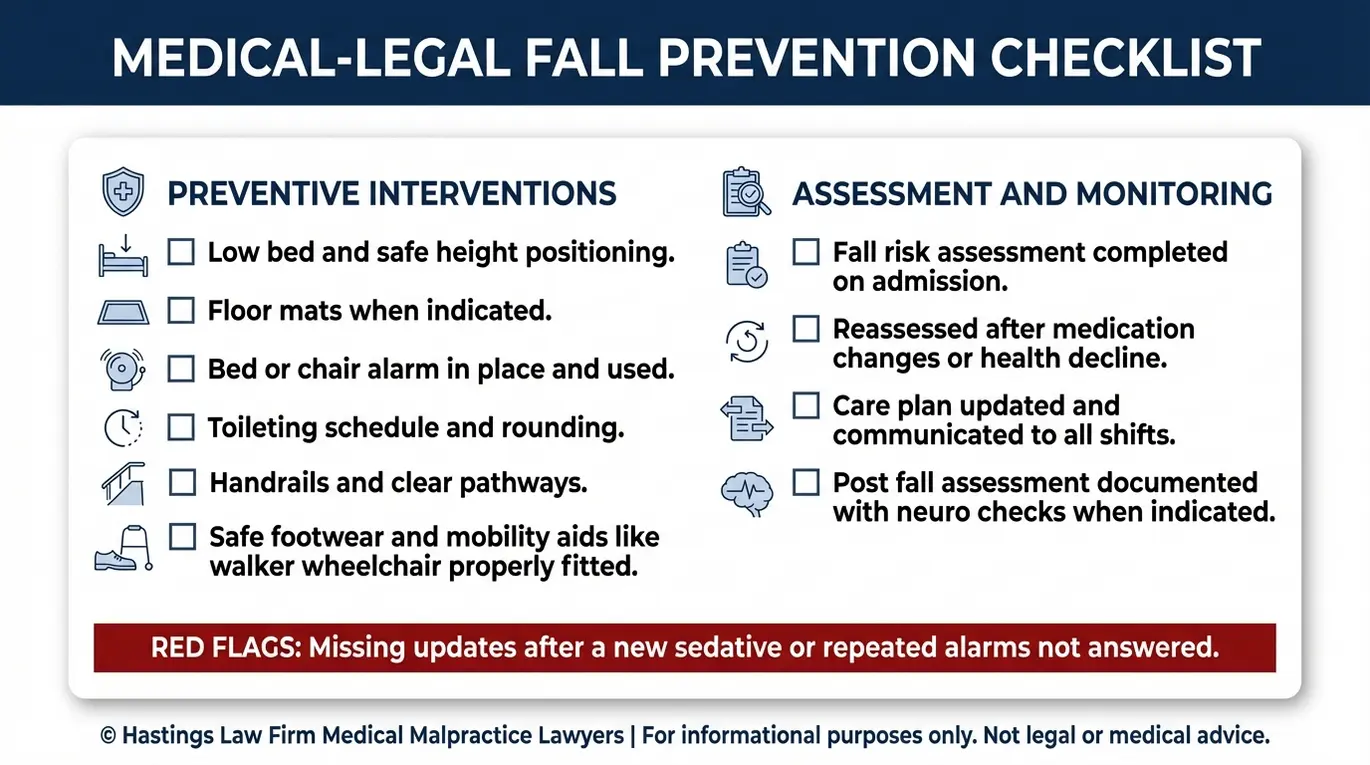
A care plan should include specific, measurable interventions tailored to the resident’s needs. The following checklist reflects the types of measures that may be required:
- Non-slip footwear provided and consistently used
- Bed set to the lowest position with floor mats in place
- Bed alarms and chair alarms activated for high-risk residents
- Handrails installed and accessible in rooms and hallways
- Toileting schedule established and followed to reduce unsupervised movement
- Wheelchair brakes checked and locked during transfers
- Adequate lighting in the resident’s room and common areas
- Mobility aids (walkers, canes) within the resident’s reach at all times
- Medication review conducted after any fall or change in prescription
One frequently overlooked issue involves the psychological impact of falling. Post-fall syndrome, sometimes called fear of falling, describes a cycle where a resident who has fallen becomes afraid to move, leading to decreased physical activity, muscle weakening, and an even greater risk of future falls. The CDC’s STEADI patient and caregiver resources outline how this cycle can be addressed through structured mobility programs. Facilities have a responsibility to manage this risk rather than allow a resident to deteriorate through inactivity.
As a Texas nursing home fall lawyer, we review whether the facility performed timely assessments, whether care plans reflected the resident’s actual condition, and whether documented interventions were consistently carried out by staff.
The Hastings Law Firm Difference
Results matter, but what truly sets us apart is how we achieve them. Every verdict, every settlement, and every Texas courtroom victory comes from one guiding promise: To treat each client’s fight for justice as if it were our own.
This balance of skill, experience, and empathy reflects our core philosophy that justice should not only compensate the injured, but also make health care safer nationwide.

Common Operational Failures Leading to Severe Falls
The most frequent causes of facility falls are administrative failures such as chronic understaffing, improper medication management affecting balance, and unsafe transfer techniques by untrained aides. These administrative failures often point to systemic issues within a facility’s management and resource allocation.
Understaffing and Supervision Gaps
When a facility does not have enough trained staff on the floor, the consequences show up in measurable ways. Call lights go unanswered for extended periods. Residents who need assistance getting to the bathroom may attempt to move on their own rather than wait.
Federal guidelines require nursing homes to maintain sufficient staff to provide for the safety and well-being of all residents. We examine staffing records, call light response logs, and shift assignments to evaluate whether understaffing contributed to a fall.
Medication-Related Falls
Certain medications significantly affect a resident’s balance, coordination, and alertness. Chemical restraints, a term for sedatives and antipsychotic medications administered to manage behavior rather than treat a diagnosed psychiatric condition, are a well-documented contributor to falls. These drugs can cause dizziness, confusion, and delayed reaction times.
When a resident is prescribed a sedating medication without a corresponding update to their fall risk assessment, the facility has created a foreseeable hazard. Red flags our team looks for in cases involving medication errors include:
- Antipsychotic medications prescribed without a documented psychiatric diagnosis
- Sedatives or sleep aids given without fall risk reassessment
- Multiple sedating medications prescribed at the same time
- No monitoring for side effects such as dizziness or unsteady gait
- Medication changes made without notifying nursing staff responsible for the resident
Transfer Injuries
Unsafe transfers, such as moving a resident from bed to wheelchair or wheelchair to toilet, account for a significant number of facility injuries. A transfer refers to the manual or mechanical movement of a patient between two surfaces, such as a bed and a commode.
A patient being dropped by staff during a bed-to-wheelchair transfer often results from aides who lack proper training, attempts to move a resident without adequate assistance, or failure to use mechanical lift equipment. These unsafe transfers are preventable when facilities follow their own protocols.
Our firm can determine whether these operational failures contributed to a loved one’s injury by examining staffing data, medication records, training logs, and incident reports.
Catastrophic Injuries and the Trajectory of Decline
Falls in elderly residents frequently result in life-altering injuries such as hip fractures and subdural hematomas, often triggering a rapid decline in health that leads to wrongful death within months. These life-altering injuries can permanently change a person’s quality of life and independence.
Hip Fractures
A hip fracture, a break in the upper portion of the femur, is one of the most common and dangerous fall-related injuries in older adults. For elderly patients, surgical repair carries substantial risk.
According to a data brief on fall-related injuries and deaths published by Tarrant County Public Health, falls are a leading cause of injury-related death among older adults in the region. Many patients never regain their prior level of mobility after a fracture, and the post-surgical period brings elevated risks of blood clots and infection.
Head Trauma and Subdural Hematomas
A subdural hematoma, bleeding between the covering of the brain and the surface of the brain, can develop after what appears to be a minor head impact. In elderly patients, particularly those on blood-thinning medications, symptoms may not appear for hours or even days. Without prompt imaging, these injuries can go undiagnosed until the damage becomes irreversible. A traumatic brain injury of this nature, along with severe spinal injuries, can result in permanent cognitive impairment, significant pain and suffering, or death.
The Delayed-Death Connection
One of the most important aspects of nursing home fall litigation involves tracing the connection between a fall and a death that occurs weeks or months later. A fall leads to immobility. Immobility leads to pneumonia, pressure ulcers, urinary tract infections, or sepsis.
The death certificate may list one of these secondary conditions as the cause of death, but the fall set the entire decline in motion. Our medical team works with qualified experts to establish this causal chain through a detailed review of clinical records, imaging studies, and treatment timelines.
Forensic Bruising Analysis
In some cases, the timing of a fall is disputed. Facilities may report a fall hours after it actually occurred, or attribute injuries to a different event entirely. Forensic bruising analysis uses the color progression of bruises to help determine when an injury likely happened. This technique can reveal discrepancies between the facility’s reported timeline and the physical evidence, which may indicate delayed reporting or attempts to conceal the incident.
As a Texas nursing home fall lawyer, we examine every available piece of evidence to connect the fall to the full scope of harm your loved one experienced.
Proving Liability Under Texas Medical Malpractice Laws
Texas law requires plaintiffs to prove negligence by a preponderance of the evidence, often necessitating expert medical testimony to distinguish between a general premises liability claim and a medical malpractice claim. Our firm is led by Tommy Hastings, who is board-certified in Personal Injury Trial Law by the Texas Board of Legal Specialization. These cases are legally defined as health care liability claims, which requires our team to meet specific procedural hurdles.
Under Texas Civil Practice and Remedies Code Chapter 74, claims involving health care liability require the plaintiff to serve a qualified expert medical report within 120 days of the defendant’s filing of an original answer. This report must identify the standard of care, explain how it was breached, and establish a causal link between the breach and the injury. Failure to meet this deadline can result in dismissal of the case.
The legal process for a claim generally follows these steps:
- Initial case evaluation: Our medical staff reviews the resident’s records, incident reports, and care plan documentation to assess whether negligence occurred. Our legal team guides families through this evaluation, which often involves working through Medicare and Medicaid standards to establish the groundwork for compensatory damages and potential punitive damages.
- Pre-suit investigation: We gather staffing records, medication administration logs, surveillance footage, and witness statements before filing.
- Filing the lawsuit and expert report: We file the lawsuit and a qualified medical expert prepares and serves the required report within the 120-day statutory window after the defendant answers.
- Discovery and depositions: Both sides exchange evidence. We depose facility staff, administrators, and medical personnel to build a detailed factual record.
- Trial preparation or settlement negotiation: Because we prepare every case as if it will go before a jury, we negotiate from a position of thorough preparation.
One issue that arises in many nursing home cases involves arbitration clauses buried in admission paperwork. Families often sign these agreements during the stress of admission without realizing they may be waiving their right to a jury trial. Our attorneys evaluate whether these clauses are enforceable under Texas law and challenge them when appropriate.
Our team includes former defense attorneys who understand how facilities and their insurers respond to these claims. That perspective allows us to anticipate defense strategies and build cases that address those arguments from the outset.

Damages and Compensation Recovery in Texas
Compensation in nursing home fall cases may include economic damages for medical bills and funeral costs, as well as non-economic damages for the resident’s physical pain, mental anguish, and physical impairment. Economic damages cover verifiable financial losses, while non-economic damages address the human impact of the incident.
Texas law recognizes two primary categories of compensatory damages in these cases:
| Damage Type | What It Covers |
|---|---|
| Economic Damages | Past and future medical expenses, rehabilitation costs, funeral and burial expenses, lost earning capacity (if applicable) |
| Non-Economic Damages | Physical pain, mental anguish, physical impairment, loss of companionship (in wrongful death claims), disfigurement, and pain and suffering |
| Punitive Damages | Available in cases of gross negligence; intended to penalize conduct that shows conscious indifference to the rights or safety of the resident |
If the claim is classified as medical malpractice under Texas Civil Practice and Remedies Code § 74.301, Texas imposes caps on non-economic damages. The cap is generally $250,000 per claimant against all individual healthcare providers combined, with separate caps for institutional providers. Economic damages, including the full cost of medical treatment, are not subject to these caps.
Punitive damages may be available when the evidence demonstrates gross negligence, meaning the facility’s conduct involved an extreme degree of risk and the facility had actual awareness of that risk. These cases often involve patterns of repeated violations, falsified records, or deliberate understaffing.
Our team can evaluate which categories of damages apply to your family’s situation and pursue the full scope of compensation the law allows.
Contact the Texas Nursing Home Attorneys at Hastings Law Firm Today for Help
Your family does not have to face a facility’s corporate legal team alone. Hastings Law Firm is built for cases like these. Founded by Tommy Hastings, a 2025 inductee into ABOTA, we focus exclusively on medical negligence litigation. Our legal team includes in-house medical professionals and former defense attorneys who understand the federal regulations that govern nursing home care.
If your loved one was seriously injured in a nursing home fall, you deserve answers about what happened and whether it could have been prevented. We work on a contingency fee basis, which means you pay no attorney fees or costs unless we secure a recovery for your family. A free consultation allows our legal team to review the facts and determine if a breach in the standard of care occurred.
Every consultation is free and confidential. If you are ready to take the next step, contact a Texas nursing home fall lawyer at Hastings Law Firm. Let us review what happened and provide a free and confidential case evaluation.
Frequently Asked Questions About Nursing Home Falls in Texas


This content was researched and written by the Hastings Law Firm editorial team, which includes attorneys, medical professionals, and experienced researchers. Our writing is informed by internal knowledge and practical experience, and we cross-check critical details against authoritative sources cited throughout. Every piece undergoes human-led fact-checking and legal review. Because legal and medical information can change, if you spot an error, please contact us. Learn more about our content standards and review process on our editorial policy page.

Brady D. Williams is a nationally recognized medical malpractice attorney who has spent his career handling high-stakes litigation for injured patients and families across the country. Licensed in both Texas and California, Brady draws on experience from hundreds of resolved medical cases to break down complex legal and medical topics for the people who need that information most. His writing reflects the same attention to detail and commitment to clarity that he brings to every case he handles.
