


Texas Dangerous Drug Injury Lawyer
A dangerous medication can cause serious harm and leave families struggling to understand how it happened. Pharmaceutical injury claims often focus on whether a drug was defective in its design, manufacturing, or warnings, while medical malpractice focuses on prescribing or monitoring errors by a healthcare provider. FDA approval and warning labels can shape responsibility, and issues like recalls, off label use, and shared fault may affect who is accountable. If you or a loved one were harmed or worse due to a dangerous drug injury in Texas, contact Hastings Law Firm for a free, confidential case review.
Last Updated: July 27, 2026
Nationally Recognized Advocacy for Victims of Pharmaceutical Negligence
When a medication you trusted to help you causes serious harm, the experience can feel deeply disorienting. An adverse drug reaction (ADR), meaning an unintended and harmful response to a medication taken at a normal dose, can upend your health, your livelihood, and your sense of security. You may be dealing with mounting medical bills while trying to understand how a product approved by regulators could have caused so much damage.
A Texas dangerous drug lawyer can help you make sense of what happened and determine whether the pharmaceutical company, not just your doctor, bears responsibility. Many of these cases involve a failure to warn, sometimes called a marketing defect, where a drug manufacturer failed to disclose known risks or side effects to doctors and patients.
Founded by board-certified trial lawyer Tommy Hastings in 2005, we focus exclusively on medical negligence and pharmaceutical injury. If you or a loved one has been harmed by a dangerous medication, we can review what happened and explain your legal options at no cost.

Distinguishing Defective Drug Claims from Medical Malpractice
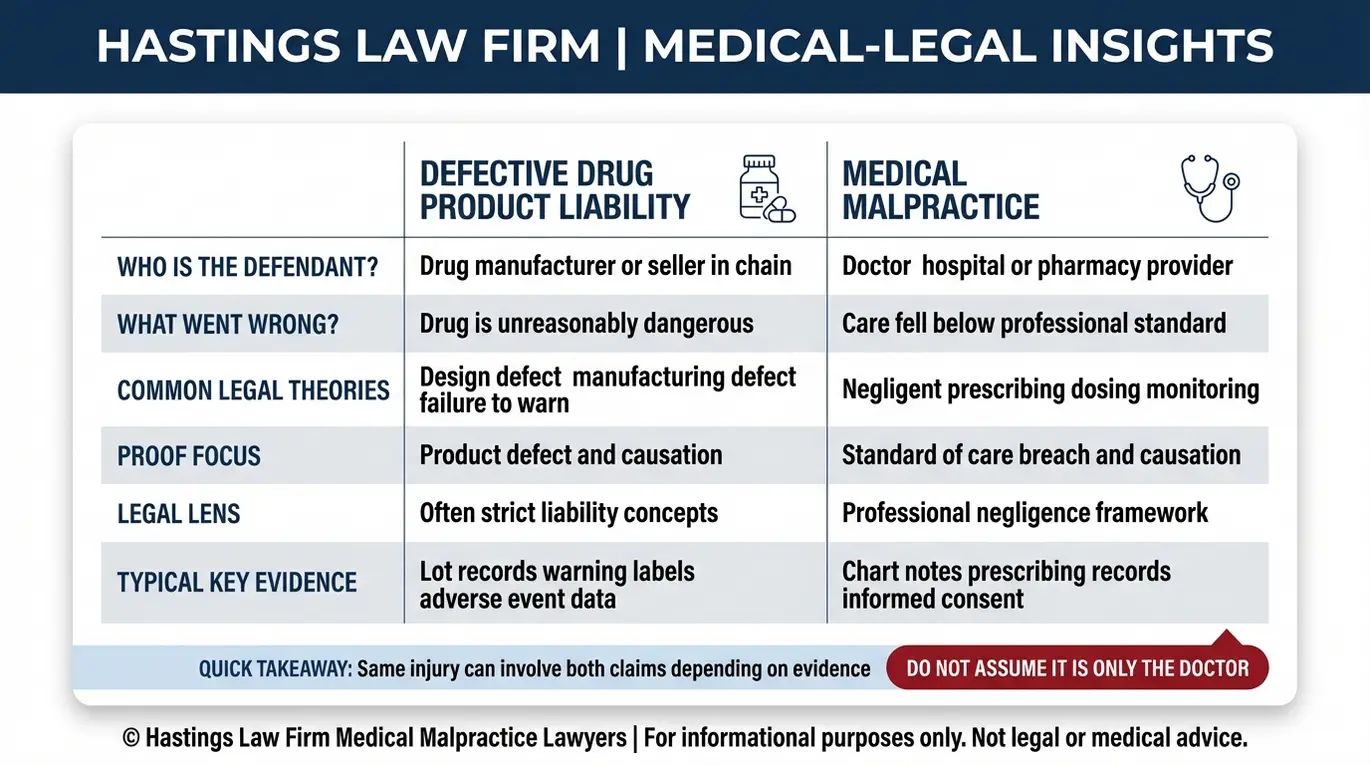
A defective drug claim targets the manufacturer for releasing an inherently dangerous product, while a medical malpractice claim targets a healthcare provider for negligent prescribing or administration. Understanding this distinction matters because the legal theories, the defendants, and the evidence involved are fundamentally different.
Most dangerous drug cases fall under product liability law, not standard negligence. Under product liability, the focus is on whether the drug itself was unreasonably dangerous when it left the manufacturer’s control. That could mean the formula was flawed, the production was contaminated, or the company concealed known risks. The drug manufacturer is the primary defendant in these claims.
Medical malpractice, on the other hand, applies when the drug was safe and properly manufactured, but a healthcare provider made an error. A doctor might prescribe a medication at the wrong dosage, fail to check for dangerous drug interactions, or prescribe a drug for an unapproved purpose. A prescription drug, a medication legally requiring a medical provider’s authorization, used “off-label,” meaning for a condition or population the FDA has not approved it for, can give rise to either type of claim depending on the circumstances.
One important legal concept in pharmaceutical cases is strict liability. In Texas, a manufacturer can be held liable for injuries caused by a defective product even without proof of carelessness. The question is not whether the company tried hard enough, but whether the product was defective and whether that defect caused harm. Under Texas Civil Practice and Remedies Code Chapter 74.051, medical liability claims have specific procedural requirements, and a Texas dangerous drug lawyer must identify early whether a case falls under product liability, medical malpractice, or both.
As a dangerous drug attorney, we often see cases that involve overlapping liability. When that happens, both the manufacturer and the prescribing doctor may share responsibility. This shared responsibility occurs because multiple parties may have failed to meet their safety obligations.
| Factor | Manufacturer Liability (Product Liability) | Doctor Liability (Medical Malpractice) |
|---|---|---|
| Who is the defendant? | Pharmaceutical company or drug maker | Prescribing physician or healthcare provider |
| What is the legal theory? | Strict liability or negligence for a defective product | Negligence in prescribing, dosing, or monitoring |
| What must be proven? | The drug had a defect (design, manufacturing, or marketing) that caused injury | The provider breached the standard of care, causing injury |
| Role of FDA approval | May create a presumption of safety, but can be rebutted | Generally not a factor in the provider’s standard of care |
| Common examples | Hidden side effects, contaminated batches, unsafe formulation | Wrong drug prescribed, missed drug interactions, improper dosage |
Grounds for Pharmaceutical Liability in Texas
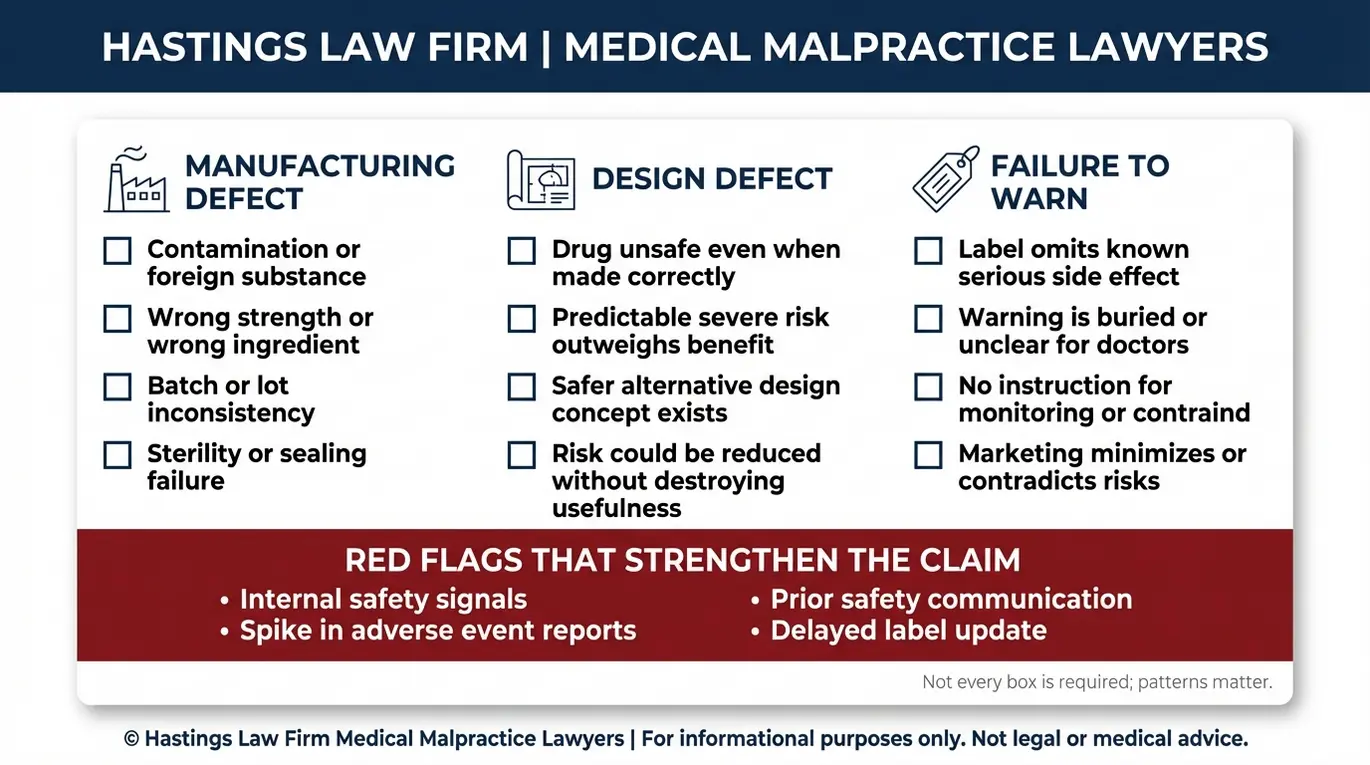
In Texas, pharmaceutical liability is typically established by proving a design defect, a manufacturing defect, or a failure to warn (also called a marketing defect) under the state’s Civil Practice & Remedies Code. Each theory addresses a different way a drug can be unreasonably dangerous, and a single medication can give rise to claims under more than one category.
A Texas dangerous drug lawyer builds defective drug claims around the specific facts of how the product caused harm under the Civil Practice & Remedies Code. Here are the three recognized grounds:
- Manufacturing Defects: These occur when something goes wrong during production, resulting in a product that differs from its intended design. Contamination, improper compounding, and mislabeling are common examples. A manufacturing defect, in simple terms, means the drug was not made the way it was supposed to be.
- Design Defects: A design defect means the drug is inherently unsafe even when manufactured exactly as intended. Under Texas Civil Practice & Remedies Code § 82.005, a person pursuing dangerous drug lawsuits based on design defect must generally show that a safer alternative design existed, that the alternative was economically and technologically feasible, and that the risks of the original design outweighed its benefits. These cases often involve drugs whose chemical formulation creates risks that a reasonable manufacturer should have avoided.
- Marketing Defects (Failure to Warn): Pharmaceutical companies have a legal duty to provide adequate warnings about known side effects and risks. A marketing defect claim arises when a manufacturer provides inadequate instructions, downplays adverse effects, or fails to update warning labels as new safety information becomes available. This includes situations where a company knows about a serious risk but does not communicate it clearly to prescribing physicians or patients.
Identifying which defect theory applies is one of the first steps in evaluating a pharmaceutical injury case. Our in-house medical staff, including nurse practitioners and board-certified patient advocates, reviews clinical records and drug safety data to determine where the failure occurred and how it connects to your injury.
The Hastings Law Firm Difference
Results matter, but what truly sets us apart is how we achieve them. Every verdict, every settlement, and every Texas courtroom victory comes from one guiding promise: To treat each client’s fight for justice as if it were our own.
This balance of skill, experience, and empathy reflects our core philosophy that justice should not only compensate the injured, but also make health care safer nationwide.

Overcoming the FDA Approval Defense (Preemption)
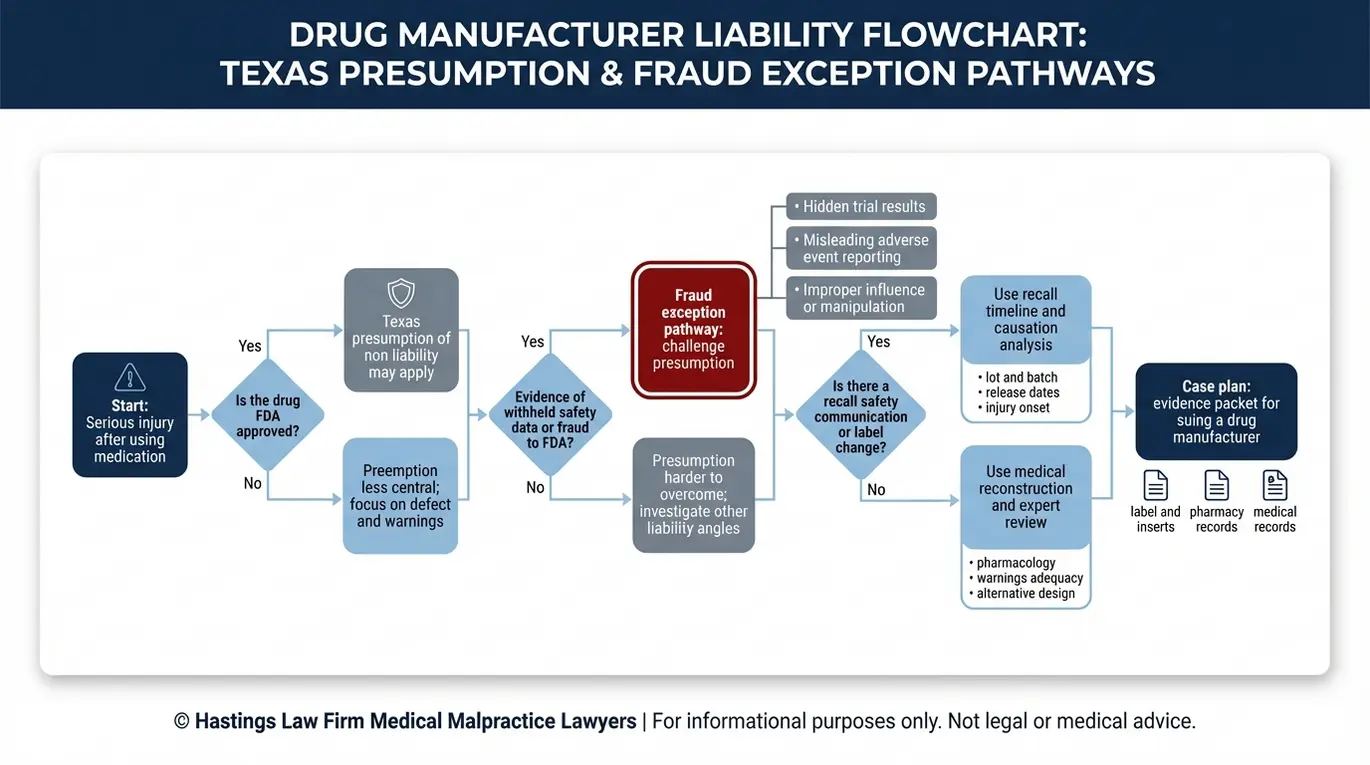
Pharmaceutical companies frequently argue that FDA approval shields them from liability, but this defense is not absolute. Plaintiffs can overcome it by proving the manufacturer withheld critical safety data from the FDA or engaged in fraud during the approval process.
Texas has a specific statute that creates this challenge. Under Texas Civil Practice and Remedies Code § 82.007, there is a rebuttable presumption that a drug manufacturer is not liable if the product’s warnings and labeling complied with FDA requirements at the time of sale. This state-law presumption functions similarly to a preemption defense, where the manufacturer argues that because the FDA reviewed and approved the drug, the company cannot be held responsible.
But this presumption can be defeated. The most common path involves proving fraud on the FDA. If a manufacturer submitted falsified clinical trial data, concealed reports of adverse effects, or bribed regulators to secure approval, the legal protection falls away. A Texas dangerous drug lawyer must gather internal company documents, correspondence with regulators, and expert analysis to establish that the approval was tainted. When suing a drug manufacturer, this evidence-gathering phase is often the most resource-intensive part of the case.
A drug recall can also significantly affect the strength of a claim. When the U.S. Food and Drug Administration issues a recall, meaning it formally removes or corrects a product found to be defective or potentially harmful, it signals that the drug did not meet safety standards. While a recall does not automatically prove liability, it creates strong evidence that the product posed an unreasonable risk. As a medication side effect lawyer, we track active recalls and FDA enforcement actions as part of our case investigation process.
Damages: Compensation for Medication Side Effects
Individuals harmed by dangerous drugs may recover compensation for medical expenses, lost earning capacity, pain and suffering, and, in cases involving fraud, malice, or gross negligence, punitive damages. A Texas dangerous drug lawyer evaluates the full scope of harm, not just immediate costs.
Compensation for drug injuries typically includes:
- Economic Damages: These cover tangible financial losses such as hospital bills, surgeries, rehabilitation, and ongoing treatment needs. Some drug injuries require lifelong medical care. Kidney damage caused by a defective medication, for example, can lead to chronic dialysis, the costs of which are outlined in recent federal rulemaking by the Federal Register on End-Stage Renal Disease payment systems. Lost wages and diminished earning capacity are also recoverable when injuries prevent you from working.
- Non-Economic Damages: These address the personal toll, including chronic pain, emotional distress, loss of quality of life, and the strain on family relationships. When a dangerous drug causes a patient’s death, surviving family members may pursue a wrongful death claim to recover both economic and non-economic losses.
- Punitive Damages: This compensation can be awarded when the evidence shows the manufacturer acted with fraud, malice, or gross negligence. These damages are not meant to compensate the injured person; they are designed to punish conduct so reckless that it demonstrates a conscious disregard for patient safety.
Contact the Texas Dangerous Drug Attorneys at Hastings Law Firm Today for Help
If a medication has caused you or a loved one serious harm, the answers you need are within reach. At Hastings Law Firm, our legal team includes former defense attorneys who understand how pharmaceutical companies build their cases and are prepared to challenge these corporations in court. We also have in-house medical professionals who can evaluate the clinical evidence from day one.
We operate on a contingency fee basis, which means you pay no attorney fees or costs unless we recover compensation on your behalf. A contingency fee arrangement means the firm takes on the financial risk of the litigation. Every case begins with a free, confidential evaluation where we listen to what happened, review the relevant medical and pharmaceutical evidence, and give you an honest assessment of your legal options.
Time limits apply to filing dangerous drug claims in Texas, so we encourage you to reach out sooner rather than later. Contact the Texas dangerous drug attorneys at Hastings Law Firm to schedule your risk-free case evaluation. Let us help you find the answers you deserve.
Frequently Asked Questions About Dangerous Drug Injury in Texas


This content was researched and written by the Hastings Law Firm editorial team, which includes attorneys, medical professionals, and experienced researchers. Our writing is informed by internal knowledge and practical experience, and we cross-check critical details against authoritative sources cited throughout. Every piece undergoes human-led fact-checking and legal review. Because legal and medical information can change, if you spot an error, please contact us. Learn more about our content standards and review process on our editorial policy page.

Tommy Hastings, founder of Hastings Law Firm, is a board-certified personal injury trial lawyer dedicated exclusively to healthcare injury cases. Since 2001, he has represented injured patients and families in litigation against major hospital systems, pharmaceutical companies, and negligent healthcare providers nationwide. He has handled numerous high-profile cases that have drawn national media attention and resulted in multi-million dollar recoveries. He draws on that experience in his writing, helping readers understand how these cases work and what options may be available to them.
