


Texas Nursing Home Choking Lawyer
Nursing home choking and aspiration events can be sudden, terrifying, and often preventable when proper screening, diet planning, supervision, and emergency response are in place. Breakdowns like skipped swallow assessments, ignored diet textures, rushed feeding, and inadequate staffing can lead to oxygen deprivation, aspiration pneumonia, and fatal outcomes. Clear documentation of care plans and staff actions can help families understand what went wrong and why. If you lost a loved one due to nursing home choking or aspiration negligence in Texas, contact Hastings Law Firm for a free, confidential case review.
Last Updated: July 27, 2026
Compassionate Texas Injury Attorneys for Nursing Home Aspiration Negligence Claims
When a loved one is harmed by choking or aspiration in a nursing home, the shock is compounded by a painful realization: the people entrusted with their care may have failed them. You may be searching for answers about what happened, why it happened, and whether it could have been prevented. These are reasonable questions, and you deserve honest, informed guidance.
At Hastings Law Firm, we focus exclusively on medical malpractice and negligence cases, including those involving preventable choking injuries and deaths in Texas nursing facilities. Our firm was founded by Tommy Hastings, a board-certified trial lawyer with over 20 years of experience in these complex cases. Our team includes in-house nursing professionals and former defense attorneys who understand how these facilities operate from the inside. If your family member suffered a choking injury or aspiration event in a nursing home, a Texas nursing home choking lawyer at our firm can review the circumstances and explain your legal options at no cost to you.
—

Common Causes of Choking Injuries in Texas Nursing Homes
Choking in nursing homes is most often caused by understaffing during mealtimes, failure to follow prescribed dietary restrictions, or neglecting to assist residents who have dysphagia, a condition that impairs the ability to swallow safely. Understanding how and why these incidents happen is an important first step for families trying to make sense of what went wrong. Our in-house nurse practitioners evaluate these cases to identify exactly where the clinical breakdown occurred.
Dysphagia is extremely common among elderly nursing home residents. Conditions like stroke, Parkinson’s disease, and dementia can weaken the muscles involved in swallowing, making it difficult to move food or liquids safely from the mouth to the stomach. When food enters the airway instead, the result can be a partial or complete airway obstruction.
Facilities are expected to identify residents with swallowing difficulties and put specific dietary modifications in place. But when staffing levels are low, these safeguards can break down. Staff may feed residents too quickly, leave high-risk residents unsupervised during meals, or fail to monitor whether a resident is tolerating their food.
These failures are not mere accidents; they are often clear instances of nursing home neglect. A thorough investigation can reveal patterns of behavior that prove the facility failed to uphold its duty of care, putting vulnerable seniors at unnecessary risk.
Common risk factors that contribute to choking incidents include:
- Serving solid foods to a resident on a pureed diet, a texture-modified diet in which all food is blended smooth to reduce choking risk
- Failure to thicken liquids for residents who cannot safely swallow thin fluids
- Leaving food trays within reach of unsupervised residents who require feeding assistance
- Rushing mealtimes due to inadequate staff-to-resident ratios
- Inadequate training on recognizing signs of swallowing distress
A Texas nursing home choking attorney can investigate whether any of these failures contributed to your loved one’s injury or death.
—
Failure to Perform Swallow Assessments and Update Diet Plans
Nursing homes have a legal duty to perform swallow assessments at admission and to update care plans immediately if a resident shows signs of difficulty swallowing to prevent aspiration events. When facilities skip these evaluations or ignore changes in a resident’s condition, they create a direct path to preventable aspiration events.
A swallow assessment is a clinical evaluation designed to determine whether a resident can eat and drink safely. It is typically performed or overseen by a speech-language pathologist (SLP). This is a licensed clinician trained to evaluate swallowing function and recommend the safest food and liquid textures for each patient. The SLP may use bedside screening methods or instrumental tests to observe how food and liquid move through the throat.
Based on the results, the SLP creates a dietary plan that specifies exactly what textures and consistencies the resident can safely consume. This plan becomes part of the resident’s care plan, and every staff member involved in meal service is responsible for following it precisely. A resident prescribed honey-thick liquids, for example, should never be given plain water. Failure to update a plan when symptoms change can constitute a breach of the standard of care under Texas law.
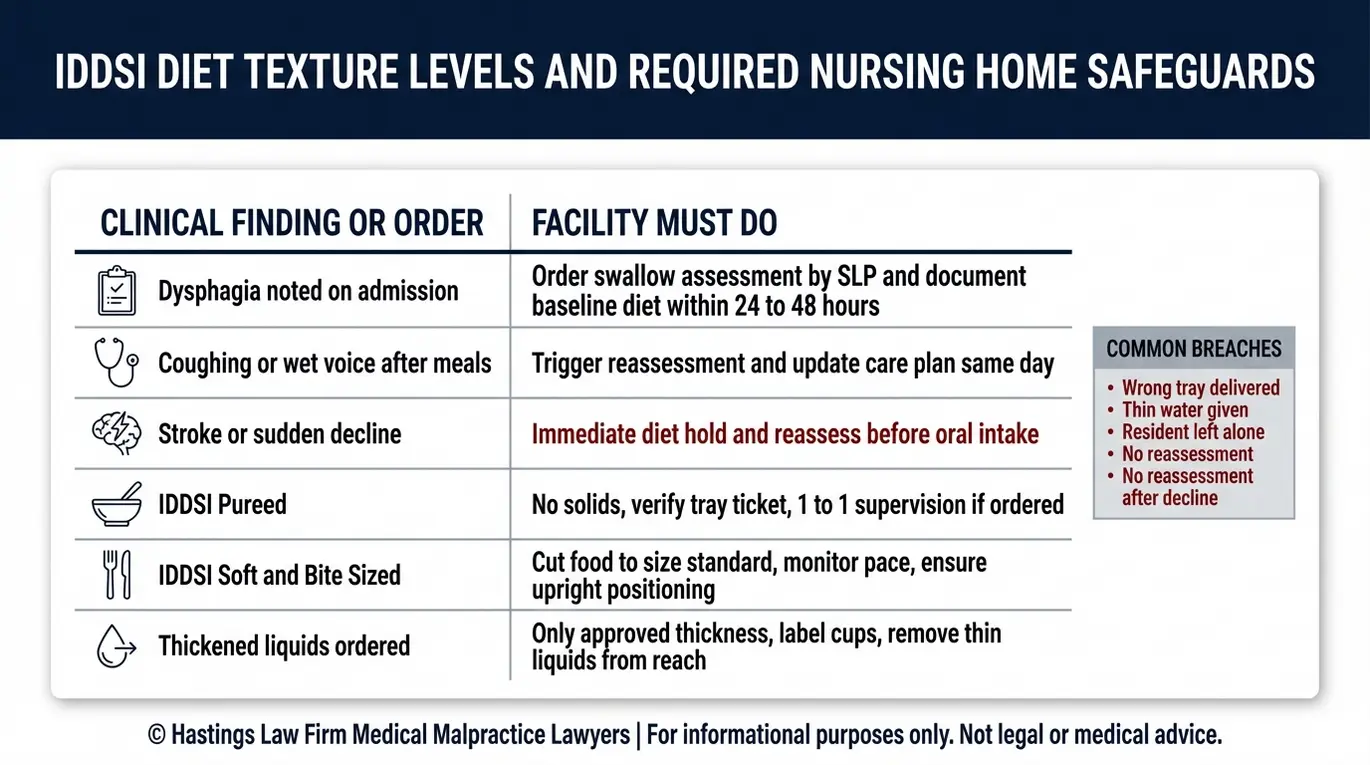
Understanding IDDSI Texture Levels and Prevention Protocols
The International Dysphagia Diet Standardisation Initiative (IDDSI) provides the globally recognized framework for classifying food and liquid textures. Facilities are expected to follow these standardized levels:
- Level 0 (Thin): Regular liquids, appropriate only for residents with no swallowing impairment
- Level 1–3 (Slightly Thick to Moderately Thick): Thickened liquids, including nectar-thick and honey-thick consistencies, prescribed for residents who aspirate on thin fluids
- Level 4 (Pureed): Smooth, lump-free food that requires no chewing
- Level 5 (Minced & Moist): Very small, soft pieces in thick sauce
- Level 6 (Soft & Bite-Sized): Soft mechanical diet with tender food cut into small pieces
- Level 7 (Regular): Normal food textures with no modification required
When a resident’s health status changes, such as after a stroke, a new infection, or a decline in cognitive function, the facility must reassess swallowing ability and update the care plan accordingly. The Texas Civil Practice and Remedies Code, Chapter 71 provides the legal framework through which families can pursue wrongful death claims when this kind of neglect leads to a fatal outcome.
—
The Hastings Law Firm Difference
Results matter, but what truly sets us apart is how we achieve them. Every verdict, every settlement, and every Texas courtroom victory comes from one guiding promise: To treat each client’s fight for justice as if it were our own.
This balance of skill, experience, and empathy reflects our core philosophy that justice should not only compensate the injured, but also make health care safer nationwide.

Identifying the Immediate Signs of Aspiration and Airway Obstruction
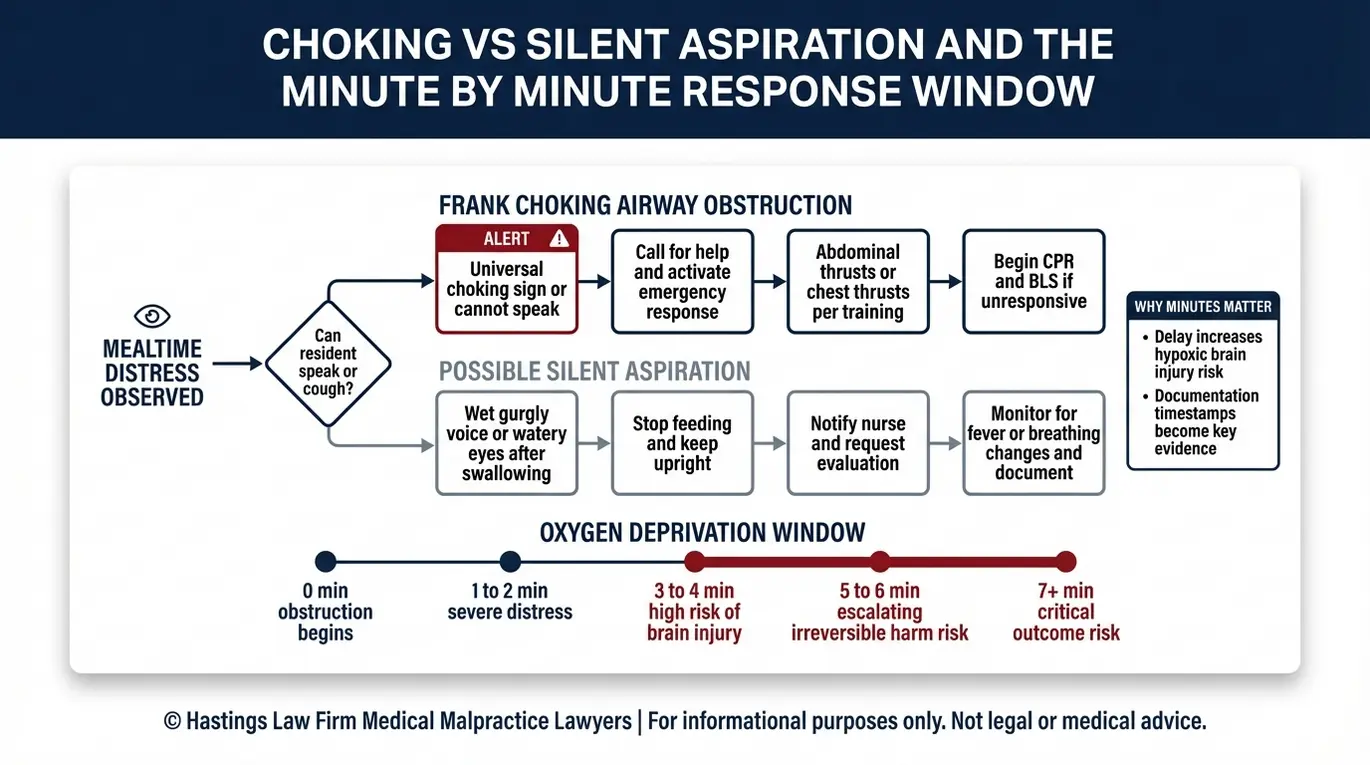
Immediate signs of choking include the universal choking sign (hands clutching the throat), inability to speak, cyanosis (a bluish discoloration of the skin caused by lack of oxygen), and visible panic. Silent aspiration, however, can be far harder to detect; it may present only as watering eyes, a red face, or a wet, gurgly voice after eating.
The distinction between these two types of events matters. Frank choking occurs when food or another object completely blocks the airway. The resident cannot breathe, speak, or cough. Without intervention, oxygen deprivation begins within seconds.
Silent aspiration, a more subtle but equally dangerous event, occurs when food or liquid slips past the vocal cords and enters the lungs without triggering a strong cough reflex. The resident may not show obvious distress at all, which is precisely what makes it so dangerous. Proper clinical screening protocols are necessary to identify this risk.
Research published on the diagnostic accuracy of screening tools for silent aspiration underscores the challenge of detecting these events.
The following table outlines key differences between frank choking and silent aspiration:
| Feature | Frank Choking (Complete Obstruction) | Silent Aspiration |
|---|---|---|
| Visible distress | Yes, clutching throat, panic | Minimal or none |
| Ability to speak/cough | No | May speak but with wet, gurgly voice |
| Skin color change | Cyanosis (blue/gray) within seconds | May appear flushed or unchanged |
| Staff recognition | Often obvious if staff are present | Frequently missed without training |
| Time to brain injury | 4–6 minutes without oxygen | Delayed; aspiration pneumonia may develop over hours or days |
Minute by Minute Timeline of Oxygen Deprivation and Brain Injury
When the airway is completely blocked, the timeline is unforgiving. Within roughly four to six minutes of oxygen deprivation, the brain begins to sustain irreversible damage, known as hypoxic brain injury, a condition in which brain cells die due to insufficient oxygen. Every minute without a clear airway increases the severity of permanent harm or the likelihood of death.
Staff must be trained and present to respond. CPR, abdominal thrusts (commonly called the Heimlich maneuver), and proper Basic Life Support (BLS) techniques are the front-line interventions. When staff are absent from the dining area, undertrained, or fail to recognize what is happening, a survivable event can become a fatal one. A nursing home choking lawyer in Texas can help determine whether staff response failures contributed to your loved one’s injury.
—
Legal Duties of Staff to Prevent Residents from Choking
Nursing home staff are legally required to provide adequate supervision during meals, prepare food in appropriate sizes and textures, and assist residents with feeding as specified in their individual care plans. These are not aspirational guidelines. They are enforceable obligations for elder care facilities under both federal and state law.
The standard of care for mealtime supervision requires that facilities maintain enough trained staff to monitor residents who need assistance. This includes positioning residents upright, pacing the rate of feeding, and watching for signs of distress throughout the entire meal. Residents with known swallowing difficulties should never eat unattended.
In emergencies, staff must be prepared to act. Training in CPR, abdominal thrusts, chest thrusts, and Basic Life Support (BLS) is not optional. Federal regulations under 42 CFR § 483.95 require nursing facilities to provide ongoing training programs that cover emergency response procedures, including choking interventions.
Facilities must also maintain functional emergency equipment, such as portable suction machines, and ensure staff know how to use them. Regulatory violations by facilities are documented through CMS (Centers for Medicare & Medicaid Services) surveys and inspections. These findings often reveal a failure to adhere to basic safety protocols.
The table below outlines the key protocols facilities must follow:
| Safety Protocol | Legal Requirement |
|---|---|
| Mealtime Supervision | Maintain adequate staff ratios to monitor all high-risk residents. |
| Emergency Training | Staff must be certified in CPR, BLS, and abdominal thrusts. |
| Equipment Maintenance | Suction machines must be functional and accessible at all times. |
| Diet Adherence | Food textures must strictly match the resident’s specific care plan. |
When a facility’s own records reveal gaps in these areas, it becomes much harder for them to argue that they met the standard of care.
—
Legal Recourse for Aspiration Pneumonia Caused by Feeding Errors
Families can pursue a negligence claim if a resident develops aspiration pneumonia due to a facility’s failure to prevent food or liquid from entering the lungs, whether through improper feeding techniques, poor positioning, or disregard of prescribed diet textures.
Not every choking-related injury is immediately apparent. Aspiration pneumonia is a serious bacterial infection of the lungs. It develops when food particles, liquids, or oral bacteria are inhaled. This is a common consequence of feeding errors.
Unlike a sudden airway obstruction, aspiration pneumonia can take hours or days to present symptoms. These include fever, cough, difficulty breathing, and rapid decline. Because the infection can escalate quickly, early detection is important.
Families should be vigilant for subtle changes in breathing or energy levels, as these can be the first indicators of a developing issue. The link between improper oral hygiene and aspiration pneumonia is well established in medical literature. When nursing home staff neglect a resident’s oral care, harmful bacteria build up in the mouth. If that resident then aspirates even a small amount of saliva or food, those bacteria are carried directly into the lungs, increasing the risk and severity of infection.
This type of harm is actionable under Texas law as a form of medical neglect. When a facility knows a resident is at risk for aspiration and fails to follow the dietary plan, monitor feedings, or maintain proper hygiene protocols, the resulting pneumonia is not a natural consequence of aging. It is a preventable injury caused by substandard care.
—
Proving Liability in Texas Nursing Home Choking Lawsuits
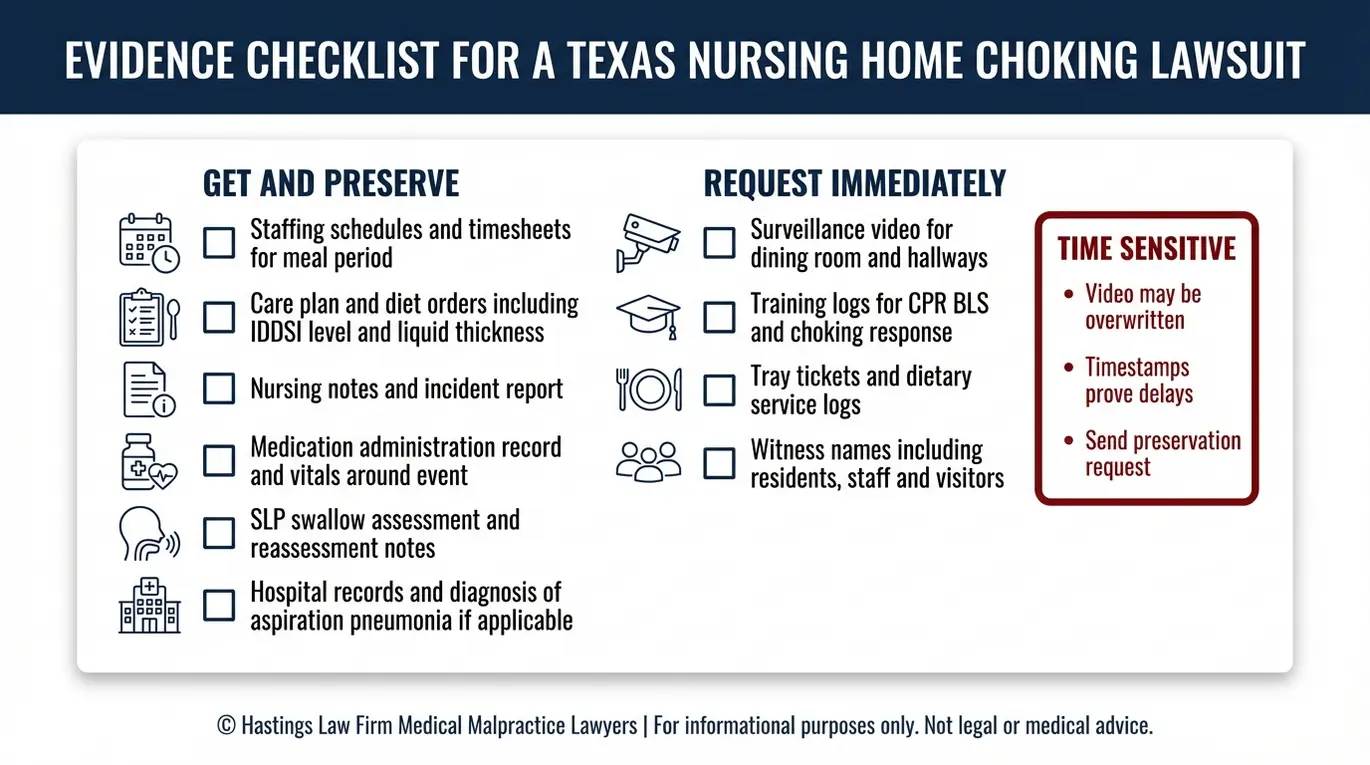
Proving liability requires evidence that the facility breached the standard of care, such as staffing records showing low ratios, surveillance footage of neglected residents, or medical records proving dietary non-compliance. As a trial-ready firm, we use a national network of medical experts to build a complete medical reconstruction of the event.
Staffing records are often the first piece of the puzzle. Timesheets, scheduling logs, and payroll data can reveal whether the facility had enough trained staff on duty at the time of the incident. If the records show that one aide was responsible for feeding a room full of residents, that is direct evidence of a systemic failure that put your loved one at risk.
Surveillance video can be equally important, but it requires fast action. Many facilities overwrite security footage on a rolling schedule, sometimes within days or weeks. Sending a formal preservation letter as early as possible is essential to prevent the loss of this evidence. Guidance from Mason Investigative Solutions on preservation letters explains why early notice to the facility is critical to protecting your legal rights.
Medical records and care plans document what the facility knew about your loved one’s swallowing risks and what they were supposed to do about it. Discrepancies between the care plan and actual practice, such as a resident on a pureed diet being served solid food, can establish a clear breach of duty.
Expert testimony ties the evidence together to establish causation. This means showing the specific failure directly led to the injury. Our firm works with qualified medical experts who can review the records and testify that the resident’s choking event or aspiration pneumonia was preventable and not simply a “natural cause” of death.
Key evidence to identify and preserve includes:
- Staffing schedules and timesheets for the date of the incident
- Dining room or hallway surveillance footage
- The resident’s complete medical chart and care plan
- Dietary orders and meal service records
- CMS survey results and any documented facility deficiencies (available through the CMS Five Star Quality Rating System)
- Witness statements from other residents, family members, or staff
- Incident and accident reports filed by the facility
The sooner this evidence is collected and preserved, the stronger the foundation for your case.
—
Compensation Available to Families After a Choking Death
Families may recover compensation for medical expenses incurred before death, the resident’s pain and suffering during the choking event, funeral and burial costs, and the family’s loss of companionship through a wrongful death claim.
Texas law provides two separate legal paths for families in these cases, and each covers different categories of harm.
A survival action allows the family to recover damages on behalf of the deceased resident for what they experienced before death. In choking cases, this can include the conscious terror and physical pain the resident endured while struggling to breathe. It also covers any medical treatment costs between the choking event and death.
A wrongful death claim compensates the surviving family members for their own losses. This includes grief, mental anguish, loss of companionship, loss of the resident’s counsel and guidance, and funeral and burial costs. These damages reflect the real, lasting impact of losing a family member to preventable neglect.
In cases involving gross negligence, such as a pattern of intentional understaffing or repeated regulatory violations, families may also be eligible to pursue punitive damages. These are not tied to a specific financial loss. Instead, they are designed to hold the facility accountable for conduct that goes beyond ordinary negligence and to deter similar behavior in the future.
Recoverable damages in a nursing home choking case may include:
- Pre-death medical expenses
- The resident’s conscious pain and suffering (survival action)
- Funeral and burial costs
- Loss of companionship and society
- Mental anguish of surviving family members
- Punitive damages in cases of gross negligence
—
Contact the Texas Nursing Home Attorneys at Hastings Law Firm Today for Help
Choking deaths in nursing homes are often preventable. When a facility fails to staff mealtimes properly, ignores prescribed diets, or neglects to train staff on basic emergency response, the consequences fall on the most vulnerable people in their care.
If you lost a loved one or your family member was seriously harmed by a choking or aspiration event in a Texas nursing facility, Hastings Law Firm is here to help you find the truth. Our team of attorneys, nurse consultants, and medical experts will conduct a thorough investigation into what happened and whether negligence played a role.
As a Texas nursing home choking lawyer, Tommy Hastings and his team have the experience and the resources to hold negligent facilities accountable. We take these cases on a contingency fee basis, which means you pay no attorney fees or costs unless we recover compensation for your family.
Contact us for a free, confidential case evaluation. We can review what happened and help you understand your options.
—
Frequently Asked Questions About Nursing Home Choking in Texas


This content was researched and written by the Hastings Law Firm editorial team, which includes attorneys, medical professionals, and experienced researchers. Our writing is informed by internal knowledge and practical experience, and we cross-check critical details against authoritative sources cited throughout. Every piece undergoes human-led fact-checking and legal review. Because legal and medical information can change, if you spot an error, please contact us. Learn more about our content standards and review process on our editorial policy page.

Gabe Sassin has focused exclusively on medical malpractice law since 2007. After spending more than a decade as a malpractice defense attorney, he knows exactly how the other side works. He has seen firsthand how healthcare providers, insurers, corporate defendants, and their legal teams think, prepare, and build their defense against claims. That knowledge works for the people who need it most today, injured patients and their families. His unique experience shapes everything he writes, giving readers a look at how these cases actually work from someone who has handled them from both sides.
