


Texas Nursing Home Infection Lawyer
Written by: Hastings Law Firm | Reviewed by: Brady D. Williams | Updated: July 27, 2026
Serious infections in nursing homes can escalate quickly when basic care breaks down, and families often feel overwhelmed while trying to understand what went wrong. The risks rise when hygiene routines are missed, hydration is not monitored, staffing is inadequate, or catheters are used or managed improperly. In older adults, early warning signs can look like sudden confusion or withdrawal, and delayed testing or treatment can lead to sepsis, organ failure, or fatal outcomes. If you or a loved one were harmed or worse due to nursing home infection neglect in Texas, contact Hastings Law Firm for a free, confidential case review.
Trusted Texas Injury Attorneys for Nursing Home Infection Claims
What You Should Know About Nursing Home UTI Negligence Claims in Texas:
- Life threatening outcomes can follow when nursing home infections are not recognized and treated promptly.
- Accountability can turn on whether facility care fell below accepted standards for hygiene, hydration, monitoring, and infection control.
- Severe infections can be linked to understaffing when hygiene rounds are skipped and infection protocols break down.
- Harm can be tied to catheter use when a catheter is not medically necessary or is not cleaned, removed, and monitored appropriately.
- Delayed diagnosis can occur when early infection signs in older adults present as confusion, delirium, or withdrawal rather than pain.
- Recovery options can be limited if a required medical support submission is not provided on time in Texas medical negligence claims.
- Compensation can include economic losses and non economic harms, and punitive damages may apply when conduct rises to gross negligence.
- Non economic recovery can be restricted in Texas medical malpractice claims due to limits on damages.
- Proof disputes can depend on whether records show missed antibiotics, missing hygiene logs, delayed testing, or delayed hospital transfer.
- Pattern evidence can matter when inspection findings show prior infection control or staffing violations at the same facility.

A Healthcare Focused Law Firm
When someone you love develops a serious infection in a nursing home, the questions come fast and the answers feel impossible to find. You may be wondering whether the facility did something wrong, whether you should have noticed sooner, or whether anyone will take your concerns seriously. Those feelings are valid, and you are not alone in asking these questions.
At Hastings Law Firm, our team of attorneys, in-house nurse consultants, and board-certified patient advocates focuses exclusively on medical negligence cases. We understand the medical science behind nursing home infections, and we know how to investigate whether a facility’s care fell below acceptable standards. If you or a loved one suffered a serious infection, such as a UTI that progressed to sepsis, in a Texas nursing home, a Texas nursing home infection lawyer at our firm can review what happened and explain your options at no cost and no obligation.
—
How Nursing Home Neglect Causes Severe Infections and Sepsis
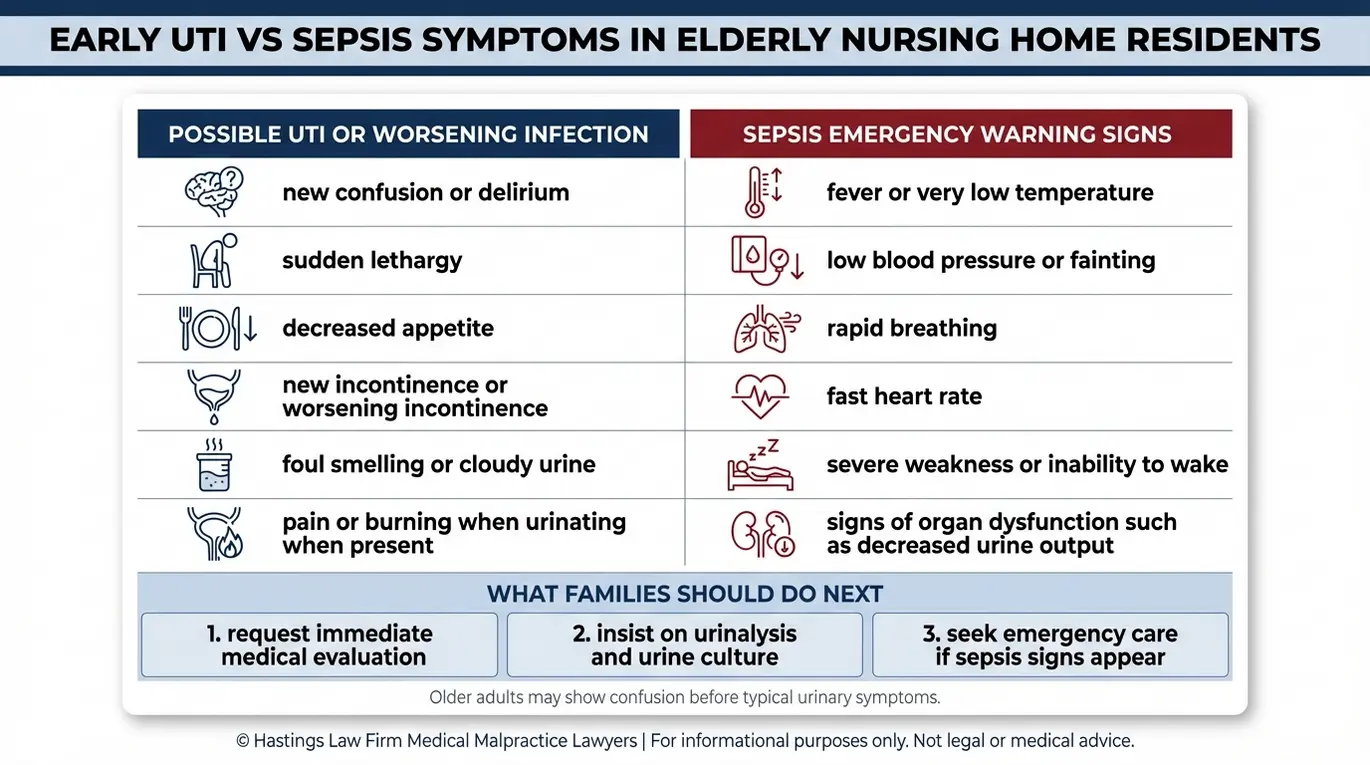
Nursing home neglect causes severe infections when facilities fail to maintain hygiene standards, adequately staff shifts, or monitor high-risk residents. Common failures include poor perineal hygiene, dehydration, and the improper use of catheters, which allow bacteria like E. coli to enter the body and progress to life-threatening conditions. Specific breakdowns often involve poor perineal hygiene, which is the cleaning and care of the genital and rectal area. Gaps in incontinence care also contribute, including failures in routine toileting, changing, and skin protection for residents who cannot control their bladder or bows.
Understanding how these infections develop is central to any medical negligence claim. A Texas nursing home infection lawyer looks at the chain of events: what care was required, what care was actually provided, and where the gaps were.
Hygiene failures are among the most common and most preventable causes of infection in skilled nursing facilities (SNFs). When staff leave residents in soiled undergarments or bedding for extended periods, bacteria migrate from the rectal area into the urinary tract. For elderly residents with weakened immune systems, even a minor bacterial exposure can quickly become a serious infection.
Dehydration compounds the problem. A well-hydrated body naturally flushes bacteria from the urinary system. When a facility fails to monitor fluid intake or encourage adequate hydration, the resident’s body loses one of its most basic defenses against infection. Dehydration is frequently tied to understaffing, because there simply aren’t enough aides available to assist residents with drinking throughout the day.
Understaffing is often the root cause behind multiple types of neglect. When a facility does not have enough qualified staff on each shift, hygiene rounds get skipped, call lights go unanswered, and infection control protocols fall apart. Families can check a facility’s staffing and safety history through the Five Star Quality Rating System maintained by the Centers for Medicare & Medicaid Services (CMS).
Red flags that may point to infection-related neglect include:
- Residents left in soiled clothing or bedding for prolonged periods
- Documented low fluid intake with no follow-up care plan
- Persistent understaffing or high staff turnover
- Recurring infections among multiple residents at the same facility
- Missing or incomplete hygiene logs in the medical record
- Failure to follow up on abnormal vital signs such as fever or elevated heart rate
If you recognize any of these patterns, infection negligence attorneys can investigate whether the standard of care was met.
The Role of Catheters in Nursing Home Infections
Catheters present a distinct and serious infection risk. An indwelling urinary catheter, often called a Foley catheter (a flexible tube inserted into the bladder to drain urine continuously), provides a direct pathway for bacteria to enter the body. The result can be a catheter-associated urinary tract infection, or CAUTI, one of the most common healthcare-associated infections in long-term care settings.
Not every catheter use is medically appropriate. In some cases, facilities may rely on the overuse of catheters to reduce the workload associated with incontinence care, rather than because the resident’s medical condition requires one. This distinction between medical necessity and convenience matters in negligence claims. When a catheter is placed or left in place without a documented medical reason, and the resident develops a CAUTI, the facility may have breached the standard of care.
Proper catheter management requires regular cleaning, timely removal when no longer needed, and close monitoring for early signs of infection. When these steps are skipped, the risk of serious infection rises sharply.
—
Recognizing Symptoms of Untreated UTIs and Sepsis in the Elderly
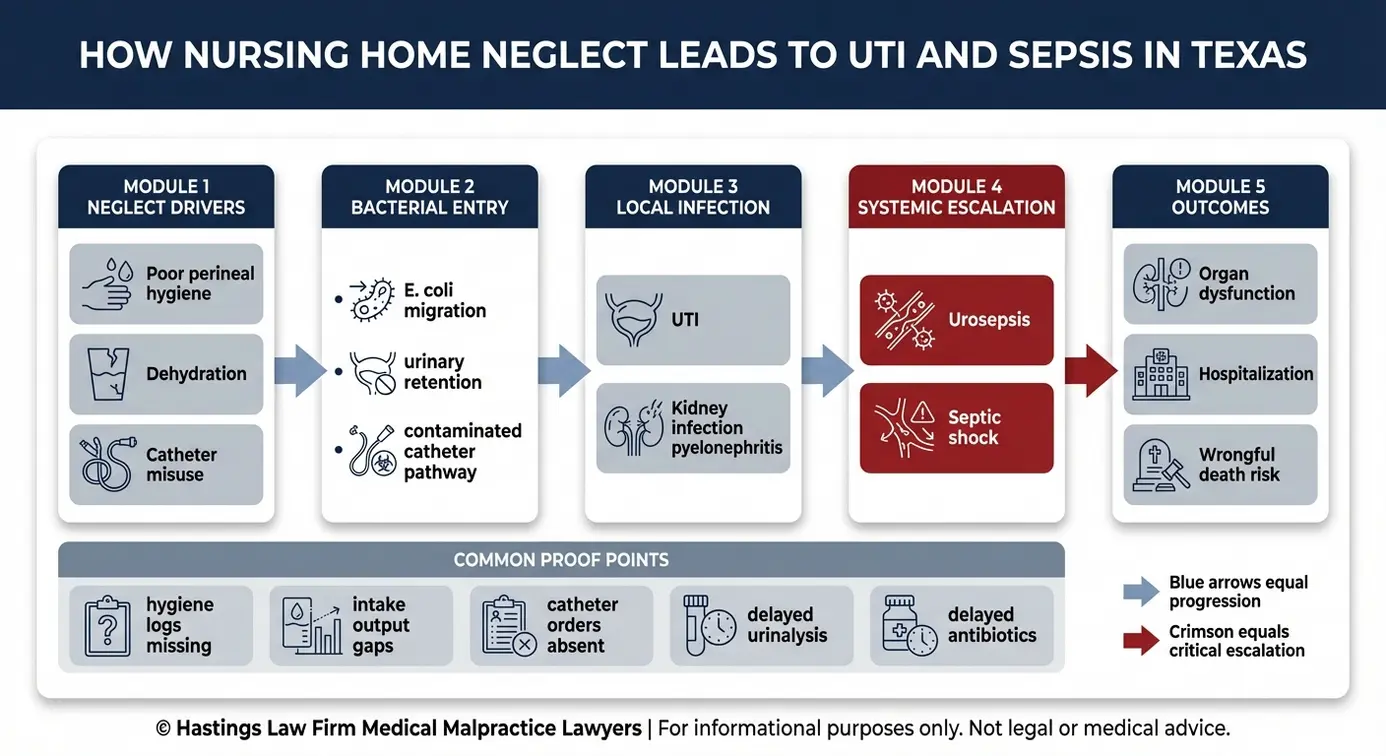
Symptoms of untreated UTIs in the elderly often present differently than in younger adults, frequently manifesting as sudden behavioral changes like confusion, delirium, or lethargy rather than just physical pain. If left untreated, these infections can rapidly escalate to sepsis, characterized by fever, low blood pressure, and organ failure.
This confusion or delirium, an acute change in mental status that causes disorientation and altered awareness, is easy to misread as dementia progression or “just aging,” which can delay testing and treatment. Because families know their loved ones best, they are often the first to notice these subtle shifts. You might notice that a parent who is usually chatty is suddenly silent, or that they cannot recall seeing you yesterday. Trust these observations. In a busy facility where staff rotate frequently, a nurse who doesn’t know your loved one’s baseline personality might dismiss these changes, missing the critical window for early intervention.
The “silent” symptoms
The “silent” symptoms deserve close attention from families. A resident who was oriented and conversational last week but is now withdrawn, confused, or unable to recognize visitors may be experiencing the cognitive effects of an active infection. Falls, loss of appetite, and increased agitation can also signal an untreated UTI. These behavioral indicators should prompt immediate testing, including urinalysis and urine culture, not reassurance that “it’s just part of getting older.”
The progression to sepsis
The progression to sepsis can happen quickly. A UTI that goes untreated can ascend to the kidneys, causing pyelonephritis (a kidney infection), which can lead to kidney failure. From there, bacteria can enter the bloodstream, triggering urosepsis, a form of sepsis that originates from a urinary tract infection. Once sepsis sets in, the body’s response can spiral into septic shock, marked by dangerously low blood pressure, rapid heart rate, and organ failure. At that stage, even aggressive intervention in an ICU may not be enough.
The following table outlines the difference between early UTI signs and indicators of sepsis progression:
| Early UTI Signs | Signs of Sepsis / Septic Shock |
|---|---|
| New or worsening confusion (delirium) | High fever or abnormally low temperature |
| Increased agitation or lethargy | Rapid heart rate and breathing |
| Loss of appetite | Dangerously low blood pressure |
| Cloudy or foul-smelling urine | Cold, clammy, or mottled skin |
| Low-grade fever | Decreased or no urine output |
| Unexplained falls | Altered consciousness or unresponsiveness |
A note on death certificates: Families should be aware that when an elderly resident dies from sepsis caused by an untreated infection, the cause of death listed on the certificate may not tell the full story. In some cases, the underlying infection is not documented, and the death is attributed to “cardiac arrest” or “natural causes.” A lawyer for nursing home infections can help determine whether a wrongful death claim is warranted because the true cause was an infection that should have been caught and treated. If your loved one passed away and you have questions about what happened, a Texas nursing home infection lawyer can investigate the medical record and the circumstances leading up to the death.
—
The Hastings Law Firm Difference
Results matter, but what truly sets us apart is how we achieve them. Every verdict, every settlement, and every Texas courtroom victory comes from one guiding promise: To treat each client’s fight for justice as if it were our own.
This balance of skill, experience, and empathy reflects our core philosophy that justice should not only compensate the injured, but also make healthcare safer nationwide.

Proving Liability and the Standard of Care in Texas Infection Claims
To prove liability in a Texas infection claim, a plaintiff must demonstrate that the nursing home breached the accepted standard of care and that this breach directly caused the infection or its escalation. This requires evidence such as medical records showing missed doses of antibiotics, lack of hygiene logs, or failure to perform timely urinalysis.
A Texas nursing home infection lawyer builds this case by reconstructing the timeline of care. The central questions are direct: Did the staff recognize the signs of infection? Did they order appropriate testing? Did they administer treatment promptly? And if the infection worsened, did they transfer the resident to a hospital in time?
Establishing the Breach
The standard of care in a nursing home setting generally requires staff to monitor residents for signs of infection, perform timely diagnostic testing such as a urinalysis (a lab test that screens urine for signs of infection, blood, or other abnormalities) and urine culture (a test that identifies the specific bacteria causing an infection so the right antibiotic can be prescribed), and initiate treatment without unreasonable delay. When intravenous antibiotics or hospital-level care is needed, the facility is expected to arrange a transfer promptly.
Evidence that we examine to evaluate a potential breach of duty includes:
- Nursing notes and vital sign records for gaps in monitoring
- Medication administration records showing missed or delayed antibiotic doses
- Lab orders and results, including whether a urinalysis or culture was ever performed
- Transfer records and any delay between recognition of decline and hospital transport
- Hygiene and incontinence care logs
- Staffing schedules for the relevant shifts
- Physician communication records and follow-up orders
Each of these sources helps establish whether the care provided matched what a reasonably competent facility should have done under the same circumstances.
The Chapter 74 Requirement
Texas imposes an additional procedural step on medical negligence claims. Under the Texas Medical Liability Act, specifically Texas Civil Practice and Remedies Code, Section 74.351, a plaintiff must serve a qualified expert report within 120 days of the date the defendant files its original answer. This report must identify the standard of care, explain how it was violated, and describe how the violation caused harm.
This requirement exists to screen out cases that lack medical support, but it also means families need an attorney who can move quickly and connect with the right experts. At Hastings Law Firm, our team includes in-house medical professionals who begin reviewing records from day one, and our national expert network allows us to secure qualified opinions efficiently. Tommy Hastings, who is board certified in personal injury trial law by the Texas Board of Legal Specialization, has directed continuing legal education courses on medical liability for the State Bar of Texas, giving our team deep familiarity with Chapter 74 requirements.
Using Systemic Evidence
Individual medical records tell part of the story. Regulatory records can reveal the rest. The CMS Statement of Deficiencies (Form 2567) documents violations found during federal and state inspections of nursing homes. If a facility has prior citations for infection control failures, inadequate staffing, or hygiene violations, that history can support a claim that the neglect was not an isolated incident but part of a pattern.
Families can review inspection results for specific facilities through public databases. For example, the inspection history for a Texas facility like The Shoal is available through Medicare’s Care Compare tool. A nursing home infection attorney can use these records to strengthen the case by showing that the facility was on notice of recurring problems and failed to correct them.
—
Compensation and Damages for Nursing Home Infection Victims
Compensation in Texas nursing home infection cases covers both economic damages, such as hospital bills and funeral costs, and non-economic damages, including physical pain, mental anguish, and disfigurement. In cases of gross negligence, punitive damages may also be awarded to punish the facility.
A Texas nursing home infection lawyer evaluates the full scope of harm when building a damages case. This includes not only the costs already incurred but also the ongoing and future impact on the resident and the family.
Economic damages reflect the financial losses tied to the infection. These may include:
- Emergency room visits and hospital stays
- Intensive care unit costs
- Prescription medications, including intravenous antibiotics
- Rehabilitation and follow-up medical care
- Funeral and burial costs in wrongful death cases
- Loss of the resident’s financial contributions to the family
Non-economic damages address the human cost of suffering. Suing for infection negligence often involves proving:
- Physical pain caused by the infection and treatment
- Mental anguish experienced by the resident and surviving family members
- Loss of companionship and consortium, which compensates spouses or children for the loss of the relationship and emotional support their loved one provided before the injury
- Disfigurement, including scarring from bedsores or pressure ulcers that developed alongside or because of the infection
Texas law does place caps on non-economic damages in medical malpractice cases. Under Texas Civil Practice and Remedies Code Section 74.301, non-economic damages are generally limited to $250,000 per facility, with an overall cap that can range from $500,000 to $750,000 depending on the number of defendants. Economic damages, however, are not capped.
Punitive damages may apply when the facility’s conduct goes beyond ordinary negligence and rises to gross negligence, meaning the facility was consciously indifferent to the resident’s safety. Evidence such as repeated regulatory violations, chronic understaffing despite known risks, or documented failure to act on infection warnings can support a punitive damages claim.
—
Immediate Steps to Take When You Suspect Infection Neglect
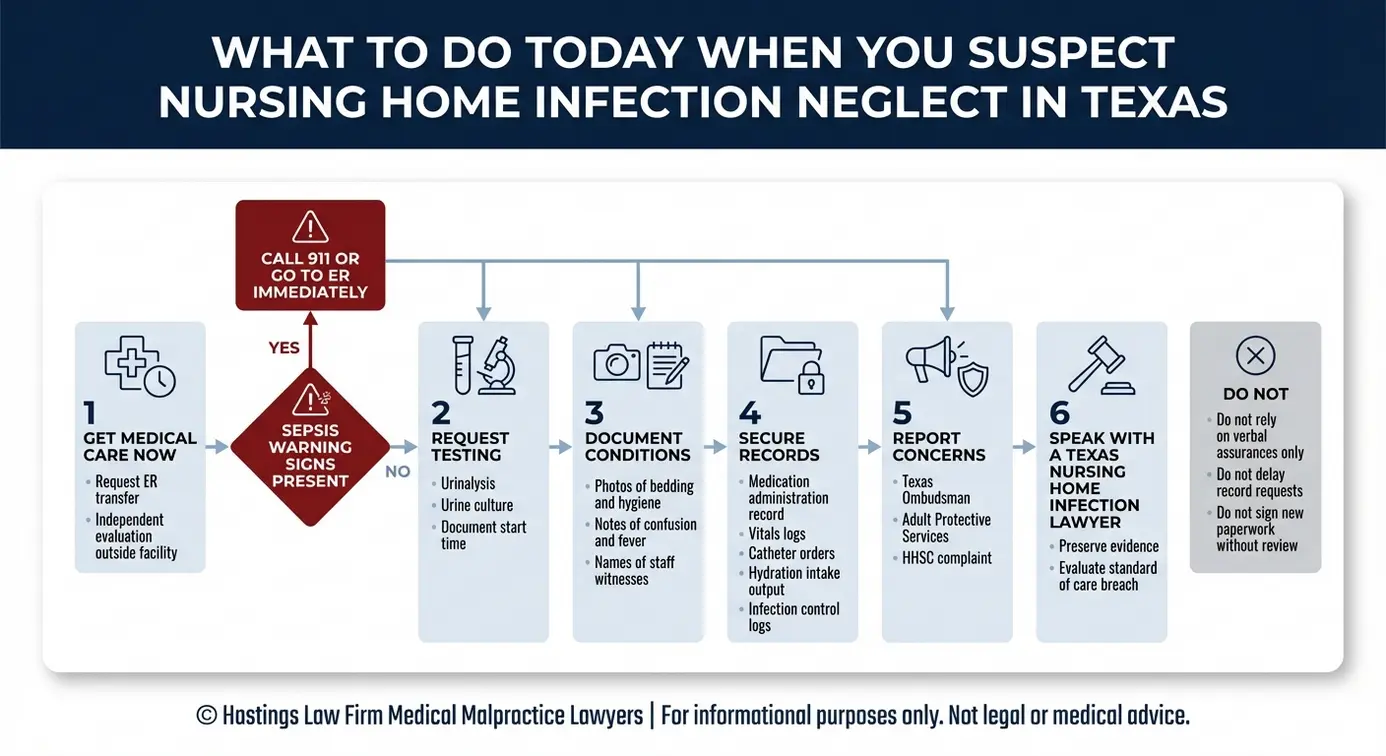
If you suspect neglect, immediately demand a transfer to a hospital for independent testing (urinalysis/culture), photograph any visible signs of poor hygiene (soiled bedding/bedsores), and file a formal report with the Texas Health and Human Services Commission. Securing medical records immediately is critical to preventing falsification. The following steps can help you secure evidence and get your family member the care they need.
Step 1: Get independent medical care. Request an immediate transfer to a hospital emergency room that is not affiliated with the nursing home. Reliance on the nursing home’s doctor can be risky because they may be incentivized to downplay the severity of the condition to protect the facility. An ER physician can order objective testing, including a urinalysis and urine culture, to confirm whether an infection is present and how severe it has become. If the infection has progressed to septic shock, the resident may need intensive care. This is a condition where the body’s response causes dangerously low blood pressure and organ failure. They may also require intravenous antibiotics delivered directly into the bloodstream.
Step 2: Document everything you can. Take photographs of the resident’s physical condition, including any visible signs of poor hygiene, soiled bedding, bedsores, or skin breakdown. Look for environment cues as well: is water placed out of reach? Are call lights going unanswered for long periods? Write down what you observed and when, including the names of any staff members present. If other family members or visitors noticed problems, ask them to write down their observations as well. These records can become important evidence later.
Step 3: Report the facility. File a formal complaint with the Texas Health and Human Services Commission, which oversees nursing home regulation in the state. You can also contact the Texas State Long-Term Care Ombudsman, an independent advocate who investigates complaints on behalf of nursing home residents. An Ombudsman can serve as a neutral party to verify your concerns and help navigate the regulatory system. If you believe the neglect rises to the level of abuse, a report to Adult Protective Services (APS) may also be appropriate.
Step 4: Contact an infection injury attorney before evidence disappears. Medical records, staffing logs, and facility communications are all critical to proving a negligence claim. Once a facility becomes aware that a complaint or lawsuit may be coming, there is a risk that records could be altered, incomplete, or delayed in production. A Texas nursing home infection lawyer can send a formal preservation letter to the facility, demanding that all relevant records and data be retained. At Hastings Law Firm, our in-house medical team can begin reviewing records and identifying potential breaches from the moment you contact us.
Taking these steps does not mean you have to file a lawsuit. It means you are protecting your loved one’s health and preserving your family’s right to get answers.
—
Contact the Texas Nursing Home Attorneys at Hastings Law Firm Today for Help
A serious infection in a nursing home is not something your family should accept as inevitable. When proper care is not provided and a resident suffers because of it, answers and accountability matter.
At Hastings Law Firm, our entire team, including former defense attorneys, in-house nurse consultants, and a national network of medical experts, is dedicated to medical malpractice cases. We prepare every case as if it will go to trial, which puts us in the strongest possible position to pursue fair compensation for your family.
If you believe a loved one’s infection was caused or worsened by negligent care, a Texas nursing home infection lawyer at our firm can evaluate what happened at no cost to you. We work on a contingency fee basis, meaning you pay no attorney fees unless we recover compensation on your behalf. Contact us today for a free, confidential case review.
—
Frequently Asked Questions About Nursing Home Infection in Texas


This content was researched and written by the Hastings Law Firm editorial team, which includes attorneys, medical professionals, and experienced researchers. Our writing is informed by internal knowledge and practical experience, and we cross-check critical details against authoritative sources cited throughout. Every piece undergoes human-led fact-checking and legal review. Because legal and medical information can change, if you spot an error, please contact us. Learn more about our content standards and review process on our editorial policy page.

Brady D. Williams is a nationally recognized medical malpractice attorney who has spent his career handling high-stakes litigation for injured patients and families across the country. Licensed in both Texas and California, Brady draws on experience from hundreds of resolved medical cases to break down complex legal and medical topics for the people who need that information most. His writing reflects the same attention to detail and commitment to clarity that he brings to every case he handles.
