


Texas Nursing Home Bedsores Lawyers
Written by: Hastings Law Firm | Reviewed by: Brady D. Williams | Updated: July 27, 2026
Bedsores in a nursing home are often a sign that basic care broke down, especially when a resident cannot move or communicate needs. Pressure ulcers can worsen quickly and may progress from skin irritation to deep wounds that can become life threatening. The discussion focuses on why older adults are vulnerable, how friction, shear, and sustained pressure contribute, and how understaffing, poor nutrition, dehydration, and unmanaged incontinence can increase risk. If you or a loved one were harmed or worse due to nursing home bedsores in Texas, contact Hastings Law Firm for a free, confidential case review.

Top Rated Texas Attorneys for Pressure Ulcer Claims
What You Should Know About Elderly Pressure Sore Negligence Claims in Texas:
- Serious harm can follow when pressure ulcers progress to advanced wounds, since complications such as sepsis and bone infection are explicitly described as possible outcomes.
- Neglect concerns can be raised when a bedsore develops in a facility, since the text links many cases to staffing, oversight, and missed prevention protocols.
- Disputes over responsibility can turn on whether a facility claims a sore was clinically unavoidable, since that defense is described as common and often contested.
- Options for recovery in Texas can be limited by caps on non economic damages, while economic damages such as medical bills and care costs are described as not capped.
- A claim can be lost if timing rules are missed, since the text states that missing the statute of limitations can permanently bar compensation.
- A case can be dismissed if an expert report requirement is not met, since the text states failure can result in dismissal.
- Hidden or delayed recognition can worsen outcomes, since the text warns some facilities may minimize or conceal wound severity and delay family notification.
- Proof issues can hinge on documentation gaps, since turning logs, wound care charts, staffing records, incident reports, and photographs are described as critical evidence.
- Preventability concerns can be heightened by patterns like understaffing or unmanaged incontinence, since the text ties these systemic failures to faster skin breakdown.
- Reporting a facility can trigger regulatory attention but not compensation, since the text states a civil lawsuit is required to pursue financial recovery.

A Healthcare Focused Law Firm
When a loved one develops bedsores in a nursing home, it can feel like a gut-level confirmation that something has gone wrong. You trusted a facility to provide safe, attentive care, and now you are looking at a painful, preventable injury that raises serious questions about how your family member has been treated.
You are not overreacting. Pressure ulcers that develop in a care facility often point to deeper problems with staffing, oversight, and basic patient care. And you have every right to demand answers.
Led by board-certified trial attorney Tommy Hastings, our team at Hastings Law Firm focuses exclusively on medical negligence cases. Our in-house nurse consultants and former defense attorneys know how facilities document care, where gaps are hidden, and what the medical records should show. We can review what happened to your loved one and explain your legal options at no cost and no obligation.
Understanding Pressure Ulcers and Decubitus Ulcers in the Elderly
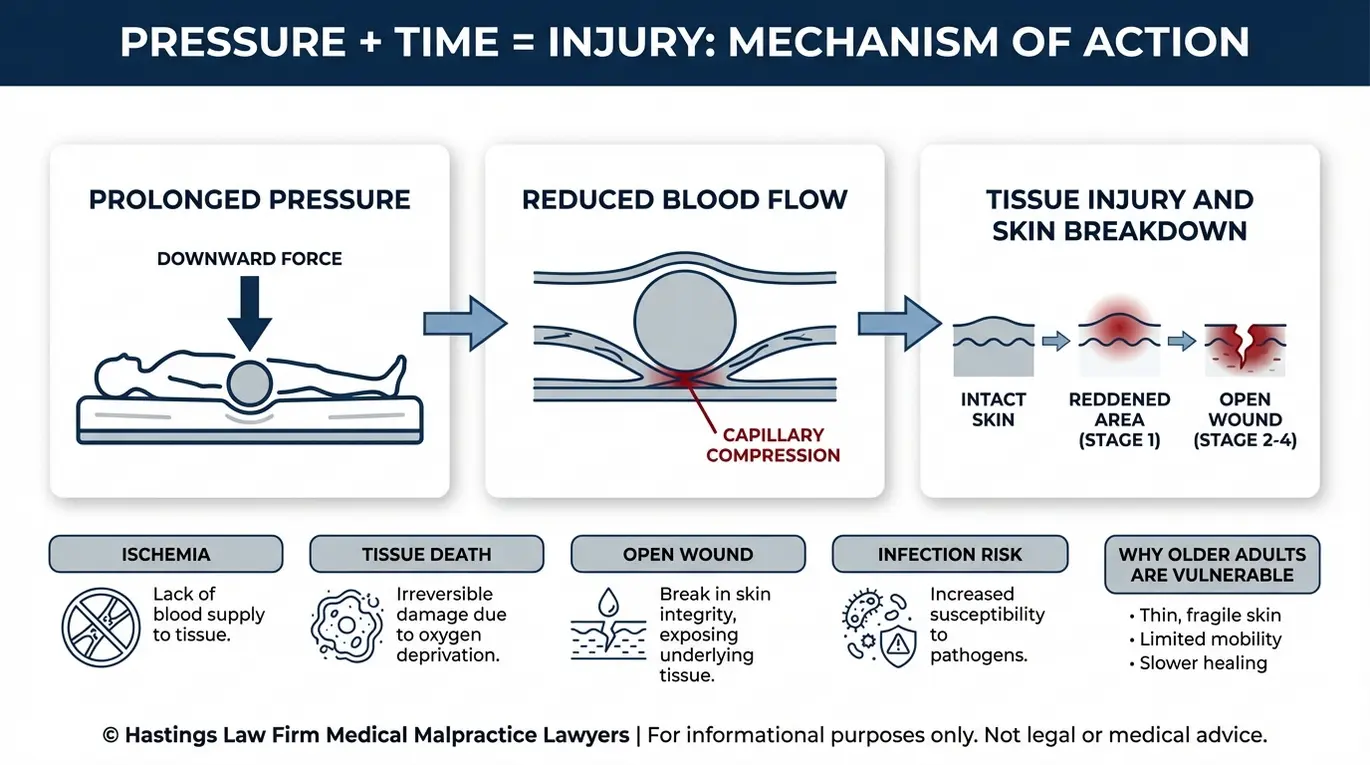
Bedsores, also known as pressure ulcers or decubitus ulcers, are injuries to the skin and underlying tissue caused by prolonged pressure that reduces blood flow to the affected area. They are not a normal part of aging, and in a properly staffed care facility, they are largely preventable. These injuries can develop with alarming speed, sometimes in as little as two hours, making constant vigilance essential.
The underlying mechanism is clear. When sustained pressure is applied to soft tissue, typically between a bony area of the body and a firm surface like a mattress or wheelchair, it compresses blood vessels. This leads to ischemia, a reduction in blood flow that starves the tissue of oxygen and nutrients. If the pressure is not relieved, tissue begins to die. What starts as persistent redness can progress to deep, open wounds that reach muscle or bone.
According to the International Guideline on pressure injury etiology, this combination of pressure intensity and duration is the primary driver of skin breakdown.
Elderly residents are especially vulnerable for several reasons:
- Thinner, more fragile skin that tears and breaks down faster under pressure.
- Reduced mobility that prevents them from shifting position on their own.
- Decreased circulation that slows the body’s ability to repair damaged tissue.
- Chronic conditions like diabetes or vascular disease that further compromise healing.
Age-related loss of subcutaneous fat reduces the natural cushioning over bones, leaving the skin defenseless against the hard surfaces of a bed or chair. Nursing homes are expected to assess risk and implement pressure injury protocols for every resident. When a bedsore develops, it raises a direct question about whether those protocols were followed. Texas bedsore attorneys look at the clinical timeline, care plans, and staffing records to determine whether the facility met its obligations.
Causes of Bedsores Indicating Nursing Home Neglect
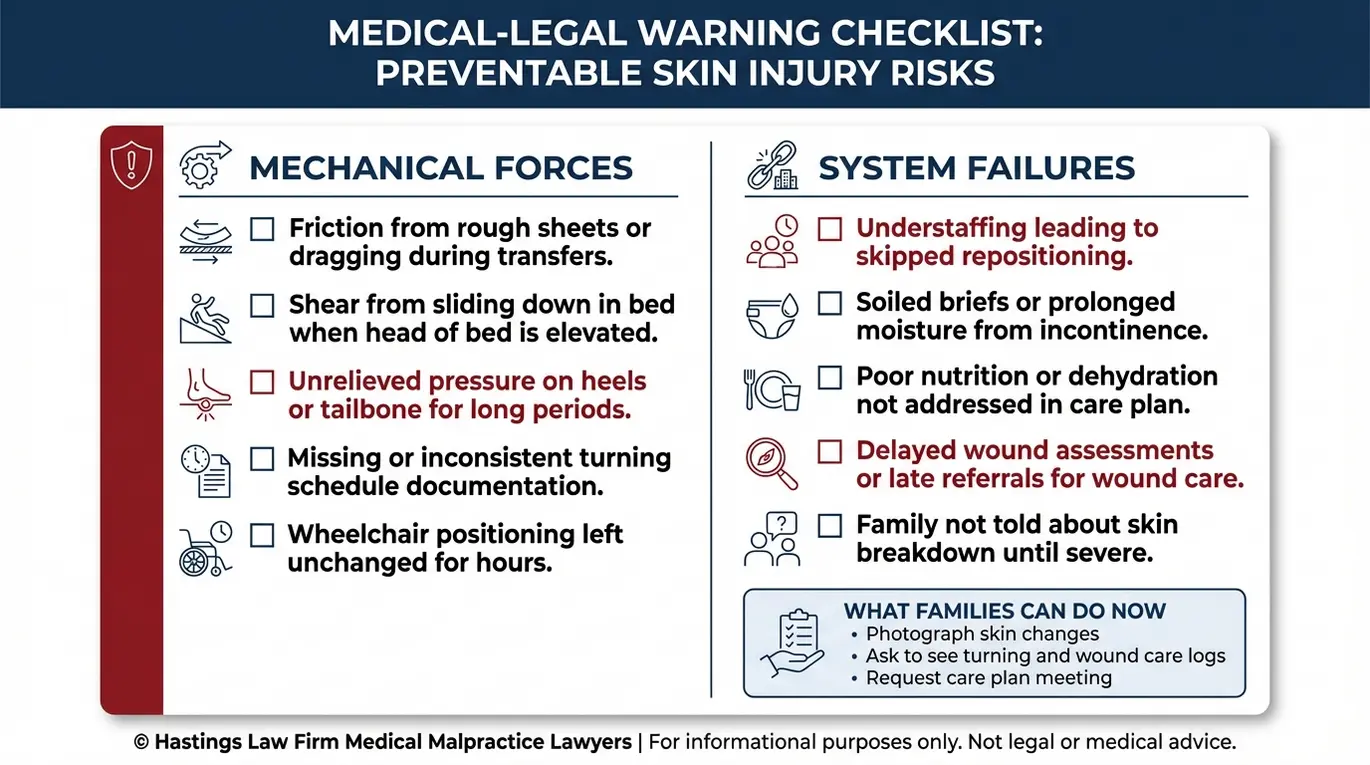
While facilities often claim sores are unavoidable, the primary causes are typically mechanical forces combined with negligent staff inattention, specifically friction, shear, and sustained pressure.
Understanding each of these forces helps explain why bedsores are so often tied to nursing home neglect.
Friction, the mechanical force exerted when skin is dragged across a surface like sheets or a wheelchair pad, commonly happens when staff pull a resident up in bed instead of lifting properly. Repeated friction strips away the outer layer of skin, making the area far more susceptible to deeper injury.
Shear is a related but distinct force. It involves layers of tissue sliding in opposite directions, damaging blood vessels beneath the skin’s surface.
Sustained pressure is the most common culprit. When a resident cannot reposition themselves and staff do not follow a consistent turning schedule, the same area bears the patient’s weight for hours at a time. The result is progressive tissue death.
Beyond these mechanical forces, several systemic failures within a facility can accelerate skin breakdown:
- Understaffing that leads to missed or skipped repositioning intervals
- Malnutrition, a lack of adequate nutrition that weakens skin integrity and slows wound healing
- Dehydration that reduces skin elasticity and resilience
- Unmanaged incontinence that exposes skin to prolonged moisture, increasing the risk of breakdown
- Missing or inadequate care plans that fail to address a resident’s specific risk factors
These are not random occurrences. They are patterns that nursing home neglect lawyers examine closely. Penalty data from the Centers for Medicare and Medicaid Services shows that facilities are regularly cited for deficiencies related to pressure ulcer prevention, and those citations often reveal a pattern of systemic failure rather than isolated incidents.
If you recognize any of these warning signs in your loved one’s care, it may be a case of pressure sore negligence, and that instinct to question the facility is worth pursuing.
The Impact of Shear Forces on Bedbound Patients
Shear forces, which are mechanical stresses that cause tissue layers to slide in opposite directions in nursing home residents, deserve special attention because they cause deep tissue damage that may not be visible on the skin’s surface right away.
Here is how it works. When the head of the bed is elevated, gravity pulls the resident’s skeleton downward toward the foot of the bed. But the skin on the back, particularly over the sacrum, stays in place because of friction against the mattress. Shear forces stretch and tear the tissue beneath the skin, severing small blood vessels and cutting off circulation to the area.
Head-of-bed (HOB) elevation, the angle at which the bed’s upper portion is raised, is a common contributor. Leaving a resident sitting up at a steep angle for extended periods without repositioning creates exactly the conditions for shear-related injuries. Staff are trained to manage bed elevation and reposition residents to relieve these forces, and when they do not, the resulting tissue damage can be significant, even before a visible wound appears on the surface.
The Hastings Law Firm Difference
Results matter, but what truly sets us apart is how we achieve them. Every verdict, every settlement, and every Texas courtroom victory comes from one guiding promise: To treat each client’s fight for justice as if it were our own.
This balance of skill, experience, and empathy reflects our core philosophy that justice should not only compensate the injured, but also make healthcare safer nationwide.

Common Anatomical Areas for Pressure Sores
Pressure sores most frequently develop on bony prominences, areas of the body where there is little muscle or fat to cushion the skin against the bed or wheelchair surface. The tailbone and heels are the most common locations, but they are far from the only ones.
The areas most at risk include:
- Sacrum and coccyx (tailbone): The single most common site for bedsores in residents who spend long periods lying on their back. The thin tissue over these bones offers very little natural protection.
- Heels: Frequently overlooked, heels rest directly against the mattress and bear concentrated pressure. Without heel-suspension devices or regular checks, breakdown can happen quickly due to the complete lack of fat tissue protecting the heel bone.
- Hips (greater trochanter): Particularly at risk for residents who are positioned on their sides for extended periods.
- Elbows: Vulnerable when arms rest against bed rails or hard surfaces without padding.
- Shoulder blades and the back of the head: Less common but significant, especially in residents who are fully immobile.
These bony prominences, or pressure points, are the reason that a strict turning schedule is a core component of pressure injury prevention. The standard protocol typically calls for a turning schedule, a strict routine of repositioning the resident every two hours, to relieve pressure. A systematic review published by PubMed Central on turning and repositioning frequency confirms that consistent repositioning remains a primary strategy for preventing hospital- and facility-acquired pressure injuries.
When bed sore lawyers in Texas review a case, one of the first things we examine is the turning log. If the facility cannot produce consistent, credible documentation that repositioning occurred on schedule, that gap becomes a central piece of the negligence claim.
Proving Liability for Decubitus Ulcers in Texas Facilities
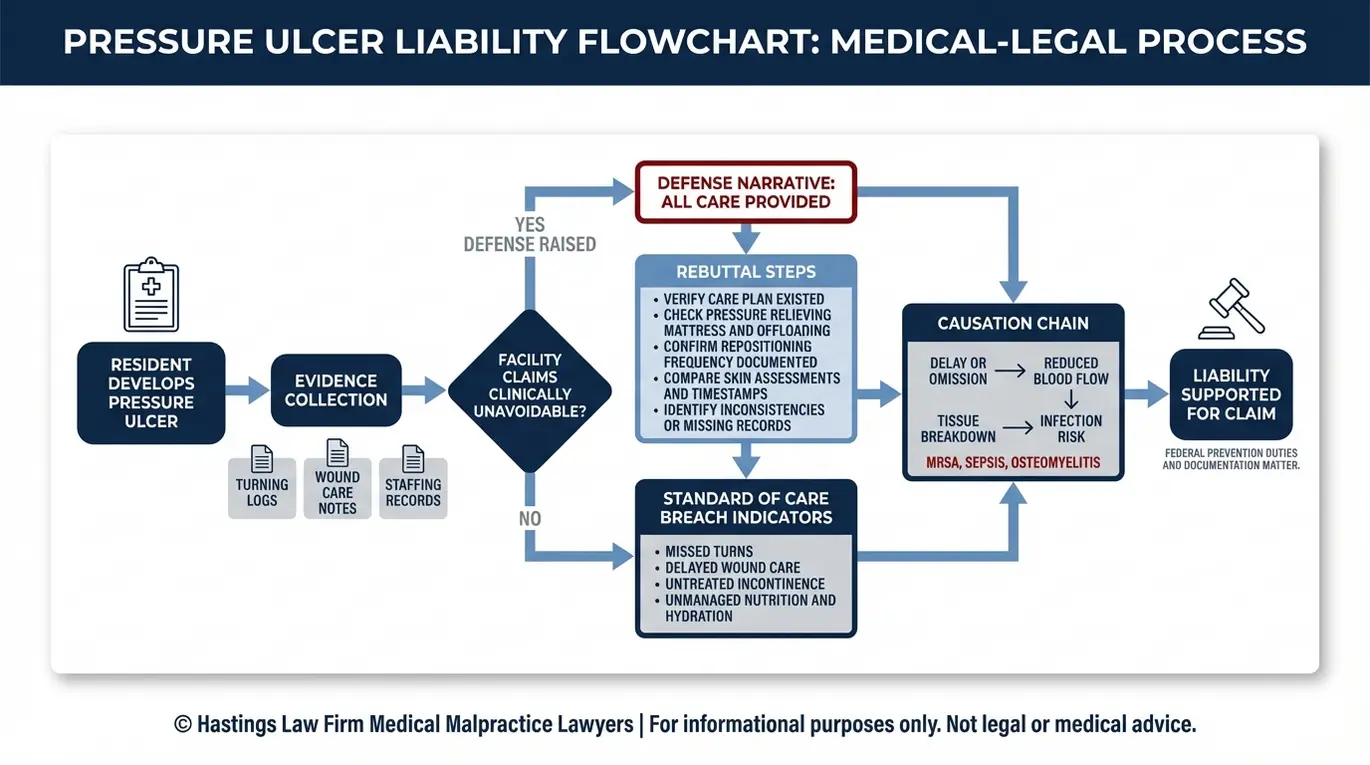
To prove liability, a plaintiff must demonstrate that the facility failed to follow federal regulations regarding prevention and that the bedsore was not a “clinically unavoidable” outcome of the patient’s condition.
The “Clinically Unavoidable” Defense
The most common defense you will encounter is the facility arguing that the pressure ulcer was clinically unavoidable, meaning the sore would have developed even if every appropriate intervention had been in place. This defense applies in limited circumstances, such as when a patient’s medical condition is so severe that tissue breakdown occurs despite proper care.
The reality is that this defense is overused. Many facilities invoke it without being able to show that a prevention plan was actually developed, implemented, and followed. Our investigation begins by evaluating these implementation gaps.
How We Build the Rebuttal
Suing a nursing home for bedsores requires proving the facility did not take the steps it was supposed to take, which often amounts to nursing home abuse. We examine whether the facility:
- Conducted a proper risk assessment at admission
- Created an individualized care plan addressing the resident’s risk factors
- Provided pressure-relieving surfaces such as specialized mattresses
- Documented consistent repositioning on the required schedule
- Addressed nutrition, hydration, and incontinence management
- Escalated wound care as the injury progressed
Our in-house medical staff, which includes nurse consultants and board-certified patient advocates, reviews clinical records line by line to identify charting inconsistencies or gaps that suggest the documented care was not actually provided.
Severe Consequences of Untreated Bedsores
Advanced pressure ulcers are not just painful. They can become life-threatening. Stage 3 and Stage 4 wounds may require debridement, a medical procedure where dead or infected tissue is surgically removed, and can lead to serious complications including sepsis (a potentially fatal bloodstream infection), MRSA (antibiotic-resistant infection), and osteomyelitis (bone infection).
Families should know that some facilities minimize or attempt facility cover-ups to hide a wound’s severity until complications set in. If you were not informed about a developing pressure sore, that raises additional questions about whether the facility met its duty of transparency.
Under Texas Civil Practice and Remedies Code Chapter 74.051, specific pre-suit notice requirements must be met before filing a nursing home negligence claim. Our team handles every procedural step, from notice letters to expert reports, so the case is built correctly from the start.
If you are looking for legal help for pressure ulcers your family member suffered in a Texas facility, our team is prepared to evaluate the evidence and explain what options may be available.
Contact the Texas Nursing Home Attorneys at Hastings Law Firm Today for Help
Bedsores are not an inevitable part of aging or nursing home life. When they appear, they are often a sign of systemic neglect, missed care protocols, and a facility that is not meeting its obligations to the people entrusted to it.
Your loved one deserved better. And you deserve to know the truth about what happened.
At Hastings Law Firm, our Texas nursing home negligence attorneys and in-house medical team are ready to review your loved one’s records, identify where care fell short, and help you understand your legal options. We work on a contingency fee basis, which means you pay no fees or costs unless we secure a recovery on your behalf.
If your family member has suffered a preventable pressure injury, contact us for a free, confidential case evaluation. Let us help you find the answers you deserve.
Frequently Asked Questions About Nursing Home Bedsores in Texas


This content was researched and written by the Hastings Law Firm editorial team, which includes attorneys, medical professionals, and experienced researchers. Our writing is informed by internal knowledge and practical experience, and we cross-check critical details against authoritative sources cited throughout. Every piece undergoes human-led fact-checking and legal review. Because legal and medical information can change, if you spot an error, please contact us. Learn more about our content standards and review process on our editorial policy page.

Brady D. Williams is a nationally recognized medical malpractice attorney who has spent his career handling high-stakes litigation for injured patients and families across the country. Licensed in both Texas and California, Brady draws on experience from hundreds of resolved medical cases to break down complex legal and medical topics for the people who need that information most. His writing reflects the same attention to detail and commitment to clarity that he brings to every case he handles.
