


Texas Nursing Home Wrongful Death Lawyer
Written by: Hastings Law Firm | Reviewed by: Brady D. Williams | Updated: July 27, 2026
Losing a loved one in a nursing home can be devastating, especially when the circumstances suggest the outcome was preventable. The discussion often centers on systemic neglect such as understaffing, missed monitoring, and failures in basic care that can lead to life threatening complications or fatal outcomes. Understanding how negligence is identified, how causation is disputed, and what types of losses may be recognized can help families make informed decisions during an already painful time. If you lost a loved one due to nursing home wrongful death in Texas, contact Hastings Law Firm for a free, confidential case review.
Compassionate Texas Medical Attorneys for Nursing Home Wrongful Death Claims
What You Should Know About Death in Nursing Home Negligence Claims in Texas:
- Fatal outcomes can follow systemic neglect such as understaffing that undermines basic safety and medical monitoring.
- Disputes over causation can be central because facilities may claim the outcome was inevitable due to age or pre existing conditions.
- Recovery options can be limited by who the law recognizes as eligible to file a wrongful death claim.
- The ability to pursue compensation can be lost if filing is not done on time.
- Compensation can include economic losses and noneconomic losses, and noneconomic recovery may be limited in health care liability cases.
- Punitive damages may be available only in extreme negligence situations where the conduct shows conscious indifference to resident safety.
- Options can be affected by admission paperwork terms such as arbitration agreements.
- Proof can depend on whether key materials are preserved, including medical charts, staffing logs, and surveillance footage.
- Independent records can matter, including CMS citations and coroner or autopsy reports.
- Video evidence from authorized electronic monitoring can be powerful when it captures neglect or abuse directly.
A Healthcare Focused Law Firm
When a loved one passes away in a skilled nursing facility (SNF), a residential care setting licensed to provide around-the-clock medical attention, the grief can be overwhelming. It becomes even harder to process when you suspect the death was preventable. Understaffing, which occurs when a facility operates with fewer qualified caregivers than residents safely require, is one of the most common triggers for the kind of neglect that leads to fatal outcomes.
You deserve honest answers about what happened. Led by Tommy Hastings, a board-certified trial lawyer, Hastings Law Firm focuses exclusively on medical malpractice. Our in-house medical staff can help determine whether substandard care contributed to your loved one’s death. If you have questions or concerns, we welcome the chance to review the circumstances and explain your legal options in a free, confidential case evaluation.
Common Causes of Fatal Nursing Home Negligence
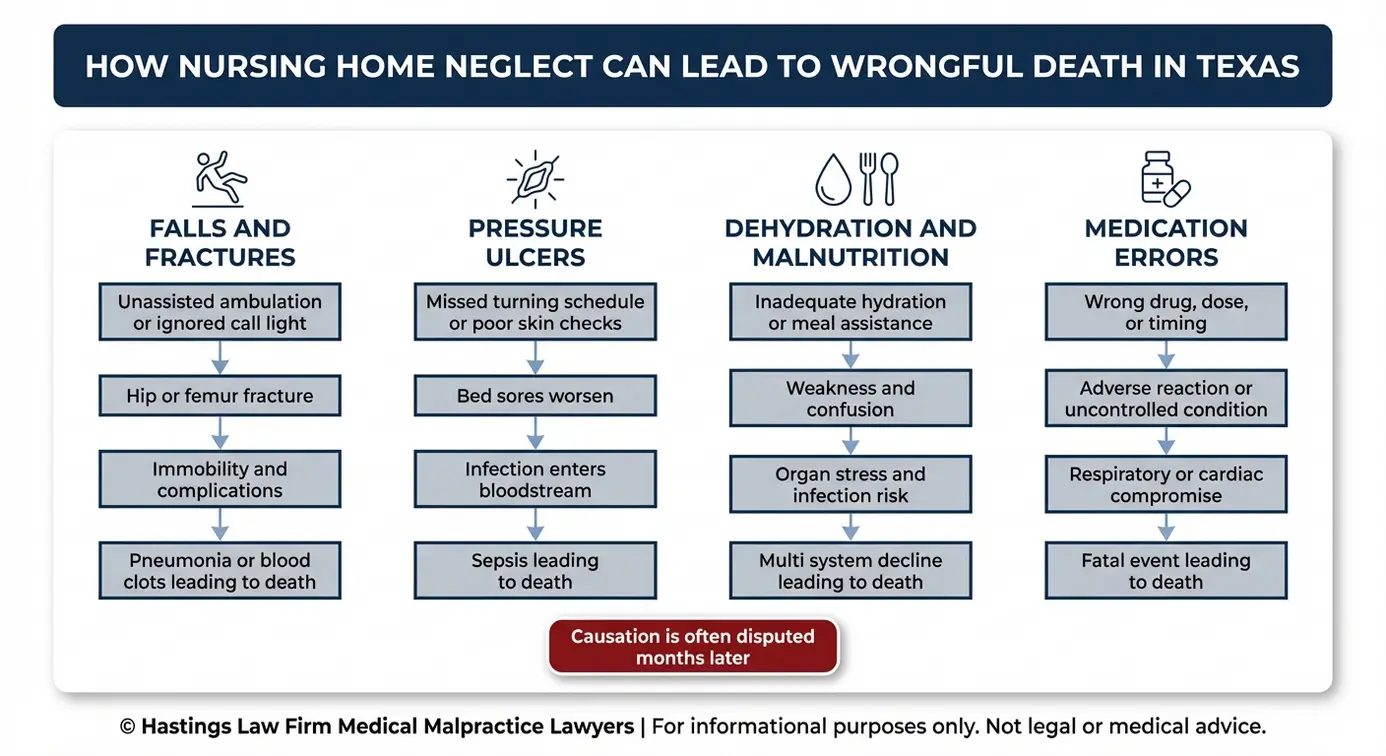
Fatal nursing home negligence often stems from systemic failures such as understaffing, leading to preventable falls, untreated infections, severe bedsores, and medication errors that compromise the resident’s survival. As a Texas nursing home negligence lawyer, we see that these are not isolated incidents.
Families typically contact us when they suspect that a facility’s inability to provide basic safety standards led to their loss. These events tend to follow predictable patterns that our medical and legal teams know how to identify and document, often requiring an elder abuse attorney Texas families trust to investigate fully.
Some of the most common causes of fatal nursing home neglect include:
- Falls and fractures: A fall that results in a hip or femur fracture, a serious fall-related fracture in older adults that often compromises mobility, can set off a slow, painful decline. Extended immobility after the fracture drastically increases the risk of blood clots, pneumonia, and muscle wasting. Proving that the original fall caused the fatal outcome is one of the more difficult aspects of these cases because the death may occur weeks or months later. We trace the timeline from the fall itself back to the staffing and supervision failures that allowed it to happen.
- Medication errors: Residents in nursing facilities often take multiple medications with precise dosing requirements. Staff may be rushing to complete their rounds, leading to mix-ups between patients or failure to follow warning labels. An incorrect dosage, a missed administration, or a dangerous drug interaction can cause organ damage, cardiac events, or fatal sedation. Even a single error during a routine medication pass, the scheduled process of distributing medications to residents, can be deadly.
- Infection and sepsis: Pressure ulcers, also called decubitus ulcers or bedsores, develop when a resident is left in one position for too long without being repositioned. What begins as skin redness can progress to an open wound exposing muscle or bone. Left untreated, these wounds become infected, and that infection can enter the bloodstream, leading to sepsis, a life-threatening condition that can cause organ failure and death. Malnutrition and dehydration, both common in understaffed facilities, accelerate this progression by weakening the body’s ability to heal and fight infection.
Federal Medication Error Thresholds
The Centers for Medicare & Medicaid Services (CMS) enforces a 5% medication error threshold for nursing facilities. If a facility’s error rate during a medication pass, often called a “med pass” by nursing staff, exceeds 5%, CMS can issue a formal citation. These citations become part of the facility’s public record and can serve as powerful evidence that the facility failed to meet the accepted standard of care. The standard of care represents the level of treatment a reasonably prudent facility would provide under similar circumstances. A pattern of citations may support an argument that the facility knew about systemic problems and failed to correct them, which can be relevant to establishing gross negligence.
Establishing Liability and Elements of a Wrongful Death Claim
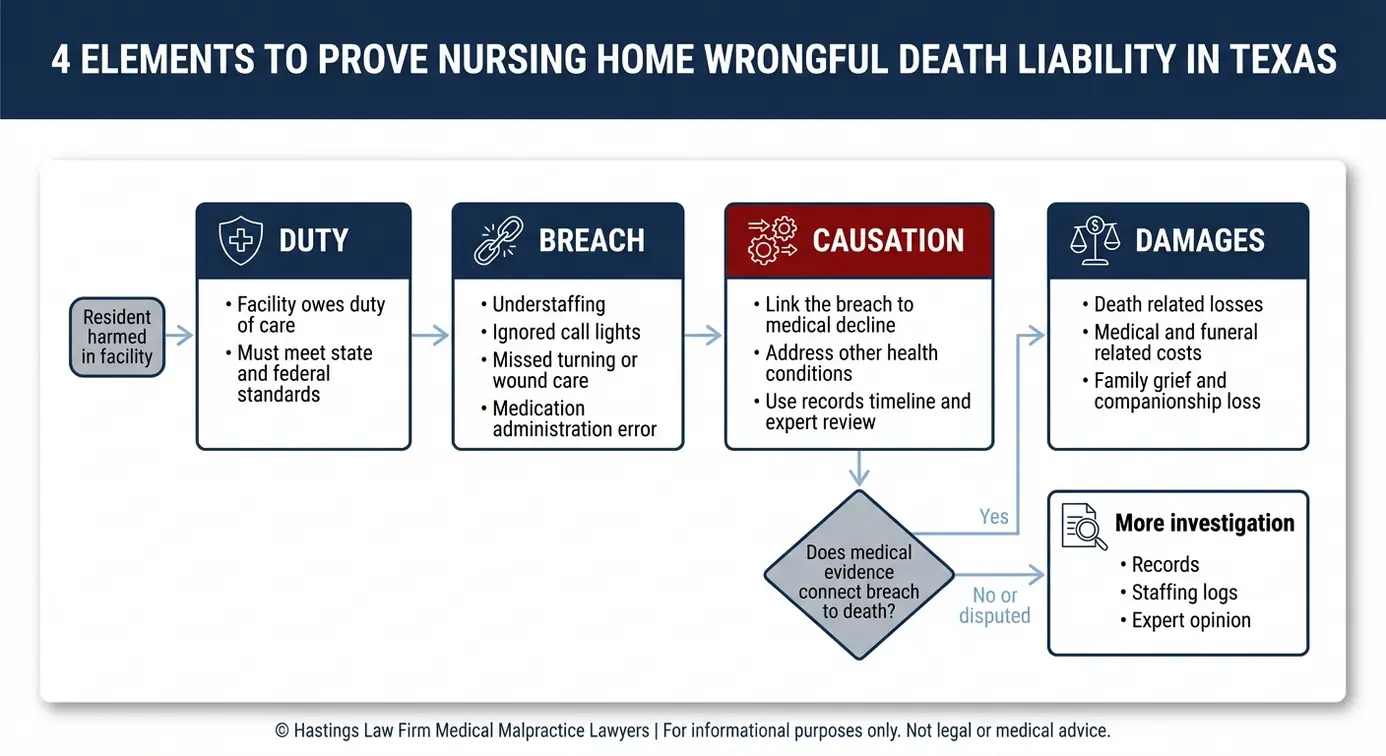
To establish liability, the plaintiff must prove that the nursing home owed a duty of care, breached that duty through negligent action or inaction, and that this specific breach was the proximate cause of the resident’s death. These elements form the legal framework for every wrongful death claim filed under Texas Civil Practice and Remedies Code Chapter 74, which governs medical malpractice and health care liability claims in the state. Chapter 74 is the specific set of laws in Texas that creates strict procedural requirements for filing a lawsuit against a healthcare provider.
Duty of care is the legal obligation a nursing facility accepts when it admits a resident. The facility is required to provide care that meets both state and federal standards, including adequate staffing, proper medical monitoring, and safe living conditions.
Breach of duty occurs when the facility fails to meet that standard of care. This might look like ignoring call lights, failing to reposition immobile residents, or neglecting to address early signs of sepsis (a dangerous infection response) or dehydration (inadequate fluid intake leading to organ stress).
Causation is often the most contested element. The defense will argue that the resident’s death was inevitable due to age or pre-existing conditions. As a Texas nursing home wrongful death lawyer team, we work with independent medical experts to draw the direct line between the facility’s specific failures and the resident’s death. We look for the proximate cause, which is the primary act or omission that naturally and directly led to the fatal injury. A skilled wrongful death attorney for elderly patients knows how to separate natural decline from preventable harm.
The Hastings Law Firm Difference
Results matter, but what truly sets us apart is how we achieve them. Every verdict, every settlement, and every Texas courtroom victory comes from one guiding promise: To treat each client’s fight for justice as if it were our own.
This balance of skill, experience, and empathy reflects our core philosophy that justice should not only compensate the injured, but also make healthcare safer nationwide.

Who Can File a Wrongful Death Lawsuit in Texas?
Under the Texas Civil Practice and Remedies Code, Chapter 71, the surviving spouse, children (biological or adopted), and parents of the deceased are the only parties eligible to file a wrongful death lawsuit; siblings and grandparents generally do not have legal standing to bring this type of claim. Statutory beneficiaries are the specific family members defined by law as having the right to seek damages.
These statutory beneficiaries may file individually or together. If no eligible family member files a wrongful death lawsuit within three months of the resident’s death, the executor or personal representative of the estate may file on the family’s behalf, unless an eligible family member specifically requests that the claim not be filed. In most cases, a surviving spouse or adult child leads the claim. The rules for filing a survival claim differ slightly, as those are brought strictly on behalf of the estate rather than for the family’s direct benefit.
Understanding who qualifies to file is an important early step, and a Texas nursing home wrongful death lawyer can clarify this during an initial consultation. Determining the correct plaintiff is critical to avoiding procedural dismissals. If you are unsure about your eligibility or the status of the estate, we can review your family’s specific situation and explain how the law applies to your potential case.
Proving Fault and Gathering Evidence in Nursing Home Deaths
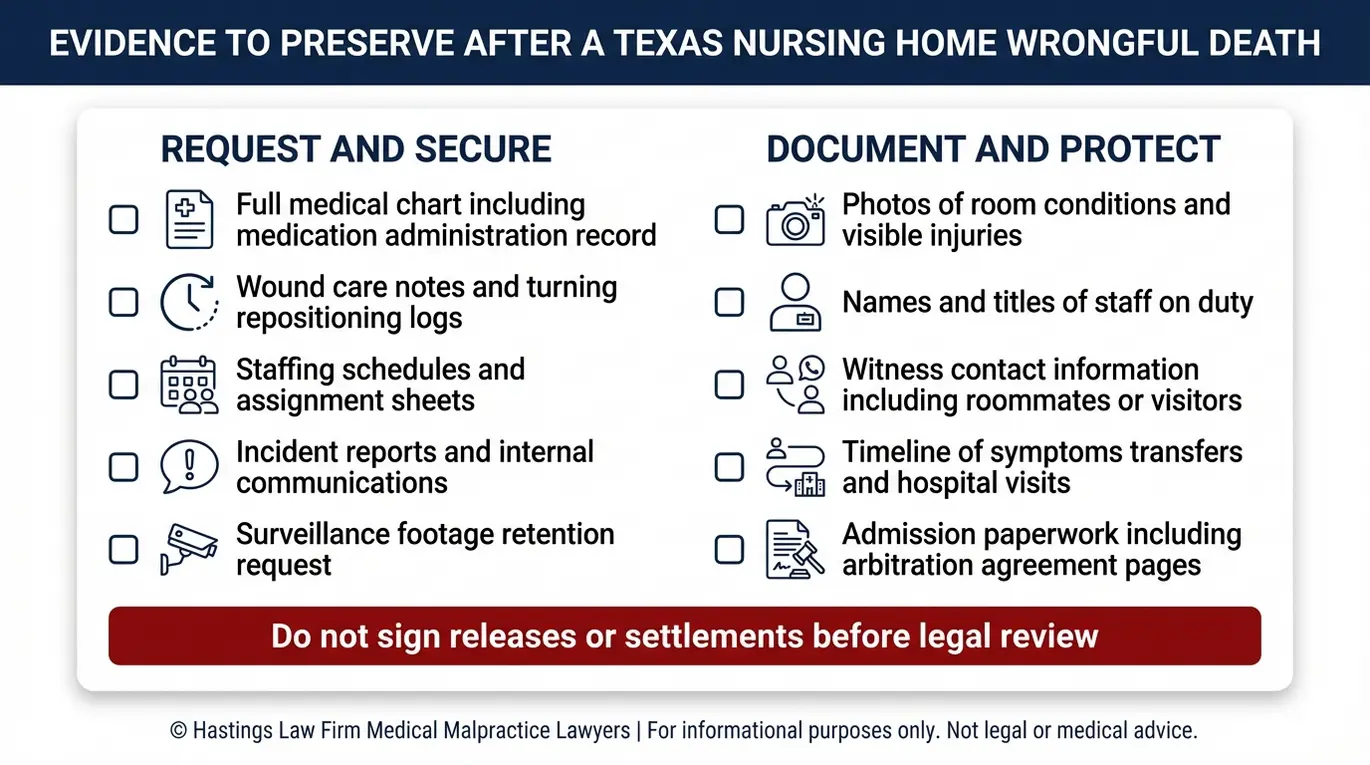
Proving fault requires a comprehensive investigation involving the securing of medical charts, staffing logs, surveillance footage, and expert testimony to reconstruct the events leading to the resident’s passing. This evidence can deteriorate or disappear quickly, which is why early action matters. As a Texas nursing home wrongful death attorney, we act immediately to prevent the destruction of critical proof.
Our team focuses on gathering and preserving several categories of evidence to expose nursing home neglect:
- Medical records and staffing logs: We review the complete medical chart, including the medication administration record (MAR), which documents every drug given to the resident and when. We also examine the turning and repositioning schedule, a log that tracks how often immobile residents were moved to prevent bedsores. Gaps in these records, or patterns of understaffing reflected in shift logs, can reveal systemic problems. We engage an expert witness to analyze these documents for discrepancies.
- Witness statements: Former staff members, roommates, and regular visitors can provide firsthand accounts of conditions inside the facility. Witness testimony from these individuals often corroborates what the records show. We also review complaints filed with the Texas Long-Term Care Ombudsman, which investigates concerns about resident care in licensed facilities.
- Coroner and autopsy reports: In some Texas counties, coroners conduct extended reviews of fall-related deaths, sometimes lasting up to six months. These reports can become a valuable source of independent evidence linking a fall or other neglect event to the cause of death.
Here is a checklist of steps families can take to help preserve evidence early:
- Request a complete copy of the resident’s medical records immediately
- Photograph any visible injuries, the resident’s room, and general facility conditions
- Write down the names of staff members who were on duty
- Save any written communications with the facility, such as emails, texts, or letters
- Locate copies of admission paperwork to check for an arbitration agreement
- Do not sign any release forms, waivers, or settlement offers from the facility
- Contact a nursing home death lawyer before speaking with the facility’s legal team or insurance representatives
Texas Authorized Electronic Monitoring (Nanny Cams)
Under Texas Health & Safety Code, Chapter 242, Subchapter R, families have the legal right to place electronic monitoring devices, sometimes called “nanny cams,” in a resident’s room. Video evidence captured this way can serve as direct proof of abuse or gross negligence. Because this footage often speaks louder than conflicting witness testimony, it is a powerful tool. If you are considering this option, a Texas nursing home wrongful death attorney can walk you through the notice and consent requirements to ensure the footage is admissible in court.
Compensation Available for Families in Texas Wrongful Death Cases
Families may recover compensation for funeral and burial expenses, loss of companionship and society, mental anguish, and in cases of extreme negligence, punitive damages to punish the facility. Seeking fair wrongful death compensation Texas families deserve requires understanding these categories. The specific types of recoverable damages generally fall into three groups.
Economic damages cover the measurable financial losses tied to the death. These include medical bills incurred before the resident passed, funeral and burial costs, and the loss of any financial support the deceased provided to the family. Economic damages are not subject to a statutory cap in Texas.
Noneconomic damages address the personal, emotional toll on the surviving family. This includes the grief and mental anguish of losing a loved one, loss of companionship, and loss of the comfort and guidance the deceased provided. Because nursing home wrongful death claims are often health care liability cases, Texas law may apply caps to noneconomic damages.
Punitive damages may be awarded when the evidence demonstrates gross negligence, meaning the facility’s conduct involved an extreme degree of risk and conscious indifference to the resident’s safety. These damages go beyond compensation and are intended to hold the facility accountable to help deter similar conduct. The threshold for punitive damages is high, but a Texas nursing home wrongful death lawyer can evaluate whether the facts of your case support this claim. Facility inspection data from the CMS Health Deficiencies dataset can help establish patterns of repeated violations that may support a gross negligence argument.
Understanding the Difference: Wrongful Death vs. Survival Actions
A wrongful death claim compensates the surviving family members for their personal loss, whereas a survival action pursues compensation for the pain and suffering the deceased resident experienced between the time of injury and their death. Both claims can arise from the same set of facts, but they serve different purposes and benefit different parties.
Wrongful death claims belong to the surviving family, specifically the spouse, children, or parents. The focus is on what the family lost: companionship, emotional support, financial contributions, and the relationship itself. Damages are paid directly to the eligible family members.
Survival actions are brought on behalf of the deceased person’s estate. These claims address the harm the resident personally endured before dying, including physical pain and suffering, and any medical expenses they accumulated. The proceeds from a survival action go to the estate rather than directly to family members, and distribution follows the terms of the will or Texas intestacy law. The estate is the legal entity that holds the deceased person’s assets and legal claims.
| Feature | Wrongful Death Claim | Survival Action |
|---|---|---|
| Who benefits | Surviving spouse, children, parents | The deceased’s estate |
| What it covers | Family’s grief, lost companionship, lost financial support | Resident’s pain, suffering, and medical costs before death |
| Who files | Eligible family members (or executor after 3 months) | Executor or administrator of the estate |
| Where proceeds go | Directly to family members | To the estate for distribution |
Filing both a wrongful death claim and a survival claim together is common in nursing home cases. A Texas nursing home wrongful death lawyer can determine which claims apply to your situation and ensure that every avenue of recovery is pursued on your family’s behalf.
Contact the Texas Nursing Home Attorneys at Hastings Law Firm Today for Help
No amount of money can undo the loss of someone you love. But holding a negligent facility accountable can provide answers, financial security, and a measure of justice that helps prevent the same thing from happening to another family.
Hastings Law Firm has handled these specialized cases since being founded in 2005. Our team includes in-house nurses, former defense attorneys who understand how facilities and insurers respond to claims, and a national network of medical experts. We prepare every case as if it will go to trial, and we do not collect a fee unless we secure a recovery for you.
If you believe your loved one’s death in a nursing home was preventable, contact us for a free, confidential case evaluation. We will review the circumstances, explain your options, and help you decide on a path forward.
Frequently Asked Questions About Nursing Home Wrongful Death in Texas

This content was researched and written by the Hastings Law Firm editorial team, which includes attorneys, medical professionals, and experienced researchers. Our writing is informed by internal knowledge and practical experience, and we cross-check critical details against authoritative sources cited throughout. Every piece undergoes human-led fact-checking and legal review. Because legal and medical information can change, if you spot an error, please contact us. Learn more about our content standards and review process on our editorial policy page.

Brady D. Williams is a nationally recognized medical malpractice attorney who has spent his career handling high-stakes litigation for injured patients and families across the country. Licensed in both Texas and California, Brady draws on experience from hundreds of resolved medical cases to break down complex legal and medical topics for the people who need that information most. His writing reflects the same attention to detail and commitment to clarity that he brings to every case he handles.
