


Austin Nursing Home Abuse Lawyer
Suspected nursing home abuse or neglect can leave families feeling shocked, uncertain, and worried about a loved one who depends on others for basic safety and care. In Austin elder care facilities, harm can stem from understaffing, poor supervision, medication mistakes, untreated wounds, or improper restraints, and the consequences can escalate into serious infections, lasting injury, or worse. Clear documentation, timely reporting, and careful review of care patterns can help clarify what happened and who may be responsible. If you or a loved one were harmed or worse due to nursing home abuse or neglect in Austin, Texas, contact Hastings Law Firm for a free, confidential case review.
Last Updated: July 27, 2026
Trusted Medical Attorneys for Elder Care Abuse Claims in Austin
When you suspect that a loved one is being harmed or neglected in a nursing home, the weight of that realization can be overwhelming. You may feel uncertain about what you saw, afraid of making the wrong move, or unsure whether anyone will take your concerns seriously. Those feelings are understandable, and they are more common than you might think.
At Hastings Law Firm, we focus exclusively on medical malpractice and negligence cases, including nursing home abuse and neglect. An abuse lawyer evaluates medical records to see if the facility met safety standards. Our Austin team includes attorneys, nurse consultants, and patient advocates who understand both the medical and legal dimensions of elder care failures. If something doesn’t seem right with your loved one’s care, an Austin nursing home abuse lawyer at our firm can review the situation and help you understand your options in a free, confidential consultation.

Types of Negligence Common in Austin Elder Care Facilities
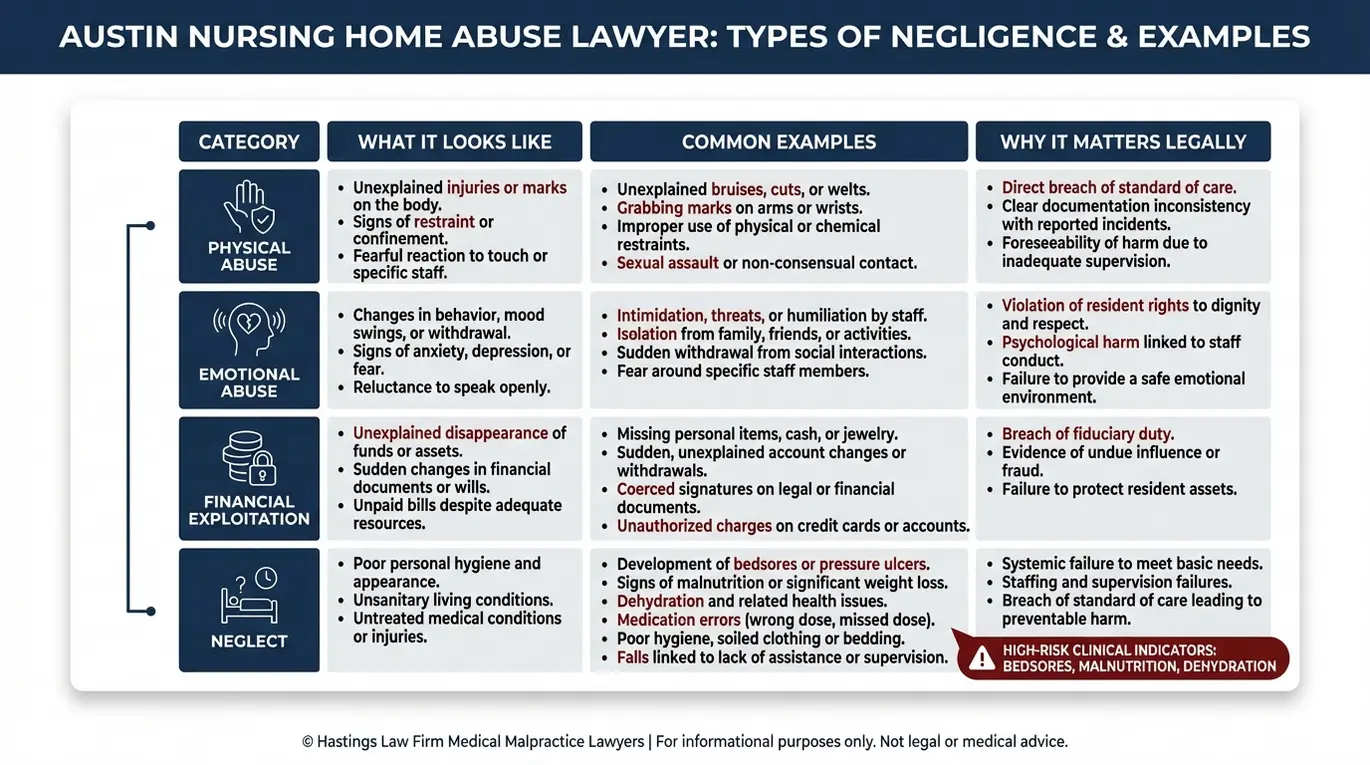
Nursing home negligence typically shows up as failures in basic care: untreated bedsores, medication errors, malnutrition, and falls caused by understaffing. Systemic problems occur when the facility’s overall management fails to maintain safety protocols. These are not isolated incidents. They often point to deeper, systemic problems within a facility.
Texas law draws a line between abuse and neglect, and both can give rise to legal claims. Abuse involves deliberate harmful conduct, whether physical, emotional, sexual, or financial. Neglect, on the other hand, is a failure to provide the level of care a resident needs, often because the facility lacks the staff, training, or oversight to do so safely.
Pressure ulcers, commonly called bedsores, are one of the most reliable indicators of neglect. These wounds develop when a resident is left in the same position for extended periods without being repositioned. A Stage 3 pressure ulcer involves full-thickness skin loss, and a Stage 4 pressure ulcer can expose muscle or bone, leading to life-threatening infections. In most cases, bedsores are preventable with basic nursing care.
Malnutrition, a condition in which the body does not receive adequate nutrition to maintain health, and dehydration are also common red flags. When residents lose significant weight or show signs of chronic dehydration, it often signals that staff members are not monitoring food and fluid intake closely enough. This is frequently tied to understaffing.
Physical abuse and sexual assault by staff members or other residents represent some of the most alarming failures a facility can allow. The same is true for the improper use of physical restraints, which can cause injury and psychological harm when used as a convenience rather than a clinical necessity. Our nursing home abuse attorneys in Austin investigate these patterns carefully, and an elder abuse lawyer can pursue accountability against those responsible.
| Category | What It Involves | Common Examples |
|---|---|---|
| Physical Abuse | Intentional use of force causing injury or pain | Hitting, pushing, improper use of physical restraints |
| Emotional Abuse | Verbal or psychological conduct causing distress | Yelling, threatening, isolating a resident from family |
| Sexual Abuse | Non-consensual sexual contact of any kind | Unwanted touching, assault by staff or other residents |
| Financial Exploitation | Unauthorized use of a resident’s funds or property | Stealing personal items, forging signatures, manipulating finances |
| Neglect | Failure to provide necessary care and supervision | Untreated bedsores, malnutrition, dehydration, medication errors |
Identifying the Warning Signs of Abuse and Neglect
Common signs of abuse include unexplained bruising, sudden weight loss, and poor hygiene. Warning signs are physical or behavioral indicators that a resident may be suffering from substandard care. You might also notice behavioral changes like withdrawal or fear. Some patients develop Sepsis and serious infections, a dangerous and potentially fatal condition triggered when the body’s response to an existing infection begins damaging its own tissues.
Not every bruise or decline in health means abuse is occurring. Aging naturally brings changes in skin integrity, mobility, and cognitive function. The difference lies in pattern and context. A single bruise on a forearm may not raise concern, but repeated unexplained injuries, infections that go untreated, or a resident who suddenly becomes fearful of certain staff members all point to something that deserves investigation.
Falls and fractures are a significant area of concern. While elderly residents are more prone to falls, a facility has a duty to assess each resident’s fall risk and implement appropriate safeguards, such as bed rails, assistive devices, and adequate supervision. When falls happen repeatedly or result in serious injuries like a traumatic brain injury, the facility’s care protocols need to be examined.
Elopement, which refers to a cognitively impaired resident wandering away from the facility unsupervised, is another serious failure. Facilities caring for residents with dementia are required to maintain secured environments and monitor at-risk individuals. A resident found wandering outside the facility often reflects a breakdown in supervision and safety planning.
Sepsis and serious infections can develop when wounds go untreated, catheters are not properly maintained, or basic hygiene standards are ignored. These conditions escalate quickly in elderly patients and can be fatal or lead to wrongful death. Families can research a facility’s safety track record through the Five Star Quality Rating System maintained by CMS, which includes inspection results and staffing data.
If your loved one is showing any of these signs, an Austin nursing home neglect lawyer or nursing home injury attorney can help you determine whether what you’re observing warrants a legal claim.
Red Flag Checklist for Family Members:
- Unexplained bruises, cuts, or fractures, especially in various stages of healing
- Sudden or unexplained weight loss
- Poor hygiene, soiled clothing, or unchanged bedding
- Worsening or new bedsores
- Signs of dehydration (dry mouth, cracked lips, sunken eyes)
- Behavioral changes: increased anxiety, withdrawal, flinching, or reluctance to speak openly
- Unsanitary living conditions or strong odors in the facility
- Resistance or deflection from staff when you ask questions about care
- Missing personal belongings or unexplained financial transactions
Distinguishing Abuse from Dementia Symptoms
Investigating suspected abuse becomes more challenging when a resident has dementia or other forms of cognitive decline. Cognitive decline can make it difficult for residents to communicate their needs or report harm. Residents with dementia may not be able to describe what happened to them, and some behavioral changes, such as agitation or confusion, can overlap with symptoms of the disease itself.
This is exactly why these cases require a medical and legal team working together. Our in-house medical staff can review clinical records and care plans to identify inconsistencies between documented care and a resident’s actual condition. When a resident with dementia develops injuries that don’t align with their care plan or medical history, that gap often points to a breach in the standard of care or instance of medical malpractice. The question isn’t just what happened; it’s whether the facility met its obligation to protect a vulnerable person who could not protect themselves.
The Hastings Law Firm Difference
Results matter, but what truly sets us apart is how we achieve them. Every verdict, every settlement, and every Austin courtroom victory comes from one guiding promise: To treat each client’s fight for justice as if it were our own.
This balance of skill, experience, and empathy reflects our core philosophy that justice should not only compensate the injured, but also make health care safer nationwide.

Liability in Texas and Who Can Be Sued
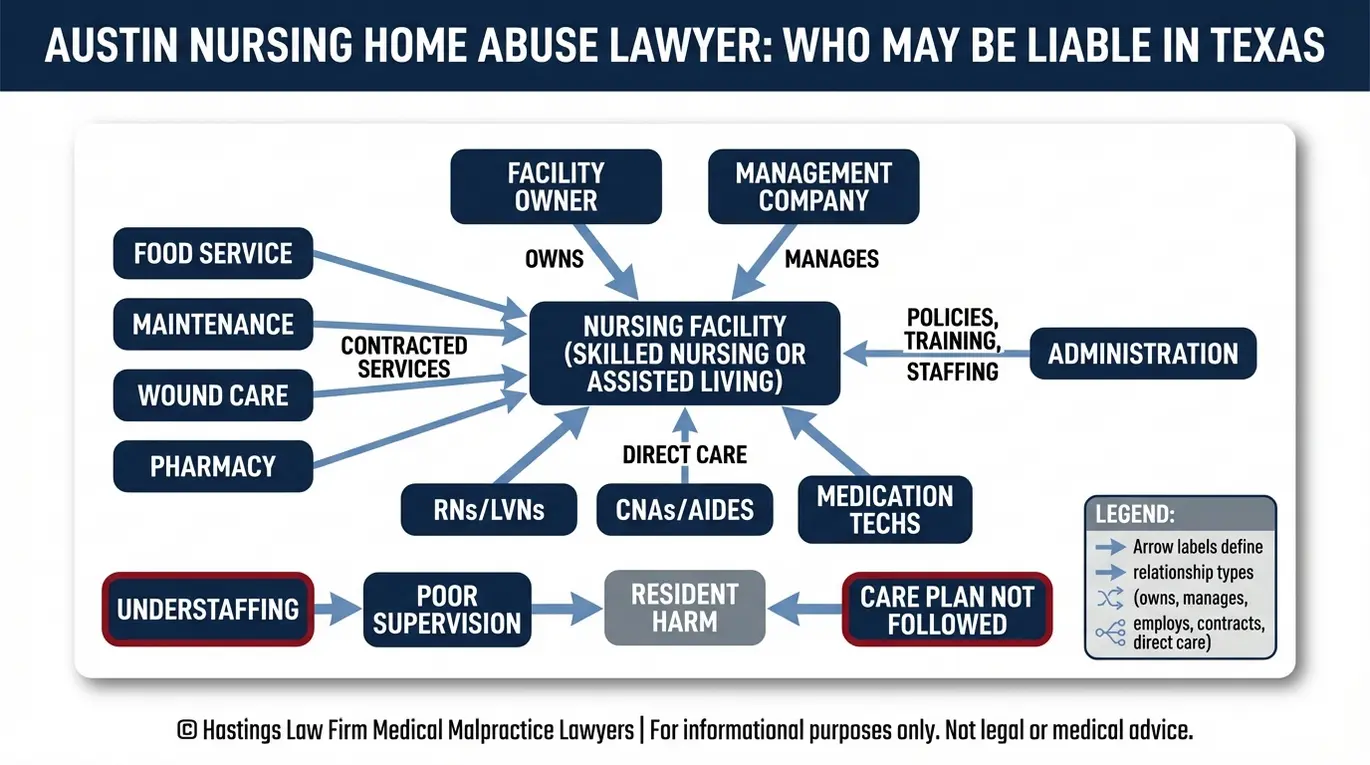
Liability often extends beyond the individual nurse or aide who caused the harm to the facility owners, management companies, and third-party contractors who failed to uphold the required standard of care. Liability is the legal responsibility a facility has for injuries caused by its failure to follow regulations. Because our team includes former defense attorneys who previously represented healthcare facilities, we understand how the other side builds its case and can prepare accordingly.
Facility-level negligence is one of the most common sources of liability in nursing homes and assisted living facilities. Many nursing home failures trace back to systemic problems like understaffing, which occurs when a facility does not employ enough qualified personnel to safely care for its resident population. Inadequate staffing can affect everything from medication administration to fall prevention to basic hygiene. A skilled nursing facility, or SNF, is a licensed facility that provides 24-hour nursing care and rehabilitation services for residents with serious medical needs; these facilities are held to strict regulatory standards.
Individual staff members, including nurses and aides, can also be held liable when their actions or omissions directly cause harm. This might involve failing to reposition a bedridden resident, ignoring signs of infection, or administering the wrong medication.
Third-party contractors are another layer of potential liability. Many facilities outsource services like food preparation, physical therapy, maintenance, or even medical staffing to outside companies. When a contractor’s failure contributes to a resident’s injury, that contractor, and sometimes the facility that hired them, may be held accountable.
As an Austin nursing home abuse attorney, our role is to trace the full chain of responsibility so that every party who contributed to the harm is identified. Families seeking legal representation for elder abuse deserve a complete picture of who failed their loved one, not just the most visible person in the room.
Protecting Resident Rights Under Federal OBRA and Texas Law
Residents of nursing homes are protected by the Omnibus Budget Reconciliation Act (OBRA), and both nursing home and assisted living residents are protected by Texas state law, which guarantee the right to dignity, privacy, freedom from abuse, and proper medical care. The Omnibus Budget Reconciliation Act (OBRA) set federal standards to ensure that residents receive high-quality care regardless of which facility they choose.
OBRA established a federal baseline of care standards that every Medicare- and Medicaid-certified facility must meet. These protections cover a wide range of resident rights, including:
- The right to be free from physical, verbal, sexual, and mental abuse
- The right to be free from unnecessary physical restraints, which are devices or manual holds used to restrict a resident’s movement, allowed only when clinically justified and ordered by a physician
- The right to privacy in medical treatment and personal affairs
- The right to participate in decisions about care and treatment
- The right to an individualized care plan, a person-centered care plan developed by the facility’s interdisciplinary team that outlines the specific medical, nutritional, and personal needs of the resident, as required under 42 CFR § 483.21
- The right to voice grievances without retaliation
Texas law provides additional protections. Facilities operating in the state must comply with regulations enforced by the Texas Health and Human Services Commission (and formerly the Texas Department of Aging and Disability Services). This agency oversees inspections, complaint investigations, and licensing for skilled nursing facilities and assisted living communities. Nursing home lawyers in Austin Texas can help families understand how both federal and state protections apply to their loved one’s situation. An elder care rights attorney can also identify whether regulatory violations support a civil claim for damages due to a breach of the standard of care.
Immediate Steps to Take if You Suspect Abuse in Austin
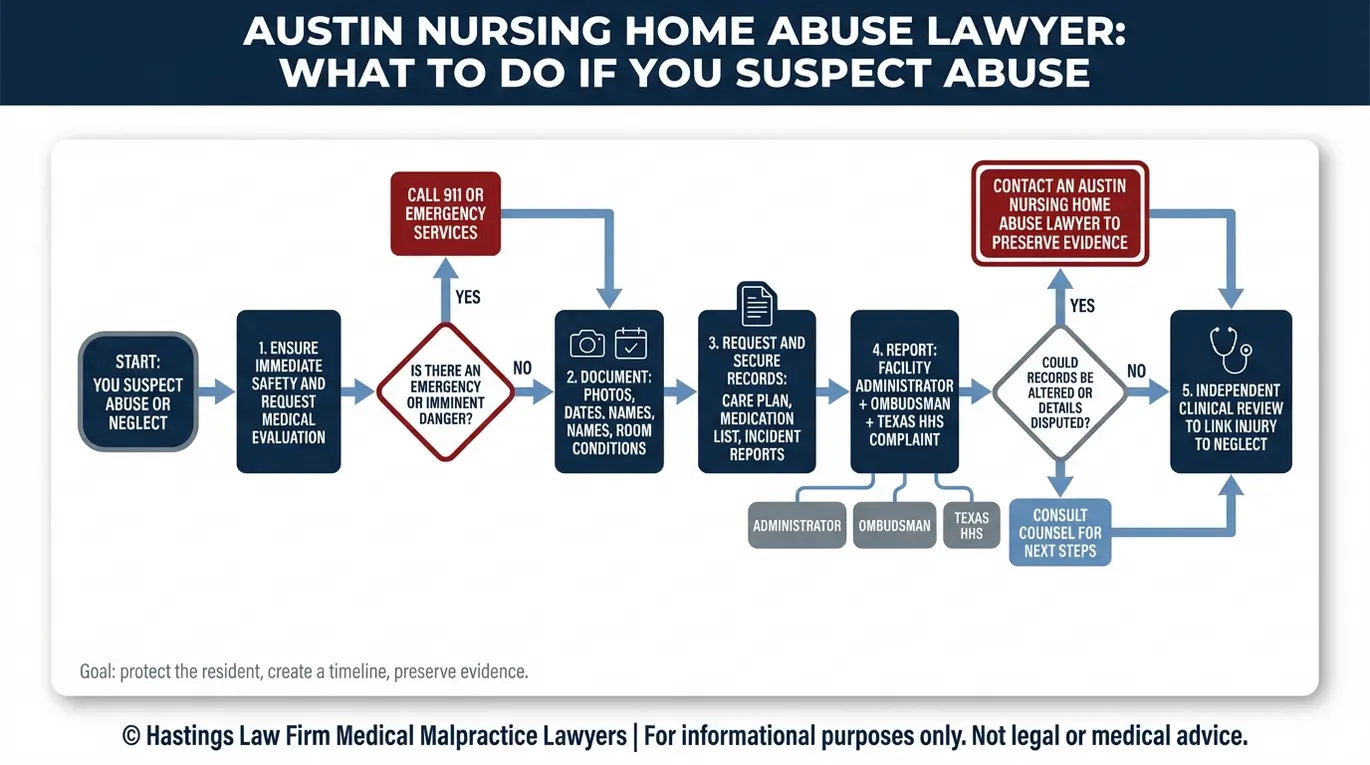
If you suspect abuse, immediately document the injuries, report the incident to the facility administrator, contact the Texas Health and Human Services Commission, and consult a lawyer to preserve evidence before it can be altered or destroyed. Preserving evidence involves securing documents and photos that prove the condition of the resident and the facility.
Here are the steps to follow:
- Document everything you can see. Take clear, dated photographs of any injuries, including bedsores, bruises, or signs of poor hygiene. Photograph the resident’s living space if conditions appear unsanitary. Write down what the resident tells you, using their exact words when possible.
- Report the concern to the facility. Notify the facility administrator or director of nursing in writing. Keep a copy of your communication. Ask for a written response and a copy of the relevant care plan.
- File a complaint with the appropriate agencies. Contact the Long-Term Care Ombudsman, an independent advocate who investigates complaints and works to resolve problems on behalf of nursing home residents. You can locate your local representative through the Texas State Long-Term Care Ombudsman Program. You should also file a complaint with the Texas Health and Human Services Commission (formerly the Texas Department of Aging and Disability Services), which handles regulatory oversight.
- Request an independent medical evaluation. An outside physician’s assessment can help distinguish medical malpractice from ordinary negligence and establish the severity of harm. This step is especially important for conditions like advanced pressure ulcers or unexplained fractures.
- Consult a nursing home negligence attorney Austin families trust. An attorney experienced in elder abuse cases can take immediate steps to preserve evidence, such as medical records, staffing logs, and surveillance footage. Under the Texas Civil Practice and Remedies Code, Chapter 71, families may also have wrongful death and survival claims if neglect contributed to a loved one’s death. Early legal involvement helps ensure that critical evidence is not lost or altered.
If you need to report nursing home abuse, time matters. Records can be changed, footage can be overwritten, and staff can be reassigned. Acting quickly protects both your loved one and the strength of any future claim.
Recovering Damages and Compensation for Abuse Victims
Families and residents may recover compensation for medical bills, pain and suffering, physical impairment, and in cases of gross negligence, punitive damages designed to punish especially reckless conduct. Legal damages are the financial awards a court may order to compensate for losses or injuries.
Economic damages cover the measurable financial losses tied to the abuse or neglect. These can include the cost of medical treatment needed to address injuries such as bedsores requiring surgical intervention, hospitalization for infections, emergency care after falls, and the expense of relocating the resident to a safer facility. If financial exploitation occurred, the stolen or misused funds can also be recovered.
Non-economic damages address the harm that doesn’t come with a receipt. This includes physical pain, mental anguish, loss of dignity, and the emotional toll on both the resident and their family members. These damages recognize that the injury goes beyond the body.
Wrongful death claims arise when neglect or abuse directly contributes to a resident’s death. Under Texas law, surviving family members may seek compensation for loss of companionship, mental anguish, funeral and burial expenses, and the financial support the deceased would have provided.
Punitive damages may be available when the evidence shows that the facility’s conduct was willful, malicious, or grossly negligent. These damages are not about compensating the family; they are meant to deter the same behavior in the future.
As an Austin nursing home abuse law firm, we work to identify every category of harm so that families seeking compensation for elder neglect receive a full settlement or verdict for what was lost and what is owed.
How Our Austin Attorneys Investigate Nursing Home Claims
We conduct a thorough investigation involving record retrieval, expert review, and staff depositions to determine whether the facility breached the standard of care owed to your loved one. A legal investigation is the process of gathering facts to build a case against a negligent facility. Founded by Tommy Hastings, a board-certified trial lawyer, our firm is built on a specialized collaboration between legal and medical professionals.
The process starts with a free case evaluation. When you contact our firm, a Board Certified Patient Advocate reviews the details of your situation. This initial screening helps us determine whether the facts suggest a viable claim and whether immediate steps are needed to preserve evidence.
Once we accept a case, our medical-legal team goes to work. Our in-house nursing staff reviews medical records, care plans, medication logs, and staffing schedules to identify gaps in care. We look for patterns, such as recurring infections, missed repositioning protocols, or documentation inconsistencies that can indicate systemic failures or medical malpractice. Research published in PubMed Central on hospital-acquired pressure ulcers underscores how facility-level practices directly affect patient safety outcomes, and we apply this same analytical framework to nursing home cases.
We also draw on our national expert network to bring in qualified medical professionals who can provide objective opinions on whether the standard of care was met. Because our team includes former defense attorneys who previously represented healthcare facilities, we understand how the other side builds its case and can prepare accordingly.
Our nursing home abuse lawyer Austin team handles every stage of the process, from investigation through litigation, so that families can focus on their loved one’s well-being. As an elder abuse law firm, we operate on a contingency fee basis, which means you pay no attorney fees or costs unless we secure a recovery on your behalf.
Contact the Austin Nursing Home Attorneys at Hastings Law Firm Today for Help
Texas imposes a statute of limitations on nursing home abuse and negligence claims, which means there is a limited window of time to take legal action. A statute of limitations is a legal deadline that limits how long you have to file a lawsuit. Waiting too long can mean losing the right to pursue a claim entirely, regardless of how strong the evidence may be. Knowing the statute of limitations is important for protecting your family’s rights in Austin.
If you believe your loved one has been harmed by the care they received in a nursing home or assisted living facility, we want to hear from you. Our team of attorneys, nurses, and patient advocates is here to review what happened, explain your legal options, and help you take the next step toward accountability.
Every case we take is driven by two goals: securing fair compensation for the family and helping prevent the same failures from affecting someone else.
Contact Hastings Law Firm for a free, confidential case evaluation. There is no fee unless we recover compensation for you and your family.
Frequently Asked Questions About Nursing Home Abuse in Austin


This content was researched and written by the Hastings Law Firm editorial team, which includes attorneys, medical professionals, and experienced researchers. Our writing is informed by internal knowledge and practical experience, and we cross-check critical details against authoritative sources cited throughout. Every piece undergoes human-led fact-checking and legal review. Because legal and medical information can change, if you spot an error, please contact us. Learn more about our content standards and review process on our editorial policy page.

Gabe Sassin has focused exclusively on medical malpractice law since 2007. After spending more than a decade as a malpractice defense attorney, he knows exactly how the other side works. He has seen firsthand how healthcare providers, insurers, corporate defendants, and their legal teams think, prepare, and build their defense against claims. That knowledge works for the people who need it most today, injured patients and their families. His unique experience shapes everything he writes, giving readers a look at how these cases actually work from someone who has handled them from both sides.
