


Texas Neonatologist Malpractice Lawyer
Neonatologists oversee critical decisions in the NICU, where small mistakes can cause lasting harm to a newborn and create overwhelming emotional and financial strain for a family. The role involves coordinating intensive monitoring, interpreting test results, and directing a care team under a high standard of neonatal practice. When care falls below accepted standards, the consequences can include permanent injury or worse and long term medical needs. If you or a loved one were harmed or worse due to neonatologist malpractice in Texas, contact Hastings Law Firm for a free, confidential case review.

Last Updated: July 27, 2026
Trusted Legal Representation for Medical Specialist Negligence in Texas
When a newborn requires care in the NICU, parents place extraordinary trust in the specialists responsible for their child’s survival. If that trust is broken by a preventable medical error, the emotional and financial consequences can reshape your family’s entire future. A micro-preemie, a baby born extremely early and often weighing just over a pound, may depend on dozens of precise medical decisions each day. These range from intravenous (IV) line placement, where medication is delivered directly into the bloodstream through a thin catheter, to ventilator settings and infection monitoring.
Understanding whether your child’s injury resulted from negligence requires a legal team with deep knowledge of neonatal medicine. If you or a loved one are facing this situation, we welcome the opportunity to review the details. Founded by Tommy Hastings, a board-certified trial lawyer with over 20 years of experience, our firm focuses exclusively on medical malpractice. We have the medical and legal resources to evaluate what happened in your child’s care and explain your options in a free, confidential consultation.

Understanding the Role of a Neonatologist in NICU Patient Care
A neonatologist is a physician specializing in the care of newborns, particularly those who are premature, critically ill, or suffering from conditions that require intensive monitoring and intervention. These doctors work within the neonatal intensive care unit (NICU), a hospital ward equipped to provide around-the-clock life support and treatment for the most fragile patients.
Becoming a neonatologist requires years of training beyond medical school. After completing a pediatric residency, a physician must finish an additional fellowship in neonatal-perinatal medicine, the subspecialty focused on managing high-risk newborns. The Neonatal Perinatal Medicine Fellowship at Baylor College of Medicine outlines the rigorous clinical and research training these specialists undergo before they are qualified to manage a NICU patient independently.
The 28-day neonatal care window represents a critical period of vulnerability. During this period, premature infants face threats ranging from underdeveloped lungs to life-threatening infections. A neonatologist is responsible for coordinating every aspect of that care, adjusting ventilator settings, ordering labs, interpreting blood gases, and making split-second decisions about interventions like therapeutic hypothermia.
Under this level of responsibility, neonatologists often function under what is sometimes called the “Captain of the Ship” concept. This means the attending neonatologist holds oversight authority over residents, nurse practitioners, and other staff involved in the infant’s care. When a Texas Neonatologist Malpractice Lawyer evaluates a case, this supervisory role is a central factor. Failure by team members may trace back to the neonatologist’s direction, violating the accepted standard of care.
Common Medical Errors Committed by Neonatologists in Texas NICUs
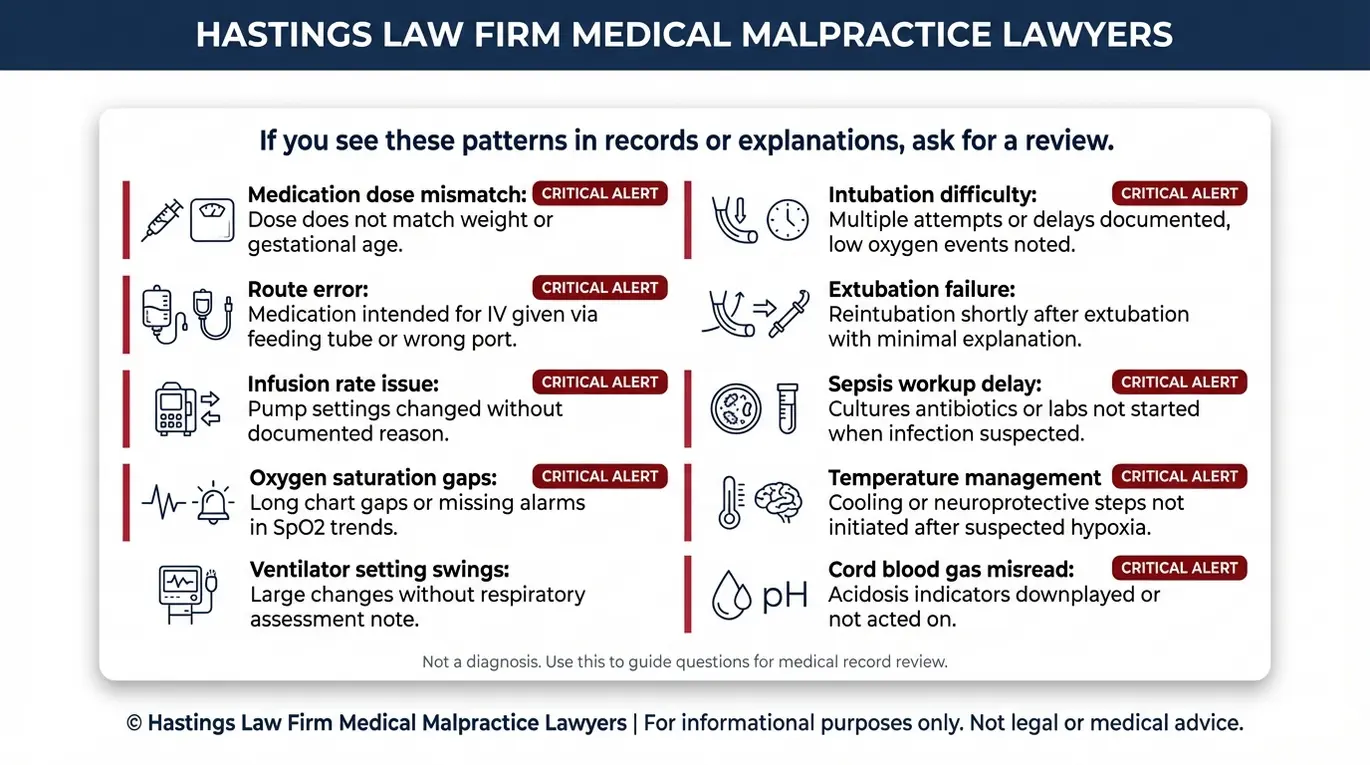
Common errors in the NICU include medication dosing mistakes, failure to diagnose sepsis or respiratory distress syndrome (RDS), improper intubation, and failure to monitor oxygen saturation levels, any of which can lead to permanent brain injury or death. Because neonatal patients cannot communicate symptoms and their physiology changes rapidly, the margin for error is extremely small.
A retrospective study published in PubMed on diagnostic errors in the NICU found that diagnostic failures occur with concerning frequency in neonatal intensive care settings. These errors take many forms, but certain categories appear repeatedly in malpractice claims:
- Medication dosing errors: Premature infants metabolize drugs differently than full-term babies. A dose appropriate for a five-pound newborn can be dangerously high for a two-pound preemie. Research reviewed by PubMed on medication errors in neonatal intensive care highlights that dosing miscalculations remain one of the most frequent and preventable sources of harm in the NICU. “Look-alike” errors also occur when medications intended for a feeding tube are mistakenly administered through an IV line, or vice versa, with potentially fatal results.
- Airway management failures: Intubation, the process of inserting a breathing tube into the airway, is one of the most technically demanding procedures performed on a newborn. Errors during intubation or extubation (removing the tube) can deprive the brain of oxygen in minutes. Improper ventilator settings can cause similar harm if oxygen levels are not continuously monitored and adjusted.
- Delayed diagnosis of sepsis or infection: Sepsis, a life-threatening response to infection that can cause organ failure, progresses rapidly in newborns. When a neonatologist fails to recognize early warning signs of sepsis or meningitis or delays ordering blood cultures and antibiotics, the window for effective treatment can close quickly.
- Cord blood gas interpretation failures: Immediately after birth, umbilical cord blood gas values help determine whether an infant suffered oxygen deprivation during delivery. Misreading these results can lead to a critical delay in initiating treatment for hypoxic-ischemic encephalopathy (HIE), a type of brain damage caused by oxygen deprivation. The standard of care may require therapeutic hypothermia, or cooling therapy, to be started within six hours. A misinterpreted blood gas can mean the difference between timely treatment and permanent injury.
If your child suffered harm in the NICU, a Texas Neonatologist Malpractice Lawyer can evaluate the medical records and determine whether these types of failures occurred.
The Hastings Law Firm Difference
Results matter, but what truly sets us apart is how we achieve them. Every verdict, every settlement, and every Texas courtroom victory comes from one guiding promise: To treat each client’s fight for justice as if it were our own.
This balance of skill, experience, and empathy reflects our core philosophy that justice should not only compensate the injured, but also make health care safer nationwide.

Proving Negligence Against a NICU Specialist
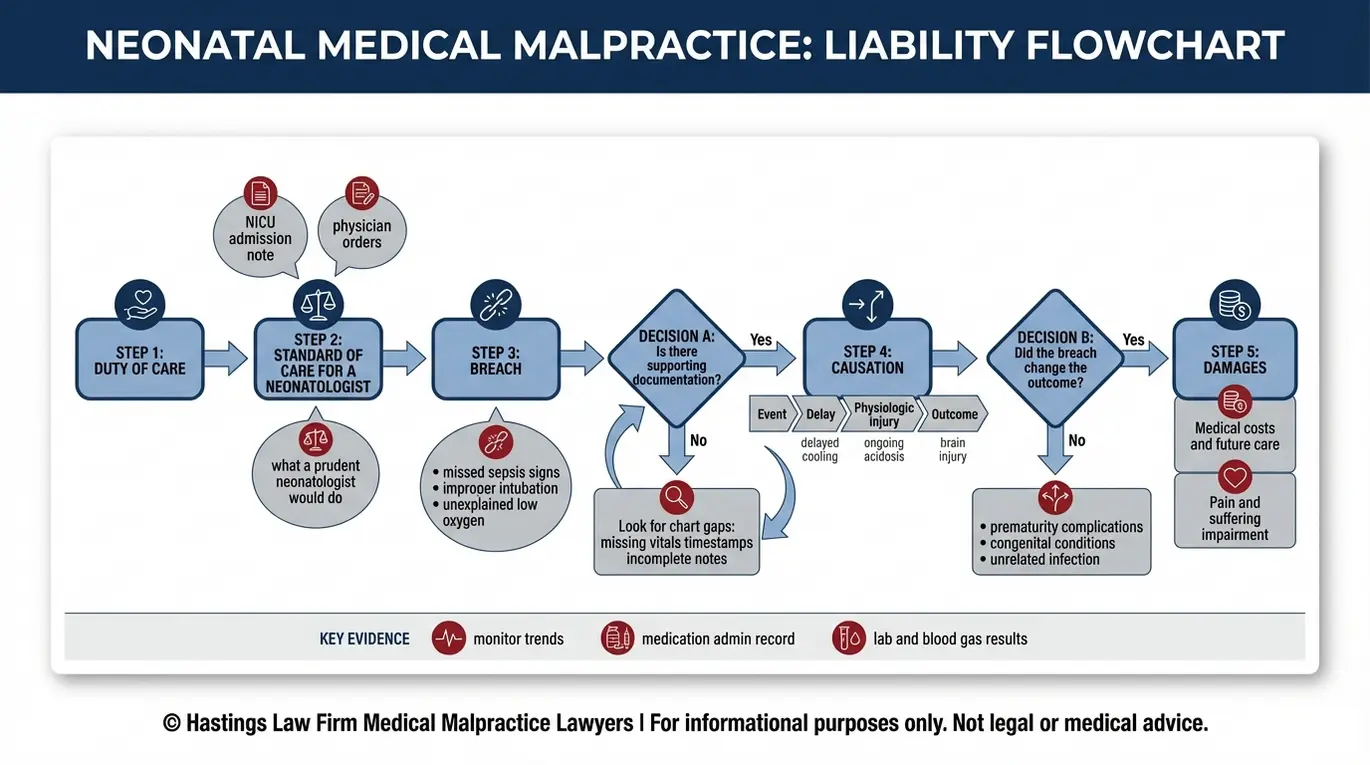
To prove negligence, a plaintiff must demonstrate that the neonatologist owed a duty of care, breached the accepted medical standard for that subspecialty, and that this breach directly caused the infant’s specific injury. These elements are essential to any medical malpractice claim. Each requires careful documentation and expert analysis.
Standard of care refers to the specific level of care that a competent neonatologist must provide in a given situation. Duty of care is typically the most straightforward element. Once a neonatologist accepts responsibility for a patient in the NICU, a doctor-patient relationship exists, and a legal duty to provide competent care attaches.
Breach of the standard of care requires a more detailed analysis. The question is not whether the neonatologist made a decision that turned out poorly. It is whether that decision fell below what a reasonably prudent neonatologist would have done under similar circumstances.
This is a subspecialty-specific standard. A general pediatrician’s approach is not the benchmark; the comparison must be to another board-certified neonatologist. Establishing this breach of the standard of care requires expert testimony. We work with qualified experts who review the medical records, nursing logs, and lab results to identify where the care deviated from accepted neonatal protocols.
Causation connects the specific error to the child’s outcome. We establish causation by reconstructing the clinical timeline. Our team uses umbilical cord blood gas values, which measure the infant’s oxygen status at birth, to identify the exact moment when the doctor should have acted.
As a Texas neonatologist malpractice lawyer, Hastings Law Firm builds each case by reconstructing this timeline from the earliest available records and identifying the precise point where the care fell short.
The Critical Role of Expert Testimony in Neonatology Cases
Texas law requires expert testimony from a physician with similar training and experience to the defendant to legally establish that the standard of care was violated. In neonatology medical negligence cases, this means the expert must typically be a board-certified neonatologist, not an obstetrician or general pediatrician.
Under Texas Civil Practice and Remedies Code Chapter 74, a family must serve a written expert report within 120 days of the defendant’s original answer. This report must identify the applicable standard of care, explain how the neonatologist breached it, and describe how that breach caused the injury. If this deadline is missed or the report is insufficient, the court can dismiss the case entirely.
Finding the right expert is essential to explain complex medical evidence. For example, they explain why oxygen saturation, which is the percentage of oxygen in the blood, dropped to dangerous levels. Our team also includes in-house nurse consultants who help us analyze medical records to identify where care fell short.
Experienced experts also know how to identify what is missing from the medical records. Gaps in charting, absent nursing notes, and unexplained time lapses can be just as telling as what is documented.
Recovering Damages for NICU Injuries and Long-Term Care
Families may recover economic damages for past and future medical bills and life care costs, as well as non-economic damages for pain, suffering, and physical impairment. Damages is the legal term for the financial compensation sought to cover the impact of the injury. When a NICU injury results in a permanent condition like cerebral palsy, the financial impact extends across the child’s entire lifetime. According to the Centers for Disease Control and Prevention’s data on cerebral palsy, the condition is among the most common motor disabilities in childhood.
| Economic Damages | Non-Economic Damages |
|---|---|
| Past and future medical expenses | Physical pain and suffering |
| Specialized therapies (PT, OT, speech) | Mental anguish |
| Adaptive equipment (wheelchairs, communication devices) | Physical impairment and disfigurement |
| 24/7 nursing or attendant care | Loss of enjoyment of life |
| Lost future earning capacity | Loss of companionship (wrongful death cases) |
Accurately projecting these costs requires a life care plan, a detailed analysis prepared by medical and financial professionals. This plan accounts for the child’s life expectancy, inflation, and evolving care needs over 50 or more years. A Texas neonatologist malpractice lawyer experienced in these cases will work with qualified life care planners to ensure the projected recovery reflects the true scope of your child’s future needs.
In wrongful death cases, surviving family members may also pursue damages for loss of companionship and mental anguish under Texas law.
Contact the Texas Doctor Malpractice Attorneys at Hastings Law Firm Today for Help
When a neonatologist’s negligence changes your child’s life, you need a legal team that understands both the medicine and the law. Founded by Tommy Hastings, a 2025 inductee into the American Board of Trial Advocates (ABOTA), our firm focuses exclusively on medical malpractice. Our team includes former hospital nurses and defense attorneys who understand how medical facilities defend these claims.
We operate on a contingency fee basis, which means you pay no attorney fees or costs unless we secure a recovery for your family. There is no financial risk in reaching out.
If you believe your child was harmed by negligent care in the NICU, we are ready to listen and investigate what happened. Contact us today to schedule a free, confidential consultation with our team. Let us help you find the answers you deserve.
Frequently Asked Questions About Neonatologist Malpractice in Texas


This content was researched and written by the Hastings Law Firm editorial team, which includes attorneys, medical professionals, and experienced researchers. Our writing is informed by internal knowledge and practical experience, and we cross-check critical details against authoritative sources cited throughout. Every piece undergoes human-led fact-checking and legal review. Because legal and medical information can change, if you spot an error, please contact us. Learn more about our content standards and review process on our editorial policy page.

Brady D. Williams is a nationally recognized medical malpractice attorney who has spent his career handling high-stakes litigation for injured patients and families across the country. Licensed in both Texas and California, Brady draws on experience from hundreds of resolved medical cases to break down complex legal and medical topics for the people who need that information most. His writing reflects the same attention to detail and commitment to clarity that he brings to every case he handles.
