


Texas Ophthalmologist Malpractice Lawyer
Ophthalmologist malpractice can leave patients facing permanent vision loss, serious eye injury, and lasting financial and personal disruption when preventable errors occur in surgery, diagnosis, referrals, or medication management. Standards of care differ by provider training, and proving negligence often depends on showing how care fell below what a competent specialist would have done. Medical records and documentation can also shape what can be proven about what happened and when. If you or a loved one were harmed or worse due to ophthalmologist malpractice in Texas, contact Hastings Law Firm for a free, confidential case review.
Last Updated: July 27, 2026
Trusted Legal Representation for Eye Doctor Negligence in Texas
If you or someone you love has suffered vision loss or a serious eye injury after treatment by an ophthalmologist, you may be dealing with more than just a bad outcome. You may be dealing with preventable medical negligence in cases involving surgical complications or medication errors like the improper prescribing of prednisolone acetate. This commonly used steroid eye drop can cause steroid-induced elevated intraocular pressure (IOP). This dangerous increase in eye pressure may lead to permanent damage if left unmonitored.
Understanding what went wrong requires both medical knowledge and legal experience. As a Texas ophthalmologist malpractice lawyer, Hastings Law Firm focuses exclusively on medical malpractice and has the clinical and legal resources to investigate these claims thoroughly.
If you believe your eye injury could have been prevented, we can review what happened and explain your options at no cost to you.

Defining Ophthalmologist Malpractice and Standards of Care
Ophthalmologist malpractice occurs when an eye care specialist deviates from the accepted medical standard of care, resulting in preventable injury or vision loss to the patient. To build a strong claim, ophthalmologist malpractice lawyers must demonstrate not only that an error occurred, but that it fell below the standard a competent specialist would have met. These rules serve as the benchmark for professional competence.
Defining the standard of care is the first step in identifying whether a doctor’s actions caused preventable harm.
Ophthalmologist vs. Optometrist
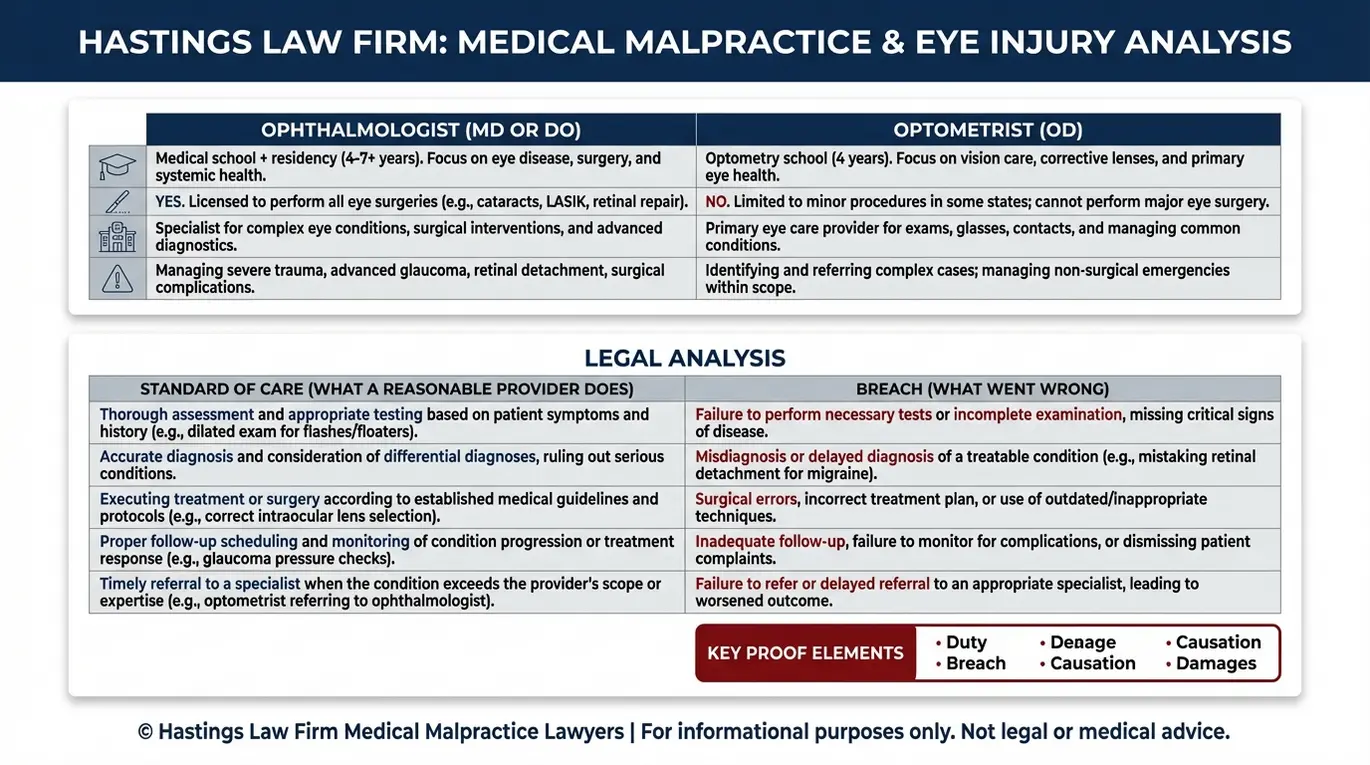
One of the first things we evaluate in any Texas eye doctor negligence case is who provided the care and what level of training they hold. According to the Massachusetts College of Pharmacy and Health Sciences, these are two distinct professionals:
- An ophthalmologist (MD or DO) is a medical doctor who has completed medical school, a residency, and often a fellowship in a surgical subspecialty. They perform eye surgeries, treat complex diseases, and manage conditions requiring advanced intervention.
- An optometrist (OD) is a doctor of optometry who provides primary eye care, including vision exams, corrective lens prescriptions, and diagnosis of common eye conditions. Optometrists do not typically perform surgery.
Because of these differences in training and scope, the standard of care, meaning the level of treatment a reasonably competent professional would provide under similar circumstances, is measured differently for each. Training levels dictate the specific legal expectations for each provider. A surgical specialist is held to a higher standard when performing a procedure like cataract removal than a primary care optometrist prescribing glasses.
Identifying the specific professional involved determines the clinical standards used to evaluate the care provided.
Proving Negligence
Under Texas Civil Practice and Remedies Code Chapter 74, a malpractice attorney for eye injuries must prove four legal elements: duty, breach, causation, and damages. These elements require showing that the doctor had a professional obligation and failed to meet it, directly resulting in measurable harm.
Each element must be supported by expert witness testimony, typically from another ophthalmologist who can explain how care should have been delivered and where it fell short. Each step is a legal requirement for holding a medical professional accountable under health care liability rules. Each legal element must be proven to hold a medical professional accountable for a patient’s injury.
Primary Care Failure to Refer
Not every case of medical negligence starts with the ophthalmologist. In some situations, a primary care doctor or optometrist may fail to recognize warning signs that require immediate specialist referral. A delayed diagnosis of a condition like retinal detachment, where the retina (the light-sensitive tissue lining the back of the eye) separates from its underlying support, can result in permanent blindness if not treated promptly. Early detection is the first line of defense against vision loss.
A dilated fundus examination, a procedure where the pupils are widened with drops so the doctor can examine the retina directly, is a standard diagnostic tool for detecting these conditions early. When a referring provider fails to order this exam or delays a referral, they may share liability for the resulting harm. This gatekeeper role is important for ensuring patients receive specialist care before an injury becomes irreversible. Timely referrals are a key part of preventing irreversible damage from eye conditions.
Common Types of Preventable Eye Injury Claims We Handle
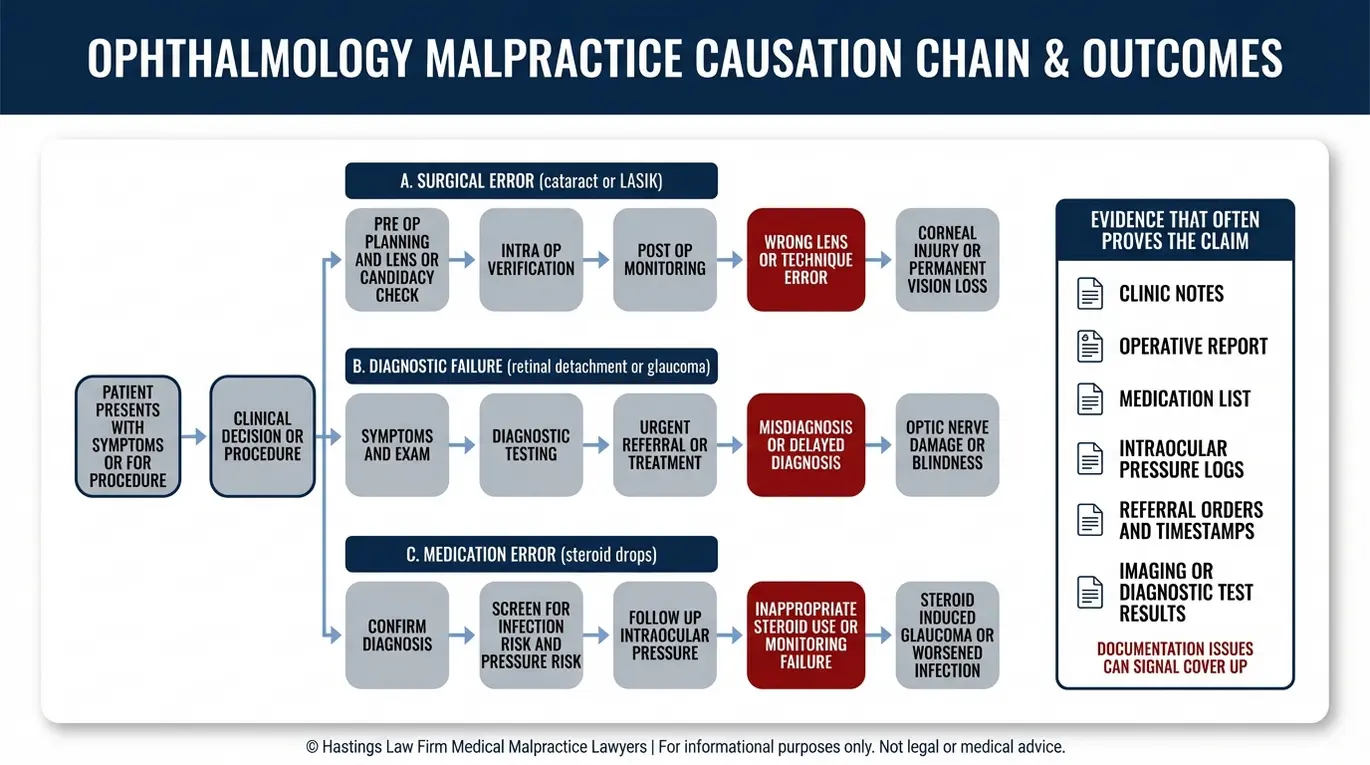
Common claims involve surgical errors during cataract or LASIK procedures, failure to diagnose conditions like glaucoma or retinal detachment, and medication errors involving steroid drops. Hastings Law Firm has the in-house medical staff, including former defense attorneys, and clinical knowledge to identify exactly where care went wrong. These examples represent common points where clinical failures occur in specialized eye care. Identifying the specific failure helps determine if a surgical complication was preventable or an inherent risk.
| Procedure or Condition | Specific Act of Negligence |
|---|---|
| Cataract surgery (phacoemulsification, a procedure that uses ultrasound to break up and remove a clouded lens) | Implanting the wrong power intraocular lens; causing capsular rupture through surgical error |
| LASIK surgery (laser-assisted in situ keratomileusis, a procedure that reshapes the cornea to correct vision) | Performing surgery on a patient who was not an appropriate candidate; overcorrection or undercorrection due to improper calibration |
| Retinal detachment | Failure to diagnose acute symptoms (sudden floaters, flashes, or visual field loss) leading to delayed surgical repair |
| Glaucoma | Failure to monitor intraocular pressure over time, resulting in irreversible optic nerve damage |
| Diabetic retinopathy / Macular degeneration | Missed or delayed diagnosis during routine exams, allowing progressive and preventable vision loss |
| Steroid eye drop management | Prescribing prednisolone acetate without monitoring for steroid-induced glaucoma or using steroids that can worsen an undiagnosed infection |
The FDA prescribing label for PRED MILD (prednisolone acetate) specifically warns that prolonged use of steroid eye drops can elevate intraocular pressure and that the medication is contraindicated in certain active infections. When a prescribing doctor ignores these warnings, the consequences for the patient can be severe.
Documentation and Record Integrity
In many of the cases we investigate, documentation tells its own story. Gaps in the medical record, inconsistent entries, or notes that appear to have been altered after the fact can all be relevant evidence. We work with forensic record analysts to identify charting irregularities that may indicate an effort to conceal what actually happened. Accurate charting of the medical record is a fundamental requirement for patient safety and legal clarity.
Accurate records provide a timeline of care and help reveal any deviations from medical protocols.
The Financial Impact of Permanent Vision Loss
When suing an eye doctor for negligence that causes permanent blindness or significant vision loss, the financial consequences extend far beyond initial medical bills. Patients may require lifelong adaptive care, assistive technology, vocational retraining, and ongoing medical treatment. The Texas Department of Insurance recognizes that certain injuries, including total blindness, can qualify for lifetime income benefits, underscoring just how seriously Texas law treats the long-term impact of these injuries. We assess how permanent blindness changes your ability to live independently when building your claim.
Calculating long-term costs ensures that any recovery covers future needs and loss of independence.
The Hastings Law Firm Difference
Results matter, but what truly sets us apart is how we achieve them. Every verdict, every settlement, and every Texas courtroom victory comes from one guiding promise: To treat each client’s fight for justice as if it were our own.
This balance of skill, experience, and empathy reflects our core philosophy that justice should not only compensate the injured, but also make health care safer nationwide.

Calculating Damages for Blindness and Permanent Vision Loss
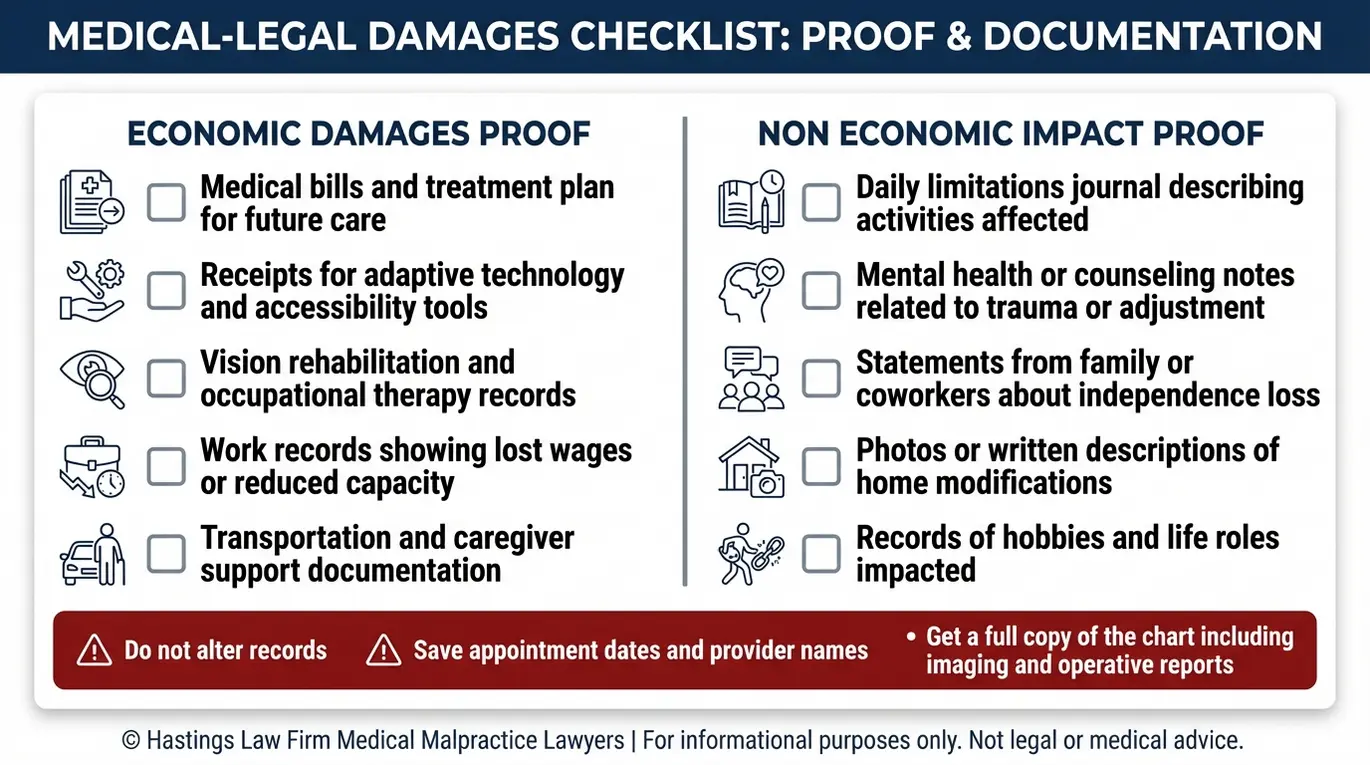
Victims of eye malpractice may recover economic damages for medical costs and lost wages, as well as non-economic damages for the profound loss of enjoyment of life associated with blindness. Economic damages cover the measurable financial impact: future surgeries, rehabilitation, adaptive equipment, and lost earning capacity. Texas law requires specific evidence to prove the full extent of financial harm.
For someone diagnosed with legal blindness, a condition where central visual acuity is 20/200 or worse even with correction, these costs can extend across a lifetime. Perimetry, a visual field test that maps the extent of peripheral and central vision loss, is one tool our medical team reviews to document the severity of injury. Non-economic damages address the personal toll, including loss of independence, emotional distress, and the inability to engage in daily activities.
As a medical malpractice lawyer experienced in high-value vision loss cases, we understand that presenting this evidence persuasively requires both clinical precision and courtroom skill. Founded by board-certified trial attorney Tommy Hastings, our firm understands the level of preparation needed for every case involving eye injury compensation. Our track record of multi-million-dollar recoveries reflects our commitment to thorough case building. Financial recovery depends on providing evidence of both tangible expenses and personal loss.
Contact the Texas Doctor Malpractice Attorneys at Hastings Law Firm Today for Help
If you or a loved one has suffered vision loss or a serious eye injury because of professional negligence, you may have legal options worth exploring. Texas law imposes strict deadlines on medical malpractice claims, so the sooner you reach out, the more effectively we can preserve critical evidence and protect your rights. Timely action is necessary to comply with legal filing requirements.
Hastings Law Firm handles these cases on a contingency fee basis, meaning you pay no attorney fees or costs unless we recover compensation for you. Our team of attorneys, nurse consultants, and medical experts is ready to review your records, identify what went wrong, and explain what a claim could look like in your situation. Our team reviews medical records and consults with experts to determine if your case meets the requirements for a claim.
As a Texas ophthalmologist malpractice lawyer with a singular focus on medical negligence, we are here to help you find answers and take the next step with confidence. Contact us today for a free, confidential case evaluation.
Frequently Asked Questions About Ophthalmologist Malpractice in Texas


This content was researched and written by the Hastings Law Firm editorial team, which includes attorneys, medical professionals, and experienced researchers. Our writing is informed by internal knowledge and practical experience, and we cross-check critical details against authoritative sources cited throughout. Every piece undergoes human-led fact-checking and legal review. Because legal and medical information can change, if you spot an error, please contact us. Learn more about our content standards and review process on our editorial policy page.

Brady D. Williams is a nationally recognized medical malpractice attorney who has spent his career handling high-stakes litigation for injured patients and families across the country. Licensed in both Texas and California, Brady draws on experience from hundreds of resolved medical cases to break down complex legal and medical topics for the people who need that information most. His writing reflects the same attention to detail and commitment to clarity that he brings to every case he handles.
