


Texas Oncologist Malpractice Lawyer
Oncologist negligence can change a cancer patient’s path through delayed diagnosis, improper treatment, or missed complications, and the harm can be physical, emotional, and financial. Cancer care is complex and outcomes can be uncertain, so the key issue is whether a preventable error occurred when the standard of care was not met. Breakdowns in coordination among specialists, missed testing, and misread results can lead to more aggressive treatment and reduced options. If you or a loved one were harmed or worse due to oncologist malpractice in Texas, contact Hastings Law Firm for a free, confidential case review.
Last Updated: July 27, 2026
Trusted Legal Representation for Oncological Negligence in Texas
When a cancer doctor’s error changes the course of your treatment, your health, or the life of someone you love, the weight of that experience can feel impossible to carry alone. You may be dealing with a worsened prognosis, unnecessary treatments, or the loss of precious time that early detection should have provided. These situations raise serious legal questions, and you deserve clear answers from someone who understands both the medicine and the law.
As a Texas Oncologist Malpractice Lawyer, Hastings Law Firm focuses exclusively on medical malpractice. Founded by Tommy Hastings in 2005, our firm dedicated its entire practice to helping patients injured by healthcare errors. Our team of attorneys, in-house nurses, and medical experts can review what happened, examine the records, and explain your legal options. Contact us for a free, confidential case evaluation.

Defining Medical Negligence by an Oncologist in Texas
Oncologist negligence occurs when a cancer specialist deviates from the accepted standard of care, resulting in a delayed diagnosis, improper treatment, or failure to manage complications that harms the patient. Not every bad outcome in cancer care is malpractice. Cancer is an unpredictable disease, and even excellent treatment sometimes fails. The legal question for a Texas Oncologist Malpractice Lawyer is whether the physician committed cancer doctor negligence, which is a preventable error that a competent specialist in the same position would not have made.
Under Texas law, the standard of care is the level of treatment a reasonably prudent oncologist would provide under similar circumstances. This standard is defined by Civil Practice and Remedies Code Chapter 74, which governs medical liability claims in Texas. Proving a breach of that standard requires testimony from a qualified expert witness, typically another oncologist who can explain what should have happened and why the deviation caused harm.
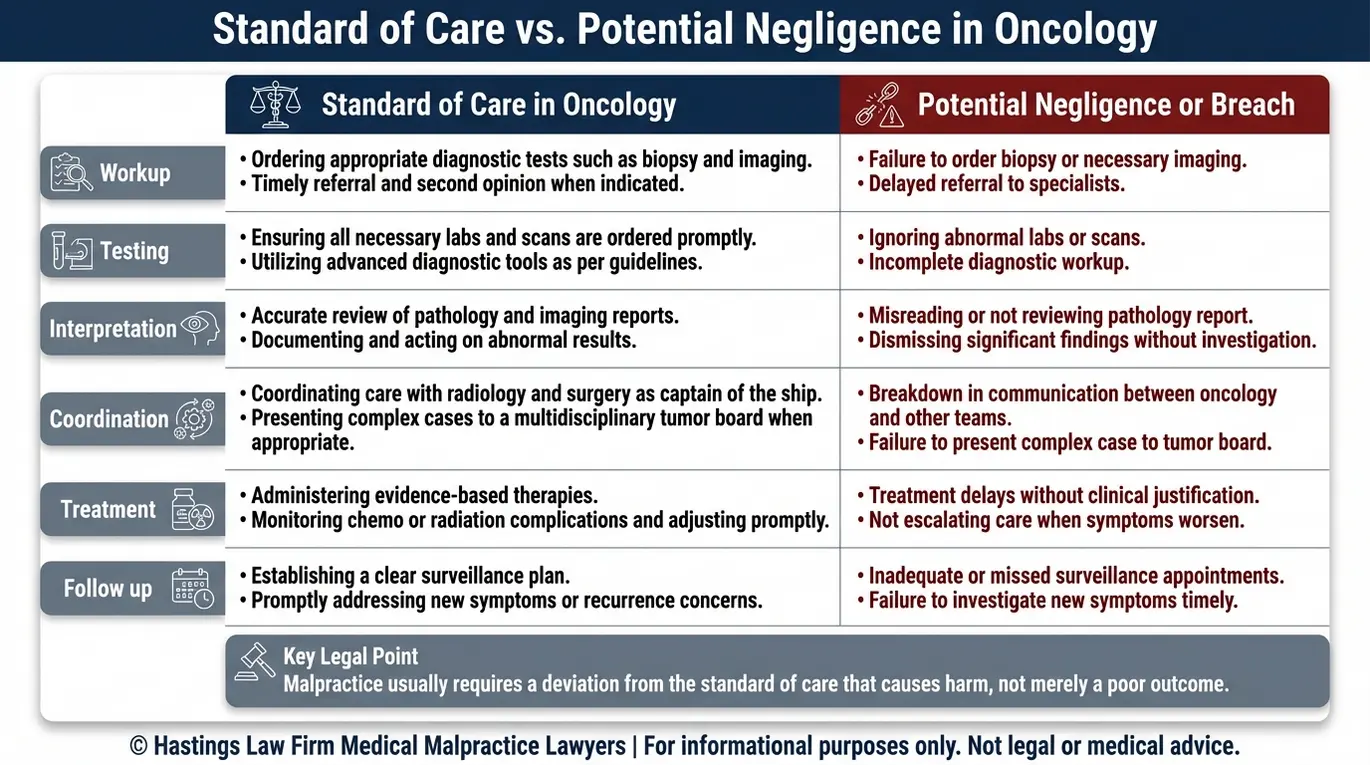
An oncologist often functions as the central coordinator of a patient’s cancer treatment, working alongside surgeons, radiologists, and pathologists. When that coordination breaks down, errors can cascade. Common standard of care violations in oncology include:
- Failing to order appropriate diagnostic tests based on symptoms or risk factors
- Misreading or ignoring abnormal lab results or imaging findings
- Prescribing a treatment plan inconsistent with the patient’s cancer staging, which is the TNM classification system used to describe how far a cancer has spread
- Delaying referral to a surgeon or radiation oncologist when time-sensitive intervention is needed
- Failing to monitor a patient’s response to chemotherapy or radiation and adjust treatment accordingly
Distinguish between negligence and a known risk of treatment. If a patient experiences a documented side effect that was properly disclosed, that is generally not malpractice. But if the oncologist failed to follow established protocols or ignored warning signs, that deviation may form the basis of a medical malpractice claim.
The Role of Multidisciplinary Tumor Boards in Establishing Standards
For complex or unusual cancer cases, the standard of care often calls for presentation to a multidisciplinary tumor board, a panel of specialists from different disciplines (oncology, surgery, radiology, pathology) who collectively review a patient’s case and recommend a treatment plan. Tumor boards exist because cancer care decisions should not rely on a single physician’s judgment when a case presents diagnostic or treatment challenges.
When an oncologist fails to bring a complex case before a tumor board, or ignores the board’s recommendations, that omission can be evidence of negligence. We examine whether a second opinion or tumor board consultation was warranted, whether one was requested, and whether the recommendations were followed. A treatment delay caused by skipping this step can directly affect patient outcomes.
Common Errors Committed by Texas Oncology Specialists
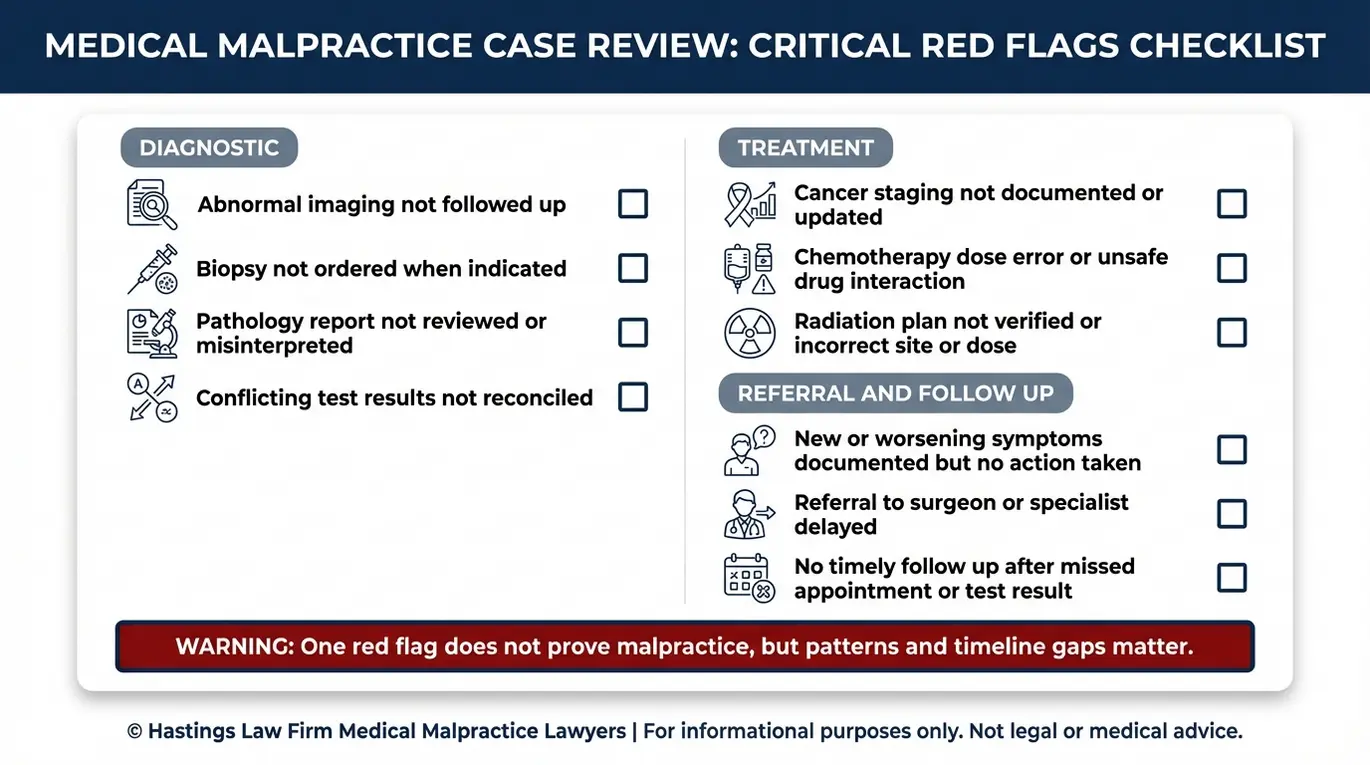
Common errors include failing to order necessary biopsies, misinterpreting pathology reports, administering incorrect chemotherapy dosages, and disregarding patient reports of new or worsening symptoms. As a Texas oncologist malpractice lawyer firm, we see patterns of oncologist negligence that fall into three broad categories: diagnostic failures, treatment errors, and referral breakdowns.
Diagnostic Failures
A failure to diagnose cancer, or a significant delay in diagnosis, can occur when an oncologist overlooks abnormal blood work, dismisses suspicious imaging results, or fails to follow up on inconclusive findings. Research published by the National Academy of Medicine on diagnostic error in the United States shows diagnostic mistakes are among the most common and harmful medical errors. In oncology, cancer misdiagnosis and delayed diagnosis are frequent occurrences. These failures can allow a treatable cancer to advance in cancer staging and lead to metastasis, meaning the cancer spreads to distant organs, dramatically reducing survival odds.
Treatment Errors
In cancer care, treatment errors involving chemotherapy dosing must be carefully managed. This involves the precise calculation of drug amounts based on a patient’s body surface area, organ function, and cancer type. An error here can cause devastating toxicity or render the treatment ineffective.
Similarly, radiation overdose, which involves delivering excess radiation beyond the therapeutic target, can cause severe tissue damage, organ injury, or secondary cancers. Prescribing medications that conflict with a patient’s known history is another preventable mistake that can lead to serious harm.
Referral Negligence
In oncological care, referral negligence occurs when an oncologist delays referring a patient to a surgeon or specialist despite clinical indicators calling for it. Timely referrals are part of the standard of care, and gaps in this area can mean the difference between a curable and incurable diagnosis.
Red flag errors we look for in oncology malpractice cases include:
- Ignoring or failing to act on abnormal biopsy or pathology findings
- Not ordering recommended screening tests (mammogram, colonoscopy, CT scan, MRI, or Pap smear) for at-risk patients
- Misinterpreting imaging studies that show suspicious masses or lesions
- Administering chemotherapy or radiation at incorrect doses or intervals
- Failing to adjust treatment when a patient’s condition worsens
- Delaying surgical referral for a tumor that requires prompt removal
Liability of Diagnostic Laboratories Versus Treating Physicians
Determining whether a physician or a lab is responsible for a diagnostic error is not always simple. A doctor may correctly perform a biopsy, which is the removal of a tissue sample for examination, but a laboratory may incorrectly analyze the results. The pathology report, which is the lab’s written interpretation of tissue findings, may contain errors that lead the treating physician to make the wrong call.
In these cases, liability may rest with the lab, the oncologist, or both. We investigate whether the oncologist should have questioned a result that was inconsistent with the clinical picture, and whether laboratory negligence occurred in processing the diagnostic tests.
Establishing proximate cause, the direct link between the error and the patient’s harm, requires a careful review of every step in the diagnostic chain. We examine these links to determine where the standard of care failed.
The Hastings Law Firm Difference
Results matter, but what truly sets us apart is how we achieve them. Every verdict, every settlement, and every Texas courtroom victory comes from one guiding promise: To treat each client’s fight for justice as if it were our own.
This balance of skill, experience, and empathy reflects our core philosophy that justice should not only compensate the injured, but also make health care safer nationwide.

The Danger of Diagnostic Delays and Missed Testing
Diagnostic delays allow cancer to metastasize from a treatable early-stage disease into a potentially terminal late-stage condition, significantly reducing the patient’s survival rate and available treatment options. As a Texas Oncologist Malpractice Lawyer team, we understand that proving the timeline of a delayed cancer diagnosis is central to these cases.
Early detection via screenings like a CT scan, MRI, mammogram, colonoscopy, or Pap smear is the single most important factor in surviving cancers like breast, colon, and lung cancer. Data from the SEER Explorer Application, maintained by the National Cancer Institute, shows dramatic differences in five-year survival rates between localized and distant-stage cancers. When a treatment delay occurs and a doctor misses the window for early intervention, patients may face far more aggressive chemotherapy, radiation, or surgery than would have been necessary.
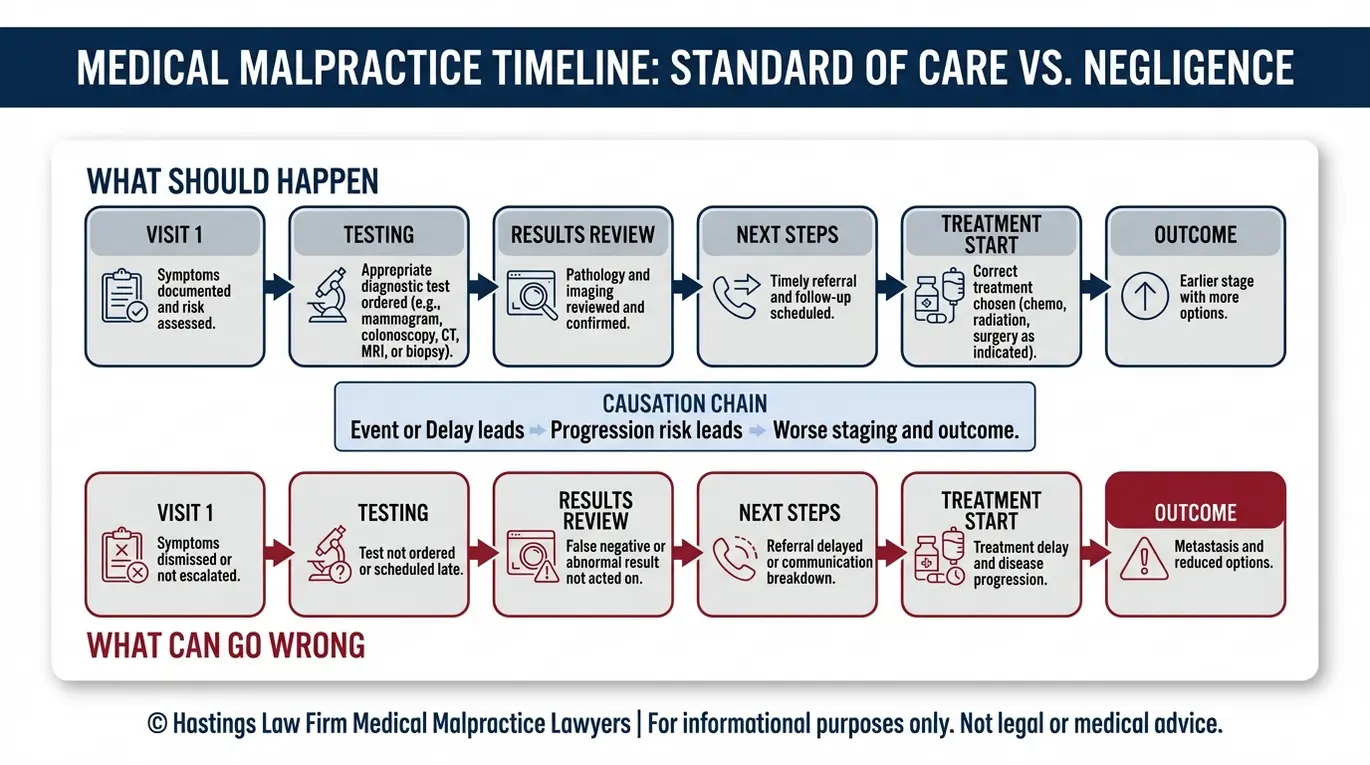
A false negative, a test result that incorrectly indicates no cancer is present, is one of the most dangerous errors in oncology. A patient told they are cancer-free may not seek further evaluation until symptoms become severe, at which point the disease may have already spread. Consider a general timeline of how this unfolds:
- Missed test or false negative result: The patient is told no cancer is detected, despite clinical warning signs
- Months pass without follow-up: The patient has no reason to seek additional testing based on the reassurance received
- Symptoms worsen or new symptoms appear: The patient returns with complaints that now suggest advanced disease
- Late-stage diagnosis: Imaging or biopsy reveals cancer that has progressed beyond its original site
- Aggressive treatment or limited options: The patient now faces treatments with lower success rates, greater toxicity, or palliative care only
Each step in that chain represents a point where earlier action could have changed the outcome. We work with oncology experts to reconstruct this timeline and establish when the correct diagnosis should have been made.
Harms From False Positive Cancer Diagnoses and Unnecessary Treatment
The opposite error, a false positive cancer diagnosis, occurs when a test or diagnosis incorrectly indicates that cancer is present. This can lead to unnecessary treatment, meaning the patient undergoes surgery, chemotherapy, or radiation for a disease they do not actually have.
The physical damage from unnecessary treatment can be severe: organ removal, nerve damage, chronic pain, immune suppression, and long-term side effects from toxic drugs. The psychological harm is also significant.
Patients who are told they have cancer and endure months of grueling treatment, only to learn the diagnosis was wrong, often suffer lasting anxiety and depression. These cases may support claims for compensation covering both the physical injuries and the emotional damages caused by the misdiagnosis.
Recoverable Damages for Cancer Negligence in Texas Courts
Patients harmed by oncologist malpractice in Texas can recover economic damages for medical bills and lost wages, as well as non-economic damages for pain, suffering, and physical impairment. The specific damages available in a cancer malpractice lawsuit depend on the nature of the injury, the stage of life affected, and whether the case involves a surviving patient or a wrongful death claim. A Texas Oncologist Malpractice Lawyer can guide you through these categories.
Texas law divides recoverable damages into two main categories:
| Damage Type | Economic Damages | Non-Economic Damages |
|---|---|---|
| What It Covers | Measurable financial losses | Subjective, quality-of-life losses |
| Examples | Past and future medical bills, corrective treatment costs, lost wages, lost earning capacity, home care needs | Physical pain, mental anguish, disfigurement, physical impairment, loss of enjoyment of life |
| Caps Under Texas Law | No cap | Capped at $250,000 per claimant against all individual health care providers; up to $500,000 total against health care institutions |
Economic damages often represent the largest portion of recovery in cancer cases because the cost of corrective treatment, extended care, and lost income can be substantial. These damages are not subject to statutory caps.
For instance, future medical costs may include expensive immunotherapy, palliative care, or permanent home nursing if the malpractice resulted in severe disability. Similarly, lost earning capacity accounts for the total career trajectory and retirement benefits the patient would have earned had their cancer been treated properly at an earlier stage.
In wrongful death cases, surviving spouses, children, and parents may recover compensation for loss of companionship, mental anguish, and the financial support the deceased would have provided. To secure these damages, we must establish causation and proximate cause, linking the negligence directly to the financial and emotional losses.
Understanding the Loss of Chance Doctrine in Texas Cancer Cases
The loss of chance doctrine addresses situations where a doctor’s negligence did not cause the cancer itself, but significantly reduced the patient’s statistical chance of survival or cure. This is one of the most difficult areas in cancer malpractice law because it raises a fundamental question: what happens when the delay worsened the odds, but the outcome was already uncertain? If you are considering suing a cancer doctor, a qualified Texas Oncologist Malpractice Lawyer is essential to manage these details.
In Texas, the legal standard for causation requires proof of “proximate cause,” meaning the plaintiff must show that the negligence more likely than not (greater than 50%) caused the injury or death. This creates a significant hurdle in cases where, for example, a patient’s survival rate dropped from 60% to 20% because of a delayed diagnosis. The negligence clearly mattered, but proving it was the probable cause of death requires strong statistical and medical evidence.
Texas courts have historically been skeptical of a pure “lost chance” theory when the patient’s initial survival odds were already below 50%. In those situations, the argument that the delay caused the death becomes harder to sustain under the more-likely-than-not standard. However, when survival odds were above 50% before the negligent delay and fell below that threshold afterward, the case for causation is stronger.
Building these claims requires detailed statistical evidence from a qualified expert witness who can testify about stage-specific survival data, the expected progression of the particular cancer, and metastasis rates. This involves analyzing medical literature to show how earlier intervention would have changed the trajectory. Our team conducts this rigorous analysis to prove that the loss of survival chance was a direct result of the malpractice, distinguishing it from the natural course of the disease.
Why Choose Hastings Law Firm for Your Oncology Case
Hastings Law Firm offers a team of board-certified attorneys and medical professionals who focus exclusively on medical malpractice, giving you the resources to take on large hospital systems and well-funded defense teams. We do not handle car accidents, slip-and-fall cases, or other personal injury matters. Every case we accept involves medical negligence, and that singular focus shapes everything we do.
What sets our approach apart as a Texas Oncologist Malpractice Lawyer firm:
- Exclusive medical malpractice focus: Our attorneys, in-house nurse consultants, and patient advocates work only on medical negligence cases. This means deeper medical knowledge, sharper case evaluation, and more effective preparation.
- Former defense insight: Our team includes attorneys who previously defended hospitals and healthcare systems. That experience gives us a clear understanding of how the other side builds its case, allowing us to anticipate and counter defense strategies.
- In-house medical review: Our nursing staff and Board Certified Patient Advocates review your medical records, identify inconsistencies, and help translate clinical data into evidence a jury can understand. We can also help arrange a second opinion review of your records to confirm where the standard of care was breached.
- National expert network: We work with top oncology experts across the country who provide objective case reviews and credible testimony.
- No fee unless we recover for you: We work on a contingency fee basis, meaning you pay no attorney fees or costs unless we secure compensation on your behalf.
Clients often search for the best medical malpractice attorney to handle their complex claims, and we strive to meet that standard through our rigorous preparation. Founder Tommy Hastings is board-certified in Personal Injury Trial Law, a distinction held by less than 2% of Texas attorneys. He has been a Texas Super Lawyer since 2013 and built this firm on the principle that accountability improves patient safety. We prepare every case from day one as if it will go to trial, because that level of preparation is what produces fair results.
Contact the Texas Doctor Malpractice Attorneys at Hastings Law Firm Today for Help
You do not have to figure this out alone. If you believe a cancer doctor’s error affected your diagnosis, your treatment, or the life of someone you love, our team is ready to listen. We will review the medical records, consult with qualified experts, and give you an honest assessment of your legal options.
As an experienced Texas Oncologist Malpractice Lawyer team, we understand the medical complexity and emotional weight of these cases. Your consultation is free, confidential, and comes with no obligation. You pay nothing unless we win.
Call Hastings Law Firm or contact us online to schedule your risk-free case evaluation. Let us help you find the answers you deserve.
Frequently Asked Questions About Oncologist Malpractice in Texas


This content was researched and written by the Hastings Law Firm editorial team, which includes attorneys, medical professionals, and experienced researchers. Our writing is informed by internal knowledge and practical experience, and we cross-check critical details against authoritative sources cited throughout. Every piece undergoes human-led fact-checking and legal review. Because legal and medical information can change, if you spot an error, please contact us. Learn more about our content standards and review process on our editorial policy page.

Brady D. Williams is a nationally recognized medical malpractice attorney who has spent his career handling high-stakes litigation for injured patients and families across the country. Licensed in both Texas and California, Brady draws on experience from hundreds of resolved medical cases to break down complex legal and medical topics for the people who need that information most. His writing reflects the same attention to detail and commitment to clarity that he brings to every case he handles.
