


Texas Otolaryngologist Malpractice Lawyer
ENT care involves delicate anatomy, and preventable errors can leave lasting harm that affects hearing, voice, appearance, and daily safety. Otolaryngologist negligence can involve surgical mistakes, diagnostic failures, medication related injuries, or inadequate informed consent, and the key issue is whether care fell below the accepted standard and caused the injury. Texas rules also shape what must be shown and what losses may be recoverable. If you or a loved one were harmed or worse due to otolaryngologist negligence in Texas, contact Hastings Law Firm for a free, confidential case review.
Last Updated: July 27, 2026
Trial-Ready Legal Representation for ENT Negligence in Texas
When a doctor you trusted with your hearing, your voice, or your ability to breathe causes harm through a preventable error, the experience can feel deeply personal. ENT procedures involve some of the most delicate anatomy in the body, and mistakes in this specialty can result in lasting sensory loss, disfigurement, or worse.
If you or a loved one suffered an injury during treatment by an ear, nose, and throat specialist, you deserve answers about what went wrong and whether negligence was involved. At Hastings Law Firm, founded by board-certified trial lawyer Tommy Hastings, we focus exclusively on medical malpractice.
Our team of attorneys, in-house nurses, and medical consultants investigates complex ENT injury claims across Texas. If you believe your care fell short, a Texas otolaryngologist malpractice lawyer at our firm can review what happened and explain your options in a free, confidential consultation.

Defining Medical Negligence in Otolaryngology
An otolaryngologist, a physician specializing in disorders of the ear, nose, and throat (commonly called an ENT), is negligent when they fail to meet the accepted medical standard of care and that failure results in injury to the patient. This specific failure to adhere to standards constitutes otolaryngologist negligence. This can include surgical errors, failure to diagnose conditions like cancer, or improper management of medication and postoperative care.
Under Texas law, the standard of care is the level of treatment that a reasonably competent, board-certified ENT would have provided under similar circumstances. ENT specialists complete extensive ENT training, typically five or more years of residency after medical school, often followed by fellowship subspecialization. That level of training sets the legal bar high.
Because of this specialized background, suing an ENT in Texas involves strict procedural requirements that distinguish these claims from general personal injury cases. When an otolaryngologist deviates from established protocols, such as failing to order a CT scan for a patient presenting with chronic sinusitis symptoms or misreading imaging results, that deviation may constitute a breach of duty.
Proving that breach requires more than showing a bad outcome. Under Civil Practice and Remedies Code Chapter 74, Texas requires plaintiffs to support their claim with an expert witness report early in the litigation. The expert, typically a board-certified ENT of equal or higher standing, must confirm that the treating doctor’s actions fell below the standard of care and caused the injury in question.
As a Texas otolaryngologist malpractice lawyer, we evaluate ENT negligence claims by examining whether the treating physician met these benchmarks:
- Performed a thorough patient history and physical examination
- Ordered appropriate diagnostic imaging (CT, MRI) when symptoms warranted it
- Followed accepted surgical protocols and techniques
- Monitored for and responded to complications in a timely manner
- Provided adequate informed consent before any procedure
- Delivered proper postoperative care and follow-up instructions
If your ENT failed to meet one or more of these standards and you were injured as a result, you may have grounds for a medical negligence claim in Texas.

Common Surgical Errors and Diagnostic Failures
Malpractice claims against ENT specialists commonly involve surgical mistakes during sinus or thyroid procedures, failure to diagnose oral or laryngeal cancers, and nerve damage leading to loss of taste, smell, or facial movement. These cases often center on whether the physician identified the condition correctly and whether the procedure was performed with the care the situation required.
Diagnostic errors, specifically misdiagnosis or delayed diagnosis, are among the most consequential. Cancers of the throat, larynx, tongue, and thyroid are highly treatable when caught early. A missed diagnosis or delayed diagnosis of these conditions can allow the disease to advance to stages where treatment is far more invasive and outcomes are significantly worse.
If an ENT dismissed persistent symptoms like hoarseness, difficulty swallowing, or a neck mass without adequate workup, that failure can form the basis of a malpractice claim. Patients of these oversights often require a malpractice lawyer for ENT errors to uncover the truth.
Surgical errors in this specialty carry unique risks because of the anatomy involved. ENT procedures take place in close proximity to the brain, major nerves, and the spinal cord. During endoscopic sinus surgery (ESS), a minimally invasive procedure used to treat chronic sinusitis and nasal polyps, even a small deviation in technique can perforate the thin bone separating the sinuses from the brain.
This can cause a cerebrospinal fluid (CSF) leak, the loss of the protective fluid surrounding the brain, which may lead to meningitis or other catastrophic injury. As noted by the Agency for Healthcare Research and Quality’s Patient Safety Network (PSNet), surgical complications and diagnostic errors remain top patient safety concerns nationwide. An experienced ENT malpractice attorney understands these risks and how to identify these subtle surgical breaches.
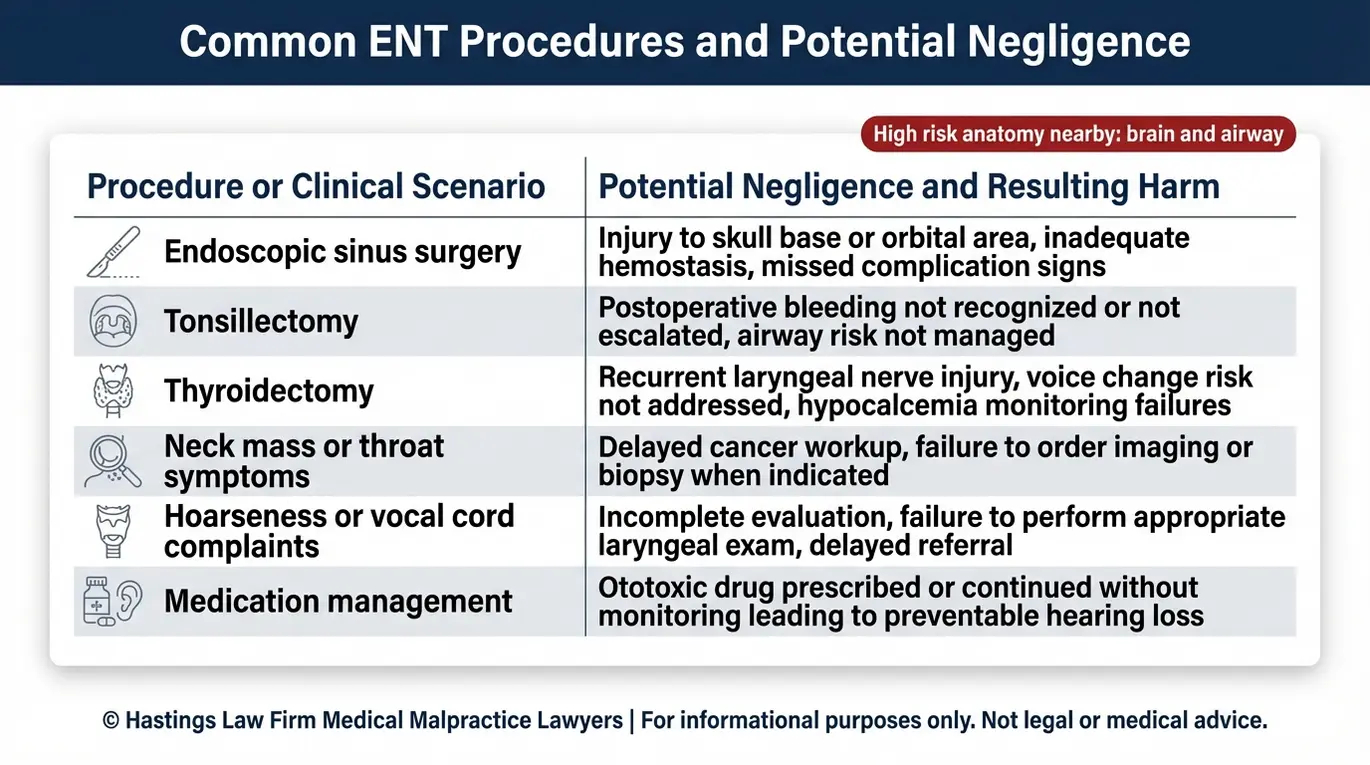
The table below outlines common ENT procedures and the types of negligence that can occur:
| Procedure | Potential Negligence |
|---|---|
| Thyroidectomy | Recurrent laryngeal nerve damage causing vocal cord paralysis or permanent voice changes |
| Endoscopic Sinus Surgery | Perforation of the skull base leading to CSF leak, meningitis, or brain injury |
| Tonsillectomy | Excessive bleeding (hemorrhage) from failure to control surgical site or inadequate postoperative monitoring |
| Septoplasty | Septal perforation, nasal collapse, or failure to obtain informed consent about risks |
| Neck Dissection (Cancer) | Injury to the spinal accessory nerve, resulting in shoulder dysfunction and chronic pain |
A Texas otolaryngologist malpractice lawyer at Hastings Law Firm works with surgical specialists and in-house nursing staff to analyze operative reports and identify where protocols broke down. This review helps determine whether the ENT’s actions fell below the standard of care. If you believe a claim against an otolaryngologist may be warranted, our team can evaluate the evidence and advise you on next steps.
Ototoxic Medication and Preventable Hearing Loss
ENT malpractice is not limited to the operating room. It also includes prescribing or administering ototoxic medications. This medication error involves using drugs known to damage the structures of the inner ear without proper monitoring. Ototoxic medications are drugs that can be toxic to the ear.
Certain antibiotics (particularly aminoglycosides) and chemotherapy agents can cause antibiotic toxicity and irreversible hearing loss or tinnitus. Even high-dose aspirin can cause hearing loss and tinnitus, though these effects are generally reversible once the medication is stopped. Before prescribing these medications, the standard of care typically requires a baseline audiogram, a hearing test that measures how well a patient detects sounds at various frequencies.
Ongoing monitoring should follow throughout treatment. When an ENT or treating physician fails to order these tests or ignores signs of ototoxicity, the resulting hearing loss may have been entirely preventable. Our ENT malpractice attorneys investigate whether appropriate monitoring protocols were followed and whether the prescribing physician warned the patient of the risks involved.
The Hastings Law Firm Difference
Results matter, but what truly sets us apart is how we achieve them. Every verdict, every settlement, and every Texas courtroom victory comes from one guiding promise: To treat each client’s fight for justice as if it were our own.
This balance of skill, experience, and empathy reflects our core philosophy that justice should not only compensate the injured, but also make health care safer nationwide.

Proving Causation Through Expert Testimony
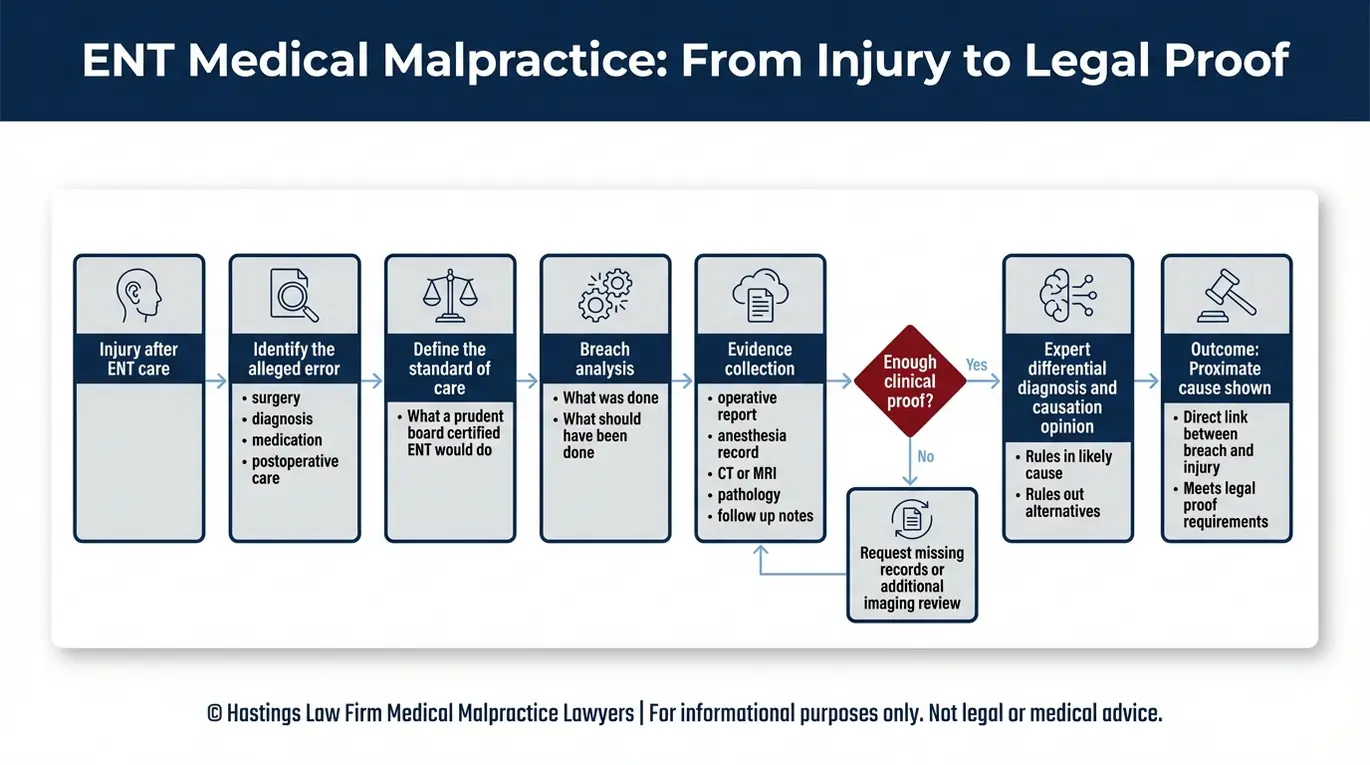
To succeed in an ENT malpractice case, the patient must prove proximate cause. Proving ENT negligence requires showing a direct link between the doctor’s specific error and the injury that followed. A bad outcome alone is not enough. The legal question is whether the ENT’s deviation from the standard of care was the actual cause of harm, and that determination almost always depends on expert medical testimony.
The process of building a causation argument typically follows these steps:
- Record collection and review: We obtain the complete medical records, including surgical notes, anesthesia records, pre-operative imaging (CT scans, MRIs), and postoperative documentation. Our in-house nursing staff reviews these records to identify gaps, inconsistencies, or red flags.
- Reconstruction of the clinical timeline: We build a detailed sequence of events to determine what was done, when it was done, and what was missed. This includes reviewing whether the ENT performed a proper differential diagnosis, which is the process of ruling out possible conditions.
- Expert analysis and opinion: A qualified ENT specialist reviews the records and provides an opinion on whether the treating doctor’s conduct fell below the standard of care and directly caused the injury.
- Causation report: The expert prepares a written report connecting the breach to the harm. If the case involves a diagnostic failure, for example, the expert may explain how a flexible laryngoscopy should have been performed and would have revealed the condition earlier.
As a Texas otolaryngologist malpractice lawyer, our team coordinates this entire process. Our attorneys, including former defense counsel who understand how hospitals and insurers challenge causation, prepare every case as if it will go to trial. This trial-ready posture ensures no link in the chain of evidence is left unsupported. Our network of medical experts allows us to match each case with the right specialist.
Recoverable Damages in ENT Injury Cases
Patients harmed by ENT negligence may recover compensation for ENT injury through economic damages for medical bills and lost wages, as well as non-economic damages for pain, suffering, disfigurement, and loss of enjoyment of life caused by sensory deprivation such as hearing or smell loss. Assessing damages in medical malpractice correctly is vital to ensuring long-term financial stability.
Economic damages cover the financial costs directly tied to the injury. These are calculated based on documented expenses and projected future needs:
- Past and future medical bills, including reconstructive surgery, hearing aids, cochlear implants, and speech therapy
- Lost wages and reduced earning capacity if the injury prevents you from returning to your previous occupation
- Costs of ongoing rehabilitation or assistive devices
- Home care or modifications needed and future medical care costs
Non-economic damages address the personal toll of the injury. Losing a sense like hearing or smell, or living with vocal cord paralysis, a condition where recurrent laryngeal nerve (RLN) injury leaves one or both vocal cords unable to move, can fundamentally change how a person experiences daily life. These damages account for chronic pain, emotional distress, disfigurement, and the loss of activities that once brought joy.
As described by PubMed Central’s overview of health care liability claims under Texas law, Texas medical malpractice claims require careful classification of damages to ensure all recoverable losses are documented and presented.
If ENT negligence resulted in a loved one’s death, surviving family members may pursue a wrongful death claim. This includes compensation for funeral expenses, loss of financial support, and loss of companionship. A Texas otolaryngologist malpractice lawyer at our firm can assess the full scope of damages in your case and work to ensure nothing is overlooked.
Contact the Texas Doctor Malpractice Attorneys at Hastings Law Firm Today for Help
Losing your hearing, your voice, or your sense of safety after an ENT procedure is not something you should have to face without answers. Our legal team focuses on securing accountability for ear, nose, and throat surgical errors across Texas. At Hastings Law Firm, medical malpractice is all we do. Our team of attorneys, former defense lawyers, and board-certified patient advocates brings deep medical insight to your claim.
We take cases on a contingency fee basis, which means you pay no attorney fees or costs unless we recover compensation for you. If you believe your ENT’s care fell below the standard you deserved, contact a Texas otolaryngologist malpractice lawyer at Hastings Law Firm for a free, confidential case evaluation. Let us help you find the answers you deserve and take the first step toward protecting your future.
Frequently Asked Questions About Otolaryngologist Malpractice in Texas


This content was researched and written by the Hastings Law Firm editorial team, which includes attorneys, medical professionals, and experienced researchers. Our writing is informed by internal knowledge and practical experience, and we cross-check critical details against authoritative sources cited throughout. Every piece undergoes human-led fact-checking and legal review. Because legal and medical information can change, if you spot an error, please contact us. Learn more about our content standards and review process on our editorial policy page.

Gabe Sassin has focused exclusively on medical malpractice law since 2007. After spending more than a decade as a malpractice defense attorney, he knows exactly how the other side works. He has seen firsthand how healthcare providers, insurers, corporate defendants, and their legal teams think, prepare, and build their defense against claims. That knowledge works for the people who need it most today, injured patients and their families. His unique experience shapes everything he writes, giving readers a look at how these cases actually work from someone who has handled them from both sides.
