


Texas Pulmonologist Malpractice Lawyer
Pulmonologist malpractice involves errors in diagnosis, procedures, medication management, or airway and ventilator care that can leave patients with lasting breathing impairment, major financial strain, and in severe cases wrongful death. These events often raise concerns about whether accepted standards were followed and whether hospitals or respiratory therapists also contributed through protocol failures or documentation gaps. Texas law also shapes what compensation may be available and how quickly options can narrow. If you or a loved one were harmed or worse due to pulmonologist malpractice in Texas, contact Hastings Law Firm for a free, confidential case review.

Last Updated: July 27, 2026
Trusted Legal Representation for Medical Specialist Negligence in Texas
When a lung specialist’s error causes harm, the experience can leave you or your family feeling confused, overwhelmed, and unsure of what to do next. You trusted a doctor with your respiratory health, and something went wrong. That kind of breach of trust is deeply personal, and the medical and financial consequences can be severe.
At Hastings Law Firm, we focus exclusively on medical malpractice. Our team of attorneys, in-house nurses, and board-certified patient advocates understands both the medicine and the law behind pulmonary care errors. As a dedicated Texas pulmonologist malpractice lawyer team, we are prepared to investigate what happened, identify where the standard of care was broken, and hold the responsible parties accountable.
If you believe a lung specialist’s negligence caused injury to you or someone you love, we welcome the chance to listen. Contact us for a free, confidential case evaluation so we can review the details and explain your options.

Defining Medical Negligence in Pulmonary Care
Pulmonologist malpractice occurs when a respiratory specialist in the field of pulmonology deviates from the accepted standard of care, directly causing injury or worsening a patient’s condition through errors in diagnosis, treatment, or management of the airway. These cases are governed in Texas by the Texas Civil Practice and Remedies Code Chapter 74, which sets the procedural framework for all medical liability claims in the state.
A pulmonologist, a physician who specializes in diseases of the lungs and respiratory system, treats conditions like COPD, asthma, pneumonia, lung cancer, and complex breathing disorders. Because these conditions can be life-threatening, the margin for error is extremely thin. Research published through PubMed Central on medical negligence in healthcare organizations confirms that pulmonary-related malpractice claims carry some of the highest mortality rates among medical specialties, underscoring the serious consequences when mistakes occur.
To pursue a pulmonologist malpractice lawyer claim in Texas, you must establish four legal elements:
- Duty: The pulmonologist had a professional obligation to provide competent care, including monitoring critical indicators like oxygen saturation (SpO2), which measures how much oxygen your blood is carrying.
- Breach of Duty: The doctor deviated from what a reasonably competent pulmonologist would have done under the same circumstances.
- Causation: That breach directly caused the patient’s injury or made an existing condition worse.
- Damages: The patient suffered measurable harm, whether physical, financial, or emotional.
Qualified experts must support each of these elements with evidence, typically through expert medical testimony and a thorough review of clinical records. Without all four, a malpractice claim cannot move forward.

Common Forms of Malpractice by Pulmonologists
Common errors in pulmonary medicine include misdiagnosis or failure to diagnose lung cancer, mismanagement of ventilator-dependent patients, surgical errors during bronchoscopy, and failure to identify and treat pulmonary embolisms. These are not rare events. When they occur, the consequences range from permanent lung damage to wrongful death.
As a Texas pulmonologist malpractice lawyer team, we investigate a wide range of clinical failures. The errors typically fall into three categories: diagnostic mistakes, procedural complications, and medication mismanagement.
| Category | Examples | Potential Consequences |
|---|---|---|
| Diagnostic Errors | Misreading a CT scan or X-ray; missing lung nodules or tumors; delayed cancer diagnosis | Cancer progression; loss of treatment window; reduced survival |
| Procedural Errors | Puncturing the lung during bronchoscopy (a procedure where a thin scope is inserted into the airways) or lung biopsy | Pneumothorax (collapsed lung); hemorrhage; respiratory failure |
| Medication Errors | Improper dosing of steroids; failure to manage anticoagulation therapy (blood-thinning medications used to prevent clots) | Uncontrolled bleeding; blood clots; organ damage |
Diagnostic failures are among the most common claims we see. A pulmonologist who overlooks an abnormal shadow on a chest X-ray or dismisses a suspicious nodule on a CT scan may cost the patient months of critical treatment time. In lung cancer cases, that delay can mean the difference between a treatable and a terminal diagnosis.
Procedural errors during bronchoscopy or biopsy can cause immediate, serious harm. A perforated lung may require emergency intervention and extended hospitalization. These complications are not always unavoidable; they may result from poor technique, inadequate planning, or failure to account for a patient’s anatomy.
Medication errors often involve the mismanagement of blood thinners or corticosteroids. Too much anticoagulation can cause dangerous internal bleeding. Too little can allow a life-threatening clot to form. Proper monitoring and dosage adjustment are part of the expected standard of care.
The Hastings Law Firm Difference
Results matter, but what truly sets us apart is how we achieve them. Every verdict, every settlement, and every Texas courtroom victory comes from one guiding promise: To treat each client’s fight for justice as if it were our own.
This balance of skill, experience, and empathy reflects our core philosophy that justice should not only compensate the injured, but also make health care safer nationwide.

Ventilator and Airway Management Errors
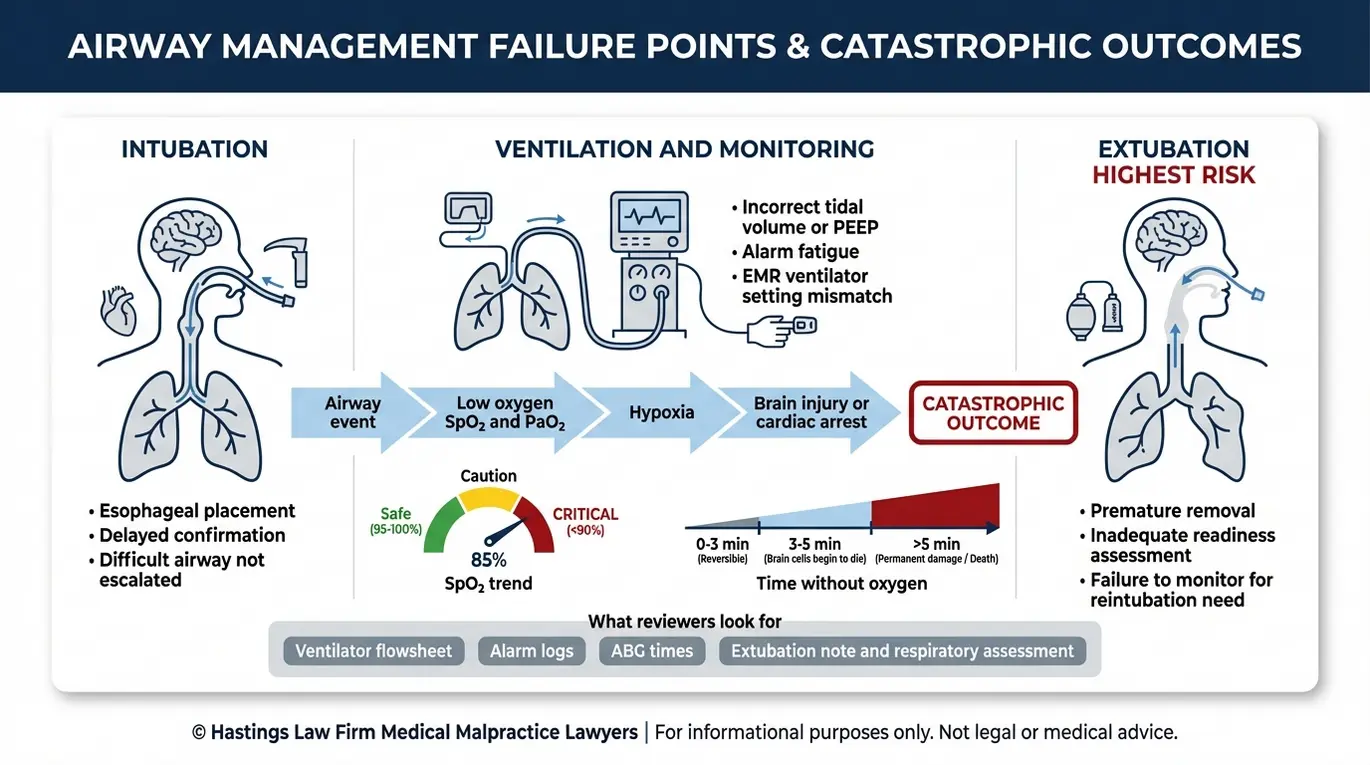
Airway negligence often involves improper intubation, failure to monitor ventilator settings, or premature extubation, and it can lead to hypoxia, brain damage, or death. A mechanical ventilator, a machine that assists or controls breathing for patients who cannot breathe adequately on their own, is one of the most critical tools in intensive care. When managed improperly, the results are devastating.
Research published through PubMed Central on the management of difficult tracheal intubation has documented that intubation-related injuries remain a leading source of malpractice claims in critical care settings. The NCBI Bookshelf resource on ventilator safety confirms that ongoing vigilance in monitoring ventilator parameters is necessary to preventing patient harm. Legal standards for respiratory care, as outlined by the Austin Community College respiratory law resource, reinforce that clinicians must adhere to accepted protocols at every stage of airway management.
Failure to monitor these settings can cause hypoxia, which is a dangerous lack of oxygen reaching the brain and essential organs. This can occur if a breathing tube is placed incorrectly or if the machine is not adjusted to meet the patient’s specific needs.
Extubation, the removal of the breathing tube, is widely recognized as the highest-risk phase of airway management. Premature removal without proper assessment of the patient’s ability to breathe independently can trigger rapid respiratory failure. We examine whether the care team performed standard readiness assessments before extubation and whether emergency re-intubation equipment was immediately available.
Another area we investigate involves discrepancies between the medical records (often the EMR) and actual ventilator machine settings. These sync failures can create dangerous gaps where the documented settings do not match what the patient is actually receiving. Common errors include:
- Incorrect tidal volume or respiratory rate documented in the chart
- Alarm parameters set too broadly, allowing unsafe conditions to persist without triggering alerts
- Delays in updating the EMR after ventilator adjustments are made at the bedside
- Failure to reconcile nursing notes with respiratory therapy documentation
Our in-house medical staff reviews ventilator flow sheets, alarm logs, and EMR entries line by line to identify where breakdowns occurred.
Pulmonary Embolism and Failure to Treat
Failure to diagnose or treat a pulmonary embolism (PE), a blood clot that travels to the lungs and blocks blood flow, can constitute malpractice if the doctor ignored clear symptoms or known risk factors, leading to preventable heart failure or death. PE is one of the most time-sensitive emergencies in medicine, and delays in recognition are often fatal.
Most pulmonary embolisms start as a deep vein thrombosis (DVT), a blood clot that forms in the deep veins of the legs. When a piece of that clot breaks free and reaches the lungs, it becomes a PE. The connection between DVT and PE is well-established in medical literature, and identifying at-risk patients is a core responsibility of any treating pulmonologist. As documented in PubMed Central’s review of imaging for acute pulmonary embolism, CT angiography is the standard diagnostic tool for confirming PE when a patient presents with shortness of breath and chest pain.
In cases involving lung doctor negligence related to PE, we examine whether the care team failed to prescribe anticoagulants. These are blood-thinning medications like Heparin or Warfarin (Coumadin) that prevent or treat clotting. We also look at whether appropriate imaging was ordered promptly. A patient presenting with classic PE symptoms who does not receive a CT angiogram may have been denied a critical, potentially life-saving diagnostic step.
Risk factors like recent surgery, prolonged immobility, cancer history, and prior DVT should prompt heightened clinical suspicion. When those risk factors are present and still missed, the consequences fall on the patient.
Establishing Liability and The Role of Respiratory Therapists
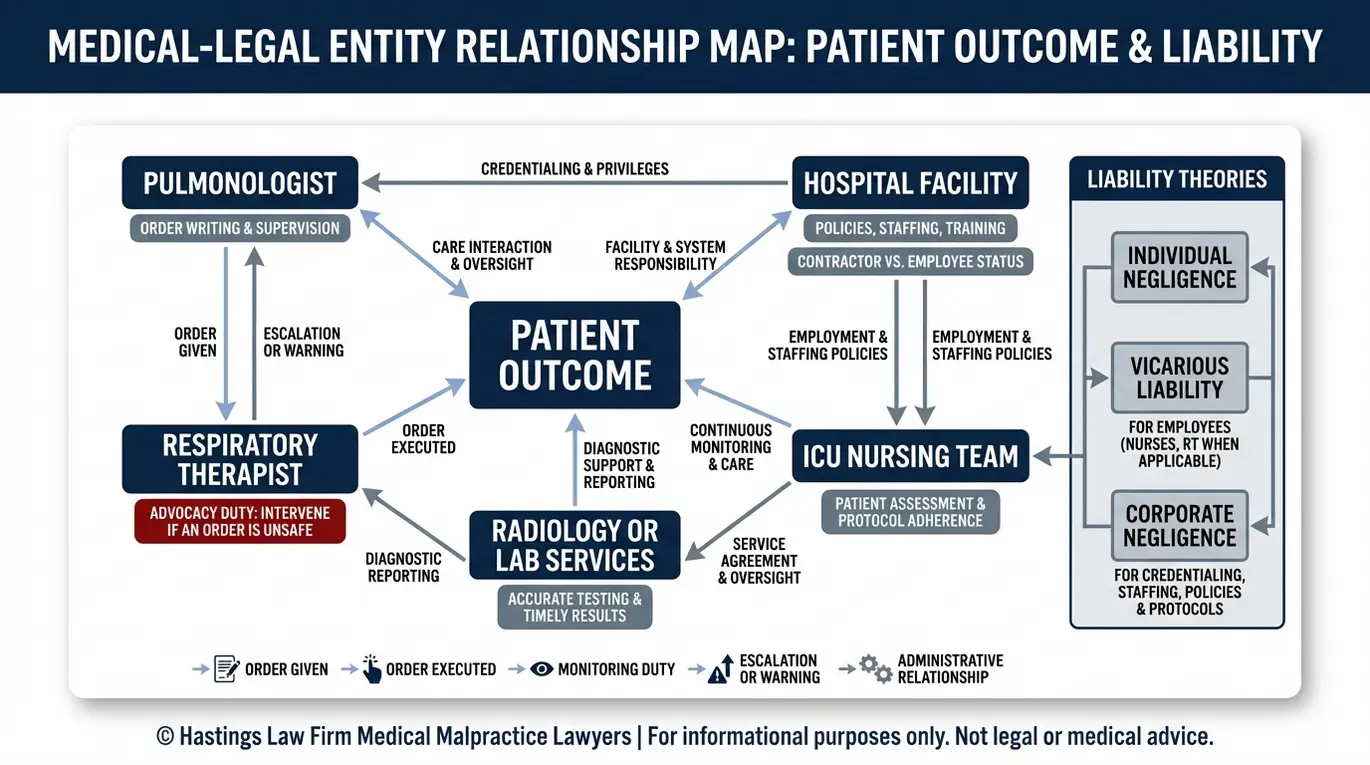
Liability in pulmonary malpractice cases may extend beyond the pulmonologist to include the hospital and respiratory therapists, especially if institutional protocols for airway management were ignored. We define liability as the legal responsibility for the harm caused by medical negligence. As a Texas pulmonologist malpractice lawyer team, we investigate every level of the care chain to determine who bears responsibility for the harm.
A respiratory therapist (RT), a licensed clinician who specializes in managing ventilators, administering breathing treatments, and monitoring airway function, is not simply following orders. Under Texas rules, RTs carry an independent duty to assess, intervene, and advocate for the patient. If a physician orders ventilator settings that an RT recognizes as unsafe, the RT has a legal obligation to speak up and, if necessary, escalate the concern. Failure to do so can make the therapist and their employer independently liable.
The “Captain of the Ship” doctrine, which historically held the lead physician solely responsible for everything that happened during treatment, has largely given way to a broader analysis. Hospitals can now face separate liability for hospital negligence involved in systemic failures like understaffing, inadequate training, broken equipment, or failure to enforce safety protocols. We also examine cases for vicarious liability, where the facility is responsible for the actions of its employees.
When we evaluate these cases, we look at each party’s role:
- The pulmonologist: Did they order appropriate tests, medications, and ventilator settings?
- The respiratory therapist: Did they follow orders correctly and fulfill their independent duty to question unsafe directives?
- The hospital or facility: Did they provide adequate staffing, functioning equipment, and enforced protocols?
- Expert witnesses: Board-certified specialists review the records and testify about whether each party met or fell below the standard of care.
Identifying every responsible party is essential to building a complete case and maximizing the recovery available to the patient.
Recoverable Damages for Lung Injuries
Patients harmed by pulmonary malpractice may recover economic damages for medical bills and lost wages, as well as non-economic damages for pain, suffering, and physical impairment. Economic damages include measurable financial losses, while non-economic damages cover intangible injuries like emotional distress. The type and amount of compensation depend on the severity of the injury and its long-term impact on the patient’s life.
Economic damages cover the measurable financial losses tied to the injury. These are uncapped under Texas law, unlike the statutory cap on damages that applies to non-economic losses. Recoverable costs can include:
- Past and future medical expenses, including hospitalizations, ventilator care, home health services, and rehabilitation
- Lost wages and diminished earning capacity if the injury prevents you from returning to work
- Costs of assistive equipment, medications, and ongoing pulmonary care
Non-economic damages address the harm that does not carry a price tag but profoundly affects quality of life:
- Physical pain and suffering
- Mental anguish and emotional distress
- Loss of consortium, the impact on your relationship with your spouse or family
- Physical impairment and disfigurement
A malpractice attorney for lung injuries will also evaluate whether a wrongful death claim applies. When a patient dies because of pulmonary negligence, surviving family members may pursue damages for loss of companionship, lost financial support, funeral expenses, and the pain their loved one endured before death.
The Texas Statute of Limitations for Medical Injury
In Texas, the statute of limitations for medical malpractice claims generally requires they be filed within two years from the date of the negligence, though exceptions exist for minors and cases where the injury was not immediately discoverable. These legal deadlines protect the integrity of evidence and ensure cases move through the court system efficiently. Missing this deadline almost always means losing the right to pursue a claim entirely.
Texas also imposes a statute of repose, which places an absolute 10-year outer boundary on medical malpractice claims. Even if the injury was hidden or undetectable for years, no claim can be filed after that 10-year window closes. The only narrow exception is the discovery rule, which may extend the two-year deadline if the patient could not reasonably have known about the injury sooner.
Pulmonary malpractice cases require significant time to investigate. Gathering medical records, having them reviewed by qualified experts, and preparing the required pre-suit expert report under Chapter 74 all take weeks or months. That is why speaking with a Texas pulmonologist malpractice lawyer as early as possible is so important. The sooner the process begins, the more time your legal team has to build the strongest possible case.
Contact the Texas Doctor Malpractice Attorneys at Hastings Law Firm Today for Help
Errors by lung specialists can cause irreversible harm, from permanent breathing impairment to wrongful death. If you suspect that a pulmonologist’s negligence changed the course of your life or the life of someone you love, you deserve answers.
Hastings Law Firm focuses exclusively on medical malpractice litigation. Our team includes former defense attorneys and experienced hospital nurses who previously worked for the systems we now challenge. This background allows us to anticipate defense tactics and identify inconsistencies in medical records.
Founded by Tommy Hastings, a board-certified trial lawyer, our firm prepares every case as though it is going to trial. He is board-certified in Personal Injury Trial Law, a distinction held by fewer than 2% of Texas attorneys. Our dedicated patient advocates provide support throughout the entire process.
There is no cost to speak with us. We handle cases on a contingency fee basis, meaning you pay no attorney fees unless we recover compensation for you. Call us today or request a free, confidential case evaluation online. Let us review what happened and help you understand the path forward.
Frequently Asked Questions About Pulmonologist Malpractice in Texas


This content was researched and written by the Hastings Law Firm editorial team, which includes attorneys, medical professionals, and experienced researchers. Our writing is informed by internal knowledge and practical experience, and we cross-check critical details against authoritative sources cited throughout. Every piece undergoes human-led fact-checking and legal review. Because legal and medical information can change, if you spot an error, please contact us. Learn more about our content standards and review process on our editorial policy page.

Brady D. Williams is a nationally recognized medical malpractice attorney who has spent his career handling high-stakes litigation for injured patients and families across the country. Licensed in both Texas and California, Brady draws on experience from hundreds of resolved medical cases to break down complex legal and medical topics for the people who need that information most. His writing reflects the same attention to detail and commitment to clarity that he brings to every case he handles.
