


Texas Radiologist Malpractice Lawyer
Radiology mistakes can cause serious harm when imaging findings are missed, downplayed, or not communicated in time. Misread scans, delayed reporting, and technical problems can change treatment decisions and allow an injury to worsen. These situations often involve questions about whether the radiologist met the accepted standard of care and whether the radiology report accurately reflected what was visible. Liability may also extend to a hospital, imaging facility, or other providers when systems and follow up break down. If you or a loved one were harmed or worse due to radiology malpractice in Texas, contact Hastings Law Firm for a free, confidential case review.

Last Updated: July 27, 2026
Trusted Legal Representation for Medical Specialist Negligence in Texas
When a radiologist misreads a scan or fails to report a critical finding, the consequences can be devastating. A missed tumor, an overlooked fracture, or a delayed diagnosis of a stroke can change the course of your life or the life of someone you love. If you believe a radiology error caused harm, you are not alone, and your instinct to ask questions is the right one.
At Hastings Law Firm, we focus exclusively on medical malpractice. Our team includes in-house nurses, board-certified patient advocates, and former defense attorneys who understand how hospitals and their insurers respond to these claims. As a Texas radiologist malpractice lawyer, we can review what happened, explain your legal options, and help you take the first step toward answers and accountability.
Contact us for a free, confidential case evaluation. You pay nothing unless we recover for you.

Defining Radiology Malpractice Under Texas Law
Radiology malpractice occurs when a radiologist deviates from the accepted medical standard of care, resulting in a misread image, a failure to diagnose, or a communication breakdown that causes patient harm. In legal terms, the medical standard of care represents the benchmark for proper treatment. This standard describes the level of skill and attention that a reasonably competent radiologist would have applied when reviewing the same imaging study under similar circumstances. A deviation from that standard, not simply a bad outcome, is what separates malpractice from an unfortunate result.
Not every diagnostic error qualifies as negligence. In legal terms, negligence is a failure to act with reasonable care. A condition may be genuinely difficult to detect, or a finding may fall within the range of reasonable medical judgment. To support a medical malpractice claim, we must show that a competent radiologist reviewing the same films would have identified the abnormality and that the failure to do so directly caused harm.
The radiology report, the written interpretation a radiologist provides after reviewing an imaging study, is often the most important piece of evidence in these cases. This document should describe what the radiologist observed and note any significant findings, abnormalities, or conditions that require follow-up. When a report omits a visible abnormality or downplays its severity, that gap between what was there and what was reported becomes the foundation of a negligence claim.
Under the Texas Civil Practice and Remedies Code, Chapter 74.051, a patient must provide written notice to the healthcare provider at least 60 days before filing a lawsuit. This pre-suit notice requirement is one of several procedural steps Texas law imposes on malpractice claims. Experienced Texas radiologist malpractice lawyers understand these requirements and build them into the case timeline from the start, so no filing deadline is missed while the medical evidence is still being evaluated.
If you suspect a radiologist failed to identify something that should have been caught, a radiologist malpractice lawyer in Texas can help determine whether the standard of care was met or whether negligence changed the course of your diagnosis and treatment.
Common Types of Radiology and Imaging Errors
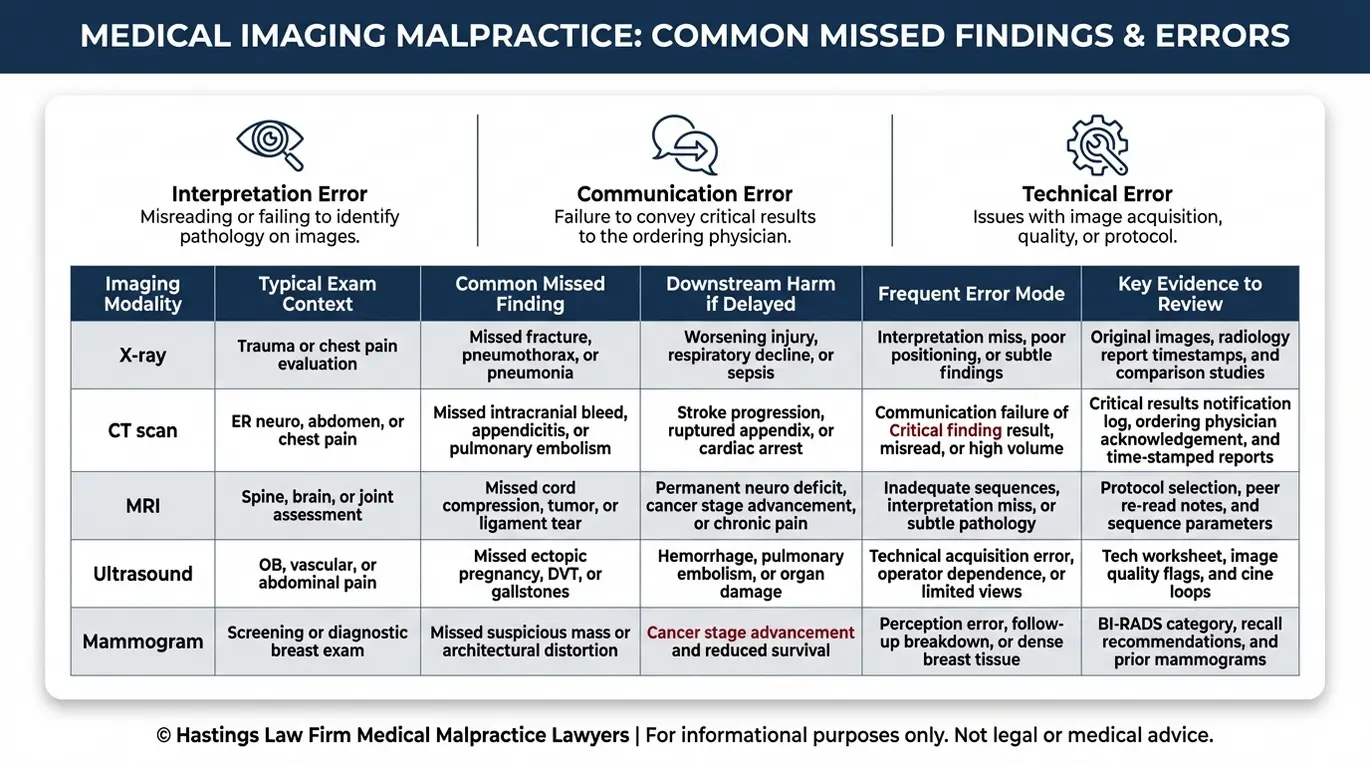
Common radiology errors include misreading scans (false negatives), failing to communicate critical findings to the treating physician, and technical errors during the imaging process. Medical imaging is a field where small details can mean the difference between health and serious illness. When a doctor fails to find a problem on an image, it is often called misreading scans.
Interpretation Errors
The most frequent basis for a radiology malpractice claim involves interpretation errors. Interpretation involves a specialist reviewing medical images to find signs of disease. These errors occur when a radiologist reviews an X-ray, CT scan, MRI, ultrasound, or mammogram and fails to identify an abnormality that is visible on the image. A false negative, a result that incorrectly indicates no disease or abnormality is present, can lead to a delayed diagnosis of cancer, a missed fracture that heals improperly, or a brain bleed that goes untreated.
As the National Academies’ *Improving Diagnosis in Health Care* report details, diagnostic errors are a leading cause of preventable patient harm. In radiology, these errors often involve conditions that a qualified specialist should have recognized given the quality of the available images.
The table below illustrates common missed diagnoses across different imaging types:
| Imaging Modality | Common Missed Diagnosis |
|---|---|
| X-Ray | Hairline fractures, early-stage lung nodules |
| Mammogram | Breast cancer (masses, microcalcifications) |
| CT Scan | Stroke, internal bleeding, pulmonary embolism |
| MRI | Spinal cord compression, soft tissue tumors |
| Ultrasound | Ectopic pregnancy, gallbladder disease, appendicitis |
A Texas radiologist malpractice lawyer will work with independent imaging experts to determine whether the abnormality was visible on the original study and whether a competent radiologist should have caught it.
Communication Errors
Sometimes the radiologist correctly identifies a problem but fails to communicate it to the treating or referring physician quickly enough. Communication errors occur when important medical information is not shared correctly between providers. A critical finding on a CT scan means nothing if the emergency room doctor never receives the alert. These breakdowns between the radiology department and the clinical team can delay life-saving treatment by hours or even days.
Technical Errors
Poor image quality can also lead to a missed diagnosis. Technical errors are mistakes made while physically performing the imaging scan. An image artifact, a distortion or anomaly on the image caused by equipment issues or patient movement, may obscure a real finding. If improper positioning or outdated equipment contributed to a failure to diagnose, the facility itself may share liability. A lawyer for radiologist malpractice in Texas will examine whether technical failures played a role in the diagnostic error.
Distinguishing Human Error From Technology Failures
We separate a radiologist’s failure to identify a finding from a malfunction in the technology itself. Diagnostic technology refers to the computer systems and imaging machines used by doctors. Modern radiology departments rely on systems like PACS, or Picture Archiving and Communication Systems, which store and display digital images, and the DICOM standard (Digital Imaging and Communications in Medicine), the universal format used to transmit medical images between devices.
Software glitches in these systems, or equipment malfunctions in the scanner itself, can produce flawed images or lose data entirely. When technology is at fault, the manufacturer or vendor may bear responsibility rather than, or in addition to, the radiologist. Our radiologist malpractice attorneys evaluate both possibilities in every case.
Complications Involving Interventional Radiology Procedures
Not all radiology errors involve reading films. Interventional radiology is a field where doctors perform procedures using real-time image guidance. This specialized field involving minimally invasive procedures includes biopsies, angiograms, and stent placements.
Errors during these procedures can include perforated organs, uncontrolled bleeding, allergic reactions, or toxicity from contrast media, the dye injected into the body to make blood vessels and tissues more visible on imaging. These cases involve different legal theories than passive diagnostic errors, often overlapping with surgical errors and malpractice claims. If you or a loved one was harmed during an interventional radiology procedure, a Texas radiologist malpractice lawyer can evaluate whether the treating physician met the applicable standard of care.
The Hastings Law Firm Difference
Results matter, but what truly sets us apart is how we achieve them. Every verdict, every settlement, and every Texas courtroom victory comes from one guiding promise: To treat each client’s fight for justice as if it were our own.
This balance of skill, experience, and empathy reflects our core philosophy that justice should not only compensate the injured, but also make health care safer nationwide.

Identifying Liability for Misread Scans and Diagnostic Failures
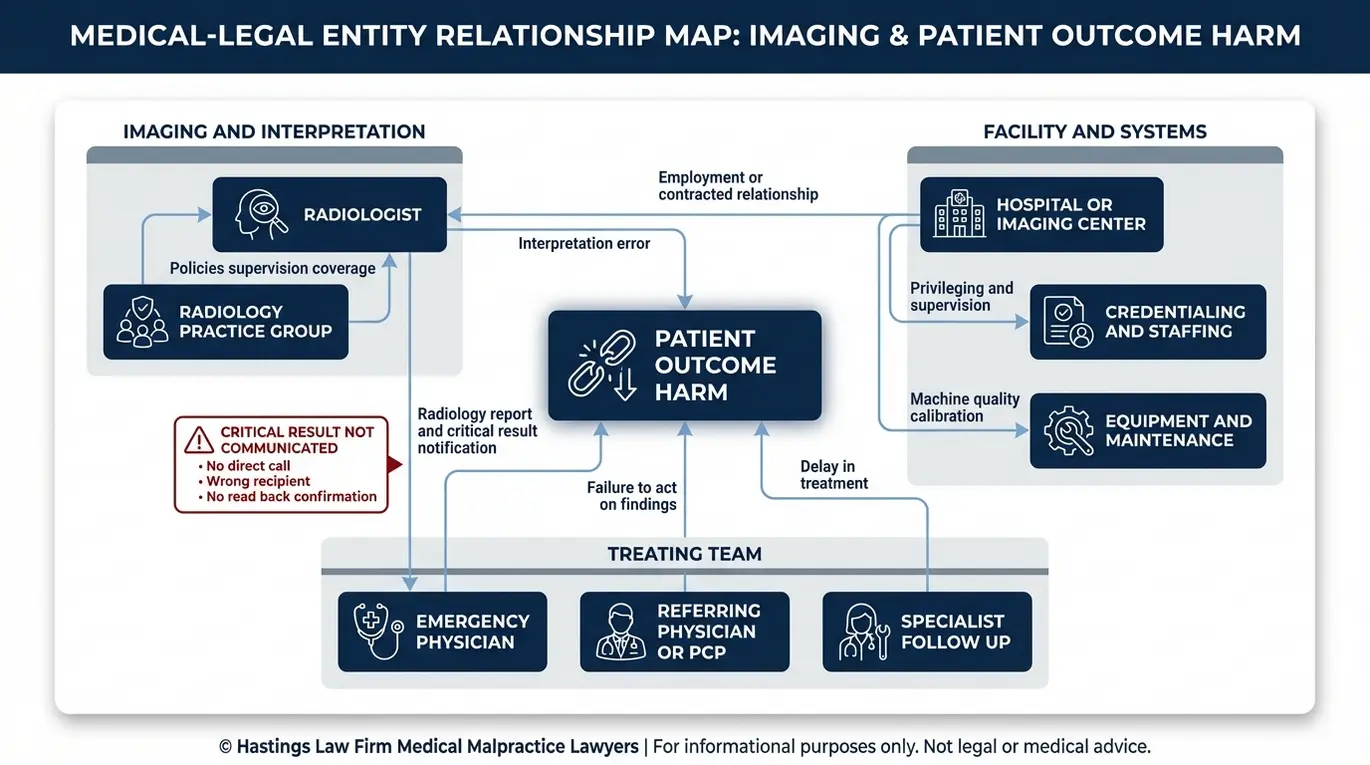
Liability can extend beyond the radiologist to include the hospital for equipment failures, the referring physician for ignoring reports, or the radiology practice group for administrative negligence. Liability identifies who is legally responsible for paying damages caused by a medical error. As a firm focused exclusively on medical malpractice, we understand the internal workflows of these radiology departments.
Here are the parties most commonly involved:
- The Radiologist: The physician who interpreted the imaging study bears primary responsibility for identifying and reporting abnormalities accurately. If the error was a misread scan, liability typically begins here.
- The Hospital or Imaging Facility: Hospitals and freestanding imaging centers can be held liable for maintaining outdated equipment, failing to credential qualified radiologists, or creating systemic staffing problems that lead to hospital negligence. Data tracked by the Texas Department of State Health Services provides insight into hospital operations.
- The Referring Physician: If the radiologist correctly identified a finding in the report but the ordering physician failed to review or act on those results, the referring doctor may bear liability for the resulting harm. This often involves the emergency room physician who acts as the primary point of contact for acute care.
- The Radiology Group or Practice: In some cases, a radiology group’s internal policies, such as excessive workloads or inadequate peer review, may contribute to the error. Vicarious liability, where an employer is held responsible for an employee’s negligence, can also bring the practice group into the claim.
A single imaging error can involve multiple responsible parties. As a Texas radiologist malpractice lawyer, we investigate every link in the diagnostic chain to identify all potential sources of liability. Holding the right parties accountable directly affects the compensation available to the patient. We examine the contracts between radiology groups and the hospitals they serve to uncover where oversight failed.
A malpractice lawyer for radiology errors will review staffing records, credentialing files, communication logs, and the imaging equipment maintenance history to build a complete picture of what went wrong and why. By analyzing the audit trails in the electronic medical record, we can determine exactly when a report was opened and who reviewed it. This helps ensure no responsible party avoids accountability.
How Our Medical-Legal Team Investigates Imaging Negligence
We investigate claims by using in-house nurses and board-certified patient advocates to audit medical records and re-examine imaging studies before filing a lawsuit. This medical-legal approach allows us to identify errors early and build the strongest possible case. Our founder, Tommy Hastings, is board-certified in Personal Injury Trial Law by the Texas Board of Legal Specialization, a distinction held by less than 2% of Texas attorneys.
Obtaining and Reviewing Your Records
The first step is collecting every relevant medical record, including the original imaging study, the radiology report, clinical notes from the referring physician, and any follow-up imaging. Medical records provide the primary evidence for what happened during your treatment. Under federal law, you have the right to access your own health information, as outlined by the U.S. Department of Health and Human Services’ HIPAA access guidance. Our team handles this process on your behalf and ensures nothing is overlooked.
The Independent Second Read
One of the most powerful tools in a radiology malpractice case is the second read, also called an overread, where an independent, board-certified radiologist reviews the original imaging study with fresh eyes. A second read is a review of your original images by a new, independent expert. This expert determines whether the abnormality was visible at the time of the initial interpretation and whether a competent radiologist should have identified it. As a lawyer specializing in radiologist malpractice, we maintain a national network of specialists to provide an independent radiologist medical opinion.
Our Process
Our team follows a specific method to ensure every qualified expert review is thorough. Here is how our radiologist malpractice legal team moves a case forward:
- Conduct a free, confidential intake with a patient advocate to understand your experience
- Collect and organize all medical records and imaging files
- Use in-house nursing staff to perform an initial clinical review
- Commission an independent second read of the original imaging study by a qualified expert
- Identify every party in the diagnostic chain who may share liability
- Build a damages assessment covering medical expenses, lost wages, and pain and suffering
- Prepare the case for trial from Day 1 to ensure insurance carriers take the claim seriously
Calculating Damages
If negligence is confirmed, we work to recover both economic damages and non-economic damages. Economic damages include measurable financial losses like medical bills, future care costs, and lost income. Non-economic damages cover the physical pain, emotional distress, and diminished quality of life caused by the error. We fight to ensure your recovery includes all future care costs related to your injury.
As a Texas radiologist malpractice lawyer, we prepare every case as if it will go before a jury. This trial-ready approach signals to defense attorneys and insurance carriers that we will not accept less than fair value for our clients. By demonstrating our readiness to proceed to trial, we increase the pressure on defendants to offer a settlement that fully accounts for your losses.
Understanding the Texas Statute of Limitations for Imaging Claims
In Texas, the general statute of limitations for medical malpractice is two years from the date of the negligence, though exceptions exist for minors and undiscovered injuries. A statute of limitations is the legal deadline for starting a court case. This two-year deadline is strict, and missing it can permanently bar your claim regardless of how clear the evidence of error may be.
Radiology cases present a unique timing challenge. Many patients do not learn that a scan was misread until months or even years later, when a second imaging study reveals what should have been caught the first time. The Texas Civil Practice and Remedies Code recognizes the discovery rule, which can delay the start of the two-year clock until the patient knew or reasonably should have known about the injury.
Waiting carries real risk. Digital imaging files can be archived, overwritten, or lost if not preserved promptly. Hospitals often migrate data systems, and older files can become corrupted or difficult to access. Securing these records immediately is essential to proving your case. If you suspect a radiology error caused a delayed diagnosis, contact a Texas radiologist malpractice lawyer as soon as possible to protect your legal rights.
Contact the Texas Doctor Malpractice Attorneys at Hastings Law Firm Today for Help
A misread scan or unreported finding can cost months of treatment time, and sometimes much more. If you or a loved one was harmed by a radiology error, you deserve to know what happened and why.
At Hastings Law Firm, we believe that holding negligent providers accountable is about more than compensation. It is about prevention, making sure the same mistake does not happen to someone else. Our team of attorneys, nurses, and patient advocates is here to help you find the truth and protect your family’s future.
You can speak with a patient advocate during a free, confidential case evaluation. There is no fee unless we recover for you. If something feels wrong about the care you received, trust that instinct and reach out. We are ready to listen.
Frequently Asked Questions About Radiologist Malpractice in Texas


This content was researched and written by the Hastings Law Firm editorial team, which includes attorneys, medical professionals, and experienced researchers. Our writing is informed by internal knowledge and practical experience, and we cross-check critical details against authoritative sources cited throughout. Every piece undergoes human-led fact-checking and legal review. Because legal and medical information can change, if you spot an error, please contact us. Learn more about our content standards and review process on our editorial policy page.

Brady D. Williams is a nationally recognized medical malpractice attorney who has spent his career handling high-stakes litigation for injured patients and families across the country. Licensed in both Texas and California, Brady draws on experience from hundreds of resolved medical cases to break down complex legal and medical topics for the people who need that information most. His writing reflects the same attention to detail and commitment to clarity that he brings to every case he handles.
