


Houston Doctor Malpractice Lawyer
Physician negligence can leave patients and families facing serious harm, mounting costs, and lasting uncertainty about what went wrong. In Houston, these cases often turn on whether a doctor followed the accepted standard of care, whether the mistake actually caused the injury, and whether the harm can be documented. Liability can also depend on whether the physician was employed by a hospital or worked as an independent contractor. If you or a loved one were harmed or worse due to physician negligence in Houston, Texas, contact Hastings Law Firm for a free, confidential case review.

Last Updated: July 27, 2026
Trial-Ready Physician Negligence Attorneys in Houston
When a doctor’s mistake changes the course of your life, the confusion and frustration can feel overwhelming. You may be unsure whether what happened qualifies as negligence, and you may not know where to turn for answers. That uncertainty is completely normal, and it does not mean you are without options.
Hastings Law Firm, founded by board-certified trial attorney Tommy Hastings in 2005, represents families throughout Houston harmed by physician negligence. As a firm that handles medical malpractice cases exclusively, every attorney and nurse consultant on our team is focused on holding negligent doctors accountable. If you or a loved one believe a Houston doctor malpractice lawyer can help you understand what went wrong, we welcome the chance to review your case in a free, confidential evaluation.

Understanding Medical Malpractice in the Doctor-Patient Relationship
Medical malpractice occurs when a physician deviates from the accepted standard of care, directly causing injury or harm to a patient under their supervision. The standard of care refers to the level of treatment a reasonably competent doctor in the same specialty would provide under similar circumstances. A general practitioner is held to a different benchmark than a specialist like a cardiologist. A specialist must act with the higher degree of skill and knowledge expected in their specific field.
One reason many patients hesitate to question their doctor is the White Coat Effect. This is the deeply ingrained tendency to defer to a physician’s authority without question. Years of conditioning tell us that “the doctor knows best,” which can make it difficult to trust your own perception when something feels wrong. But your instinct matters. If your condition worsened after treatment, or if a diagnosis was missed despite clear symptoms, those concerns deserve investigation.
The scale of this problem is larger than most people realize. Research from Johns Hopkins Medicine has identified medical errors as the third leading cause of death in the United States. Behind each case is a patient whose doctor failed to follow through on the duty they accepted. As Houston doctor malpractice attorneys, we evaluate whether negligence caused your harm by examining the differential diagnosis process.
Four Legal Elements Required to Sue a Doctor
To win a malpractice claim, you must prove four elements: the existence of a duty of care, a breach of that duty, causation linking the breach to the injury, and quantifiable damages. Under Texas law and the Civil Practice and Remedies Code Chapter 74, these elements form the foundation of every medical negligence case. A doctor malpractice lawyer in Houston can help you understand how the four elements apply to your specific situation.
Here is what each element requires:
- Duty of care: A formal doctor-patient relationship must exist. This is typically established the moment a physician agrees to evaluate or treat you. Without this relationship, there is no legal obligation.
- Breach of duty: You must show that the doctor did something a competent physician in the same specialty would not have done, or failed to do something they should have. This is measured against the standard of care for that specific medical situation.
- Causation: This is often the most difficult element to prove. You must demonstrate that the doctor’s error directly caused your injury, rather than the injury being an expected progression of your condition. The defense frequently argues that the patient’s poor health led to the negative outcome, which requires expert testimony to overcome.
- Damages: There must be a measurable loss. This includes medical expenses, lost income, physical pain, and emotional suffering. Without documented harm, even a clear breach may not support a viable claim.
Each of these elements must be supported by evidence. If any one of them cannot be established, the case will not succeed. Early investigation and qualified expert review are important from the start.

The Hastings Law Firm Difference
Results matter, but what truly sets us apart is how we achieve them. Every verdict, every settlement, and every Houston courtroom victory comes from one guiding promise: To treat each client’s fight for justice as if it were our own.
This balance of skill, experience, and empathy reflects our core philosophy that justice should not only compensate the injured, but also make health care safer nationwide.

Liability Differences Between Private Doctors and Hospitals
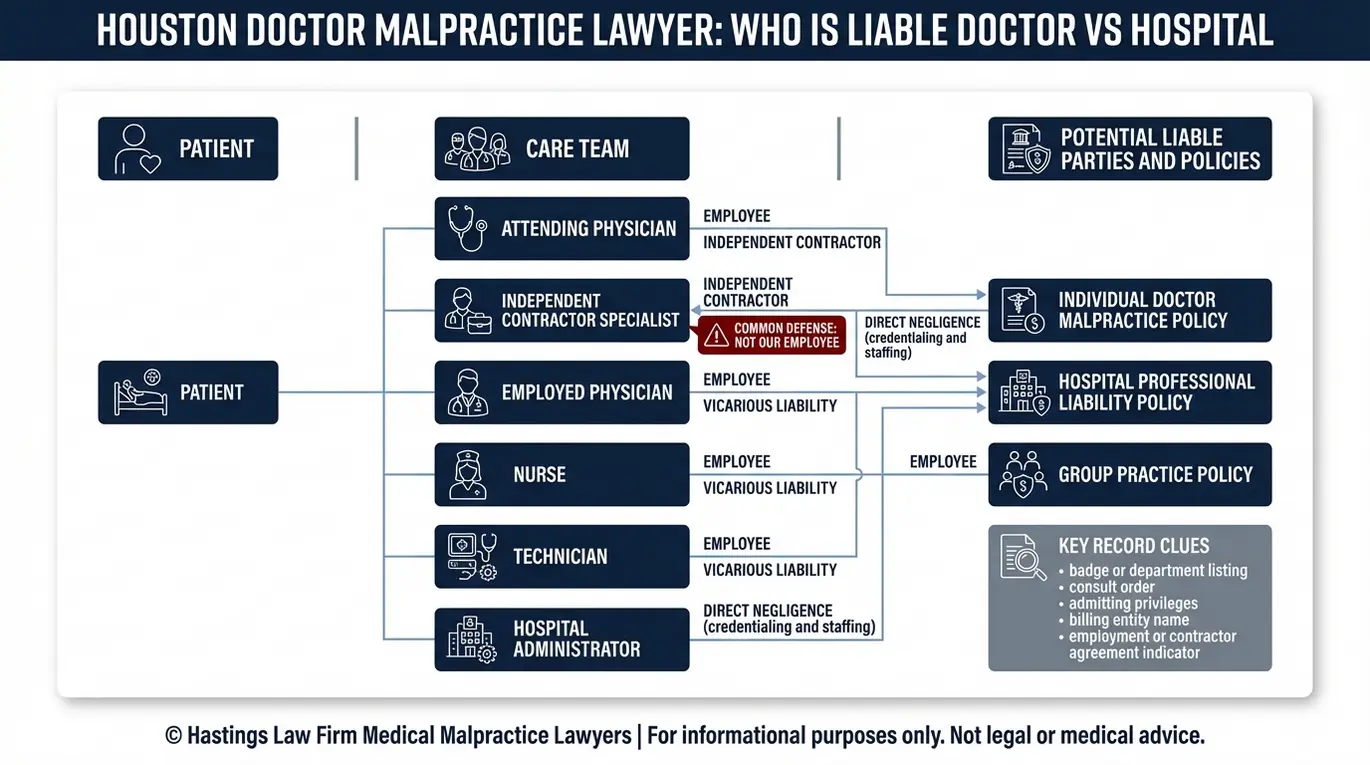
Liability depends on employment status. Liability refers to legal responsibility for harm. Hospitals are generally liable for the negligence of their employees, while private practice doctors typically carry their own independent malpractice insurance policies. This distinction matters because it affects who you can sue and which insurance policy must respond to your claim.
An independent contractor physician practices inside a hospital but is not technically employed by that facility. When a patient is harmed, the hospital may argue it bears no responsibility. This argument often limits the hospital’s liability, even though the patient had no say in which doctor treated them. Vicarious liability means the hospital is legally responsible for the actions of its staff.
| Factor | Hospital-Employed Doctor | Independent Contractor Doctor |
|---|---|---|
| Liability | Hospital may be directly liable | Doctor carries personal liability |
| Insurance | Hospital’s policy typically covers | Doctor’s own malpractice policy applies |
| Common Defense | Rarely disputes employment status | Hospital claims no responsibility |
| Liability for Staff | Often applies to nurses and staff | Must be evaluated case by case |
Credentialing and privileging is the process by which a hospital reviews a doctor’s qualifications. This process can become relevant in cases of catastrophic injury. A hospital may share responsibility if it grants permission to a doctor with a history of errors found in their medical records. This is known as hospital liability. As attorneys specializing in these cases, we trace these relationships to identify every responsible party.
Common Medical Errors Committed by Houston Physicians
The most frequent physician errors involve diagnostic failures, surgical mistakes, and medication administration problems that result in preventable patient harm. Medical errors are preventable mistakes made by healthcare providers. While each case is different, certain patterns appear repeatedly in malpractice claims across Houston.
Diagnostic errors are among the most common. These include misdiagnosis or delayed diagnoses of conditions like cancer, heart attacks, and stroke. When a physician fails to order the right tests or ignores symptoms, the patient may lose critical treatment time.
Surgical errors can range from wrong-site surgery to a retained surgical item (RSI), which is an object accidentally left inside a patient. Anesthesia errors during surgery can also lead to catastrophic outcomes, including brain damage or death. Mistakes often follow poor communication or fatigue. These errors violate the strict protocols meant to keep patients safe.
Treatment and medication errors involve prescribing incorrect dosages or medications that conflict with a patient’s known allergies. These mistakes are often preventable with proper chart review and medication reconciliation.
Birth injuries represent another significant category. Failing to recognize fetal distress or delaying a C-section can cause permanent harm to both mother and child. Suing a doctor for a birth injury requires a careful review of delivery records. We analyze the timeline and fetal monitoring strips to find answers.
Distinction Between a Birth Injury and a Birth Defect
We must distinguish between a birth injury, a preventable harm caused by medical negligence during pregnancy, labor, or delivery, and a birth defect, a genetic or developmental condition that occurs naturally and is not caused by a doctor’s actions. This distinction is critical because causation must be proven; only injuries caused by negligence support a legal claim. Our team works with qualified expert witnesses to examine medical records and determine whether the harm was avoidable.
Proving Negligence Against a Physician in Texas
Proving negligence requires credible evidence supported by expert testimony from a similarly qualified medical professional. This process means showing a doctor failed to provide proper care. In Texas, a bad outcome alone is not enough to prove negligence; you need an expert who can explain what should have happened.
Here is how we approach the investigation process:
- Gathering and reviewing medical records. We obtain the complete medical file, including physician notes and nursing charts. Our in-house medical staff includes nurse practitioners who review these records to identify inconsistencies or gaps in documentation.
- Identifying charting inconsistencies. Medical records sometimes contain entries that were altered or added after the fact. These inconsistencies can be significant evidence, often revealing attempts to cover up a mistake once the harm became apparent.
- Retaining qualified expert witnesses. Under Texas Civil Practice and Remedies Code § 74.351, a detailed expert report must be submitted within 120 days after the date the defendant’s original answer is filed. If this deadline is missed, the case is dismissed. The expert must explain how the standard of care was violated and how that violation caused the injury.
- Building the causation analysis. Building the causation analysis involves connecting the breach to the injury. Our experts evaluate whether the outcome would have been different if the doctor had followed the appropriate standard of care.
We prepare every case with this level of detail from day one. Medication reconciliation is the process of verifying that a patient’s medications are documented and managed correctly. This is just one detail we examine when building a case.
Compensation Available in a Malpractice Lawsuit
Patients harmed by physician negligence may recover economic damages for financial losses and non-economic damages for the physical and emotional impact of the injury. Compensation is money awarded to cover losses from an injury. Understanding what compensation is available, and how Texas law limits certain categories, is an important part of evaluating your case.
Economic damages are the measurable financial costs of an injury. These include:
- Past and future medical bills
- Lost wages and lost earning capacity
- Rehabilitation and long-term care costs
- Home modifications or assistive devices
These damages are not capped under Texas law, meaning there is no legal limit on the amount a jury can award for documented financial losses.
Non-economic damages address the less tangible consequences of the injury, such as pain and suffering and mental anguish. Under Texas Civil Practice and Remedies Code § 74.301, these damages are subject to a statutory cap, generally limited to $250,000 per claimant against all physicians and individual healthcare providers. This cap applies regardless of the severity of the injury, which can feel unjust to clients and their families.
Because of these caps, a Houston doctor malpractice law firm must thoroughly document every economic loss. We demonstrate the financial impact of the injury through medical billing records and life care plans. This helps build a path to a fair settlement or verdict.
Statute of Limitations for Filing Suit Against a Doctor
In Texas, the general statute of limitations for medical malpractice is two years from the date of the negligence or the date the injury was discovered. The statute of limitations is the legal deadline for filing a case. Missing this deadline almost always results in losing the right to file a lawsuit.
Texas also imposes a statute of repose, which sets an absolute limit of ten years from the medical error. A statute of repose is a strict deadline that cuts off the right to sue regardless of when the harm was discovered. Even if the injury could not have been discovered within two years, no claim may be filed after ten years. There are limited exceptions for minors and individuals who are legally incapacitated.
Patients must provide written notice to healthcare providers 60 days before filing a suit. This notice temporarily pauses the statute of limitations if it is sent correctly and on time. A doctor malpractice attorney can make sure these procedural requirements are met so your claim is not dismissed on a technicality.

Seeking Justice for Wrongful Death Caused by a Doctor
A wrongful death claim allows surviving family members to seek compensation when a doctor’s negligence results in the loss of a loved one. A wrongful death claim is a case filed when someone dies due to negligence. Losing a family member to a preventable medical error is a devastating experience, and the legal system provides a path for accountability.
Under Texas law, the surviving spouse, children, and parents of the deceased may file a claim. These claims may include damages for loss of companionship, mental anguish, and funeral expenses.
If you have lost someone you love because of a physician’s failure, a Houston doctor malpractice lawyer at our firm can help you understand your rights. We evaluate whether the evidence supports a wrongful death case.
Contact the Houston Doctor Malpractice Attorneys at Hastings Law Firm Today for Help
Hastings Law Firm is dedicated exclusively to medical malpractice. We do not split our attention across unrelated practice areas. Every member of our team is focused on holding negligent physicians accountable for the harm they cause.
If something went wrong during your medical care and you are not getting answers, we are here to listen. Hastings Law Firm includes professionals who once worked inside the systems we now challenge, including former defense counsel. This gives us insight into hospital protocols that most firms do not have.
Consultations are free and confidential. You pay no attorney fees or costs unless we recover compensation on your behalf. If you are looking for a Houston doctor malpractice lawyer who will take the time to understand what happened, contact us today.
Frequently Asked Questions About Doctor Malpractice in Houston


This content was researched and written by the Hastings Law Firm editorial team, which includes attorneys, medical professionals, and experienced researchers. Our writing is informed by internal knowledge and practical experience, and we cross-check critical details against authoritative sources cited throughout. Every piece undergoes human-led fact-checking and legal review. Because legal and medical information can change, if you spot an error, please contact us. Learn more about our content standards and review process on our editorial policy page.

Tommy Hastings, founder of Hastings Law Firm, is a board-certified personal injury trial lawyer dedicated exclusively to healthcare injury cases. Since 2001, he has represented injured patients and families in litigation against major hospital systems, pharmaceutical companies, and negligent healthcare providers nationwide. He has handled numerous high-profile cases that have drawn national media attention and resulted in multi-million dollar recoveries. He draws on that experience in his writing, helping readers understand how these cases work and what options may be available to them.
