


Texas Orthopedist Malpractice Lawyer
Orthopedic malpractice claims often arise when a preventable error during diagnosis, treatment, or surgery causes lasting harm. Patients may face worsening pain, loss of mobility, additional procedures, and long term disability that affects work and daily life. Texas law draws a line between a known surgical risk and negligence tied to a breach of the standard of care and causation. Understanding common orthopedic errors, the role of medical records and imaging, and how damages are categorized can clarify what happened. If you or a loved one were harmed or worse due to orthopedist malpractice in Texas, contact Hastings Law Firm for a free, confidential case review.

Last Updated: July 27, 2026
Trial-Ready Legal Representation for Orthopedic Surgery Injuries
When you trust an orthopedic surgeon with your care, you expect to leave the operating room on a path toward recovery. If that trust was broken by a preventable error, the physical and emotional toll can be overwhelming. You may be dealing with worsening pain, an unexplained loss of mobility, or the prospect of additional surgeries you never planned for.
You deserve answers about what went wrong, and you have the right to hold the responsible parties accountable. As a Texas orthopedist malpractice lawyer, Tommy Hastings and the legal-medical team at Hastings Law Firm focus exclusively on representing patients harmed by medical negligence. We understand the medicine behind your injury, and we know how to build a case that reflects the full scope of what you have lost.
If you believe an orthopedic surgeon’s error changed your life, we are here to listen. Contact us for a free, confidential case evaluation to learn more about your options.

Understanding Orthopedic Malpractice and Negligence in Texas
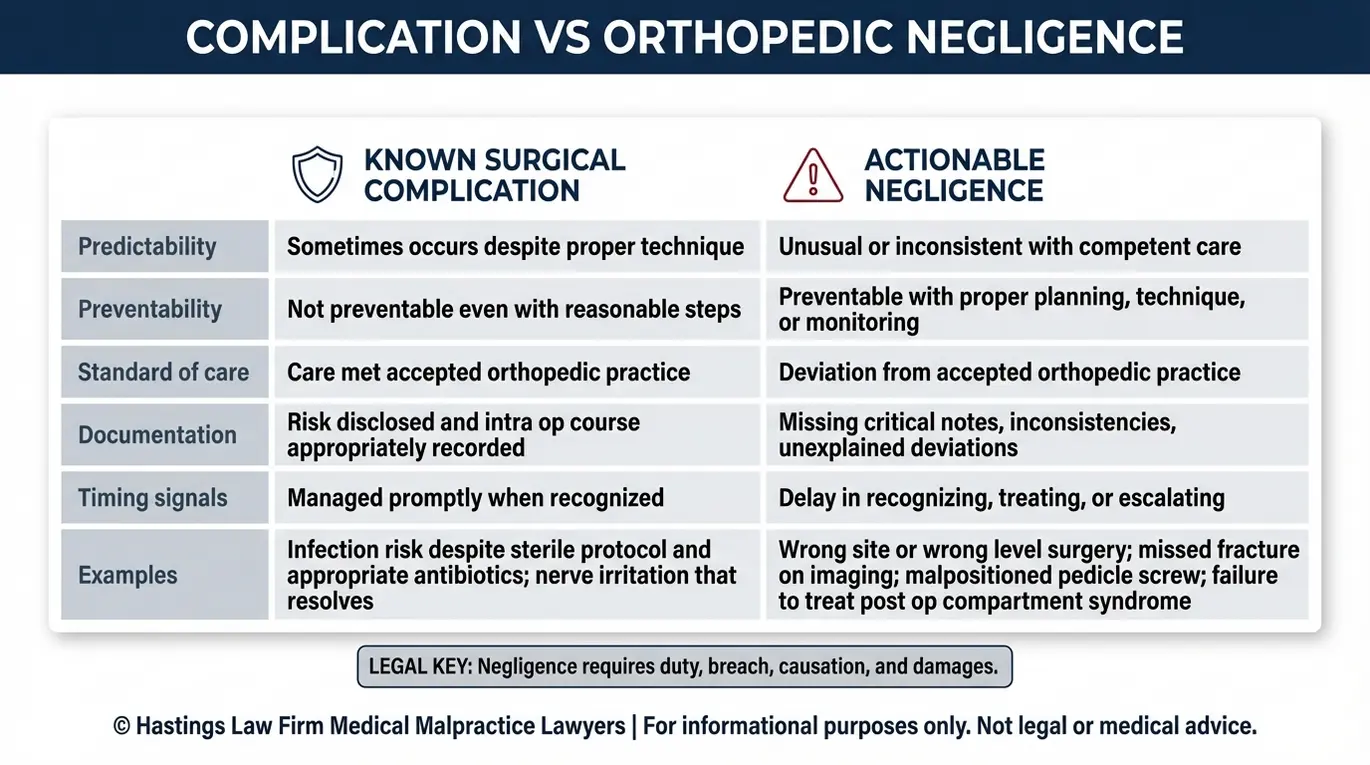
Orthopedic malpractice occurs when a surgeon or specialist deviates from the accepted standard of care during the diagnosis, treatment, or surgical management of a musculoskeletal injury, and that deviation causes harm to the patient. Negligence in a medical context refers to a failure to act with the level of care that a similar professional would have used. Not every disappointing outcome after surgery qualifies as negligence. The distinction between the two is at the center of every orthopedic malpractice case.
When you see an orthopedist, a legal duty of care is established. That duty requires the surgeon to provide treatment consistent with what a reasonably competent orthopedic specialist would deliver under similar circumstances. This is the standard of care, and it applies to everything from reading an X-ray to placing hardware during a spinal fusion.
A breach of that standard occurs when the surgeon’s actions fall below what the medical community expects. To have a viable claim, there must also be causation, meaning the breach directly caused or contributed to your injury. In legal terms, we must establish proximate cause to link the surgeon’s failure directly to the damages you suffered.
A known complication that occurs despite proper technique is a recognized surgical risk. But when a surgeon makes an avoidable mistake, like operating on the wrong spinal level or failing to identify a fracture on imaging, the outcome may cross the line from unfortunate to actionable.
Cases involving malpractice by an orthopedist are medically complex and defended by insurance companies. Proving that a doctor failed to meet the standard of care often requires dissecting years of medical history and surgical protocols. Texas medical malpractice claims are governed by specific procedural requirements outlined in the Texas Civil Practice and Remedies Code Chapter 74.051. These rules set timelines and evidentiary standards that must be met before a case can move forward. An experienced orthopedic malpractice lawyer can help you understand whether the facts of your situation meet this legal threshold.
Common Errors Committed by Orthopedic Surgeons
Common orthopedic errors include performing surgery on the wrong site, improper placement of hardware like pedicle screws, failure to diagnose fractures on imaging, and post-operative negligence leading to infection or nerve damage. Surgical errors often involve deviations from established safety protocols in the operating room. These errors can leave patients with permanent disabilities that require years of corrective treatment. Taking legal action against a Texas orthopedist for these mistakes requires a deep understanding of surgical procedures and protocols.
Orthopedic negligence generally falls into three broad categories: surgical errors, diagnostic failures, and hardware-related mistakes. Skilled orthopedist malpractice attorneys often uncover these errors during a detailed review of the operative reports.
Surgical errors include operating on the wrong body part or the wrong side, damaging surrounding structures during a procedure, or failing to manage complications in real time. One well-documented example involves injury to the peroneal nerve, the nerve that runs along the outside of the knee, during knee replacement surgery. Damage to this nerve can cause foot drop, a condition where the patient loses the ability to lift the front of the foot, often resulting in permanent gait problems.
Diagnostic failures occur when a surgeon or radiologist misreads or overlooks findings on diagnostic imaging. A fracture that is visible on an X-ray, CT scan, or MRI but goes undiagnosed can lead to improper treatment, delayed healing, or worsening structural damage. In some cases, a misdiagnosis or delayed diagnosis allows a treatable injury to progress into something far more serious.
Hardware-related mistakes are particularly common in joint and spine procedures. Joint arthroplasty, the surgical reconstruction or replacement of a joint such as a hip replacement or knee replacement, requires precise component positioning. When implants are misaligned, patients may experience chronic pain, instability, or early implant failure requiring revision surgery. Unfortunately, patients affected by what is colloquially called bone doctor negligence often face a lifetime of pain due to these preventable technical failures.
The Texas Tech University Health Sciences Center Patient Handbook outlines patients’ rights to safe, competent medical care and informed consent, both of which are directly relevant when evaluating whether an orthopedist met the expected standard.
Red flags that may indicate orthopedic negligence include:
- Worsening pain or new symptoms that were not present before surgery
- Loss of function, sensation, or mobility in the affected limb
- Imaging that reveals misplaced hardware, wrong-site surgery, or a previously missed fracture
- Post-operative infection that developed due to inadequate sterile technique or follow-up care
- A second surgeon recommending revision surgery to correct errors from the first procedure
Spine Surgery Mistakes and Hardware Malposition
Spine surgery carries inherently high risks, and even small errors can produce serious outcomes. Surgical interventions on the spine require precise identification of anatomy to prevent nerve damage. One of the most serious mistakes is wrong-level spine surgery, where a surgeon operates on the incorrect vertebral segment, such as performing a laminectomy at L4 instead of the intended L5. This error means the patient endures an invasive procedure that provides no benefit while the actual problem remains untreated.
Pedicle screw malposition, where screws meant to stabilize the spine are placed outside their intended bony corridor, is another significant concern in lumbar fusion procedures. Misplaced pedicle screws can impinge on nerve roots, damage the spinal cord, or fail to provide adequate stabilization, sometimes leading to allograft spacer migration or hardware failure. These errors are often identifiable on post-operative imaging and may require additional corrective surgeries.

The Hastings Law Firm Difference
Results matter, but what truly sets us apart is how we achieve them. Every verdict, every settlement, and every Texas courtroom victory comes from one guiding promise: To treat each client’s fight for justice as if it were our own.
This balance of skill, experience, and empathy reflects our core philosophy that justice should not only compensate the injured, but also make health care safer nationwide.

Proving Negligence in Orthopedic Injury Cases
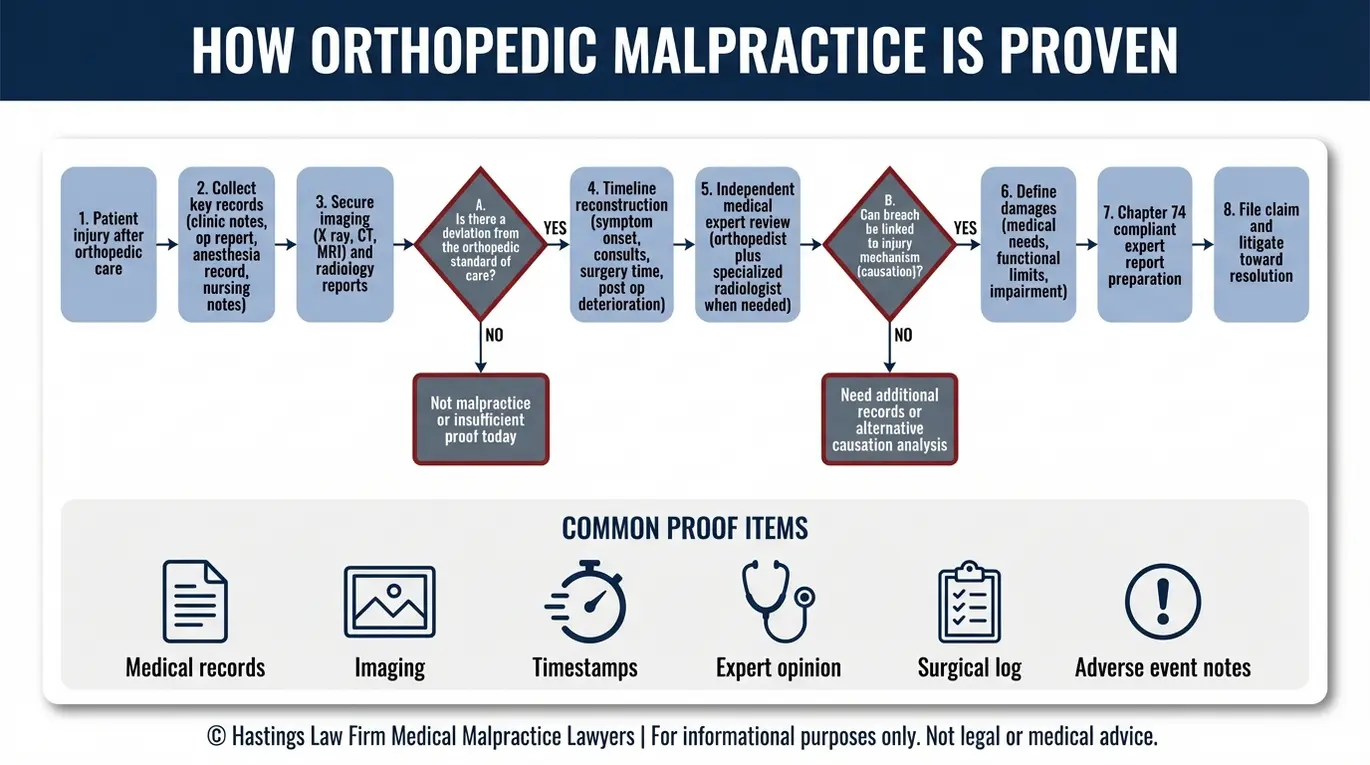
Proving negligence requires clear evidence that the doctor breached the standard of care, typically established through medical records, imaging studies, and testimony from qualified medical expert witnesses. A legal claim for negligence relies on establishing that a specific duty was owed and then breached. Without this evidence, even a case with obvious injuries may not survive the legal process.
Under Texas law, a plaintiff must serve a qualified expert report within 120 days after the date each defendant files an original answer in a medical malpractice lawsuit. This requirement, codified in the Texas Civil Practice and Remedies Code, Chapter 74.051, means your legal team needs access to credible medical experts from the very start of your case. A Texas orthopedist malpractice lawyer who handles these claims regularly will already have relationships with the right specialists.
Finding the right malpractice counsel is important because building these claims requires significant labor. Medical records and surgical operative notes form the foundation of every orthopedic malpractice case. These documents create a timeline of decisions: what the surgeon saw, what they planned, what they did, and what happened afterward.
Gaps, inconsistencies, or missing documentation in these records can be just as telling as what is written down. An experienced orthopedic injury attorney knows how to spot these discrepancies.
Imaging is often the most powerful piece of evidence in orthopedic cases. Pre-operative and post-operative X-rays, CT scans, and MRIs allow experts to reconstruct what happened during a procedure or evaluate whether a misdiagnosis or delayed diagnosis occurred.
Key evidence our team examines when building an orthopedic injury claim:
- Pre-operative imaging and diagnostic workups
- Surgical operative reports and anesthesia records
- Post-operative imaging showing hardware placement or structural changes
- Nursing notes and post-surgical monitoring records
- Physical therapy progress notes and rehabilitation records
- Testimony from qualified orthopedic expert witnesses
Using Specialized Radiologists to Interpret Imaging
Not all imaging reviews are created equal. A general radiologist may miss subtle orthopedic findings that a specialist would catch. Specialized imaging reviews focus on structural details that a general evaluation might overlook. An occult fracture, a break that is not immediately visible on standard imaging, can be easy to overlook without the trained eye of a musculoskeletal radiologist.
Our legal team works with specialized orthopedic radiologists who re-examine X-rays, CT scans, and MRIs for findings that may have been missed or misinterpreted during initial treatment. This specialized malpractice review is essential for uncovering the truth. They also evaluate post-operative diagnostic imaging for signs of hardware migration, where screws, plates, or other implants shift from their intended position over time. This level of focused review can make the difference between a strong claim and one that falls short of proving causation.
Compensation for Orthopedic Injuries and Damages
Patients harmed by orthopedic malpractice may recover economic damages for medical bills and lost wages, as well as non-economic damages for pain, suffering, physical impairment, and disfigurement. Damages in these cases are designed to compensate the patient for losses resulting from the error. The value of a claim depends on the severity of the injury and how it affects the patient’s daily life and ability to earn a living. Securing fair compensation for surgeon negligence is important for your future security.
Texas law recognizes two primary categories of recoverable damages:
| Economic Damages | Non-Economic Damages |
|---|---|
| Past and future medical expenses (including revision surgery, the follow-up procedure needed to correct a prior surgical error) | Physical pain and suffering |
| Lost wages and lost earning capacity | Mental anguish and emotional distress |
| Costs of rehabilitation and physical therapy | Physical impairment and loss of mobility |
| Home modifications or assistive devices | Disfigurement and scarring |
| In-home care and nursing costs | Loss of enjoyment of life |
Economic damages are not capped under Texas law. Non-economic damages, however, are subject to limits set by the Texas Civil Practice and Remedies Code Chapter 74. A lawyer for orthopedic malpractice can help you understand how these caps may apply to your specific situation.
Calculating future medical costs is especially important in orthopedic cases. A patient who develops foot drop, the inability to lift the front of the foot due to nerve damage, may require bracing, physical therapy, and possible surgical intervention for years. Revision surgeries alone can cost tens of thousands of dollars, and the need for them may not become apparent until months or years after the original procedure. This financial burden is compounded by the risk of permanent injury and disability, which can strip a patient of their independence.
Biomechanical Forces and Long-Term Disability
A primary orthopedic injury does not always remain static. In some cases, the initial harm sets off a chain of biomechanical forces that evolve into more complex conditions over time. Physical injuries can cause secondary conditions that impact long-term health and mobility. Complex Regional Pain Syndrome (CRPS), a chronic condition characterized by severe, burning pain that is disproportionate to the original injury, can develop after nerve damage or surgical trauma. Post-traumatic arthritis, the accelerated deterioration of a joint following injury or surgical error, is another condition that may emerge months or years later.
These secondary conditions can significantly increase the long-term value of a claim because they affect the patient’s quality of life, ability to work, and future medical needs. Documenting this progression early, with the help of qualified medical experts, is essential for building a compensation claim that accounts for the full picture of harm.
Why Choose Hastings Law Firm for Your Orthopedic Claim
Hastings Law Firm offers a combination of board-certified trial experience, in-house medical expertise, and a trial-ready approach that gives your orthopedic malpractice claim the foundation it needs from day one. We do not handle car accidents, slip-and-fall cases, or general personal injury. We are a dedicated medical negligence firm, and that singular focus shapes everything we do.
Founder Tommy Hastings is Board Certified in Personal Injury Trial Law by the Texas Board of Legal Specialization, a distinction held by fewer than 2% of Texas attorneys. He has secured multi-million-dollar results for patients harmed by surgical errors, diagnostic failures, and dangerous medical products. His team includes former defense attorneys who understand how hospitals and their insurers build their cases, along with in-house nurse consultants who can interpret clinical records and identify where the standard of care broke down.
As a Texas orthopedist malpractice lawyer, Tommy prepares every case as if it will go to trial. That preparation signals to the opposing side that we will not accept less than fair compensation for our clients. Insurance companies know which firms settle and which firms are truly trial-ready. Because we work on a contingency fee basis, you pay no attorney fees or costs unless we recover for you. This allows you to pursue justice without financial risk, knowing you have a powerful advocate in your corner.
Contact the Texas Doctor Malpractice Attorneys at Hastings Law Firm Today for Help
Texas law places strict time limits on medical malpractice claims, and evidence can become harder to obtain as time passes. Acting early gives your legal team the best opportunity to preserve records, secure expert opinions, and build a strong case.
At Hastings Law Firm, our mission is to restore trust for patients who have been let down by the healthcare system. If you or a loved one was harmed by an orthopedic surgeon’s error, we want to help you find answers and protect your future.
Contact a Texas orthopedist malpractice lawyer at Hastings Law Firm today to schedule your free, confidential case evaluation. A patient advocate is ready to listen to your story and explain your options. There is no fee unless we win.
Frequently Asked Questions About Orthopedist Malpractice in Texas


This content was researched and written by the Hastings Law Firm editorial team, which includes attorneys, medical professionals, and experienced researchers. Our writing is informed by internal knowledge and practical experience, and we cross-check critical details against authoritative sources cited throughout. Every piece undergoes human-led fact-checking and legal review. Because legal and medical information can change, if you spot an error, please contact us. Learn more about our content standards and review process on our editorial policy page.

Brady D. Williams is a nationally recognized medical malpractice attorney who has spent his career handling high-stakes litigation for injured patients and families across the country. Licensed in both Texas and California, Brady draws on experience from hundreds of resolved medical cases to break down complex legal and medical topics for the people who need that information most. His writing reflects the same attention to detail and commitment to clarity that he brings to every case he handles.
