


Texas Radiation Oncologist Malpractice Lawyer
Radiation therapy can be life saving when it is planned and delivered correctly, but mistakes in dosing, calibration, or treatment delivery can cause severe and lasting injury. Some harm appears right away, while other radiation injuries emerge months or years later and can be hard to separate from expected side effects. Responsibility may involve multiple parties, including the prescribing physician, the medical physicist, the facility, or a device maker. If you or a loved one were harmed or worse due to radiation oncologist malpractice in Texas, contact Hastings Law Firm for a free, confidential case review.

Last Updated: July 27, 2026
Trusted Legal Representation for Oncological Negligence in Texas
Radiation therapy is one of the most powerful tools in cancer treatment. It uses ionizing radiation, a form of energy strong enough to damage DNA in targeted cells, to destroy cancerous tissue. When delivered correctly, it can save lives. But when errors occur in planning, dosing, or delivery, the same energy that should heal can cause devastating, irreversible harm.
If you or someone you love suffered unexpected injuries during or after radiation treatment, you may be dealing with more than a known side effect. You may be dealing with medical negligence. Sorting out what went wrong and who is responsible requires medical knowledge and legal skill that most firms do not have.
As a Texas radiation oncologist malpractice lawyer team, Hastings Law Firm focuses exclusively on medical malpractice. Our founder, Tommy Hastings, is board-certified in Personal Injury Trial Law, a distinction held by less than 2% of Texas attorneys. Our legal team includes in-house nurses and former defense attorneys who understand how these cases are built, challenged, and won. If something about your treatment doesn’t feel right, we can review what happened and explain your options in a free, confidential evaluation.

Distinguishing Normal Side Effects from Radiation Injury Symptoms
Radiation injury symptoms differ from normal side effects by their severity, timing, and location. Radiation therapy is a common cancer treatment that uses high-energy rays to destroy cancer cells and shrink tumors. Mild skin redness or fatigue is expected, but deep tissue damage, skin ulcers, or harm to organs outside the treatment field is not.
Radiation therapy works by delivering controlled doses of ionizing radiation to a tumor. While this causes managed cell death in cancer tissue, the National Cancer Institute lists side effects like skin irritation, swelling, and localized soreness as common and typically temporary.
Malpractice involving radiation crosses a different line. Instead of controlled damage, the patient experiences excessive DNA destruction in healthy tissue. This can result in severe skin burns, soft tissue necrosis (the death of healthy tissue that fails to heal), or organ damage far from the intended treatment site. The American Cancer Society Journals detail how radiation therapy toxicity, when it goes beyond expected parameters, often points to errors in dose planning or delivery.
We investigate latent radiation injury, meaning damage that does not appear for months or even years after treatment ends. Internal organ deterioration, chronic wounds, or secondary cancers in the radiation field can emerge long after the last session. Delayed injuries require a thorough review of your medical records and treatment history by a qualified radiation injury lawyer who understands the science behind these claims.
Here is a general comparison to help you recognize the difference:
| Expected Side Effect | Potential Sign of Malpractice |
|---|---|
| Mild redness or skin irritation at the treatment site | Severe burns, blistering, or open wounds at or beyond the treatment area |
| Temporary fatigue during treatment | Chronic exhaustion persisting long after therapy ends |
| Localized soreness or swelling | Pain or tissue breakdown in organs not targeted by the beam |
| Gradual skin darkening in the treatment zone | Burns appearing on the wrong part of the body |
| Manageable nausea (abdominal radiation) | Unexplained internal organ failure or hemorrhage |
If any of these red flags match your experience, an oncologist negligence claim may be worth investigating. Our medical and legal teams work together to compare your treatment records against what the standard of care required.
The Fine Line Between Aggressive Treatment and Negligent Overdose
Some cancers demand aggressive radiation protocols. A higher-than-typical dose does not automatically mean something went wrong. A radiation oncologist must carefully manage the dose to maximize cancer cell death while protecting healthy tissue, and we evaluate whether your dosage crossed into a deviation from the standard of care.
Radiation dose is measured in units called Gray (Gy), which quantify the amount of energy absorbed by the body. Treatment is typically broken into sessions through a process known as dose fractionation, which spreads the total dose over days or weeks to give healthy tissue time to recover. When an expert reviews a potential malpractice case, they examine whether the prescribed dose per fraction was appropriate and whether the total dose exceeded safe limits. A dosage that might be acceptable for one type of tumor could be reckless for a different site.

Common Causes of Radiation Therapy Errors and Negligence
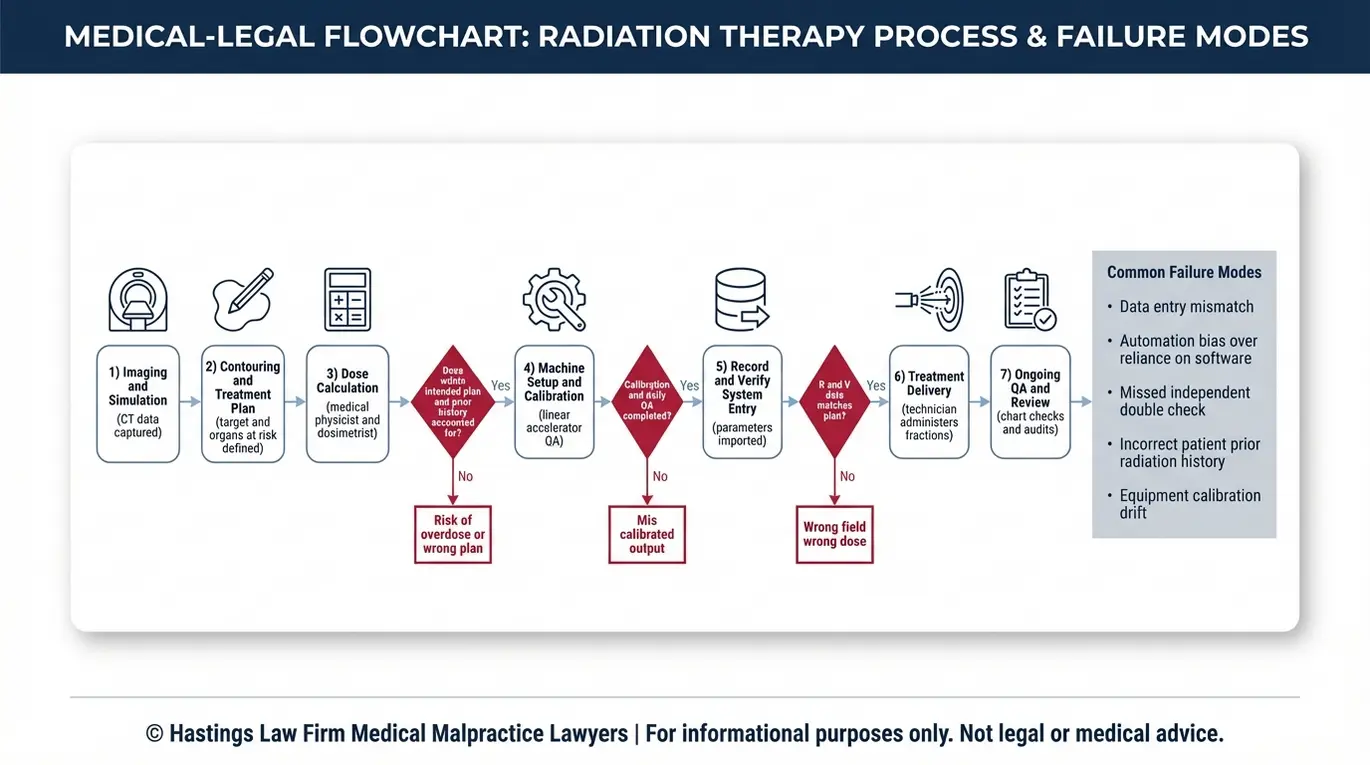
Radiation therapy errors often stem from human error during calibration, software glitches in Record-and-Verify systems, or a failure to account for a patient’s prior radiation history. Medical professionals must follow strict safety protocols to ensure the radiation equipment delivers the exact prescribed dose. Any one of these breakdowns can lead to dangerous radiation overexposure in a short period.
To understand how these errors happen and before suing a radiation oncologist, it helps to know who is involved. The radiation oncologist prescribes the treatment plan, while a medical physicist verifies machine accuracy and ensures the plan is technically sound. A dosimetrist helps design the treatment geometry, and a radiation therapy technician operates the equipment during each session. A mistake by any member of this team can cause serious harm, which our legal team will investigate thoroughly.
Here are some of the most common failure points we investigate in a radiation error lawsuit:
- Incorrect equipment calibration: When the linear accelerator or delivery device is not properly calibrated, it may deliver far more radiation than intended. As outlined by AAPM Task Group 142, regular quality assurance testing is essential to safe operation.
- Software or Record-and-Verify failures: Record-and-Verify (R&V) systems are automated programs used to double-check treatment parameters. When this technology malfunctions, every subsequent session may repeat the same error. PSNet’s primer on Radiation Safety highlights how these system-level failures compound quickly.
- Exceeding lifetime radiation limits: Every patient has a cumulative threshold for how much radiation their body can safely tolerate. A radiation overdose can occur when a provider fails to review a patient’s full treatment history. This error is especially dangerous because it can eliminate future treatment options for the patient’s cancer.
System Failures and Technology Over-Reliance
A recurring theme in radiation malpractice cases is over-reliance on automated systems. Technology like Record-and-Verify systems helps prevent human error but requires regular manual checks for accuracy. When technicians trust the system without performing independent safety checks, software malfunctions go undetected.
Imaging scans like a CT scan guide the radiation beam, so any initial error in the imaging data can lead to repeated mistakes during therapy. If no one catches the error manually, the machine delivers the wrong plan session after session. We investigate this kind of automation bias by reviewing daily quality assurance logs and maintenance records.
The Hastings Law Firm Difference
Results matter, but what truly sets us apart is how we achieve them. Every verdict, every settlement, and every Texas courtroom victory comes from one guiding promise: To treat each client’s fight for justice as if it were our own.
This balance of skill, experience, and empathy reflects our core philosophy that justice should not only compensate the injured, but also make health care safer nationwide.

Determining Liability in Radiation Oncology Malpractice Cases
Liability in radiation cases is often shared among the radiation oncologist, the medical physicist who calculated the dose, the facility responsible for equipment maintenance, and potentially the device manufacturer. Chapter 74 is the primary Texas law governing medical malpractice, establishing the rules for how patients must prove their case.
Texas law does not limit your claim to a single defendant. Under Texas Civil Practice and Remedies Code Chapter 74, you can name every party whose negligence contributed to the injury. In some cases, the oncologist bears direct responsibility under the “Captain of the Ship” doctrine, where the prescribing physician is accountable for the treatment plan. In others, the hospital or clinic is liable for systemic failures like poor maintenance or inadequate staffing.
Our team examines whether the harm resulted from a decision error by the treating physician or a calculation error by the medical physicist. We also look for facility-level system failures. If defective equipment or faulty software contributed to the injury, we evaluate potential product liability claims against the manufacturer. This layered investigation is one reason families seeking legal help for radiation injury need a radiation oncologist malpractice lawyer with dedicated medical malpractice experience.

Contact the Texas Doctor Malpractice Attorneys at Hastings Law Firm Today for Help
Radiation injuries caused by medical negligence can alter the course of your life and your family’s future. If you are living with unexplained pain, tissue damage, or the loss of someone you love after radiation treatment, you deserve honest answers about what happened.
Hastings Law Firm focuses exclusively on medical malpractice litigation. Every case we accept is prepared from day one as though it will go before a jury because that level of preparation is what produces results. Our team of attorneys, in-house nurses, and medical consultants will review your treatment records and identify where the standard of care may have been violated.
We charge no fee unless we recover compensation for you. Contact us today for a free, confidential case evaluation. Let us help you find the answers you deserve.
Frequently Asked Questions About Radiation Oncologist Malpractice in Texas


This content was researched and written by the Hastings Law Firm editorial team, which includes attorneys, medical professionals, and experienced researchers. Our writing is informed by internal knowledge and practical experience, and we cross-check critical details against authoritative sources cited throughout. Every piece undergoes human-led fact-checking and legal review. Because legal and medical information can change, if you spot an error, please contact us. Learn more about our content standards and review process on our editorial policy page.

Gabe Sassin has focused exclusively on medical malpractice law since 2007. After spending more than a decade as a malpractice defense attorney, he knows exactly how the other side works. He has seen firsthand how healthcare providers, insurers, corporate defendants, and their legal teams think, prepare, and build their defense against claims. That knowledge works for the people who need it most today, injured patients and their families. His unique experience shapes everything he writes, giving readers a look at how these cases actually work from someone who has handled them from both sides.
