


Texas Endocrinologist Malpractice Lawyer
Endocrinologist malpractice can happen when a hormone specialist fails to diagnose a serious problem, makes a medication error, or does not act on abnormal lab results. The consequences can be severe and long lasting, especially when endocrine care depends on careful monitoring, accurate interpretation of testing, and timely treatment adjustments. These situations often involve disputes about whether the outcome was a recognized complication or a preventable error that fell below the accepted standard of care. If you or a loved one were harmed or worse due to endocrinologist malpractice in Texas, contact Hastings Law Firm for a free, confidential case review.
Last Updated: July 27, 2026
Trusted Legal Representation for Medical Specialist Negligence in Texas
When you trust a specialist with your hormonal health, you expect a level of care that matches their advanced training. If that trust has been broken by a misdiagnosis, a medication error, or a failure to act on abnormal lab results, the physical and emotional consequences can be severe and lasting. You may be dealing with a worsening condition that should have been caught, and you deserve to know whether what happened was preventable.
A Texas endocrinologist malpractice lawyer can help you understand whether your care fell below the accepted medical standard and what legal options may be available to you. At Hastings Law Firm, our team of attorneys, in-house nurses, and medical consultants focuses exclusively on medical malpractice. If you believe your endocrinologist’s care caused you harm, we can review what happened and explain your options in a free, confidential evaluation.

What Constitutes Malpractice by an Endocrinologist
Endocrinologist malpractice occurs when a hormone specialist deviates from the accepted medical standard of care, resulting in patient injury or death through misdiagnosis, medication errors, or failure to monitor. Not every poor outcome is malpractice. The distinction lies between a recognized complication and a preventable error caused by medical negligence that a Texas endocrinologist malpractice lawyer can help identify.
When a doctor-patient relationship is established, the endocrinologist takes on a duty of care, meaning they are legally obligated to provide treatment consistent with what a competent specialist would deliver under similar circumstances. A bad result from a properly managed treatment plan is not grounds for a claim. But when a specialist fails to order the right tests, misreads results, or ignores warning signs, the outcome may cross from unfortunate into actionable, requiring the attention of a Texas endocrinologist malpractice lawyer.
The endocrine system is the network of glands that produces and regulates hormones throughout the body. This complex network includes the thyroid, adrenal glands, pancreas, and pituitary gland. Conditions affecting these areas require careful interpretation of lab values and an understanding of how hormonal disorders interact with other body systems. This complexity is why these cases demand a Texas endocrinologist malpractice lawyer with access to qualified medical experts who can evaluate what went wrong.
Generalist physicians and even some attorneys may not recognize when a specialist’s care fell short. Metrics like Hemoglobin A1C, a blood marker that reflects average blood sugar control over two to three months, can reveal patterns of neglect that only a trained eye would catch. Our team at Hastings Law Firm includes in-house nurse consultants and medical staff who previously worked for the hospital systems we now challenge, giving us an insider’s view of how to read these records and identify where the standard was violated. A strong medical-legal foundation helps clarify these complex patterns if you are looking for an endocrinologist malpractice lawyer in Texas.
Common Errors Committed by Hormone Specialists
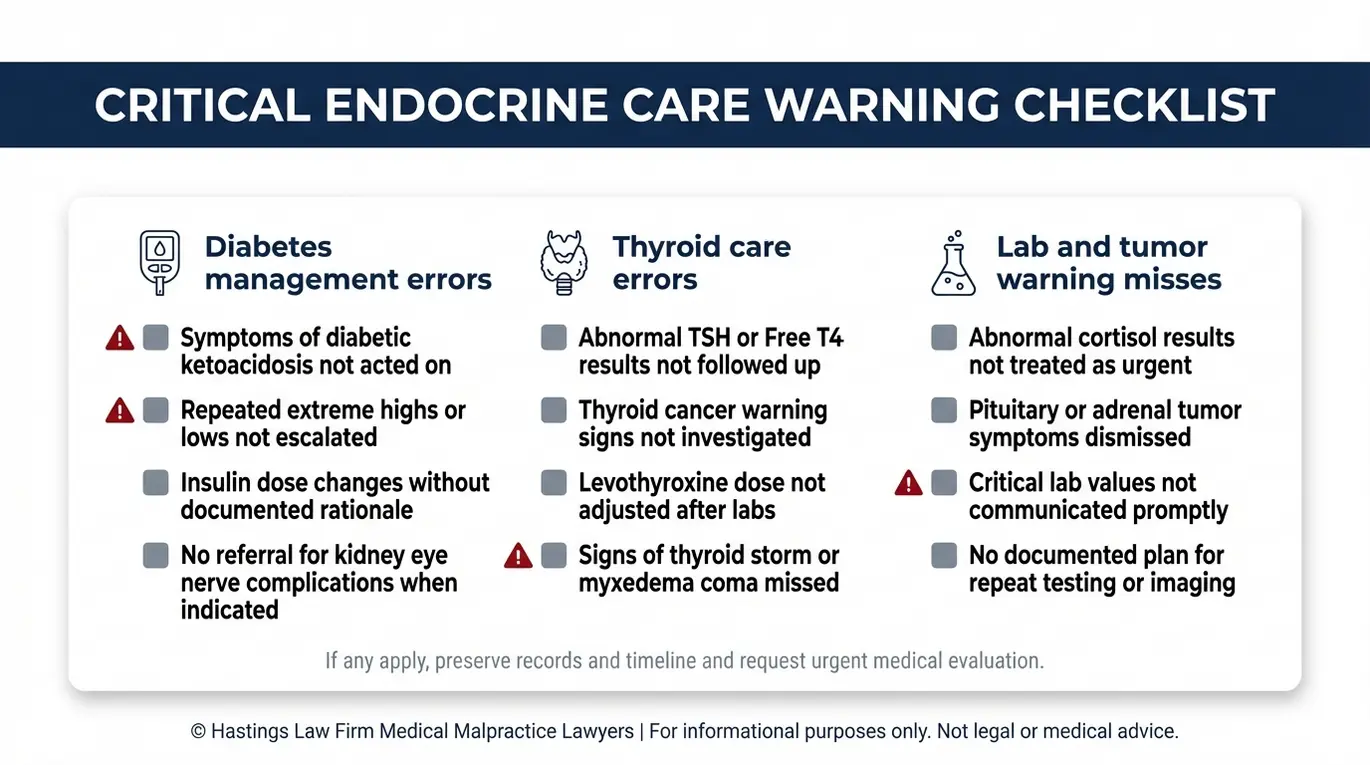
Frequent errors include failure to diagnose thyroid cancer, mismanagement of diabetes leading to ketoacidosis, improper insulin dosing, and missing signs of pituitary or adrenal tumors. These are not rare events, and they often lead patients to seek a Texas endocrinologist malpractice lawyer. They represent patterns our team sees repeatedly when reviewing endocrinology malpractice cases.
Diabetes Management Failures
Diabetes requires ongoing, proactive management of blood sugar levels. When an endocrinologist fails to monitor glucose levels, mismanages insulin dosing, or ignores signs of organ damage, patients can suffer life-threatening consequences. Diabetic ketoacidosis (DKA), a dangerous condition where the body produces dangerously high levels of blood acids due to insufficient insulin, is one of the most common results of negligent diabetes care. An insulin overdose can cause hypoglycemic coma, while chronic underdosing can lead to kidney failure, nerve damage, and vision loss.
The Centers for Disease Control and Prevention’s Diabetes Care Schedule outlines the testing and monitoring every diabetes patient should receive. When an endocrinologist fails to follow these guidelines, a delayed diagnosis of complications can result in irreversible harm. A Texas endocrinologist malpractice lawyer can evaluate whether your provider met these baseline monitoring requirements.
Thyroid Errors
Thyroid disease requires precise medication management and timely diagnostic follow-up. Misdiagnosis or delayed diagnosis of thyroid cancer can allow the disease to spread beyond the point of effective treatment. Improperly managed thyroid medication can trigger thyroid storm, a sudden and potentially fatal surge of thyroid hormones that causes dangerously high heart rate, fever, and organ failure. On the other end, severe undertreatment can lead to myxedema coma, a life-threatening state of extreme hypothyroidism. A Texas endocrinologist malpractice lawyer can review your records to determine if negligence occurred.
Lab Interpretation Failures
Abnormal lab values are the early warning system in endocrine care. When a specialist fails to act on elevated TSH levels, worsening A1C results, or abnormal cortisol readings, the window for effective treatment can close. Endocrine health relies on these blood markers to identify internal dysfunction and capture early warning signs of disease. These are the types of red flags we look for:
- Abnormal TSH or thyroid hormone levels left unaddressed across multiple visits
- Rising A1C values without medication adjustment or patient counseling
- Cortisol levels suggesting adrenal dysfunction that were never investigated
- Missed or delayed follow-up on imaging that showed a nodule or mass
- Failure to refer a patient to an oncologist or other specialist when test results warranted it
A lawyer for endocrinologist malpractice will work alongside medical experts to determine whether these warning signs were present and ignored. At Hastings Law Firm, our in-house nurse consultants and board-certified patient advocates review your records with the same clinical eye that should have been applied to your care in the first place.
Training and Specialization Standards for Endocrinologists
Endocrinologists complete years of rigorous training beyond medical school, including an internal medicine residency and a dedicated endocrinology fellowship. This advanced education covers the full spectrum of glandular disorders, from pancreas dysfunction and diabetes management to rare conditions affecting the pituitary and adrenal glands. Fellowships are specialized training programs that follow a doctor’s residency.
That level of training carries legal weight. When a physician holds themselves out as a specialist, the standard of care they are measured against is higher than that of a general practitioner. They are expected to possess and apply the specialized knowledge their training provides. Our founder, Tommy Hastings, is Board Certified in Personal Injury Trial Law by the Texas Board of Legal Specialization, a distinction held by less than 2% of attorneys in the state. If a Texas endocrinologist malpractice lawyer can demonstrate that the specialist failed to meet that elevated standard, it strengthens the foundation for a negligence claim.
The Hastings Law Firm Difference
Results matter, but what truly sets us apart is how we achieve them. Every verdict, every settlement, and every Texas courtroom victory comes from one guiding promise: To treat each client’s fight for justice as if it were our own.
This balance of skill, experience, and empathy reflects our core philosophy that justice should not only compensate the injured, but also make health care safer nationwide.

Violating the Standard of Care in Endocrinology
The standard of care requires an endocrinologist to order appropriate lab tests, correctly interpret hormonal data, and adjust treatment plans according to current medical guidelines. A violation occurs when the specialist’s decisions fall below what a reasonably competent endocrinologist would have done in the same situation.
Chronic endocrine conditions like diabetes, hypothyroidism, and adrenal gland dysfunction require consistent monitoring. Blood work is the primary tool. A specialist should be tracking hormone levels at regular intervals and responding to changes promptly. For example, a patient on Levothyroxine, a synthetic thyroid hormone used to treat hypothyroidism, should have their thyroid-stimulating hormone (TSH), checked regularly to confirm the dose is correct.
Failing to monitor these levels can lead to prolonged periods of over- or under-treatment with serious health consequences. If you believe this occurred, a Texas endocrinologist malpractice lawyer should be consulted. Medication adjustments for insulin and thyroid drugs must be based on current lab data, patient symptoms, and established protocols. When a doctor sets a dose and never revisits it, or changes a dose without supporting test results, that gap in care may constitute a breach of the standard in a medical malpractice lawsuit handled by a Texas malpractice attorney.
Communication is another area where violations occur. Endocrinologists have a responsibility to coordinate with the patient’s primary care physician and to clearly explain treatment plans and risks directly to the patient. When we evaluate these cases, we look for breakdowns such as:
- Lab tests ordered but results never reviewed or communicated to the patient
- No documented follow-up plan after an abnormal result
- Failure to coordinate with other providers about medication changes
- No record that risks of treatment or non-treatment were discussed with the patient
As a Texas endocrinologist malpractice lawyer, our role is to reconstruct the timeline of care and identify where the standard was breached. Our team includes former defense attorneys who understand the tactics used by hospital systems to defend these claims. We are prepared to build the evidence from day one.
Proving Negligence Against a Hormone Doctor
Proving liability requires establishing a doctor-patient relationship, demonstrating a breach of the standard of care, linking that breach directly to the injury through causation, and quantifying the resulting damages. Each of these elements must be supported by evidence, and missing even one can prevent recovery.
Duty
The first step is confirming that a doctor-patient relationship existed. In most endocrinology cases, this is established through appointment records, referral documentation, and billing records showing that the specialist accepted the patient for treatment. A Texas endocrinologist malpractice lawyer will first confirm this relationship to establish the duty of care.
Breach
Next, we must identify the specific act or omission that fell below the accepted standard. This could be a missed diagnosis, an incorrect prescription, or a failure to follow up on test results. The breach must be defined with precision, and it must be supported by the patient’s medical records.
Causation
This is often the most contested element. Causation, specifically proximate cause, requires proof that the harm would not have occurred “but for” the specialist’s error. This means the medical error must be the direct reason the injury happened. For example, if a delayed diagnosis of thyroid cancer allowed the disease to reach an advanced stage, we must demonstrate that earlier detection would have led to a better outcome. Experienced Texas endocrinologist malpractice lawyers understand that proving this link is critical. This analysis demands qualified expert witness testimony from physicians who practice in endocrinology.
Proving negligence against a hormone doctor follows a clear sequence:
- Confirm the doctor-patient relationship through records and referrals
- Identify the specific act or omission that breached the standard of care
- Retain a qualified endocrinology expert to provide testimony on the breach
- Establish causation by linking the breach directly to the patient’s injury
- Document and calculate the full scope of damages resulting from the harm
An endocrinology malpractice lawyer at Hastings Law Firm manages each step of this process. We work with our national network of medical expert witnesses to build a case that is ready for trial from the beginning.
The Role of Expert Testimony in Hormone Cases
In Texas, expert testimony is not optional in medical malpractice cases. Under Texas Civil Practice and Remedies Code Chapter 74, the expert witness must have qualifications that are directly relevant to the type of care at issue. A general practitioner typically cannot testify against an endocrinologist because the law requires the expert to have specialized experience in the same field. The expert must practice or teach in the same or a substantially similar specialty.
This requirement is one of the reasons why working with a Texas endocrinologist malpractice lawyer matters. Firms without established relationships in the medical community may struggle to locate and retain the right expert. Our firm maintains a national expert network of specialists across every major discipline, including endocrinology, so we can match your case with the right physician from the start.

Compensation for Endocrine Injuries and Losses
Patients may recover economic damages for medical bills and lost wages, as well as non-economic damages for pain, suffering, physical impairment, and mental anguish caused by the negligence. Economic damages include measurable financial losses, while non-economic damages cover the human impact of an injury.
Endocrine injuries often create long-term or permanent conditions that require ongoing care. Emergency hospitalization for DKA, surgery for a tumor that should have been caught earlier, and dialysis for kidneys damaged by uncontrolled diabetes can generate enormous medical costs. According to the USRDS 2024 Annual Data Report on End Stage Renal Disease Costs, the cost of treating end-stage kidney disease remains one of the highest in chronic care. When that condition results from a specialist’s failure to manage diabetes properly, those costs are recoverable. A Texas endocrinologist malpractice lawyer can help quantify these costs.
Future care needs are equally significant. A patient who develops adrenal crisis, a sudden and life-threatening drop in cortisol from acute adrenal insufficiency, may require lifelong hormone replacement therapy and emergency protocols. A patient whose hypothyroidism was left untreated to the point of myxedema coma, a rare but dangerous state of extreme thyroid hormone deficiency, may face permanent cognitive and physical impairment. Consulting a Texas endocrinologist malpractice lawyer ensures that future care is fully accounted for.
| Economic Damages | Non-Economic Damages |
|---|---|
| Past and future medical bills | Physical pain and suffering |
| Emergency care and hospitalization | Mental anguish and emotional distress |
| Prescription medications and hormone therapy | Loss of enjoyment of life |
| Lost wages and reduced earning capacity | Physical impairment and disfigurement |
| Home health care and assisted living | Loss of consortium (for spouses) |
A malpractice lawyer in Texas experienced in endocrine cases understands how to document both the immediate and long-term financial impact. At Hastings Law Firm, we work with medical experts and economists to calculate the true cost of the harm so that nothing is left out of your claim.
Endocrinology Impact on Fertility and Vocational Capacity
Hormonal disorders caused by negligent care can affect areas of life that extend far beyond the original condition. The pituitary gland is a small structure at the base of the brain that controls many of the body’s major hormones. This gland directly influences reproductive function. A pituitary adenoma, a typically benign tumor on the pituitary gland, can disrupt fertility if left undiagnosed. Hypopituitarism, a condition where the pituitary fails to produce adequate hormones, can cause infertility, chronic fatigue, and loss of bone density.
These injuries carry unique damages. A patient who loses the ability to conceive due to a missed diagnosis suffers a harm that lost wages alone cannot capture. Similarly, chronic fatigue from untreated hormonal disorders can make it impossible to maintain employment. These vocational and reproductive losses are recoverable and should be part of any thorough case evaluation.
Working Through the Texas Medical Malpractice Process
The process involves a strict statute of limitations, a mandatory 60-day pre-suit notice, and the submission of an expert report within 120 days after the defendant’s original answer is filed. Missing any of these deadlines can end your case before it begins.
The Statute of Limitations
In most cases, you have two years from the date of the injury to file a medical malpractice lawsuit. This deadline is known as the statute of limitations. Texas also imposes a 10-year statute of repose, which is an absolute outer boundary regardless of when the injury was discovered. A Texas endocrinologist malpractice lawyer can ensure you file within this window.
The 75-Day Pre-Suit Notice
Before filing suit, Texas law requires you to send written notice to the healthcare provider at least 60 days before the lawsuit is filed. Under Texas Civil Practice and Remedies Code § 74.051, this notice triggers an automatic 75-day tolling of the statute of limitations, giving both sides time to evaluate the claim. This step is mandatory, and failing to comply can result in dismissal. Your Texas endocrinologist malpractice lawyer will handle this notice to preserve your rights.
The Expert Report
Within 120 days after the date each defendant’s original answer is filed, you must serve an expert report authored by a qualified physician. This report must detail the standard of care, the specific breach, and how that breach caused the injury. If the report is not filed on time, or if it does not meet the statutory requirements, the court can dismiss the case with prejudice. This means you would be legally barred from filing the claim again.
Here is a simplified timeline of the key procedural steps:
- Injury occurs or is discovered
- Pre-suit investigation and medical record review
- 60-day pre-suit notice sent to the healthcare provider
- Lawsuit filed in the appropriate Texas court
- Expert report served within 120 days after the defendant’s original answer is filed
- Discovery, depositions, and case development
- Settlement negotiations or trial
A Texas medical malpractice lawyer at Hastings Law Firm handles every procedural requirement so that deadlines are met and your case remains on track. Because we prepare every case as if it will go to trial, we negotiate from a position of strength. We know that early settlement offers are often undervalued attempts to resolve the case cheaply.
Contact the Texas Doctor Malpractice Attorneys at Hastings Law Firm Today for Help
If you or a loved one was harmed by an endocrinologist’s negligence, you do not have to face the legal process alone. Hastings Law Firm was built for cases like this. Legal claims involving medical errors require a thorough investigation of clinical records and provider decisions to hold negligent medical providers accountable. Founded by Tommy Hastings, a board-certified trial attorney recognized as one of the leading medical malpractice lawyers in the country, our firm focuses exclusively on medical negligence.
Our team includes former defense attorneys, in-house nurse consultants, and a national network of medical experts. We are trial-ready from day one, and we do not collect a fee unless we recover compensation for you.
As your Texas endocrinologist malpractice lawyer, we are here to help you find the answers you deserve. Contact us today for a free, confidential case evaluation to learn about your options before critical deadlines pass.
Frequently Asked Questions About Endocrinologist Malpractice in Texas


This content was researched and written by the Hastings Law Firm editorial team, which includes attorneys, medical professionals, and experienced researchers. Our writing is informed by internal knowledge and practical experience, and we cross-check critical details against authoritative sources cited throughout. Every piece undergoes human-led fact-checking and legal review. Because legal and medical information can change, if you spot an error, please contact us. Learn more about our content standards and review process on our editorial policy page.

Brady D. Williams is a nationally recognized medical malpractice attorney who has spent his career handling high-stakes litigation for injured patients and families across the country. Licensed in both Texas and California, Brady draws on experience from hundreds of resolved medical cases to break down complex legal and medical topics for the people who need that information most. His writing reflects the same attention to detail and commitment to clarity that he brings to every case he handles.
