


Texas Otologist Malpractice Lawyer
Otologist malpractice can leave lasting harm when specialized ear care falls below the standard expected of a highly trained specialist. Because the ear sits close to the facial nerve and the brain, even small errors in diagnosis, surgery, or medication decisions can lead to permanent hearing loss, facial paralysis, serious infection, or worse. Disputes often focus on whether the outcome was an unavoidable risk or a preventable deviation from accepted care. If you or a loved one were harmed or worse due to otologist malpractice in Texas, contact Hastings Law Firm for a free, confidential case review.
Last Updated: July 27, 2026
Trusted Legal Representation for Ear Specialist Negligence in Texas
When a doctor you trusted with your hearing or balance causes harm instead of healing, the experience can feel isolating. You may be dealing with symptoms that are invisible to everyone around you, yet profoundly disruptive to your daily life. If you or a loved one suffered injury due to an ear specialist’s negligence, you deserve honest answers about what went wrong and whether it should have been prevented.
At Hastings Law Firm, we focus exclusively on medical malpractice. Founded by Tommy Hastings, who is among the less than 2% of Texas attorneys board-certified in personal injury trial law, our team understands the medical details behind ear injury claims and the personal toll they carry. Our legal and medical professionals work together to investigate what happened, identify where the standard of care was broken, and build cases prepared for trial from the start.
If you believe negligent care caused your injury, we encourage you to reach out for a free, confidential case evaluation. We can review what happened and explain your options.

The Role of an Otologist and the Standard of Care
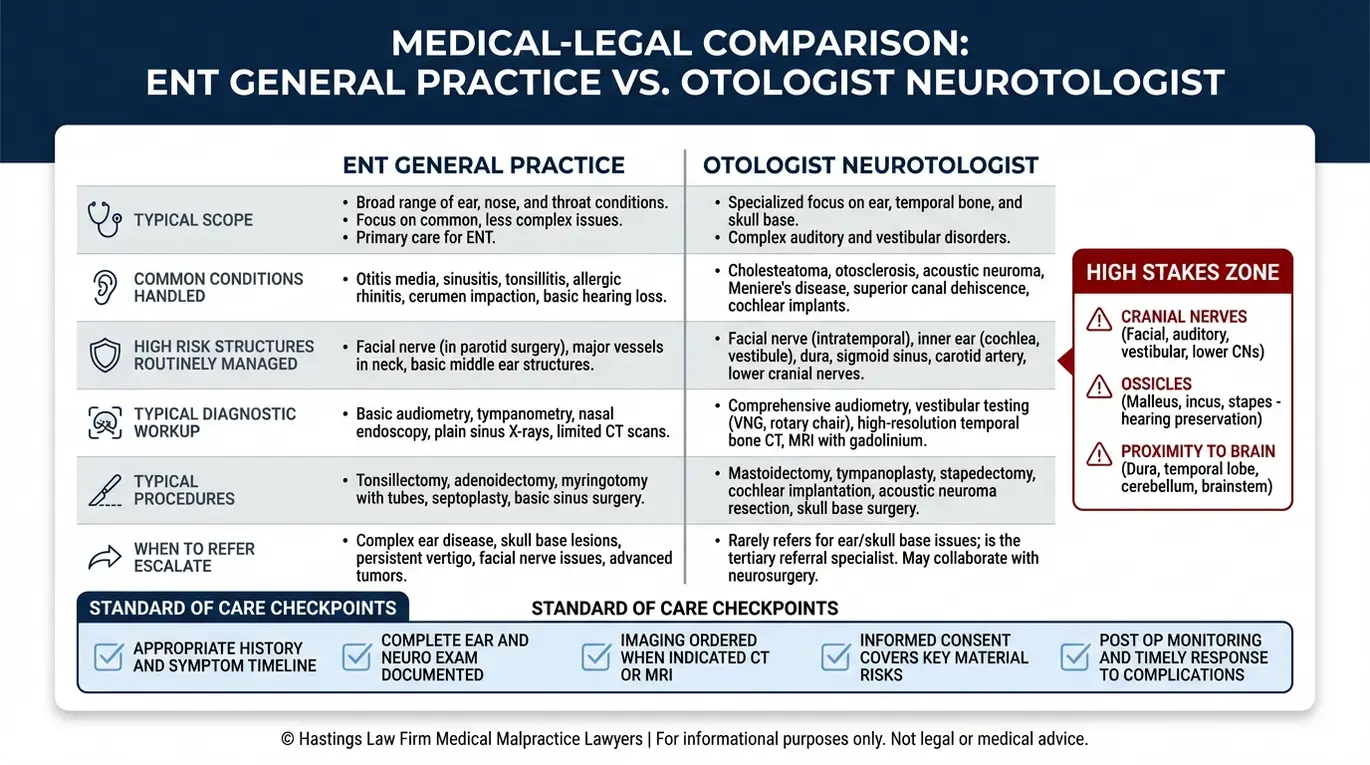
An otologist is a sub-specialist within otolaryngology focused exclusively on the ear and its connecting structures, adhering to a strict standard of care that requires precise diagnostic and surgical execution to prevent permanent sensory loss. Otology is a medical sub-specialty focusing on the ear and its connecting structures. While a general ENT doctor treats a broad range of conditions affecting the ears, nose, throat, and sinuses, an otologist, sometimes called a neurotologist, concentrates on complex disorders involving hearing, balance, and the delicate anatomy where the ear meets the skull base.
A neurotologist specifically focuses on neurological disorders of the ear. This additional fellowship training typically involves two years of study focused solely on the lateral skull base. This distinction matters in a malpractice case. An otologist’s advanced training means they are held to a higher standard of care than a general practitioner or even a general ENT.
The standard of care is the level of treatment a reasonably competent specialist with similar training and experience would provide under the same circumstances. When an otologist fails to meet that standard, and the failure causes injury, that breach of duty can form the basis of a medical negligence claim.
The stakes in otology are particularly high because of the anatomy involved. The ear contains the ossicular chain, the three tiny bones (malleus, incus, and stapes) that transmit sound vibrations. These structures sit millimeters from cranial nerve VII, the facial nerve, which controls movement on one side of the face.
The inner ear also borders the brain itself, separated by a thin layer of bone. Because the inner ear shares a bony wall with the brain cavity, an untreated infection or surgical slip can lead to meningitis or brain abscesses. This anatomical reality means there is no room for error.
A Texas otologist malpractice lawyer must understand this anatomy to evaluate whether an error occurred and what damage it caused. Otolaryngologist malpractice and ear specialist negligence cases require a granular understanding of surgical landmarks, imaging interpretation, and the physiological consequences of even minor deviations during treatment.
Because of this proximity to critical structures, the standard of care in otology demands precision at every stage. From ordering the correct imaging before surgery to identifying anatomical variants during a procedure, even a small lapse can result in permanent hearing loss, facial paralysis, or worse. That is why these cases require attorneys and medical consultants who can evaluate the clinical details with the same rigor as the specialists who performed the care.
Common Surgical Errors and Diagnostic Failures in Otology
Malpractice in otology often involves surgical errors during stapedectomies or tympanoplasties, failure to diagnose cholesteatomas, or damaging the facial nerve, resulting in permanent hearing loss, facial paralysis, or chronic vertigo.
Surgical Errors
Ear surgery requires operating in one of the smallest and most delicate spaces in the human body. These procedures require precision because the ear is highly delicate. Procedures ranging from a simple myringotomy (ear tube placement) to complex skull base surgery all demand exacting care.
A stapedectomy, a procedure to replace a diseased stapes bone and restore hearing, carries significant risk if the surgeon displaces the prosthesis or damages the inner ear. The result can be total hearing loss in the affected ear or severe tinnitus that never resolves. These injuries often form the basis of surgical negligence claims when the error was avoidable.
A tympanoplasty, which repairs a perforated eardrum, can lead to surgical negligence claims when a surgeon fails to identify surrounding structural damage or inadvertently injures the ossicular chain. Mastoidectomy procedures, where infected bone behind the ear is removed, carry the risk of puncturing the dura (the membrane surrounding the brain), potentially causing cerebrospinal fluid leaks or intracranial infection.
Cochlear implant surgery, while often life-changing, also carries documented risks when performed negligently. A detailed review published by PMC on complications in cochlear implant surgery outlines risks including electrode misplacement, facial nerve injury, and device failure linked to surgical technique. When these outcomes result from a departure from the standard of care rather than an inherent risk of the procedure, they may support a medical negligence claim.
Diagnostic Failures
Not all otology malpractice involves the operating room. Diagnostic failures occur when a condition is missed or treatment is delayed. A missed or delayed diagnosis of an acoustic neuroma, a slow-growing tumor on the nerve connecting the ear to the brain, can allow the tumor to reach a size where removal causes permanent hearing loss or brain damage.
Similarly, a cholesteatoma, an abnormal skin growth in the middle ear, can erode bone and spread infection to the brain if not identified and treated in time. These diagnostic failures often trace back to a physician’s failure to order appropriate imaging.
A CT scan or MRI that should have been ordered based on the patient’s symptoms may have been delayed or never requested, allowing a treatable condition to become a catastrophic one. A Texas otologist malpractice lawyer acts as a safeguard for patients harmed by these preventable errors.
Medication Errors and Ototoxicity
Certain medications are known to be ototoxic, meaning they can damage the structures of the inner ear. According to Nemours KidsHealth on ototoxicity, antibiotics such as aminoglycosides and some chemotherapy drugs can cause irreversible hearing damage. When a provider prescribes or administers these medications without appropriate monitoring or without considering safer alternatives, the resulting injury may constitute medical negligence.
The following table summarizes common procedures and the types of negligent outcomes that can arise:
| Procedure / Clinical Scenario | Potential Negligence Outcome |
|---|---|
| Stapedectomy | Prosthesis displacement, total sensorineural hearing loss |
| Tympanoplasty | Ossicular chain damage, persistent conductive hearing loss |
| Mastoidectomy | Dural puncture, CSF leak, meningitis |
| Cochlear implant surgery | Electrode misplacement, facial nerve paralysis |
| Acoustic neuroma evaluation | Delayed MRI, tumor growth causing brain damage |
| Cholesteatoma management | Missed diagnosis, bone erosion, intracranial infection |
| Ototoxic medication administration | Irreversible sensorineural hearing loss, chronic tinnitus |
Risks of Intracranial Injury and Infection
The ear canal sits in an anatomical danger zone where surgical instruments operate millimeters from the brain. Intracranial injuries involve damage within the skull near the brain. The facial nerve, known as cranial nerve VII, threads through the temporal bone directly adjacent to the middle ear. Damage to this nerve during surgery can cause permanent facial paralysis on one side.
Perhaps the most serious risk involves a cerebrospinal fluid leak, which occurs when the thin bone separating the ear from the brain is breached. CSF is the protective fluid surrounding the brain and spinal cord.
A leak creates a direct pathway for bacteria to reach the brain, potentially leading to meningitis or abscess formation. When a surgeon fails to recognize or properly manage a CSF leak during or after surgery, the consequences can be devastating, including permanent brain damage.

The Hastings Law Firm Difference
Results matter, but what truly sets us apart is how we achieve them. Every verdict, every settlement, and every Texas courtroom victory comes from one guiding promise: To treat each client’s fight for justice as if it were our own.
This balance of skill, experience, and empathy reflects our core philosophy that justice should not only compensate the injured, but also make health care safer nationwide.

Proving Causation and Liability in Ear Injury Cases
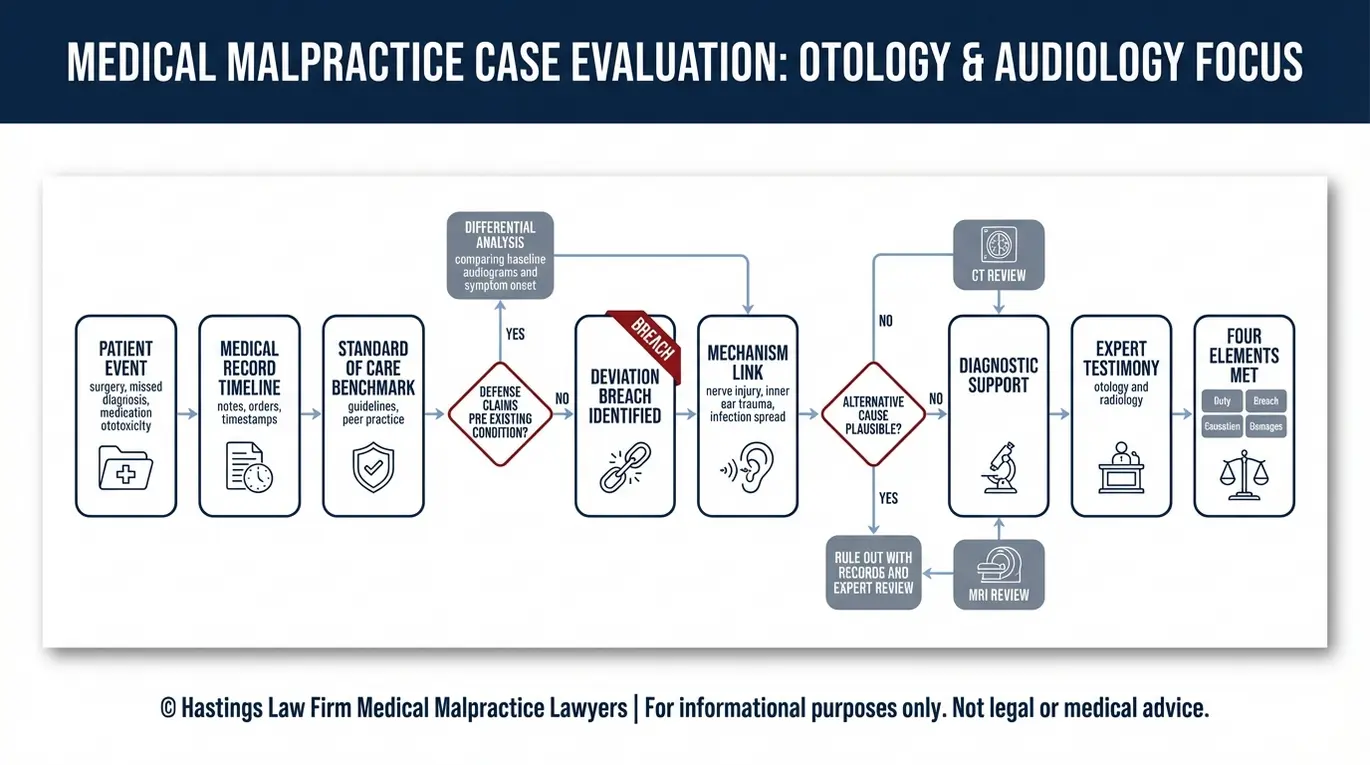
Proving liability requires demonstrating that the otologist deviated from accepted medical standards and that this deviation directly caused the patient’s hearing loss or vestibular injury, typically confirmed through expert testimony and medical record analysis. Liability refers to the legal responsibility of a healthcare provider for patient harm. To succeed, we must establish that the error was the proximate cause of the patient’s current physical condition.
The Four Legal Elements
Every medical malpractice claim in Texas rests on four elements. First, the physician owed a duty of care to the patient. Second, the physician breached that duty by failing to meet the standard of care.
Third, that breach was the proximate cause of the injury, meaning the harm would not have occurred but for the physician’s error. Fourth, the patient suffered actual damages as a result.
In otology cases, establishing causation can be especially challenging. The ear’s anatomy is complex, and defense teams frequently argue that hearing loss or balance problems were caused by pre-existing conditions, natural aging, or inherent surgical risks rather than negligence. A Texas otologist malpractice lawyer must be prepared to counter these arguments with objective medical evidence.
Overcoming Defense Tactics
Insurance companies and defense attorneys routinely point to pre-existing hearing loss or age-related decline to avoid liability. This is why an independent review of the patient’s medical history is so important.
We meticulously compare the audiometric data. If a patient had mild high-frequency hearing loss prior to surgery but woke up with profound deafness in all frequencies, the defense argument that this was “natural progression” crumbles under scrutiny. We use the objective data to paint a clear timeline of causation.
Our team conducts this type of analysis from the beginning of every case. We examine high-resolution temporal bone CT scans, which provide high-resolution images of the bony structures of the ear, and internal auditory canal MRI (IAC MRI), which evaluates soft tissue and nerve integrity near the inner ear. These imaging tools can reveal whether an error was avoidable.
Evidence We Gather
To build a case, we focus on collecting and analyzing clinical records to determine if medical errors occurred.
- Pre-operative and post-operative audiograms to document changes in hearing
- High-resolution temporal bone CT scans and IAC MRI imaging
- Operative reports and surgical notes detailing the procedure step by step
- Anesthesia records and intraoperative monitoring data
- Nursing notes and post-operative observation records
- Correspondence between treating physicians regarding referrals or follow-up
- Independent expert review by a qualified otologist or neurotologist
Gathering this evidence requires persistence. Hospitals often provide incomplete records initially. Our team knows exactly what a complete chart looks like and we do not stop until we have every page.
This evidence is then reviewed by medical experts from our national network who provide objective opinions on whether the standard of care was met. Their testimony as an expert witness is essential to establishing both breach and causation before a jury.
Calculating Damages for Sensory Loss and Vestibular Damage
Damages in otology malpractice cases cover economic losses such as hearing devices and vocational retraining, along with non-economic damages reflecting the psychological and social toll of conditions like tinnitus, vertigo, and communication loss. Pursuing compensation for sensory loss ensures that patients have the resources needed for lifelong specialized care.
Economic Damages
The financial cost of ear injuries can accumulate over a lifetime. A cochlear implant, an electronic device surgically placed in the inner ear to provide sound signals to the brain, can cost tens of thousands of dollars, and the device requires ongoing maintenance, mapping sessions, and eventual replacement.
Future medical costs must also be projected accurately. For a young child, these costs are compounded over decades. They may require educational accommodations, specialized speech therapy, and replacement of prosthetic devices every few years. We calculate these lifecycle costs to ensure the settlement covers the patient’s needs for the rest of their life, not just today.
Patients who suffer severe hearing loss or balance disorders may also need vestibular rehabilitation therapy (VRT), a specialized physical therapy program designed to retrain the brain’s ability to process balance signals. Vestibular rehabilitation therapy (VRT), a program to help manage dizziness, is not a quick fix. It is often a grueling, months-long process where patients must relearn how to balance. The cost of these sessions and the time away from work add up significantly.
Beyond direct medical expenses, economic damages include lost wages during recovery, reduced earning capacity if the injury prevents a return to a previous occupation, and the cost of vocational rehabilitation if the patient must transition to a different career. Someone who worked in construction, emergency services, or any field requiring reliable hearing and balance may find their livelihood permanently altered.
Non-Economic Damages
The losses that do not come with a receipt are often the most profound. Vestibular damage affects the sensory system responsible for balance. Chronic tinnitus, a persistent ringing or buzzing in the ears, can disrupt sleep, concentration, and emotional well-being for years. Many patients describe it as a sound that never stops, affecting every quiet moment of their lives.
Hearing loss carries its own form of isolation. Difficulty following conversations, missing important sounds, and withdrawing from social situations can lead to depression and anxiety. For patients who lose hearing after negligent care, these are not abstract concerns. They reshape relationships, limit independence, and diminish quality of life.
Vestibular damage compounds these challenges. Vertigo and chronic imbalance can make it unsafe to drive, exercise, or even walk without assistance. The loss of enjoyment of life, a recognized category of non-economic damages in Texas, captures the way these injuries restrict activities that once brought meaning and purpose.
This encompasses the inability to enjoy music, the frustration of background noise making social gatherings impossible, and the safety fears that come with balance issues. A Texas otologist malpractice lawyer must present these losses clearly and persuasively, helping a jury understand the full scope of pain and suffering that extends far beyond the initial medical error.
Why Choose Hastings Law Firm for Your Otology Claim
Hastings Law Firm brings a specialized medical-legal team to every otology case, including board-certified trial attorneys and in-house nursing staff who ensure complex ear injury claims are prepared for trial from the start. We focus specifically on medical negligence cases to provide the highest level of advocacy for our clients.
The Hastings Difference
- Exclusive Focus on Medical Malpractice: We do not divide our attention across unrelated practice areas. Every attorney, nurse consultant, and staff member at our firm is dedicated to medical negligence cases.
- Trial-Ready From Day One: We investigate and prepare every case as though it will go before a jury. Many firms look for a quick settlement. We prepare opening statements and witness cross-examinations from the moment we file. This pressure often compels the defense to offer a fair resolution rather than face us in court.
- In-House Medical Staff: Our team includes nurse practitioners and Board Certified Patient Advocates who analyze medical records, identify charting inconsistencies, and help translate clinical data into evidence a jury can understand. They review nursing notes and vital sign logs that outside lawyers might miss. This internal medical capability allows us to screen cases faster and identify the ‘smoking gun’ evidence of negligence early in the process.
- Former Defense Attorneys on Our Team: Several of our lawyers previously defended hospitals and physicians. That experience gives us direct insight into the strategies the other side will use, and we prepare to counter them before they are raised.
- National Expert Network: We work with top-tier otologists, neurotologists, and other medical specialists across the country to provide credible, objective expert testimony.
- No Fee Unless We Win: Our firm operates on a contingency fee basis. We offer a free evaluation to all potential clients. You pay no attorney fees or costs unless we secure a recovery for you. This removes the financial barrier that prevents many families from pursuing legitimate claims.
As a Texas otologist malpractice lawyer team with deep medical knowledge and courtroom experience, we are built to handle the specific challenges that ear injury cases present. Our medical malpractice attorneys understand both the clinical science and the legal strategy required to hold negligent providers accountable.
Contact the Texas Doctor Malpractice Attorneys at Hastings Law Firm Today for Help
Hearing loss, chronic tinnitus, and vestibular damage should never be the price of medical care you trusted a specialist to provide. If you or a loved one suffered an injury that you believe was caused by an ear specialist’s negligence, you have the right to find out what happened and whether it could have been prevented.
Hastings Law Firm offers a free, confidential case evaluation led by a patient advocate who can help determine whether your experience warrants a closer look. Our trial-ready approach means that from the first conversation, we are building toward the strongest possible outcome for you and your family.
You pay nothing unless we win. Contact us today to speak with a Texas otologist malpractice lawyer who can review your records and help you understand your legal options.
Frequently Asked Questions About Otologist Malpractice in Texas


This content was researched and written by the Hastings Law Firm editorial team, which includes attorneys, medical professionals, and experienced researchers. Our writing is informed by internal knowledge and practical experience, and we cross-check critical details against authoritative sources cited throughout. Every piece undergoes human-led fact-checking and legal review. Because legal and medical information can change, if you spot an error, please contact us. Learn more about our content standards and review process on our editorial policy page.

Gabe Sassin has focused exclusively on medical malpractice law since 2007. After spending more than a decade as a malpractice defense attorney, he knows exactly how the other side works. He has seen firsthand how healthcare providers, insurers, corporate defendants, and their legal teams think, prepare, and build their defense against claims. That knowledge works for the people who need it most today, injured patients and their families. His unique experience shapes everything he writes, giving readers a look at how these cases actually work from someone who has handled them from both sides.
