


Texas Chiropractor Malpractice Lawyer
Chiropractic care is meant to relieve pain, but negligent spinal manipulation or a missed warning sign can lead to severe, lasting harm. Texas chiropractic malpractice claims often focus on whether the chiropractor met the accepted standard of care, obtained informed consent, and recognized when symptoms required urgent medical referral. Serious outcomes can involve vascular injury, stroke, paralysis, and permanent cognitive damage, and disputes often center on causation and pre existing vulnerabilities. If you or a loved one were harmed or worse due to chiropractic negligence in Texas, contact Hastings Law Firm for a free, confidential case review.

Last Updated: July 27, 2026
Trusted Legal Representation for Chiropractic Negligence in Texas
When a chiropractor’s adjustment causes a serious injury, such as a herniated disc (a condition where the cushioning between vertebrae is pushed out of place) or fractured vertebrae (a break in one of the bones of the spine), you may feel confused, scared, and unsure of where to turn. You trusted a healthcare provider, and now you are dealing with pain and medical bills that should never have been yours to carry.
At Hastings Law Firm, we focus exclusively on medical malpractice litigation. Founded in 2005, our firm focuses on helping patients restore trust after a medical error and protecting their financial future. If you need a Texas Chiropractor Malpractice Lawyer, we are here to review what happened and explain your options in a free, confidential consultation.

Understanding Chiropractic Malpractice in Texas Courts
Chiropractic malpractice occurs when a licensed chiropractor fails to meet the accepted standard of care, directly causing injury or worsening a patient’s condition through negligent treatment or a failure to diagnose. Not every bad outcome qualifies as malpractice, but when a chiropractor’s actions fall below what a competent peer would have done in the same situation, that gap is the foundation of a legal claim.
The standard of care for chiropractors is distinct from the standard applied to medical doctors. It refers to the level of skill, caution, and judgment that a reasonably competent chiropractor would exercise under similar circumstances. This includes knowing when spinal manipulation, the manual adjustment of the spine to restore alignment and reduce pain, is appropriate and when it is not. A chiropractor performing cervical manipulation, an adjustment targeting the neck, has a duty of care to screen for risk factors like vascular conditions before proceeding.
Informed consent is another critical element. Before performing any adjustment, especially to the neck, a chiropractor should explain the potential risks, including the possibility of stroke or arterial injury. If the patient was never warned of these dangers before consenting to treatment, that failure can form part of a malpractice claim.
As outlined in research published by PubMed Central, chiropractic care falls under health care liability claims in Texas, meaning these cases are governed by the same strict procedural rules that apply to medical negligence. A chiropractor malpractice attorney in Texas must understand these rules from the outset to build a case that can withstand early legal challenges.
Common Types of Negligence and Chiropractic Errors
Negligence in chiropractic care often involves high-velocity cervical manipulation performed despite warning signs, failure to refer a patient to a medical doctor when concerning symptoms appear, or performing adjustments on patients with pre-existing spinal instability. These errors are not minor judgment calls. They can result in permanent, life-altering injuries.
Improper Technique and Excessive Force
One of the most frequent allegations of improper manipulation involves the use of a high-velocity, low-amplitude (HVLA) thrust, a rapid, controlled force applied to a spinal joint, with too much intensity or in the wrong direction. When applied improperly, particularly to the cervical spine, this technique can tear blood vessels, damage nerves, or fracture weakened bone.
Failure to Diagnose
Some patients visit a chiropractor for what seems like routine back or neck pain, but the actual cause of their symptoms is something far more serious, such as an evolving stroke, a tumor, or a cardiac event. A chiropractor has a responsibility to recognize when symptoms fall outside their scope of practice and refer the patient to the appropriate medical professional. When that referral does not happen, a diagnosis failure can lead to catastrophic outcomes.
Ignoring Contraindications
Contraindications are pre-existing conditions or clinical findings that make a specific treatment unsafe. For example, adjusting a patient with osteoporosis or a known herniated disc without modification creates a foreseeable risk of fracture or further disc herniation. Under the Eggshell Plaintiff doctrine, a provider must take patients as they find them.
If a chiropractor knew or should have known about a vulnerability and adjusted the patient anyway, they are liable for the resulting harm, even if a healthier patient might have tolerated the same treatment. A Texas chiropractic malpractice lawyer will examine the medical records closely to determine which category of negligence applies.
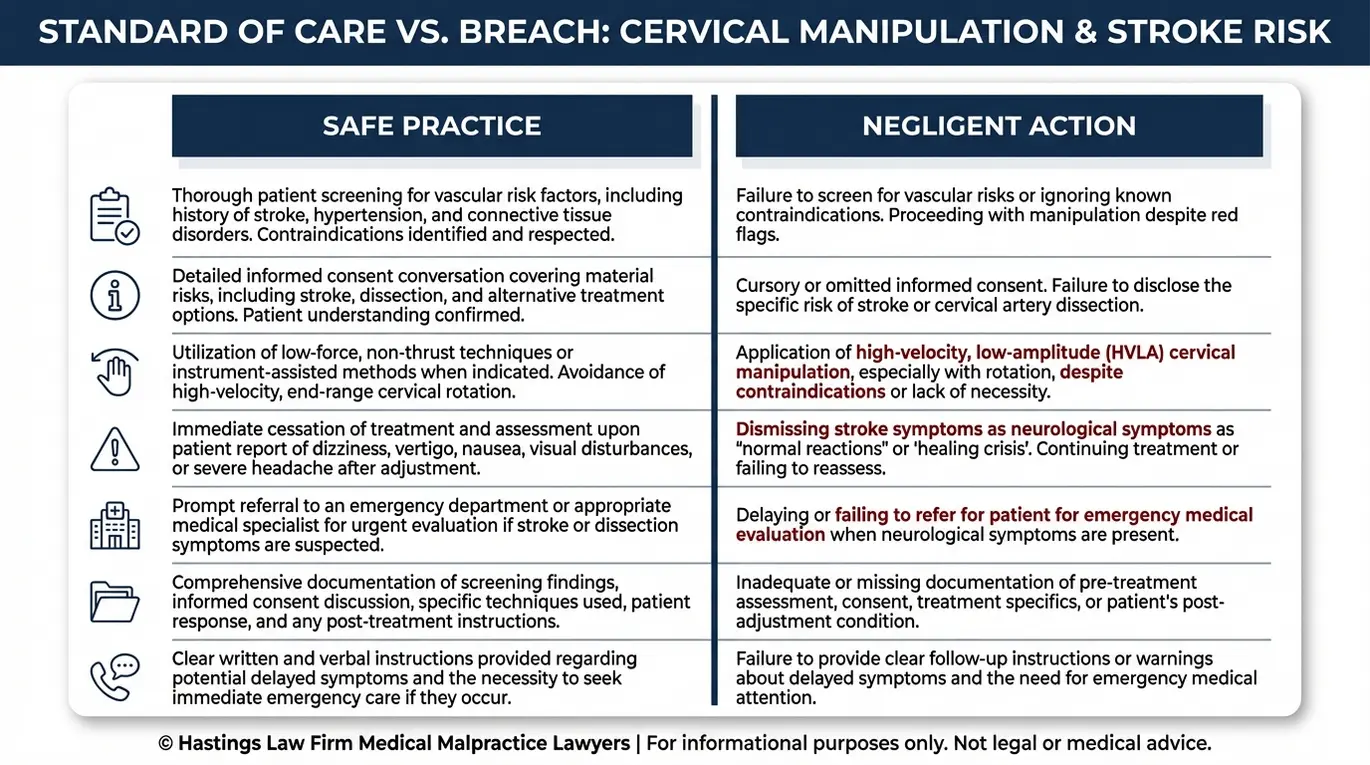
| Safe Practice | Negligent Action |
|---|---|
| Screening for vascular risk factors before cervical manipulation | Performing high-velocity neck adjustments without any vascular screening |
| Referring a patient to an MD when symptoms suggest stroke or cardiac issues | Continuing chiropractic treatment despite neurological warning signs |
| Reviewing imaging and medical history for contraindications | Adjusting a patient with known osteoporosis or spinal instability without modification |
| Explaining risks of cervical manipulation and obtaining informed consent | Performing neck adjustments without disclosing stroke or arterial dissection risks |
| Modifying technique for patients with pre-existing disc herniation | Applying full-force HVLA thrusts to a patient with documented herniated discs |
The Hastings Law Firm Difference
Results matter, but what truly sets us apart is how we achieve them. Every verdict, every settlement, and every Texas courtroom victory comes from one guiding promise: To treat each client’s fight for justice as if it were our own.
This balance of skill, experience, and empathy reflects our core philosophy that justice should not only compensate the injured, but also make health care safer nationwide.

Vertebral Artery Dissection and Stroke Injuries
The most severe injury associated with neck adjustments is a vertebral artery dissection (VAD), where the vessel supplying blood to the brain is torn, potentially causing a massive ischemic stroke, paralysis, or death. When this artery is torn, a blood clot can form and travel to the brain, triggering an ischemic stroke, a type of stroke caused by a blocked blood vessel cutting off oxygen to brain tissue. The consequences can include paralysis, permanent cognitive damage, or wrongful death.
How It Happens
During a cervical manipulation, rapid rotation or extension of the neck can stretch or tear the vertebral artery wall. Research published in the Journal of Contemporary Chiropractic has documented case reports linking spinal manipulative therapy to cervical artery dissection events. The injury may occur during the adjustment itself or develop in the hours immediately following the arterial dissection.
Recognizing the Warning Signs
The period right after a neck adjustment is critical. Symptoms of a vertebral artery dissection or developing stroke can appear within minutes or emerge over the next several hours. If you or someone you know experienced any neurological symptoms after a chiropractic visit, seek emergency medical care immediately:
- Sudden, severe headache unlike anything previously experienced
- Dizziness or vertigo that does not resolve
- Difficulty speaking or slurred speech
- Numbness or weakness on one side of the body
- Loss of coordination or difficulty walking
- Blurred or double vision
- Neck pain that intensifies after the adjustment
The Danger of Dismissal
One of the most troubling patterns in these cases is when a chiropractor dismisses early stroke symptoms as a “normal adjustment reaction” or part of a “detox response.” These are not medically recognized explanations for neurological symptoms. Every minute that treatment is delayed during a stroke causes additional brain damage.
When a chiropractor reassures a patient instead of calling 911, the window for effective stroke treatment narrows significantly. If you believe a chiropractic adjustment caused a stroke or arterial injury, a lawyer for chiropractor negligence can help you understand what went wrong and determine who is responsible.
Dual Liability: When the ER Misses the Stroke
In some cases, the harm does not stop at the chiropractor’s office. A patient experiencing post-adjustment symptoms may go to an emergency room, only to encounter a diagnosis failure where the ER team misses the stroke in progress. When that happens, there may be grounds to pursue claims for hospital liability and medical negligence against both the chiropractor who caused the arterial tear and the hospital that failed to diagnose the stroke in time.
Our team includes former defense attorneys and hospital nurses who previously worked for the systems they now challenge. This background helps us understand how both chiropractic offices and hospital systems operate. Malpractice attorneys for chiropractic stroke cases at our firm evaluate the full chain of care to identify every responsible party and every missed opportunity to prevent the harm from worsening.

Proving Negligence and The Expert Report Requirement
Texas law requires plaintiffs to produce an expert report from a qualified medical professional within 120 days after the defendant’s original answer is filed, establishing exactly how the chiropractor breached the standard of care and caused the injury. Missing this deadline can result in your case being dismissed entirely, so early preparation is essential.
This requirement comes from Texas Civil Practice and Remedies Code Section 74.351, part of Chapter 74, the body of Texas law governing medical malpractice claims. Chapter 74 imposes strict procedural requirements designed to screen out cases that lack legitimate medical support. For patients with real injuries, this means the legal team must move quickly and have the right experts in place from the beginning.
Here is how the process works when you are suing a chiropractor in Texas:
- Step 1: Case Evaluation and Medical Record Review. Our in-house medical staff includes nurse practitioners and board-certified patient advocates. Working under the direction of board-certified trial lawyer Tommy Hastings, they review your treatment records and clinical notes to identify where the standard of care was breached.
- Step 2: Expert Consultation. We retain qualified expert witnesses, typically a neurologist, vascular surgeon, or biomechanical specialist, who can provide objective analysis. In these cases, expert testimony often needs to come from a physician who can speak to the vascular or neurological consequences of the adjustment, not just from another chiropractor.
- Step 3: Expert Report Filing. The expert prepares a written report detailing the specific breach of care and how it caused your injury. This report must be served on the defendant within the 120-day window after the defendant’s original answer is filed.
- Step 4: Litigation and Discovery. Once the expert report satisfies the court’s threshold, the case moves forward into depositions, document requests, and trial preparation.
Causation is often the most contested element. Defense attorneys will argue that the stroke was caused by a pre-existing condition or lifestyle factors rather than the adjustment. A Texas chiropractor malpractice lawyer must be prepared to counter this with imaging timelines, medical literature, and expert testimony that connects the injury directly to the negligent treatment.

Recoverable Damages in Chiropractic Injury Lawsuits
Patients injured by chiropractic negligence may recover compensation for past and future medical bills, lost wages, loss of earning capacity, permanent disability, and non-economic damages such as pain and suffering or physical impairment. The value of each case depends on the severity of the injury and the degree to which it has altered the patient’s life.
Economic Damages
These cover the measurable financial losses tied to the injury:
- Emergency medical treatment, hospitalization, and surgical costs
- Ongoing rehabilitation, including physical therapy, speech therapy, and occupational therapy
- The cost of long-term or 24/7 care for patients with permanent disabilities from stroke
- Lost wages from time missed at work during treatment and recovery
- Loss of earning capacity if the injury prevents you from returning to your prior career
In catastrophic cases involving stroke or paralysis, a life care plan may be developed by medical and economic experts to project the total cost of future care over the patient’s lifetime.
Non-Economic Damages
Not all harm can be measured with a receipt. Texas law also allows recovery for physical impairment and other losses:
- Physical pain and suffering, both past and future
- Physical impairment and loss of bodily function
- Loss of enjoyment of life and daily activities
- Mental anguish and emotional distress
Settlement vs. Trial
Insurance carriers evaluate how likely a firm is to actually take a case to trial when deciding what to offer in settlement. At Hastings Law Firm, every case is prepared from day one as if it will go before a jury. This trial-ready approach puts our clients in a stronger position during negotiations. A chiropractic injury attorney who is willing and prepared to go to trial sends a clear signal that undervaluing a claim is not an option.
Contact the Texas Doctor Malpractice Attorneys at Hastings Law Firm Today for Help
If you or a loved one suffered a stroke, spinal injury, or other serious harm after a chiropractic adjustment, you do not have to face the insurance companies and legal process alone. Our team of attorneys, former defense counsel, and in-house medical professionals is built to handle exactly these cases.
Hastings Law Firm is dedicated to restoring trust for patients who have been harmed by the healthcare system. We work to uncover what happened, hold the responsible parties accountable, and protect your financial future. As your Texas Chiropractor Malpractice Lawyer, we operate on a contingency fee basis, meaning you pay no attorney fees or costs unless we recover compensation for you.
Contact us today for a free, confidential case evaluation. Let us review your records and help you understand your options.
Frequently Asked Questions About Chiropractor Malpractice in Texas


This content was researched and written by the Hastings Law Firm editorial team, which includes attorneys, medical professionals, and experienced researchers. Our writing is informed by internal knowledge and practical experience, and we cross-check critical details against authoritative sources cited throughout. Every piece undergoes human-led fact-checking and legal review. Because legal and medical information can change, if you spot an error, please contact us. Learn more about our content standards and review process on our editorial policy page.

Brady D. Williams is a nationally recognized medical malpractice attorney who has spent his career handling high-stakes litigation for injured patients and families across the country. Licensed in both Texas and California, Brady draws on experience from hundreds of resolved medical cases to break down complex legal and medical topics for the people who need that information most. His writing reflects the same attention to detail and commitment to clarity that he brings to every case he handles.
