


Texas Hepatologist Malpractice Lawyer
Hepatologist negligence can leave patients facing worsening liver disease, lost treatment options, and lasting harm when monitoring, diagnosis, or medication decisions fall short of accepted care. These cases often involve missed warning signs in lab work, delayed cancer surveillance, or preventable injuries during procedures and follow up care. Disputes commonly focus on whether the outcome was a known risk of serious liver disease or the result of avoidable error, and what losses can be compensated under Texas law. If you or a loved one were harmed or worse due to hepatologist negligence in Texas, contact Hastings Law Firm for a free, confidential case review.
Last Updated: July 27, 2026
Trusted Legal Representation for Healthcare Negligence in Texas
When a liver specialist’s error changes the course of your health, it can feel like the medical system you trusted has let you down. Hepatology, the branch of medicine focused on diseases of the liver, gallbladder, and pancreas, demands precise and timely decision-making. A hepatologist, a physician specially trained to diagnose and treat these conditions, holds your wellbeing in their hands. If that care fell short and you or a loved one suffered real harm, you deserve clear answers about what happened and what comes next.
Founded by Tommy Hastings, who is Board Certified in Personal Injury Trial Law by the Texas Board of Legal Specialization, our firm focuses exclusively on medical negligence. Our team includes in-house medical professionals who review records and identify where care went wrong. If you believe a liver specialist’s error caused harm, we invite you to contact us for a free, confidential case evaluation so we can explain your options.

Common Forms of Negligence by Liver Specialists
Hepatologist negligence occurs when a liver specialist deviates from the accepted standard of care and that deviation results in harm, such as progression to liver failure or advanced cancer. These cases often involve a failure to monitor key lab values, medication errors, or critical delays in referring a patient for transplant evaluation.
Liver disease can be silent. Conditions like hepatitis B, hepatitis C, and non-alcoholic fatty liver disease (NAFLD) may progress for months or years without obvious symptoms. That makes the specialist’s role as a watchful monitor essential. When that monitoring breaks down, the consequences can be severe and irreversible.
A Texas hepatologist malpractice lawyer can help determine whether lapses in care crossed the line from an unfortunate outcome into actionable negligence. Because hepatology involves complex disease pathways, a lawyer for liver doctor negligence must carefully analyze the medical records to identify where protocols were ignored.
Here are some of the most common patterns we evaluate:
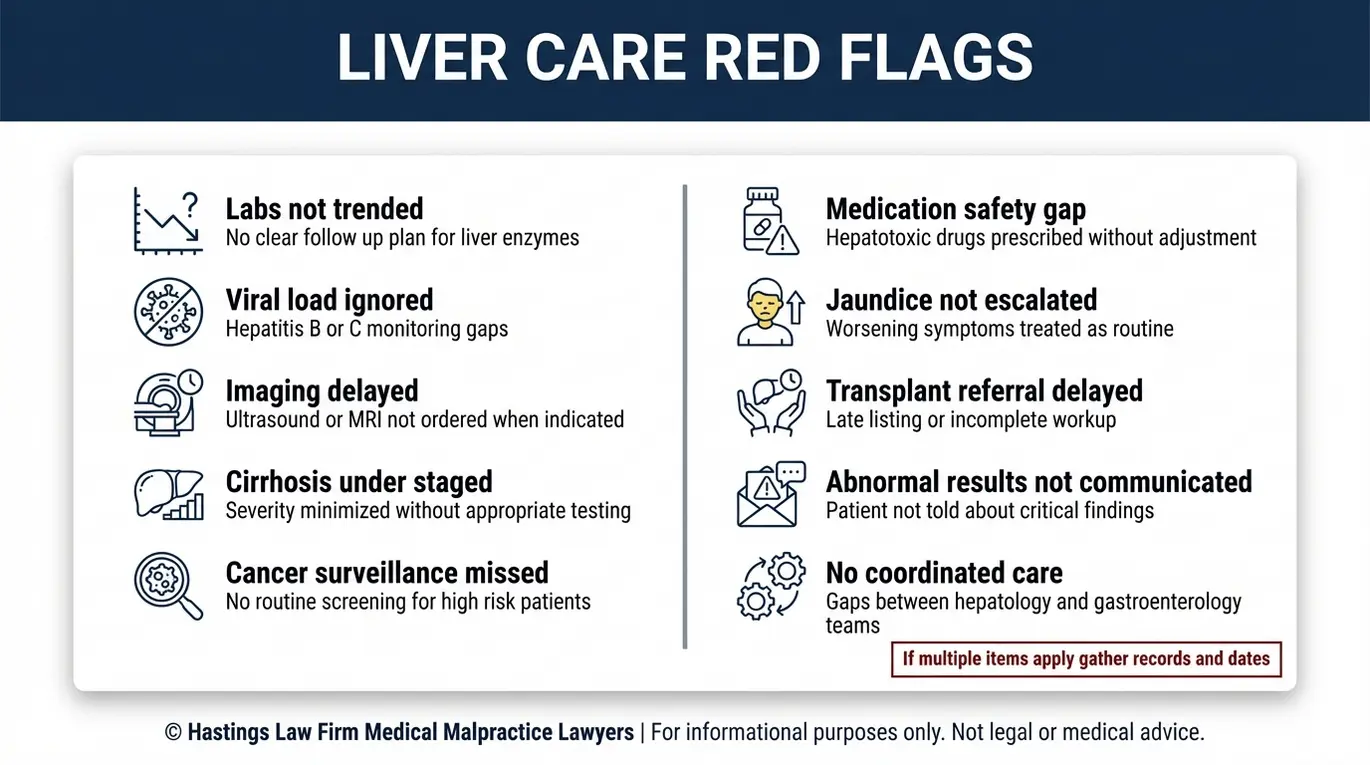
- Failure to monitor viral loads and liver enzymes. Patients with chronic hepatitis B or C require regular blood work to track viral activity and liver function. Liver function tests (LFTs), which are blood panels measuring enzymes like ALT and AST, reveal how the liver is responding to treatment or disease. According to the CDC’s guidelines on clinical testing and diagnosis for hepatitis B, structured monitoring is a core component of managing these infections. Skipping scheduled labs or ignoring rising enzyme trends can allow the disease to advance unchecked.
- Diagnostic errors and missed conditions. A hepatologist may misidentify early-stage cirrhosis as a less serious condition like NAFLD, particularly if they fail to order appropriate imaging or a liver biopsy. This misdiagnosis can be fatal. Jaundice, unexplained weight loss, or abnormal lab patterns that go uninvestigated can signal a missed opportunity to catch a treatable condition before it becomes life-threatening.
- Prescribing hepatotoxic medications. Hepatotoxicity, chemical-driven liver damage caused by certain drugs, creates additional risks for liver patients. Prescribing medications known to be harmful to the liver, or failing to adjust dosages for a patient with already compromised liver function, can accelerate organ damage. This type of error introduces a preventable cause of injury on top of the existing disease.
Failure to Diagnose Liver Cancer
One of the most consequential forms of hepatologist negligence involves the failure to detect hepatocellular carcinoma (HCC), the most common form of primary liver cancer. Patients with cirrhosis or chronic hepatitis are at elevated risk for HCC, and the standard of care generally calls for routine surveillance using liver ultrasound imaging, a protocol for visualizing organ structure, and a blood marker called alpha-fetoprotein (AFP).
Early detection of HCC opens a critical window for treatment, including surgical resection, ablation, or transplant candidacy. When a hepatologist fails to order these routine diagnostic tests, or dismisses abnormal results without follow-up, that window can close.
By the time cancer is discovered at a later stage, treatment options may be limited and survival rates drop significantly. In wrongful death cases involving missed liver cancer, we examine whether surveillance protocols were followed and whether earlier detection could have changed the outcome. Our team works with board-certified hepatologists and oncologists to evaluate the timeline and determine if delayed diagnosis directly contributed to the patient’s decline.
Distinguishing Known Risks From Surgical Errors
Not every bad outcome is malpractice; however, surgical errors such as puncturing the biliary tree or bowel during an ERCP or endoscopy often exceed the definition of a “known risk” and constitute actionable negligence. The biliary tree, the network of ducts that carry bile from the liver and gallbladder, is delicate, and endoscopic retrograde cholangiopancreatography (ERCP), a specialized scope procedure used to examine the bile ducts and pancreas, requires high precision.
Investigating these surgical errors involves reviewing surgical logs to see if the surgeon used proper technique.
The “Known Complication” Defense
Defense attorneys frequently argue that injuries like perforations or infections are inherent risks of the procedure, risks the patient accepted through informed consent. Informed consent means you agreed to the procedure after the doctor explained the risks. The American Society for Gastrointestinal Endoscopy’s guideline on informed consent for GI endoscopic procedures does recognize that certain complications can occur even with proper technique.
This defense can be persuasive, but it does not tell the full story. While patients consent to risks associated with a properly performed endoscopy, they do not consent to negligence.
Where Known Risk Ends and Negligence Begins
The critical question in surgical negligence is not whether a complication occurred, but how and why it occurred. A perforation caused by anatomical variation during a carefully performed scope is different from one caused by improper technique, excessive force, or failure to use fluoroscopic guidance. As a malpractice attorney for hepatology and gastroenterology procedures, we examine the operative notes, imaging records, and post-procedure response to determine whether the injury resulted from a preventable technical error. We look for evidence that the physician rushed the procedure or failed to visualize the anatomy correctly before advancing instruments.
| Known Complication | Actionable Surgical Error | |
|---|---|---|
| Cause | Occurs despite proper technique | Results from improper technique or deviation from protocol |
| Informed Consent | Adequately disclosed and accepted by the patient | May have been disclosed, but the manner of injury was avoidable |
| Post-Procedure Response | Promptly recognized and appropriately managed | Missed or inadequately treated, leading to worsening injury |
| Legal Liability | Generally not grounds for a malpractice claim | May support a medical malpractice claim |
Post-Operative Failures
Even when a perforation occurs without clear fault during the procedure itself, a second layer of liability can arise if the care team fails to recognize and treat the injury promptly. Delayed response to signs of perforation, such as worsening abdominal pain, fever, or dropping blood pressure, can turn a survivable complication into sepsis, organ failure, or death.
A Texas hepatologist malpractice lawyer evaluates both the procedure and the post-operative care to identify every point where the standard of care may have been breached. If the medical team ignores classic signs of a perforated bowel, the resulting infection is often more damaging than the initial puncture.

The Hastings Law Firm Difference
Results matter, but what truly sets us apart is how we achieve them. Every verdict, every settlement, and every Texas courtroom victory comes from one guiding promise: To treat each client’s fight for justice as if it were our own.
This balance of skill, experience, and empathy reflects our core philosophy that justice should not only compensate the injured, but also make health care safer nationwide.

Proving Liability in a Hepatologist Malpractice Case
Proving liability requires establishing four elements: a doctor-patient relationship, a breach of the standard of care, direct causation of injury, and quantifiable damages. This legal framework is rigid, and successfully suing a liver specialist demands clear, convincing evidence for each step.
Defining the Standard of Care
The standard of care is the level of treatment a reasonably competent hepatologist with similar training and experience would have provided under the same circumstances. We work with board-certified hepatologists who provide expert testimony about what should have happened at each stage of your care, from initial workup through ongoing disease management.
Overcoming the “Pre-Existing Condition” Defense
Because patients seeing a hepatologist already have liver disease, the defense will almost always argue that the patient’s poor outcome was inevitable. They frequently cite data showing that chronic liver disease and cirrhosis are leading causes of death to claim the death was natural. Proving this acceleration is a common hurdle in these cases. Our job is to prove causation, specifically that the hepatologist’s error accelerated the decline or eliminated treatment options that were otherwise available.
We examine the Model for End-Stage Liver Disease (MELD) score. This is a numerical scale used to assess the severity of chronic liver disease and prioritize patients for transplant. If a neglected score worsened, we can show how timely intervention could have changed the outcome. If a delayed liver transplant evaluation and listing, the formal process of qualifying for a donor organ, caused a patient to lose their place on the donor list or become too sick for surgery, that delay itself becomes the injury.
The Role of Expert Testimony
Texas law requires expert testimony in medical malpractice cases, and hepatology cases are no exception. The expert must be qualified to speak to the specific standard of care at issue. A Texas hepatologist malpractice lawyer from our firm works with a national network of specialists, including hepatologists, transplant surgeons, and oncologists, who provide objective case reviews and credible courtroom testimony.
Steps to Proving Your Case
To reach the legal threshold for negligence in a medical malpractice case, our team follows a structured process to build your claim:
- Establish Relationship: Confirm the doctor formally agreed to treat the patient.
- Identify Breach: Pinpoint the specific action or omission that violated medical standards.
- Link Causation: Use expert analysis to connect the breach directly to the injury, ruling out the underlying disease.
- Calculate Damages: Quantify the financial and personal loss resulting from the malpractice.

Compensation Available Under Texas Medical Malpractice Laws
Victims of hepatologist malpractice in Texas may recover economic damages for medical bills and lost wages, as well as non-economic damages for pain and suffering, subject to state caps. Securing fair compensation requires a deep understanding of how these categories interact with Texas tort reform statutes.
Economic Damages
Economic damages cover the financial losses directly tied to the injury. These include past and future medical expenses, such as the cost of a liver transplant, ongoing medication, and follow-up care. Lost wages and diminished earning capacity are also recoverable, particularly when a patient can no longer work at the level they did before the injury. There is no cap on economic damages in Texas, meaning families can recover the full value of the medical care necessitated by the negligence.
Non-Economic Damages
Non-economic damages compensate for pain and suffering, physical impairment, and loss of enjoyment of life. Under Texas Civil Practice and Remedies Code Chapter 74, these damages are subject to statutory caps. For claims against a physician, the cap is $250,000. For hospitals or other healthcare institutions, the cap is $250,000 per institution, up to $500,000 total. This aspect of Texas tort reform was designed to limit liability, making it essential to accurately categorize every loss to maximize the total recovery.
Wrongful Death Claims
When hepatologist negligence results in a patient’s death, surviving family members may bring a wrongful death claim. These cases often involve significant economic damages, including loss of future income and support, in addition to the non-economic losses that come with losing a loved one. Establishing that negligence, rather than the natural course of disease, caused the death is a central focus of our investigation. A Texas hepatologist malpractice lawyer at Hastings Law Firm can walk you through how these categories apply to your case and what a realistic recovery may look like.
Contact the Texas Doctor Malpractice Attorneys at Hastings Law Firm Today for Help
If you or a loved one was harmed by a liver specialist’s negligence, Hastings Law Firm is here to help you understand what happened and whether you have a viable legal claim. Our team of attorneys, nurse consultants, and medical experts focuses exclusively on medical malpractice, and we bring that concentrated experience to every case we take.
We know how difficult it can be to question a doctor’s care, especially when you are still dealing with the physical and emotional consequences of the injury. You do not have to work through this alone.
Our consultations are free, confidential, and carry no obligation. We handle every case on a contingency fee basis, which means you pay no attorney fees unless we recover compensation on your behalf. Contact us today to schedule your free, confidential case evaluation.
Frequently Asked Questions About Hepatologist Malpractice in Texas


This content was researched and written by the Hastings Law Firm editorial team, which includes attorneys, medical professionals, and experienced researchers. Our writing is informed by internal knowledge and practical experience, and we cross-check critical details against authoritative sources cited throughout. Every piece undergoes human-led fact-checking and legal review. Because legal and medical information can change, if you spot an error, please contact us. Learn more about our content standards and review process on our editorial policy page.

Gabe Sassin has focused exclusively on medical malpractice law since 2007. After spending more than a decade as a malpractice defense attorney, he knows exactly how the other side works. He has seen firsthand how healthcare providers, insurers, corporate defendants, and their legal teams think, prepare, and build their defense against claims. That knowledge works for the people who need it most today, injured patients and their families. His unique experience shapes everything he writes, giving readers a look at how these cases actually work from someone who has handled them from both sides.
