


Texas Dermatologist Malpractice Lawyer
Dermatologist negligence can leave lasting harm when a skin cancer warning sign is dismissed or a cosmetic procedure is performed improperly. The impact often shows up as delayed treatment, worsening disease, visible scarring, disfigurement, nerve injury, emotional distress, or worse. Texas claims often focus on whether the dermatologist met the accepted standard of care, obtained informed consent, and followed through on biopsy and pathology decisions. Clear documentation such as records, pathology results, and photographs can shape what can be proven. If you or a loved one were harmed or worse due to dermatologist malpractice in Texas, contact Hastings Law Firm for a free, confidential case review.

Last Updated: July 27, 2026
Trusted Legal Representation for Medical Negligence in Texas
When a dermatologist misses a diagnosis or causes harm during a cosmetic procedure, the consequences can be life-altering. You may be dealing with a worsening condition, visible scarring, or the shock of learning that a treatable cancer was overlooked. These situations raise serious questions, and you deserve honest answers about what went wrong.
Hastings Law Firm represents patients across Texas who have been harmed by dermatologist negligence. Our team includes in-house medical professionals and former defense attorneys who understand how these cases are investigated, built, and won. If you believe a skin doctor’s error caused you harm, a Texas dermatologist malpractice lawyer at our firm can review your situation and explain your options at no cost.
—

Liability for Skin Doctor Negligence in Texas
Negligence by a skin doctor occurs when a skin specialist deviates from the accepted standard of care, resulting in injury, worsening of a condition, or disfigurement. Not every bad outcome qualifies as negligence, but when a doctor’s decisions fall below what a competent dermatologist would have done under similar circumstances, the law provides a path to hold them accountable.
The standard of care in dermatology refers to the level of treatment and diagnostic attention that a reasonably skilled dermatologist would provide given the same patient presentation. This standard is shaped by clinical guidelines, peer-reviewed research, and the practices accepted within the specialty. Our founder, board-certified trial attorney Tommy Hastings, uses his experience to identify exactly where these standards were ignored.
When evaluating a potential case, a dermatology malpractice attorney will examine whether the doctor’s actions aligned with those expectations or fell short.
One important distinction is the difference between a known complication and actual medical negligence. A chemical peel, a controlled application of acid solution to remove damaged skin layers ranging from superficial to deep, can cause redness or sensitivity even when performed correctly. That is a known risk.
If the provider applies the wrong concentration, fails to screen for contraindications (medical reasons not to use a treatment), or doesn’t monitor the patient’s reaction, the resulting injury may reflect a breach of the standard of care. Our team evaluates whether these procedural steps were followed to protect patient safety.
We also investigate cases involving the “White Coat Effect,” where a patient may trust a doctor’s authority over their own intuition. In some cases, a dermatologist may dismiss a changing mole or provide reassurance that a lesion is harmless without further testing. If a patient accepts that reassurance because of the authority the doctor carries, any resulting delay is not the patient’s fault.
Texas law requires that before filing a medical malpractice claim, patients must provide written notice to the healthcare provider at least 60 days before initiating legal action, as outlined in Texas Civil Practice and Remedies Code Chapter 74.051. This pre-suit notice requirement is one of the procedural steps our team handles on your behalf.
Informed consent factors into many dermatology negligence claims. Informed consent means your doctor explained the risks and you agreed to the treatment before the procedure began. If a provider performed a procedure without adequately disclosing the risks, that failure can form the basis of a separate legal claim.
—

Common Errors by Dermatologists Regarding Cancer and Cosmetics
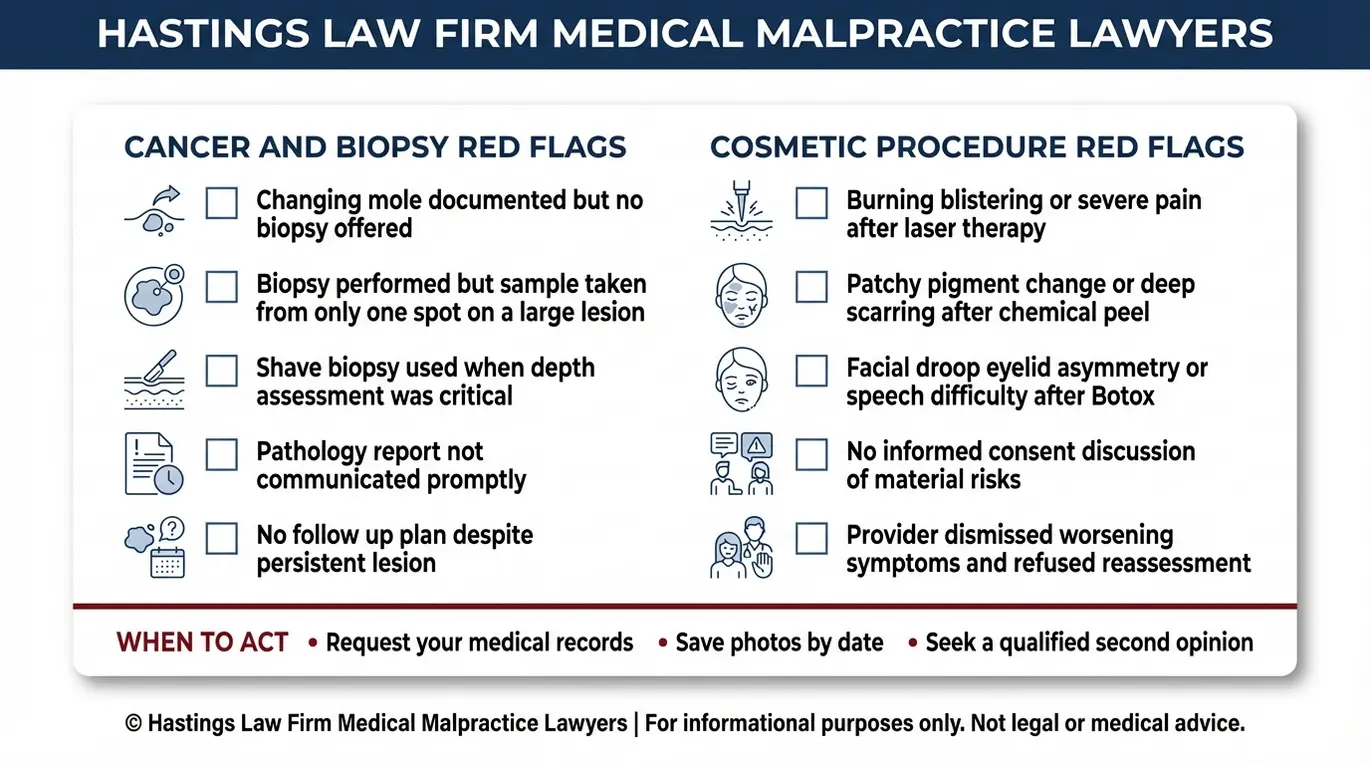
The most frequent grounds for malpractice claims include the failure to biopsy suspicious lesions, misdiagnosis of melanoma as benign, and surgical errors during cosmetic procedures. Dermatology malpractice attorneys often categorize these errors into diagnostic failures and procedural negligence.
Diagnostic Errors
Diagnostic failures happen when a medical professional makes an error in identifying a disease or condition. Skin cancer misdiagnosis is one of the most consequential forms of dermatologist negligence. According to the National Center for Biotechnology Information’s clinical guidelines on cutaneous malignant melanoma, early identification and appropriate biopsy technique are essential for accurate staging. When steps are missed, a treatable cancer can progress.
Common diagnostic failures include:
- Dismissing a changing mole without a biopsy. A lesion is a patch of skin that looks different from the surrounding area. If it has changed in size, shape, or color, it warrants evaluation. If a dermatologist documents the mole as benign based on visual inspection alone, that decision may fall below the standard of care.
- Using the wrong biopsy technique. A biopsy is the removal of a small piece of tissue for laboratory testing. A shave biopsy, which removes only the surface layer of skin, may not capture enough tissue. In many cases, a punch biopsy, a technique that removes a cylindrical core of tissue including deeper skin layers, is necessary for accurate diagnosis.
- Failing to follow up on ambiguous results. Inconclusive pathology results may require additional testing or referral to a specialist.
Cosmetic and Procedural Errors
Dermatologists also perform cosmetic procedures, which are elective treatments used to improve appearance. Errors in these treatments can cause physical harm, such as thermal injuries and scarring.
Examples include:
- Laser therapy burns. Incorrect settings or failure to account for skin type can cause thermal injuries and permanent marks.
- Botox injection mistakes. Improper technique or dosage can lead to nerve damage, facial asymmetry, or drooping eyelids.
- Chemical peel complications. Using an overly aggressive formulation can cause deep tissue damage and disfigurement.
Pathology and Tissue Sampling Failures
A less visible error involves what is known as a tissue sampling error, where the doctor biopsies a lesion but collects tissue from the wrong area, missing the cancerous margin entirely. This can produce a false negative on the pathology report, meaning the cancer is missed even though a biopsy was performed.
In these cases, the analysis may also involve a dermatopathologist, a pathologist with specialized training in diagnosing skin diseases at the cellular level. If a general pathologist misreads a slide that should have been referred to a dermatopathologist, that failure can support a claim. Our Texas dermatologist malpractice lawyers work with qualified experts to trace exactly where the breakdown occurred.
—
The Hastings Law Firm Difference
Results matter, but what truly sets us apart is how we achieve them. Every verdict, every settlement, and every Texas courtroom victory comes from one guiding promise: To treat each client’s fight for justice as if it were our own.
This balance of skill, experience, and empathy reflects our core philosophy that justice should not only compensate the injured, but also make health care safer nationwide.

Proving a Texas Dermatologist Breached the Standard of Care
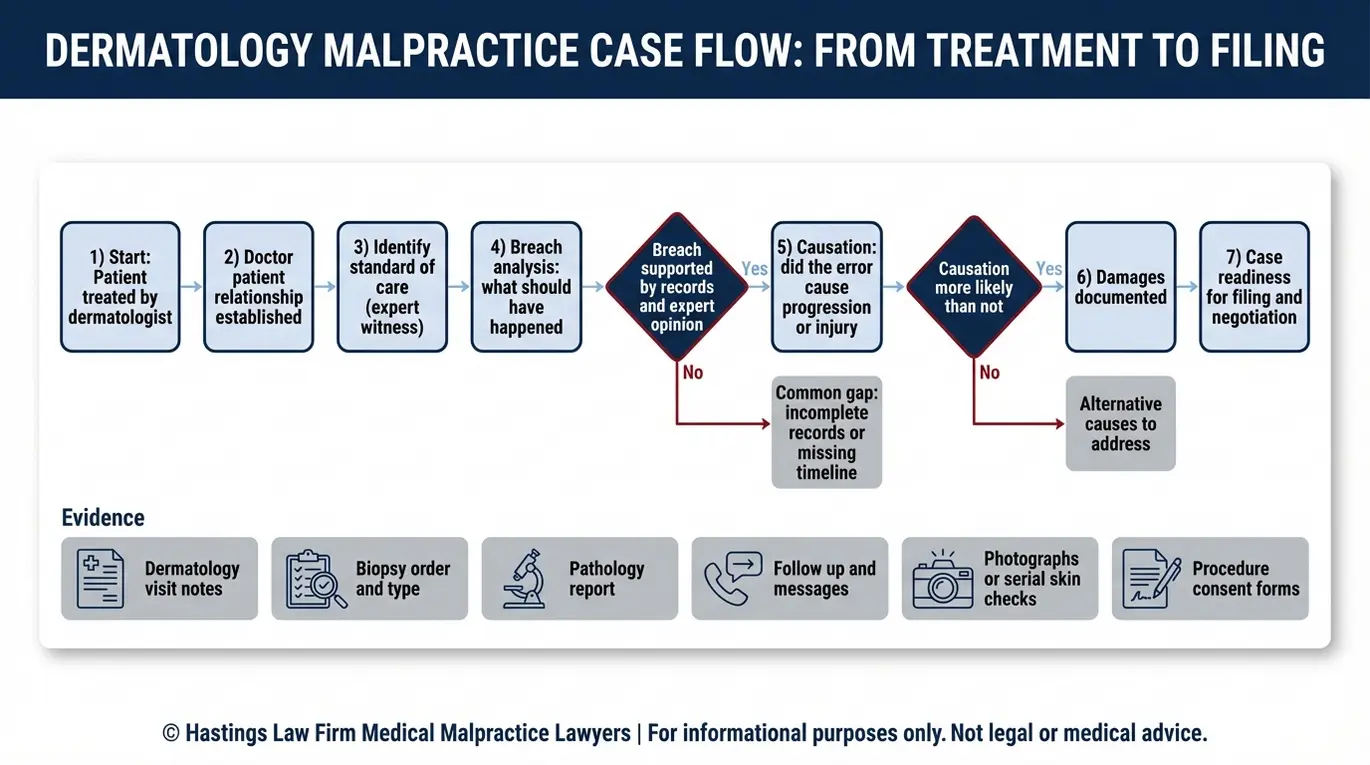
Proving malpractice requires four elements: establishing a doctor-patient relationship, demonstrating a breach of the standard of care, linking that breach directly to the injury, and proving quantifiable damages. Each of these must be supported by evidence, and building that evidence is the core of what a malpractice lawyer for dermatologist errors does. The standard of care is the level of care a reasonably competent doctor would have provided in the same situation.
Duty and breach are typically established through expert testimony. A qualified dermatologist reviews the medical records and offers an opinion on whether the treating doctor’s decisions were consistent with what a competent specialist would have done.
Causation is often the most contested element. In a delayed skin cancer diagnosis, we work to demonstrate that the delay allowed the cancer to advance. In cosmetic cases involving laser therapy, a procedure capable of causing thermal injury or laser burn, causation may involve showing that the disfigurement resulted directly from the procedural error rather than a known risk.
Documentation is critical. Medical records, a pathology report (the laboratory analysis of biopsied tissue), and clinical photographs form the foundation of the case. Under federal guidelines, patients have the right to access their own health information, as explained by HealthIT.gov’s guide to health information rights.
Using Photographs as Evidence of Progression
Patient-taken photographs can be powerful evidence. If you documented a mole over time, those images can help construct a visual timeline showing that the spot was changing while the dermatologist took no action. This type of evidence, sometimes referred to as serial skin checks, provides a record that exists independently of the provider’s chart notes. Our Texas dermatologist malpractice lawyer team examines these photographs alongside the records to identify gaps between what was visible and what was ignored.
Key evidence our team gathers includes:
- Complete dermatology records, including visit notes
- Pathology and biopsy reports
- Patient photographs showing changes over time
- Informed consent documentation
- Communications between the dermatologist and other providers
—
Damages for Disfigurement and Delayed Cancer Diagnosis
Patients harmed by dermatologist negligence in Texas may recover economic damages for medical costs and lost wages, as well as non-economic damages for pain, suffering, disfigurement, and mental anguish. The full scope depends on the nature of the injury.
Economic damages cover direct financial costs, including:
- Costs of corrective surgeries to address scarring
- Ongoing oncology treatment if a delayed diagnosis allowed cancer to progress
- Future medical expenses and reconstructive procedures
- Lost wages and diminished earning capacity
Non-economic damages address the personal toll. Visible facial scarring can affect a person’s confidence and career. A delayed melanoma diagnosis may bring the psychological weight of a reduced survival prognosis. According to the National Cancer Institute’s SEER Program data on melanoma, five-year survival rates drop significantly as the cancer advances, underscoring the consequences of diagnostic delay.
Nerve damage, sometimes referred to as iatrogenic nerve injury (meaning nerve harm caused by medical treatment), can result in chronic pain or loss of sensation.
For families who lost a loved one to undiagnosed skin cancer, wrongful death claims may provide compensation. Damage caps under the Texas Civil Practice and Remedies Code Chapter 74 apply to these cases.
Non-Monetary Terms in Cosmetic Cases
In some cosmetic disputes, settlements may include non-monetary terms. These can include payment for corrective procedures performed by a different surgeon or formal acknowledgments of the error. These terms reflect the unique nature of cosmetic injury claims.
—
Contact the Texas Doctor Malpractice Attorneys at Hastings Law Firm Today for Help
You should not bear the cost of a dermatologist’s preventable error. If you are dealing with a missed skin cancer diagnosis, scarring from a cosmetic procedure, or harm from a biopsy failure, you have the right to seek answers and accountability. Tommy Hastings is an inductee into ABOTA, an invitation-only group for elite trial lawyers, and he leads our firm with a commitment to national excellence in medical malpractice.
Hastings Law Firm handles dermatologist malpractice cases on a contingency fee basis, which means you pay no attorney fees or costs unless we recover compensation for you. Our team of attorneys, nurse consultants, and medical staff is ready to review your records, identify what went wrong, and determine whether you have a viable claim.
Contact our Texas dermatologist malpractice lawyers today for a free, confidential case evaluation. Let us help you find the answers you deserve and understand what comes next.
—
Frequently Asked Questions About Dermatologist Malpractice in Texas


This content was researched and written by the Hastings Law Firm editorial team, which includes attorneys, medical professionals, and experienced researchers. Our writing is informed by internal knowledge and practical experience, and we cross-check critical details against authoritative sources cited throughout. Every piece undergoes human-led fact-checking and legal review. Because legal and medical information can change, if you spot an error, please contact us. Learn more about our content standards and review process on our editorial policy page.

Gabe Sassin has focused exclusively on medical malpractice law since 2007. After spending more than a decade as a malpractice defense attorney, he knows exactly how the other side works. He has seen firsthand how healthcare providers, insurers, corporate defendants, and their legal teams think, prepare, and build their defense against claims. That knowledge works for the people who need it most today, injured patients and their families. His unique experience shapes everything he writes, giving readers a look at how these cases actually work from someone who has handled them from both sides.
