


Houston Medical Misdiagnosis Lawyer
Written by: Hastings Law Firm | Reviewed by: Tommy Hastings | Updated: July 27, 2026
A wrong, delayed, or missed diagnosis can send treatment in the wrong direction and allow a condition to worsen, sometimes leading to life threatening consequences. These cases often turn on whether a healthcare provider met the accepted standard of care and whether the diagnostic failure caused a worse outcome. Diagnostic errors can happen in different settings, including emergency rooms and primary care, where expectations may differ based on available information and time pressures. If you or a loved one were harmed or worse due to medical misdiagnosis in Houston, Texas, contact Hastings Law Firm for a free, confidential case review.

Trusted Medical Attorneys for Wrong Diagnosis Claims in Houston
What You Should Know About Wrong Medical Diagnosis Claims in Houston:
- Recovery can depend on showing that a diagnostic error caused a worsening of the condition or denied a better outcome.
- Options can be limited when a wrong, delayed, or missed diagnosis does not rise to a breach of the accepted standard of care.
- Harm can be compounded when a delayed diagnosis narrows or closes the opportunity for effective treatment.
- Injury can be worsened by unnecessary medications, procedures, or surgeries when the wrong condition is treated.
- Liability can change based on the care setting because emergency rooms and primary care operate under different diagnostic expectations.
- Responsibility can extend beyond one clinician when systemic communication breakdowns cause test results or referrals to fall through the cracks.
- Compensation can include economic losses such as medical expenses and lost wages and non economic losses such as pain and emotional suffering.
- A claim can be barred if legal time limits are missed, even when the misdiagnosis is discovered later.
- Recovery for non economic losses can be limited by caps in Texas medical malpractice cases.
- Case outcomes can hinge on what medical records, test results, imaging, and clinician notes show about what information was available and when.

A Healthcare Focused Law Firm
A wrong diagnosis can change everything. One doctor’s oversight, one missed test result, or one moment of anchoring bias can send your health in the wrong direction for years. This happens when a physician locks onto an initial impression and stops considering other possibilities.
If that happened to you or someone you love, the confusion and frustration you feel right now are completely valid. You may not be sure whether what happened qualifies as malpractice, and that uncertainty can feel paralyzing.
Led by board-certified trial lawyer Tommy Hastings, our Houston medical misdiagnosis law firm focuses exclusively on medical malpractice. Our team includes in-house nurses and former defense attorneys who know how to examine what went wrong and why. If you believe a diagnostic error caused real harm, we can review the facts and explain your legal options in a free, confidential case evaluation.
What Qualifies as Actionable Medical Misdiagnosis in Texas
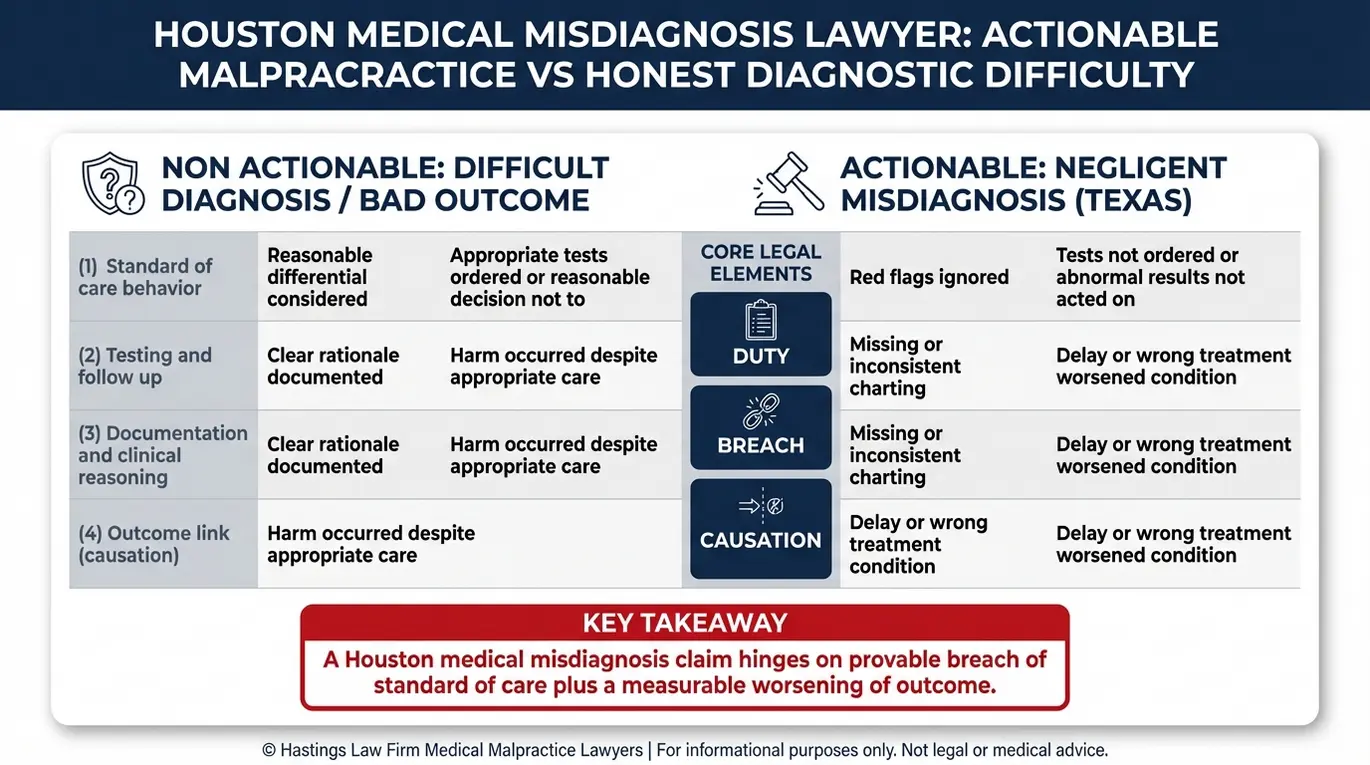
Medical misdiagnosis becomes actionable malpractice when a healthcare provider fails to meet the accepted standard of care, resulting in a wrong, delayed, or missed diagnosis that causes harm to the patient. Not every unfavorable outcome meets that threshold.
Medical misdiagnosis refers to any situation where a physician identifies the wrong condition, overlooks a condition entirely, or identifies the correct condition too late to prevent avoidable harm. Under Civil Practice and Remedies Code Chapter 74, Texas law requires proof that the physician’s conduct constituted a breach of the standard of care, falling below what a reasonably competent doctor would have done in similar circumstances. That benchmark is the standard of care, and it represents the duty of care a provider owes to every patient.
A difficult diagnosis is not the same as a negligent one. Some conditions present with overlapping symptoms, and medicine involves uncertainty. That said, physicians are trained to use a differential diagnosis, a systematic process of listing and ruling out potential conditions based on symptoms, test results, and patient history. When a doctor skips critical steps in that process, ignores red flags, or fails to order appropriate testing, the line between “difficult” and “negligent” becomes much clearer.
Proving negligence also requires causation. It is not enough to show that the doctor made an error. A medical misdiagnosis attorney in Houston must establish that the diagnostic failure directly caused a worsening of the condition or denied the patient the chance at a better outcome. Without that causal link, there is no actionable claim.
Types of Diagnostic Errors Our Houston Attorneys Handle
Actionable diagnostic errors generally fall into three categories: a complete failure to diagnose a condition, misdiagnosing a condition as something else, or a delayed diagnosis that allows a disease to progress unchecked. These errors often mean the difference between a simple recovery and a life-altering injury.
Failure to diagnose occurs when a physician entirely misses an existing illness. A patient may present with clear symptoms, but the doctor dismisses them or attributes them to something benign. This frequently happens in a chaotic hospital environment where providers are rushed.
For example, heart attack symptoms may be written off as indigestion or anxiety, sending the patient home without the urgent intervention they need. Failure to diagnose means the condition was present and detectable via standard diagnostic tests, but the physician never identified it.
Delayed diagnosis means the correct condition is eventually identified, but only after a window of effective treatment has narrowed or closed. This error often stems from misinterpreting test results or failing to communicate findings to the patient. It is especially common in cancer cases, where weeks or months of delay can mean the difference between early-stage treatment and late-stage disease with limited options. A delayed diagnosis does not erase the original error; it compounds it.
Wrong diagnosis involves identifying the wrong illness entirely. The patient may receive treatment for a condition they do not have, exposing them to unnecessary medications, procedures, or surgeries, while the actual condition goes untreated. These errors are often discovered only when a patient seeks a second opinion after their condition fails to improve.
These errors frequently involve conditions where timing is critical:
- Cancer (breast, lung, colon)
- Stroke
- Heart attack
- Meningitis
- Sepsis
As a Houston wrong diagnosis lawyer, our team evaluates these cases by tracing the full diagnostic timeline, from the first reported symptom to the eventual correct diagnosis.
ER vs. Primary Care Standards of Liability
In a Texas medical malpractice case, the standard of care is not identical in every medical setting. Emergency rooms operate under high pressure, with limited patient histories and rapidly evolving conditions. Triage, the process of prioritizing patients based on the severity of their symptoms, means that physicians are making fast decisions with incomplete information. Courts recognize this, and the standard of care in an ER accounts for those constraints.
In a primary care setting, the physician typically has access to the patient’s full history, prior test results, and the ability to schedule follow-up visits. There is more time and more information available, which raises the diagnostic expectations. An atypical presentation, where a disease shows up with unusual or subtle symptoms, may be more forgivable in a chaotic emergency room than in a doctor’s office where the provider had every opportunity to investigate further.
Understanding which standard applies is essential to determining liability.
The Hastings Law Firm Difference
Results matter, but what truly sets us apart is how we achieve them. Every verdict, every settlement, and every Houston courtroom victory comes from one guiding promise: To treat each client’s fight for justice as if it were our own.
This balance of skill, experience, and empathy reflects our core philosophy that justice should not only compensate the injured, but also make healthcare safer nationwide.

Proving Liability and Building a Winning Case
Proving liability requires demonstrating that a competent physician in the same situation would have correctly diagnosed the condition based on the available symptoms and test results. A wrong diagnosis, meaning the physician identified the incorrect condition, must be tied to a specific failure in the diagnostic process and a resulting injury.
The Investigation
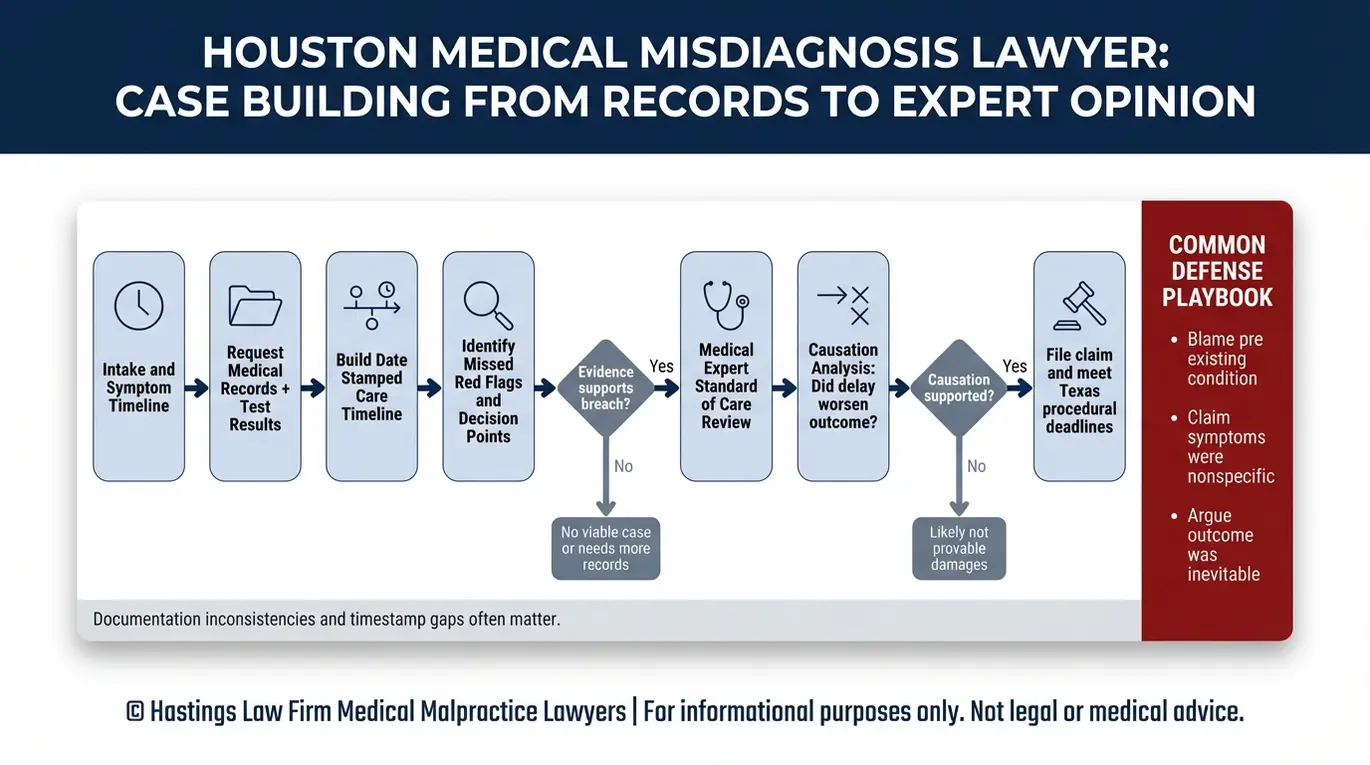
Every case we take begins with a detailed reconstruction of the medical timeline. Our in-house staff includes Board Certified Patient Advocates who work alongside nurses to review medical records, lab results, imaging studies, and physician notes. This evidence builds a minute-by-minute picture of what information was available, when it was available, and what the treating provider did or did not do with it. This is the foundation of any claim a Houston medical misdiagnosis lawyer can bring.
The Expert
Texas law requires qualified medical expert testimony to establish that the standard of care was breached. We work with a national network of specialists who practice in the same field as the defendant physician. Their role is to evaluate the records, identify where the diagnostic process broke down, and explain to a jury why a competent doctor would have reached a different conclusion. Establishing this breach is critical to proving causation, meaning the error directly led to the injury.
How Hospitals Defend These Cases
Defense teams often argue that the patient failed to report symptoms, did not follow up on appointments, or that the outcome would have been the same regardless of when the diagnosis was made. Our misdiagnosis law firm anticipates these strategies because our team includes former defense attorneys who used to develop them.
We examine several factors to build a strong case:
- Complete medical records and physician notes from all treating providers
- Lab results, imaging, and diagnostic test orders
- Internal hospital communication logs and referral records
- Expert analysis of the differential diagnosis process
- Statistical outcome data to establish what timely diagnosis would have changed
Institutional Liability and Systemic Failures
Diagnostic errors are not always the fault of a single physician. In many cases, systemic problems within the hospital or healthcare system contribute to the failure.
Fragmentation of care, where a patient’s treatment is spread across multiple providers without coordinated communication, can cause critical information to fall through the cracks. One doctor orders a test, but the results are never routed to the physician managing the case. This breakdown in closed-loop communication, the process of confirming that test results are received, reviewed, and acted on, is a common institutional failure.
When understaffing, lack of specialist access, or poor internal protocols contribute to a diagnostic error, the hospital or healthcare corporation may share liability alongside the individual provider. In some instances, hospital administration protocols may focus on patient volume in a way that reduces the opportunity for comprehensive diagnostic review. We investigate these systemic factors, including potential corporate negligence, because holding the institution accountable often reflects the full scope of what went wrong.
Recovering Compensation for Misdiagnosis Victims
Patients harmed by diagnostic errors in Texas are entitled to recover economic damages for financial losses and non-economic damages for the physical pain and emotional suffering caused by the negligence. Damages are the monetary awards intended to cover your losses and help you move forward.
Economic damages cover measurable financial harm: past and future medical expenses, including hospital stays, surgeries, medication, and rehabilitation. They also include lost wages and loss of earning capacity if the misdiagnosis left you unable to work at your previous level. These damages are calculated based on documented expenses and projected future costs.
Non-economic damages address the human toll: physical pain, mental anguish, emotional distress, and loss of enjoyment of life. Since these losses are subjective, they require skilled legal advocacy to communicate their full impact to a jury or insurance adjuster. These losses are harder to quantify, but they are no less real.
When a misdiagnosis leads to a patient’s death, surviving family members may pursue a wrongful death claim. This can include compensation for loss of companionship, lost financial support, and funeral expenses. Proposed legislation such as 89th Legislature HB 4036 reflects ongoing efforts to address how Texas law treats damages in medical negligence cases.
A Houston diagnostic error attorney at our firm works to document every category of loss so that nothing is left out of your claim.
Texas Statute of Limitations for Misdiagnosis Claims
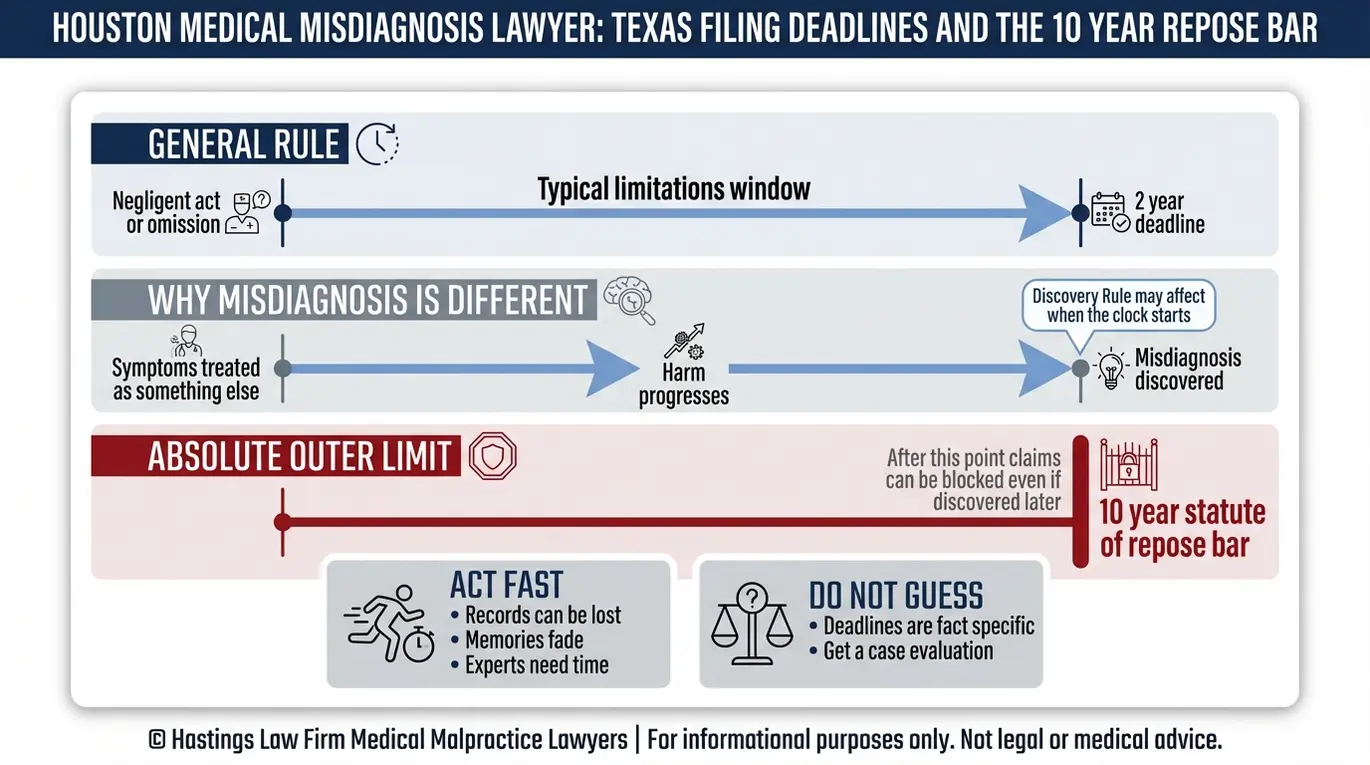
Texas law generally imposes a two-year statute of limitations for medical malpractice claims, but the “Discovery Rule” may extend this deadline if the misdiagnosis could not have been reasonably discovered right away. A statute of limitations is the legal time limit for filing a lawsuit.
The general rule is clear: you have two years from the date of the negligent act or omission to file a claim. The problem with misdiagnosis cases is that patients often do not learn they were misdiagnosed until months or even years after the original error. A cancer that was missed in 2021 may not be correctly identified until 2024, well past the standard two-year limit.
The Discovery Rule exists to address this. It allows the statute of limitations to begin when the patient knew, or reasonably should have known, that a diagnostic error occurred. This extension has limits, though. Texas enforces a statute of repose, an absolute 10-year deadline that bars claims regardless of when the misdiagnosis was discovered.
Even within these timeframes, waiting carries risk. Medical records can be altered, lost, or destroyed. Witnesses move or forget details. If you suspect a diagnostic error caused harm, contact us for a free case evaluation; consulting a misdiagnosis lawyer in Houston sooner protects both your legal rights and the evidence your case depends on.
Contact the Houston Misdiagnosis Attorneys at Hastings Law Firm Today for Help
Money cannot undo the damage of a wrong diagnosis. It cannot give back the time lost to the wrong treatment or erase the fear that came with learning the truth too late. But it is the one tool available to stabilize your future and hold the responsible provider accountable.
Hastings Law Firm has focused exclusively on medical negligence cases since 2005. Our attorneys, nurses, and patient advocates have the resources to take on major hospital systems and individual providers alike.
We work on a contingency fee basis, which means you pay no attorney fees or costs unless we recover compensation for you. There is no financial risk in reaching out.
If you or a loved one suffered harm because of a diagnostic error, contact us today for a free, confidential case evaluation. Let us help you find the answers you deserve.
Frequently Asked Questions About Medical Misdiagnosis in Houston


This content was researched and written by the Hastings Law Firm editorial team, which includes attorneys, medical professionals, and experienced researchers. Our writing is informed by internal knowledge and practical experience, and we cross-check critical details against authoritative sources cited throughout. Every piece undergoes human-led fact-checking and legal review. Because legal and medical information can change, if you spot an error, please contact us. Learn more about our content standards and review process on our editorial policy page.

Tommy Hastings, founder of Hastings Law Firm, is a board-certified personal injury trial lawyer dedicated exclusively to healthcare injury cases. Since 2001, he has represented injured patients and families in litigation against major hospital systems, pharmaceutical companies, and negligent healthcare providers nationwide. He has handled numerous high-profile cases that have drawn national media attention and resulted in multi-million dollar recoveries. He draws on that experience in his writing, helping readers understand how these cases work and what options may be available to them.
