


Texas Cancer Misdiagnosis Lawyer
A delayed or missed cancer diagnosis can change treatment options, increase the intensity of care, and worsen prognosis, especially when warning signs were present but not acted on. These situations often involve breakdowns in testing, communication, or follow up that allow cancer to progress and spread. The resulting harm can bring higher medical costs, lost income, and lasting emotional distress for patients and families. If you or a loved one were harmed or worse due to delayed or missed cancer diagnosis in Texas, contact Hastings Law Firm for a free, confidential case review.

Last Updated: July 27, 2026
Compassionate Texas Medical Attorneys for Delayed Cancer Diagnosis Claims
A cancer diagnosis changes everything. When that diagnosis was delayed or missed because a doctor failed to act on the evidence in front of them, the consequences can be devastating. You may be dealing with a more advanced stage of disease, more aggressive treatment, and a prognosis that could have looked very different if the cancer had been caught sooner.
If you or a loved one experienced a delayed or missed cancer diagnosis, you are not alone, and you do not have to figure this out by yourself. A Texas cancer misdiagnosis lawyer at Hastings Law Firm can review your medical records, help you understand what happened, and explain your legal options.
Consultations are free and confidential. We do not collect a fee unless we recover compensation for you. Contact us to start the conversation.

Understanding Cancer Misdiagnosis and Delayed Diagnosis
Cancer misdiagnosis occurs when a medical professional fails to identify cancer, diagnoses the wrong condition, or delays a diagnosis despite signs that a reasonably careful doctor would have recognized. These failures fall into three broad categories:
- Missed diagnosis (false negative): The doctor performs a test or evaluation but incorrectly concludes that cancer is not present. A false negative means the results suggest everything is normal when it is not, allowing the disease to progress without treatment.
- Wrong diagnosis (false positive or incorrect condition): The doctor diagnoses the patient with a different condition entirely. A false positive may indicate cancer where there is none, leading to unnecessary treatment. In other cases, the doctor attributes symptoms to a benign condition and never investigates further.
- Delayed diagnosis: The doctor eventually identifies the cancer, but only after a significant and avoidable delay. By the time the correct diagnosis is made, the cancer may have advanced to a later stage or spread to other parts of the body.
The immediate impact of any of these errors can be severe. Cancer that might have been treated effectively at an early stage can progress to a point where treatment options are more limited and far less likely to succeed. This progression, known as metastasis, occurs when cancer spreads from its original site to other organs. It is often the direct consequence of lost time.
When a delayed diagnosis allows the disease to advance, the patient often faces a more grueling recovery, higher medical costs, and significant emotional distress, all of which are central to a medical malpractice claim.
Not every missed diagnosis amounts to medical malpractice. Medicine is an imperfect science, and some cancers are difficult to detect even with the best care. Texas cancer misdiagnosis attorneys must establish that the doctor’s conduct fell below the accepted standard of care. This means a reasonably competent physician in the same specialty would have acted differently under the same circumstances.
If a doctor followed all appropriate protocols and the cancer was undetectable at that time, there is likely no negligence; however, if they ignored screening guidelines or dismissed clear symptoms, liability may exist.
The Loss of Chance Doctrine in Oncology Cases
In many delayed diagnosis cases, the patient is not suing because the doctor caused their cancer. This legal framework addresses cases where medical errors reduced a patient’s probability of recovery. The cancer already existed. The legal claim centers on the loss of chance doctrine, a framework addressing the reduced survival rate or recovery probability caused by the delay.
If a patient had an 80% chance of surviving a particular cancer at Stage I, but the delayed diagnosis allowed the disease to reach Stage III where survival drops significantly, the patient may pursue a claim for that lost opportunity. Proving this causation requires expert analysis comparing the patient’s prognosis at the time the cancer should have been caught to the prognosis at the time of diagnosis. This process helps determine the damages available for a reduction in life expectancy.
Common Medical Errors Leading to Delayed Cancer Detection
Delayed detection often results from systemic failures, including misinterpreted imaging studies (such as X-rays, CT scans, and MRIs used to visualize internal structures), lost pathology reports, or a failure to order a biopsy (a procedure where tissue is removed and examined for cancer cells) when symptoms call for further investigation.
Research published through the National Center for Biotechnology Information (NCBI Bookshelf) has documented that diagnostic errors remain one of the most common and harmful types of medical mistakes. In cancer cases, these errors tend to follow recognizable patterns that often constitute a breach of standard of care.
The most common errors lawyers for cancer misdiagnosis in Texas investigate include:
- Communication breakdowns: Lab results that never reach the ordering physician, or test results that are received by the doctor’s office but never communicated to the patient. A patient may assume no news is good news, while a critical finding sits in an inbox or filing system.
- Interpretation errors: A radiologist who fails to identify a mass on a CT scan, or a pathologist who misreads a tissue sample as benign when it is malignant. These are not always judgment calls; in many cases, the abnormality was visible and should have been flagged, failing the standard of care.
- Dismissal of symptoms without proper testing: Doctors sometimes attribute warning signs to less serious conditions without ordering the diagnostic tests needed to rule out cancer. When a doctor stops investigating too soon, treatable cancers go undetected. Had the physician followed the appropriate protocols, the cancer might have been identified before spreading, drastically altering the patient’s treatment path.
Each of these errors creates a gap between when the cancer should have been caught and when it actually was. That gap is where the harm occurs.
The Hastings Law Firm Difference
Results matter, but what truly sets us apart is how we achieve them. Every verdict, every settlement, and every Texas courtroom victory comes from one guiding promise: To treat each client’s fight for justice as if it were our own.
This balance of skill, experience, and empathy reflects our core philosophy that justice should not only compensate the injured, but also make health care safer nationwide.

Cancers Frequently Missed or Misdiagnosed by Physicians
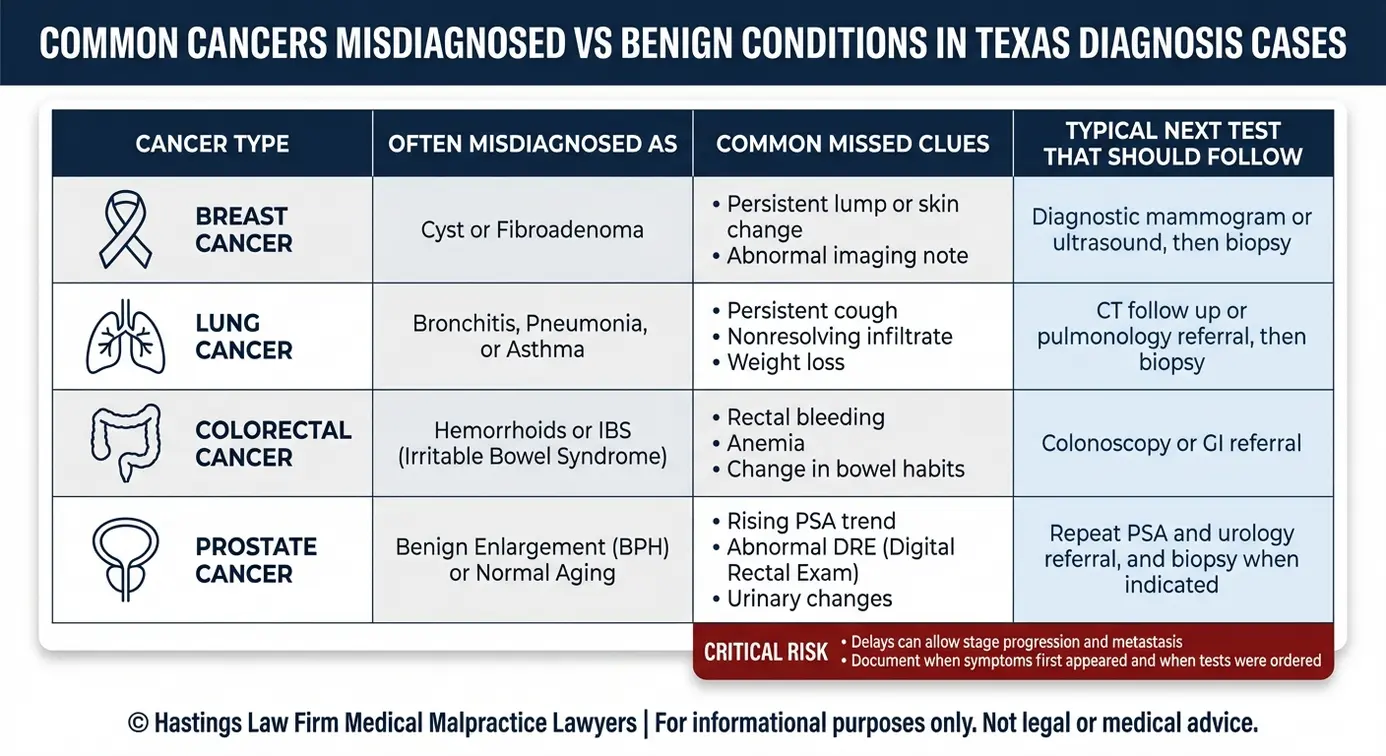
Certain cancers with non-specific symptoms, such as lung, breast, and colorectal cancer, are frequently misdiagnosed as benign respiratory issues, cysts, or digestive disorders. Because their early symptoms overlap with common, less serious conditions, doctors may not order the right tests quickly enough.
Breast cancer is one of the most commonly misdiagnosed cancers, particularly in younger women. Lumps may be dismissed as cysts or fibroadenomas without ordering a mammogram, an imaging test specifically designed to detect breast cancer. When the correct diagnosis finally comes, the disease may have already spread.
Lung cancer is frequently mistaken for bronchitis, pneumonia, or asthma. According to Cancer Stat Facts from the Surveillance, Epidemiology, and End Results (SEER) Program, lung cancer remains one of the most common and deadly cancers in the United States, in part because it is often caught late. This is especially true for non-smokers, whom doctors may be less inclined to screen.
Colorectal cancer symptoms, such as blood in the stool, changes in bowel habits, and abdominal pain, are often attributed to hemorrhoids or irritable bowel syndrome. Prostate cancer detection can be delayed when PSA (prostate-specific antigen) testing is not ordered or follow-up on elevated results is postponed. In both cases, early screening is necessary to preventing metastasis, which is the spread of cancer to other parts of the body.
| Cancer Type | Common Misdiagnosis | Consequence of Delay |
|---|---|---|
| Breast Cancer | Cysts, fibroadenomas | Metastasis, spread to lymph nodes |
| Lung Cancer | Bronchitis, pneumonia, asthma | Advanced-stage disease, reduced survival |
| Colorectal Cancer | Hemorrhoids, IBS | Spread beyond the colon, need for aggressive treatment |
| Prostate Cancer | Benign prostatic hyperplasia | Progression to untreatable stages |
A Texas misdiagnosis legal team will examine which tests were ordered, which were not, and whether the treating physician’s workup met the standard of care given the patient’s symptoms and risk factors.
Proving Liability When a Missed Diagnosis Becomes Malpractice
Proving liability requires establishing that a doctor-patient relationship existed, the doctor breached the accepted standard of care, and this specific breach directly caused a worsening of the patient’s condition or prognosis. This process unfolds in a series of connected steps that transform a medical error into a legal claim.
Step 1: Establishing the standard of care. The first question is what a “reasonably prudent” specialist would have done under the same circumstances. For a patient presenting with certain symptoms, would a competent oncologist, radiologist, or primary care physician have ordered additional testing? Would they have referred the patient to a specialist? Medical expert witnesses define this benchmark based on their training and clinical experience.
Step 2: Proving a breach occurred. Next, we examine the medical records to identify where the treating provider’s actions diverged from that standard, an act often legally defined as negligence. This includes reviewing diagnostic tests, imaging results, and a pathology report, which is a written analysis of tissue or cell samples that determines whether cancer is present. Building a detailed timeline of every appointment, test, and communication is essential to this process.
Under HIPAA’s right-of-access provisions outlined by the U.S. Department of Health and Human Services, patients have the right to obtain copies of their own medical records, an important first step in building that timeline.
Step 3: Establishing causation. This is often the most contested element. A cancer malpractice lawyer in Texas must demonstrate that the delay directly caused harm, not just that the doctor made a mistake. Expert testimony typically compares the patient’s cancer staging (a system ranging from Stage I through Stage IV) at the time the cancer should have been caught versus when it was actually found. Expert witnesses are important here to explain how the delay altered the outcome.
Distinguishing Liability Between Individual Physicians and Hospital Systems
Liability does not always rest with a single doctor. Identifying responsibility involves looking at both individual physician actions and hospital administrative protocols. When a hospital’s lab mixes up pathology samples, when test results are lost in an administrative system, or when an employed physician commits an error, the hospital itself may bear responsibility through a legal theory known as vicarious liability.
Vicarious liability means an employer is responsible for the actions of their employees. In other instances, hospital negligence may involve credentialing failures, where the facility allowed an unqualified physician to practice. Our legal team includes former defense attorneys and hospital nurses who understand the internal protocols healthcare systems use to defend these cases.

Texas Medical Malpractice Laws for Cancer Claims
Texas law imposes strict procedural requirements on cancer misdiagnosis claims, and missing a deadline can end your case before it truly begins. Attorneys for delayed diagnosis claims must manage the detailed provisions of the Texas Medical Liability Act to ensure clients retain their right to sue.
The statute of limitations under Texas Civil Practice and Remedies Code § 74.251 generally gives patients two years from the date of the alleged breach to file a medical malpractice lawsuit. In delayed diagnosis cases, pinpointing the exact date of the breach can be difficult. This is because the failure may have been an ongoing omission rather than a single event.
The 120-day expert report requirement is another critical hurdle. Under Texas Civil Practice and Remedies Code § 74.351, after a defendant files an answer, the patient must serve a written report from a qualified medical expert within 120 days. This report must identify the applicable standard of care, explain how the provider breached it, and describe how that breach caused harm. It is a gatekeeping measure intended to weed out frivolous lawsuits.
For individuals with genuine claims, it represents a substantial upfront burden requiring immediate legal coordination. If the expert report is not served within 120 days, the court will dismiss the case with prejudice, meaning it cannot be refiled.
Key Texas Deadlines for Cancer Misdiagnosis Claims:
- 2-year statute of limitations from the date of the breach
- 120 days after a defendant’s answer is filed to serve a compliant expert report
- 10-year statute of repose as the absolute outer boundary for most claims
The Discovery Rule and Texas Statutes of Limitations
In some cases, a patient may not realize that a misdiagnosis occurred until years after the fact. These rules determine the timeframe for filing a lawsuit when injuries are not immediately apparent. The discovery rule can extend the two-year filing window by starting the clock when the patient knew or should have known about the potential negligence.
This concept often applies to a latent injury, which is a harm that manifests slowly. However, Texas also enforces a 10-year statute of repose, which acts as a hard deadline. No claim can be filed more than 10 years after the date of the negligent act, regardless of when the error is discovered. Attorneys for delayed diagnosis cases evaluate both rules carefully to protect each client’s right to file.
Compensation for the Progression of Untreated Cancer
Patients harmed by a delayed cancer diagnosis can recover damages for the difference in their prognosis, meaning the gap between where they would have been with a timely diagnosis and where they are now.
Economic damages cover the tangible financial costs: additional rounds of chemotherapy, radiation, surgical procedures, and future medical expenses that may not have been necessary if the cancer had been caught earlier. Lost wages and lost earning capacity are also recoverable when treatment prevents a patient from working.
Non-economic damages address the physical pain, emotional distress, and loss of quality of life caused by the disease’s advancement. Under the Texas Civil Practice and Remedies Code, Chapter 74, non-economic damages in medical liability cases are subject to statutory caps, but economic damages are not.
Wrongful death claims are available to surviving family members when a delayed diagnosis leads to a patient’s death. These claims can include compensation for loss of companionship, loss of financial support, and funeral expenses. A Texas cancer negligence lawyer evaluates the full scope of harm to ensure every category of loss is accounted for.
Contact the Texas Misdiagnosis Attorneys at Hastings Law Firm Today for Help
No amount of compensation can undo a delayed diagnosis. But holding negligent providers accountable serves a purpose beyond any individual case: it helps prevent the same failures from happening to someone else.
At Hastings Law Firm, our team of attorneys, in-house nurse consultants, and medical experts focuses entirely on medical malpractice. Our founder, Tommy Hastings, is board-certified in Personal Injury Trial Law, a distinction held by fewer than 2% of Texas attorneys. We understand the medicine behind your case because we work with professionals who have lived it from the inside.
If you believe a delayed or missed cancer diagnosis caused you or your family member additional harm, we are here to listen. A Texas cancer misdiagnosis lawyer at our firm can review your records, explain what the evidence shows, and help you understand your legal options through a free, confidential case evaluation.
There is no fee unless we recover compensation for you. Call us or complete our online form to start your investigation.
Frequently Asked Questions About Cancer Misdiagnosis in Texas


This content was researched and written by the Hastings Law Firm editorial team, which includes attorneys, medical professionals, and experienced researchers. Our writing is informed by internal knowledge and practical experience, and we cross-check critical details against authoritative sources cited throughout. Every piece undergoes human-led fact-checking and legal review. Because legal and medical information can change, if you spot an error, please contact us. Learn more about our content standards and review process on our editorial policy page.

Tommy Hastings, founder of Hastings Law Firm, is a board-certified personal injury trial lawyer dedicated exclusively to healthcare injury cases. Since 2001, he has represented injured patients and families in litigation against major hospital systems, pharmaceutical companies, and negligent healthcare providers nationwide. He has handled numerous high-profile cases that have drawn national media attention and resulted in multi-million dollar recoveries. He draws on that experience in his writing, helping readers understand how these cases work and what options may be available to them.
