


Texas Lymphoma Misdiagnosis Lawyer
A delayed or missed lymphoma diagnosis can change the course of treatment and leave patients facing more aggressive care, greater suffering, and outcomes that are far less certain. These cases often involve missed warning signs, inadequate follow up, or pathology and biopsy errors that create false reassurance while the disease progresses. Proving harm commonly turns on whether the delay worsened the prognosis and whether the medical response met the standard of care. If you or a loved one were harmed or worse due to delayed lymphoma diagnosis in Texas, contact Hastings Law Firm for a free, confidential case review.

Last Updated: July 27, 2026
Trusted Texas Medical Attorneys for Delayed Lymphoma Diagnosis Claims
If you or someone you love received a late or incorrect lymphoma diagnosis, you may be dealing with more than just a medical setback. You may be facing the reality that earlier action could have changed everything.
Lymphoma is a cancer of the lymphatic system, the network of vessels and organs that helps your body fight infection. It targets lymphocytes, the white blood cells responsible for your immune defense. When doctors miss or delay this diagnosis, the cancer can spread to a point where treatment becomes far more aggressive and outcomes far less certain.
At Hastings Law Firm, we focus exclusively on medical malpractice. Our founder, Tommy Hastings, is Board Certified in Personal Injury Trial Law and established the firm in 2005 to provide expert guidance in these complex cases. As a Texas lymphoma misdiagnosis lawyer, our team is prepared to review what happened. We will explain your legal options during a free, confidential consultation.

Understanding Lymphoma Misdiagnosis and Delayed Diagnosis
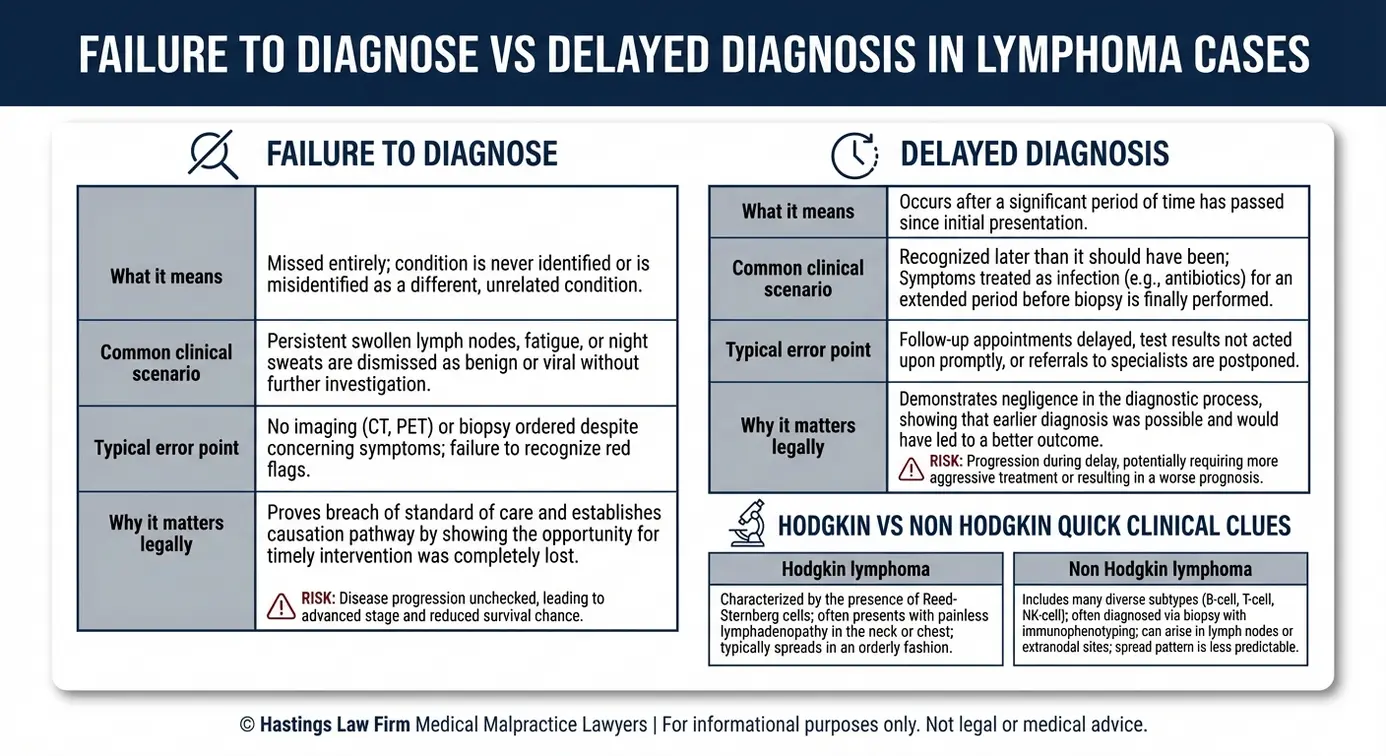
A lymphoma misdiagnosis occurs when a doctor fails to identify Hodgkin or Non-Hodgkin lymphoma in a timely manner, often attributing symptoms to benign infections, or when a pathologist interprets biopsy results incorrectly, delaying life-saving treatment.
Early detection is directly tied to better survival rates for cancers affecting the immune system. When the diagnosis is delayed, the cancer may progress from a localized, treatable stage to one that requires aggressive intervention with a far less favorable prognosis.
There are two distinct ways a diagnosis can go wrong:
- Failure to diagnose means the lymphoma was missed entirely. The patient may have been told nothing was wrong, or the condition was attributed to something else altogether.
- Delayed diagnosis means the cancer was eventually identified, but not soon enough. The lost time allowed the disease to advance.
An experienced lymphoma misdiagnosis attorney will also need to understand the specific type of lymphoma involved, because the medical and legal analysis differs:
- Hodgkin lymphoma, a cancer characterized by the presence of Reed-Sternberg cells, which are abnormally large B lymphocytes identifiable under a microscope, depends on these cells for accurate pathological diagnosis. According to the National Center for Biotechnology Information (NCBI), these cells are the hallmark of Hodgkin lymphoma.
- Non-Hodgkin lymphoma is a broader category that includes many subtypes and does not involve Reed-Sternberg cells. It is more common and can behave very differently depending on the subtype.
Understanding these distinctions matters because a pathologist who confuses one for the other, or who fails to identify the correct subtype, can set the entire course of treatment in the wrong direction.
Common Medical Errors Leading to Lymphoma Misdiagnosis
Misdiagnosis often stems from a physician’s failure to order necessary imaging tests or biopsies, dismissing persistent swollen lymph nodes as a minor infection, or pathology errors where tissue samples are misread or mishandled. A Frontiers in Oncology study analyzing 2,291 cases of haematolymphoid neoplasms confirmed that diagnostic discrepancies in lymphoma cases remain a significant problem.
One of the most common patterns involves the dismissal factor. A patient presents with lymphadenopathy, the clinical term for swollen lymph nodes, along with fatigue or unexplained weight loss. Rather than ordering follow-up blood work, CT scans, or X-rays, the doctor attributes the symptoms to a viral illness and sends the patient home. When nodes persist for weeks, the standard of care typically calls for additional investigation, not a second round of antibiotics.
Testing errors are equally dangerous. An improperly performed bone marrow biopsy or a misread tissue sample can produce a false negative, giving both doctor and patient a false sense of security while Non-Hodgkin lymphoma, a diverse group of blood cancers, or another subtype continues to grow.
Under Texas Civil Practice and Remedies Code, Chapter 74, a Texas lymphoma lawyer must demonstrate that the physician’s actions fell below the accepted standard. The table below illustrates how common symptoms, negligent responses, and the expected standard of care compare:
| Symptom | Negligent Action | Standard of Care |
|---|---|---|
| Persistent swollen lymph nodes | Prescribing antibiotics without follow-up | Ordering biopsy if nodes persist beyond 4–6 weeks |
| Unexplained weight loss and night sweats | Attributing symptoms to stress or infection | Ordering CBC blood work and imaging (CT/MRI) |
| Abnormal white blood cell counts | Failing to refer to oncology | Prompt referral for hematologic evaluation |
| Inconclusive initial biopsy | Accepting results without further testing | Ordering repeat or excisional biopsy |
Biopsy Technique Distinctions & Pathology Errors
Not all biopsies are equal when it comes to diagnosing lymphoma. An excisional biopsy, where an entire lymph node is surgically removed and examined, is considered the gold standard because it preserves the tissue architecture pathologists need to make an accurate diagnosis.
Fine-needle aspiration (FNA), a less invasive technique that extracts a small sample of cells with a thin needle, is often insufficient for lymphoma. FNA can miss the structural patterns that distinguish lymphoma from reactive conditions. Regarding a patient with clinical signs pointing toward a misdiagnosis of lymphoma, the choice to use only an FNA may represent a breach of the standard of care.
The Hastings Law Firm Difference
Results matter, but what truly sets us apart is how we achieve them. Every verdict, every settlement, and every Texas courtroom victory comes from one guiding promise: To treat each client’s fight for justice as if it were our own.
This balance of skill, experience, and empathy reflects our core philosophy that justice should not only compensate the injured, but also make health care safer nationwide.

Proving Medical Negligence in Cancer Cases
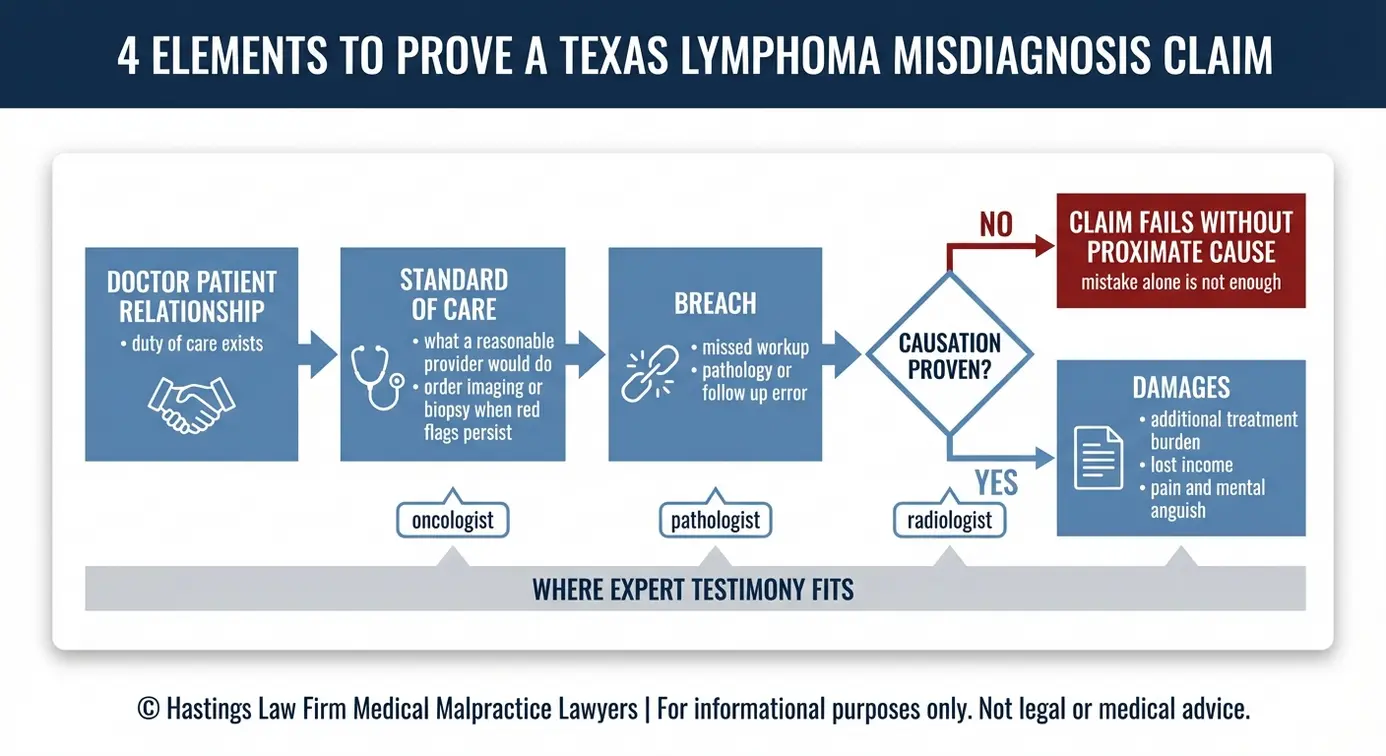
To prove negligence, a patient must demonstrate that the doctor breached the standard of care, meaning a competent physician under similar circumstances would have ordered further testing or identified the lymphoma sooner, and that this breach directly caused a worsening of the patient’s condition.
The standard of care in oncology and primary care settings refers to the level of treatment a reasonably skilled doctor would provide given the same symptoms, patient history, and available information. For lymphoma cases, this often comes down to whether the physician recognized warning signs and responded with appropriate diagnostic steps such as biopsies or imaging.
Establishing the breach alone is not enough. The legal concept of proximate cause requires showing that the delay actually changed the medical outcome. For example, if lymphoma staging, the classification system from Stage I (localized) through Stage IV (widespread), shows the cancer progressed significantly during the period of delay, that progression can serve as evidence of harm caused by the missed diagnosis.
A bone marrow biopsy, which examines the soft tissue inside bones for cancer cells, or imaging of organs like the spleen may be part of the evidence showing how far the disease had advanced by the time it was correctly identified.
Expert testimony is essential. A medical malpractice lawyer for lymphoma cases will retain qualified oncologists, pathologists, or radiologists who can review the records and testify about what a reasonable doctor should have done. At Hastings Law Firm, our in-house medical staff, including nurse practitioners and Board Certified Patient Advocates, work alongside our attorneys to analyze clinical records. Our team includes former defense attorneys who understand exactly how the other side will try to challenge causation, and we prepare for those arguments from day one.
Texas Malpractice Laws Impacting Lymphoma Claims
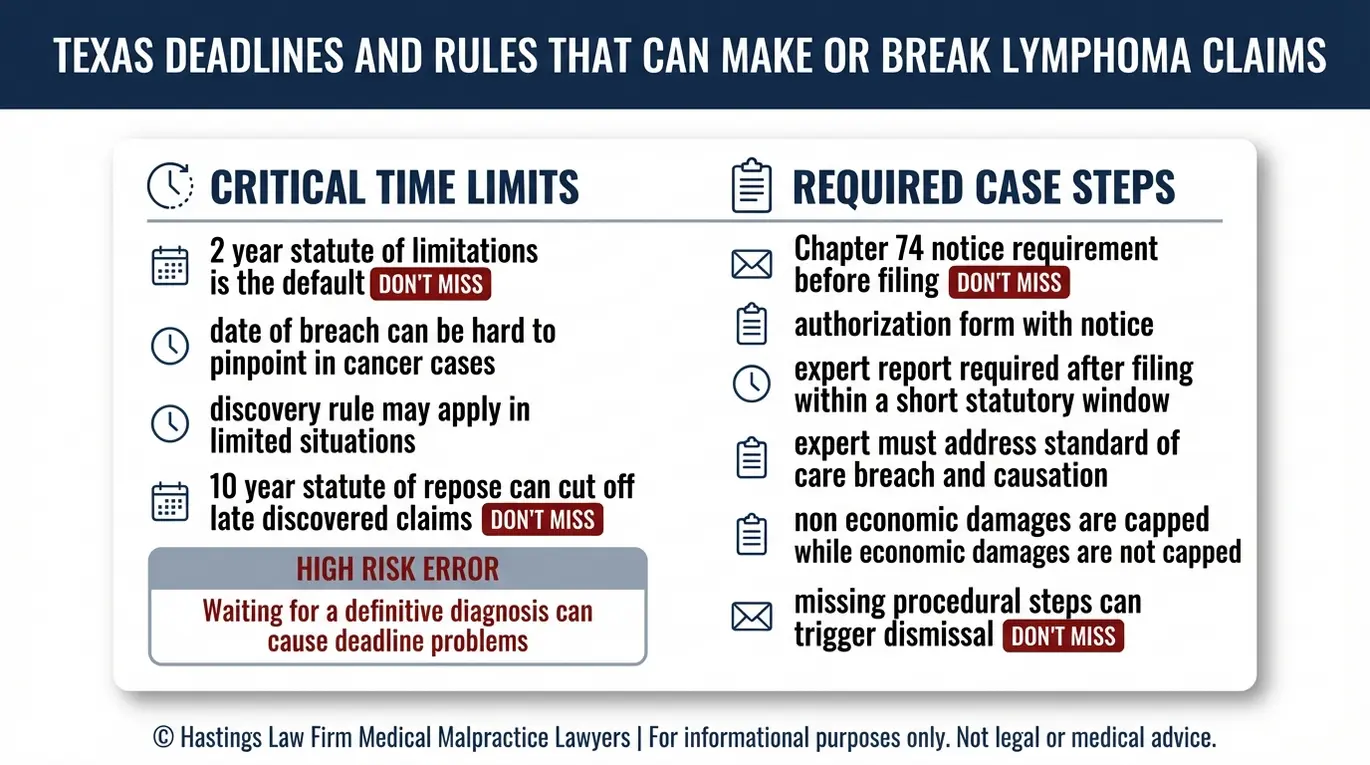
Texas law imposes strict regulations on malpractice claims, including a two-year statute of limitations, a requirement to serve an expert report within 120 days after the defendant files an answer, and specific caps on non-economic damages. These legal rules govern how and when a patient can seek compensation for medical errors.
If you are considering a claim, here are the key procedural requirements you should be aware of:
- Two-year statute of limitations: You generally have two years from the date the negligence occurred, or from the date it was discovered, to file a medical malpractice claim. In cancer cases, identifying that date can be complicated because the misdiagnosis may not become apparent until much later.
- Expert report within 120 days: After the defendant files an answer, Texas law requires plaintiffs to serve a written expert report from a qualified physician explaining the standard of care, how it was breached, and how the breach caused injury. Missing this deadline results in automatic dismissal.
- Non-economic damages cap: Texas caps non-economic damages (pain, suffering, mental anguish) at $250,000 per claimant against all individual physicians and health care providers, with a separate cap of $250,000 per health care institution (up to $500,000 for two or more institutions), for an overall maximum of $750,000. There is no cap on economic damages like medical bills and lost wages.
- 60-day pre-suit notice: Before filing, you must send a written Notice of Health Care Claim to every potential defendant at least 60 days in advance.
A Texas medical malpractice attorney experienced in cancer cases will know how to manage each of these deadlines and build a case that meets every procedural requirement.
Texas ‘Lost Chance of Survival’ Doctrine
Texas does not recognize “lost chance of survival” as a standalone legal theory. In many states, a patient can recover damages simply by showing that a doctor’s negligence reduced their survival rate, even by a small percentage. Texas takes a stricter approach.
Here, the patient must prove that the negligence was the proximate cause of the injury or death. This means it was more likely than not (greater than 50%) the reason the outcome worsened. Simply showing that survival odds dropped from 40% to 20% is generally not enough under Texas law. This makes the quality of expert testimony and the strength of medical evidence even more critical in these cases.
Recoverable Damages for Delayed Treatment
Patients harmed by lymphoma misdiagnosis can recover compensation for economic losses like additional medical bills and lost wages, as well as non-economic damages for the physical pain, mental anguish, and unnecessary aggressive treatments caused by the delay.
Economic losses often make up a significant portion of these claims in medical malpractice cases. A delayed diagnosis can push a patient from early-stage treatment into far more aggressive chemotherapy or radiation therapy regimens, each carrying higher costs and greater physical toll. Research published by PubMed Central on incremental health care expenditures for Non-Hodgkin lymphoma confirms that cancer patients face substantially higher medical costs compared to the general population. Lost income during extended treatment and the cost of future medical care are also recoverable.
Non-economic damages account for the suffering that does not come with a receipt: physical pain, emotional distress, loss of enjoyment of life, and the mental anguish of knowing the disease could have been caught sooner. If the delayed diagnosis resulted in a patient’s death, surviving family members may pursue a wrongful death claim. A lawyer for cancer misdiagnosis can help families identify every category of damages that applies and, for those pursuing lymphoma misdiagnosis settlements, build a case that reflects the full scope of harm.
Contact the Texas Misdiagnosis Attorneys at Hastings Law Firm Today for Help
No amount of compensation can undo the progression of cancer or the suffering caused by a missed diagnosis. But holding the responsible parties accountable matters, both for your family’s financial security and for the safety of future patients.
Hastings Law Firm represents patients and families across Texas who have been harmed by diagnostic failures. Our team of attorneys, nurse consultants, and medical experts focuses exclusively on medical malpractice, and we prepare every case as if it is going to trial.
If you believe your lymphoma diagnosis was missed or delayed due to a medical error, we encourage you to reach out. As a Texas lymphoma misdiagnosis lawyer, we offer a free, confidential case evaluation, and you pay no fees unless we recover compensation on your behalf. Contact us today to discuss what happened and learn what options may be available to you.
Frequently Asked Questions About Lymphoma Misdiagnosis in Texas


This content was researched and written by the Hastings Law Firm editorial team, which includes attorneys, medical professionals, and experienced researchers. Our writing is informed by internal knowledge and practical experience, and we cross-check critical details against authoritative sources cited throughout. Every piece undergoes human-led fact-checking and legal review. Because legal and medical information can change, if you spot an error, please contact us. Learn more about our content standards and review process on our editorial policy page.

Gabe Sassin has focused exclusively on medical malpractice law since 2007. After spending more than a decade as a malpractice defense attorney, he knows exactly how the other side works. He has seen firsthand how healthcare providers, insurers, corporate defendants, and their legal teams think, prepare, and build their defense against claims. That knowledge works for the people who need it most today, injured patients and their families. His unique experience shapes everything he writes, giving readers a look at how these cases actually work from someone who has handled them from both sides.
