


Texas Testicular Cancer Misdiagnosis Lawyer
A delayed or missed testicular cancer diagnosis can turn a treatable condition into advanced disease with more aggressive treatment and lasting physical and emotional consequences. Diagnostic errors may involve dismissing symptoms without appropriate testing, misreading imaging, or failing to follow up when symptoms persist. Some patients also suffer harm from a false positive diagnosis that leads to unnecessary surgery and permanent effects. Understanding how these errors happen can help clarify whether the harm was preventable. If you or a loved one were harmed or worse due to testicular cancer misdiagnosis in Texas, contact Hastings Law Firm for a free, confidential case review.

Last Updated: July 27, 2026
Compassionate Texas Medical Attorneys for Delayed Testicular Cancer Diagnosis Claims
When a doctor overlooks or misidentifies testicular cancer, the consequences can be life-altering. What may have been a highly treatable condition can progress to advanced-stage disease, requiring aggressive treatment that might have been avoidable. If you or a loved one experienced a delayed or missed testicular cancer diagnosis, the confusion and frustration you feel are valid.
At Hastings Law Firm, we have focused exclusively on medical malpractice since 2005. Founded by board-certified trial lawyer Tommy Hastings, our team understands the medicine and the law behind these cases. Tommy’s board certification is a distinction held by less than 2% of Texas attorneys. As a Texas testicular cancer misdiagnosis lawyer, we know how to investigate what went wrong and identify where the standard of care was breached.
If something about your care does not sit right, we are here to listen. Contact us for a free, confidential case evaluation to understand your options.

When Delayed Testicular Cancer Diagnosis Becomes Medical Malpractice
Medical malpractice occurs when a physician deviates from the accepted standard of care, and that deviation results in verifiable harm, such as metastasis or the loss of a testicle that could have been preserved. Not every diagnostic error rises to this level. The distinction between a simple mistake and actionable medical negligence lies in whether a reasonably competent doctor, facing the same clinical situation, would have acted differently.
The standard of care for a young male presenting with a scrotal lump, pain, or swelling generally requires a prompt and structured diagnostic workup. According to the National Cancer Institute’s Testicular Cancer Treatment PDQ, early detection and accurate staging are central to effective treatment. When a physician skips essential steps or defaults to a “wait and see” approach, treatable early-stage cancer can quietly advance.
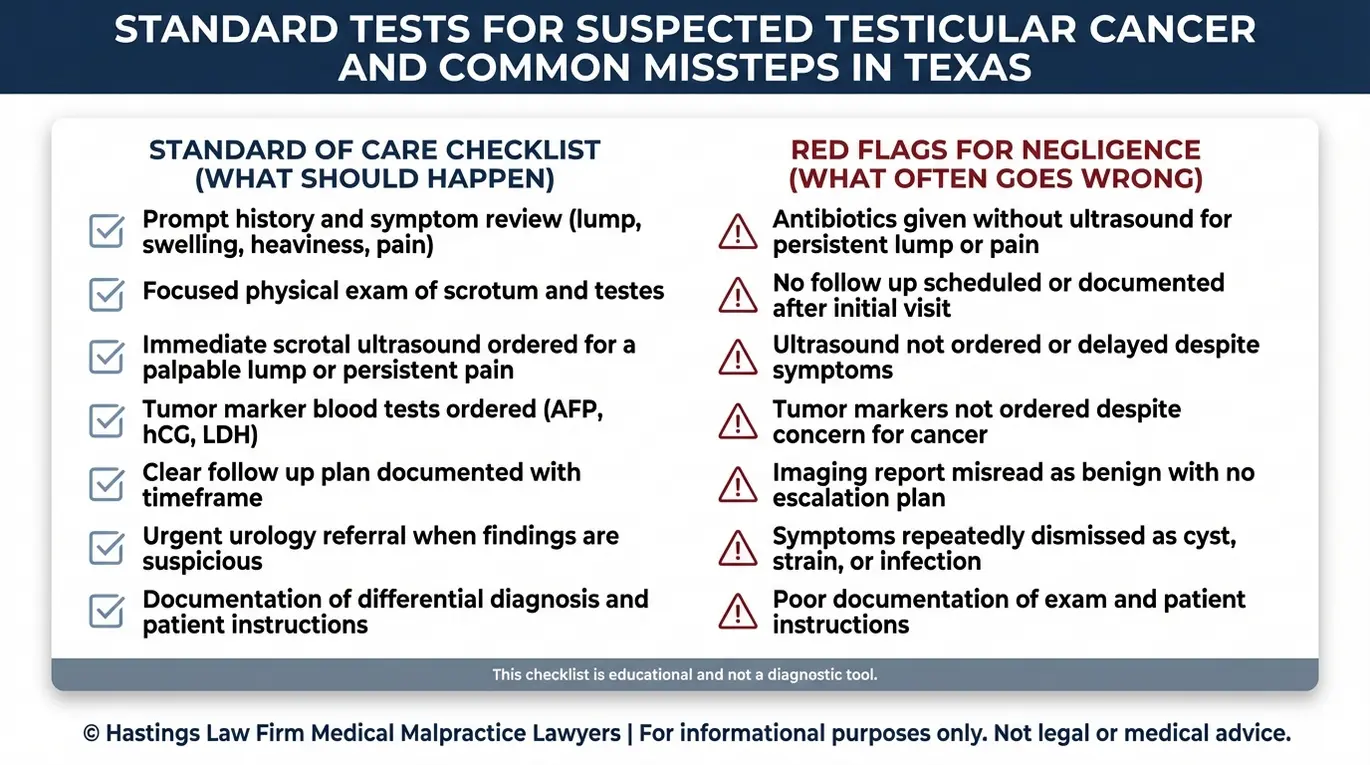
A delayed testicular cancer diagnosis becomes a potential malpractice claim when specific diagnostic steps were omitted or unreasonably delayed. The standard of care, which is the level of care a reasonably competent doctor would provide, outlines these necessary steps. Those steps typically include:
- Physical examination: A thorough clinical assessment of the scrotum to evaluate the size, shape, and consistency of any mass.
- Scrotal ultrasound: The physician should order a scrotal ultrasound, a non-invasive imaging study that uses sound waves to determine whether a mass is solid or fluid-filled. Solid masses are highly suspicious for malignancy (cancerous growth).
- Tumor marker blood tests: The workup must include tumor markers, lab work measuring levels of alpha-fetoprotein (AFP) and human chorionic gonadotropin (hCG), which are proteins often elevated in the presence of testicular cancer.
If a doctor examines a patient and prescribes antibiotics without ordering diagnostic imaging or bloodwork, that gap in care is exactly what a Texas testicular cancer misdiagnosis lawyer would investigate. Our in-house medical staff, including experienced nurse consultants, reviews records to determine whether each of these standard steps was taken. We look to see if the omission changed the medical outcome.
Common Examples of Testicular Cancer Diagnostic Errors
Common errors include dismissing a lump as a cyst or infection without imaging, failing to order tumor marker blood tests, or misinterpreting ultrasound results as benign. These mistakes can delay a cancer diagnosis by weeks or months, giving the disease time to spread beyond the testicle. Failure to diagnose testicular cancer often happens when symptoms are mistaken for less serious, non-cancerous issues.
One of the most frequent patterns involves a condition called epididymitis, an inflammation of the tube behind the testicle commonly caused by infection. Because its symptoms can overlap with testicular cancer, doctors sometimes prescribe a course of antibiotics and send the patient home without further testing. If no ultrasound or follow-up is ordered and the symptoms persist, cancer may continue to grow undetected. According to data from the National Cancer Institute’s SEER Program, testicular cancer has a high survival rate when caught early.
These diagnostic failures can turn a treatable condition into a life-threatening illness. Other errors our testicular cancer misdiagnosis lawyers in Texas commonly evaluate include:
- False-negative imaging: A radiologist may deliver a false-negative scrotal ultrasound, an erroneous result where a cancerous mass is identified as a benign finding, delaying biopsy or referral.
- Failure to order tumor markers: A doctor does not check AFP or hCG levels, missing an important indicator of malignancy.
- Laboratory mishandling: Blood samples for tumor marker testing are improperly processed, producing inaccurate results.
- No follow-up after treatment: A physician prescribes antibiotics but never schedules a return visit to confirm the issue has resolved.
A failure to diagnose testicular cancer does not always involve a single dramatic error. Often, it is a series of small oversights that add up to a significant and preventable delay.
The Hastings Law Firm Difference
Results matter, but what truly sets us apart is how we achieve them. Every verdict, every settlement, and every Texas courtroom victory comes from one guiding promise: To treat each client’s fight for justice as if it were our own.
This balance of skill, experience, and empathy reflects our core philosophy that justice should not only compensate the injured, but also make health care safer nationwide.

Proving Liability in Texas Testicular Cancer Lawsuits
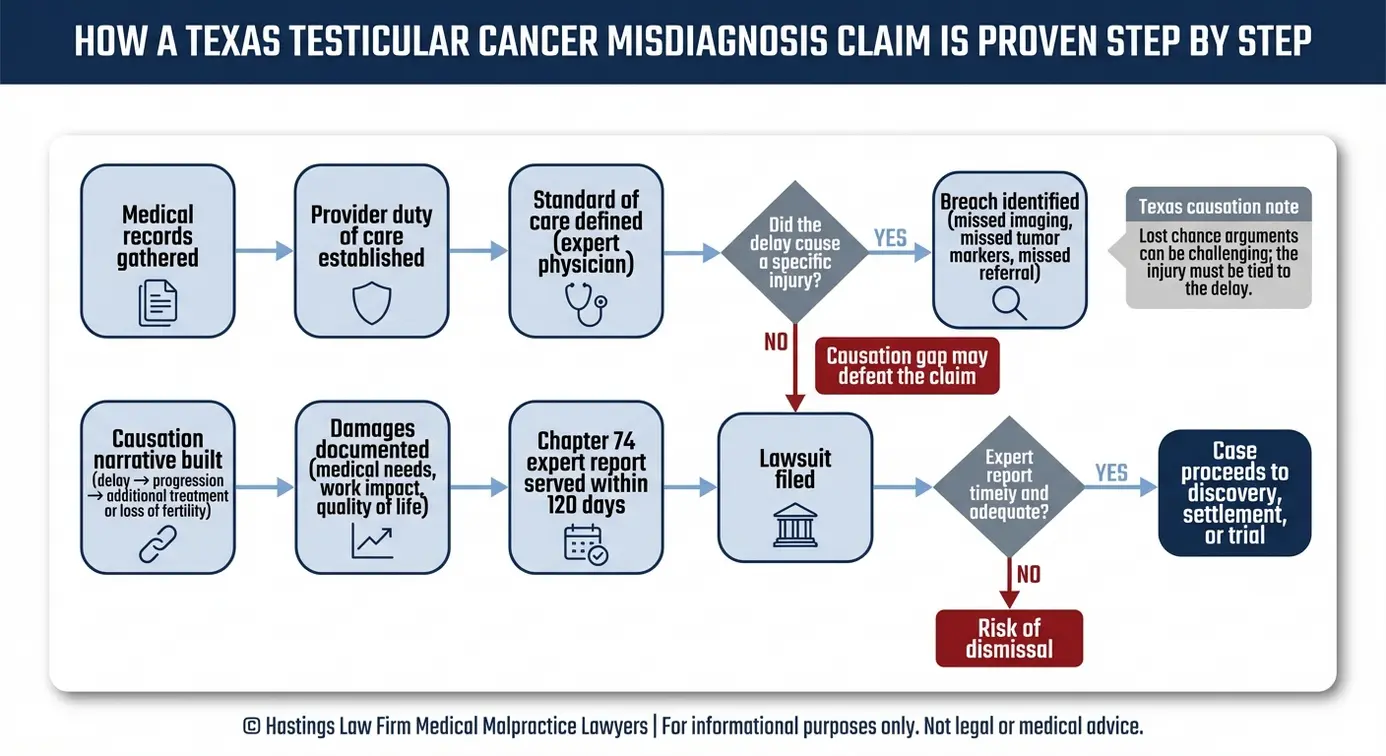
To prove liability, a plaintiff must demonstrate that the doctor had a duty of care, breached that duty by missing the diagnosis, and that this specific delay caused injuries that would not have occurred with timely treatment. Each of these elements must be supported by evidence, including expert testimony, and Texas law imposes strict procedural requirements that make experienced legal counsel essential.
Causation is often the most contested element. It is not enough to show that the doctor missed the cancer. You must also prove that the delay led to a specific, measurable harm, such as the need for chemotherapy or the spread of cancer cells. Defense attorneys will argue that the outcome would have been the same regardless. That is why pursuing a medical malpractice claim for cancer misdiagnosis in Texas requires detailed medical evidence linking the timeline of the delay to the progression of the disease.
Texas also requires strict compliance with Chapter 74 of the Texas Medical Liability Act. Under Texas Civil Practice and Remedies Code § 74.351, a patient must serve a qualified expert report within 120 days after the date each defendant’s original answer is filed. Chapter 74 is the part of Texas law that sets specific rules for medical malpractice lawsuits. This report must identify the standard of care, explain how the physician breached it, and establish causation.
There is another challenge specific to cancer cases in Texas: the “lost chance” doctrine. If a patient’s chance of survival was already below 50% before the negligent delay, Texas courts generally do not allow recovery. This makes early legal evaluation critical. A Texas testicular cancer misdiagnosis lawyer can assess whether the facts of a case support a viable causation argument under current state precedents.
The Impact of False Positive Diagnosis
The reverse scenario also causes serious harm. A false-positive testicular cancer diagnosis can lead to unnecessary surgery, including a radical inguinal orchiectomy. This procedure involves the surgical removal of the testicle through the groin and is only appropriate when cancer is actually present. Losing a testicle to a condition that was never present carries permanent physical, hormonal, and emotional consequences. These cases may involve claims of medical negligence against the diagnosing physician or the pathologist.
Damages and Compensation for Worsened Prognosis
Patients harmed by a delayed or missed testicular cancer diagnosis can recover economic damages for additional medical costs and lost wages, as well as non-economic damages for pain, suffering, physical impairment, and loss of fertility. In medical malpractice law, damages represent the financial and personal losses a patient experiences due to negligence.
The physical toll of a worsened prognosis often includes the loss of one or both testicles, aggressive chemotherapy or radiation, and the spread of disease to the lymph nodes or lungs. Many men face reproductive consequences that last a lifetime, including infertility and the inability to conceive children naturally. Some may need testosterone replacement therapy (TRT), which is an ongoing medical treatment to supplement the hormone the body can no longer produce adequately.
A testicular cancer misdiagnosis attorney will work to document the full scope of these losses. Recoverable damages generally fall into two categories:
| Damage Type | Examples |
|---|---|
| Economic Damages | Past and future medical bills, chemotherapy costs, hormone therapy, sperm banking, lost wages, loss of earning capacity |
| Non-Economic Damages | Pain and suffering, physical impairment, emotional distress, loss of fertility, disfigurement |
Texas does limit non-economic recovery through specific non-economic damages caps. Under Texas Civil Practice and Remedies Code § 74.301, recovery for non-economic damages is limited to $250,000 against all physicians or individual health care providers combined, and $250,000 per health care institution (up to $500,000 for all institutions), with an aggregate cap of $750,000. There is no cap on economic damages, which is why thorough documentation of every financial loss matters.
Statute of Limitations for Cancer Misdiagnosis Cases in Texas
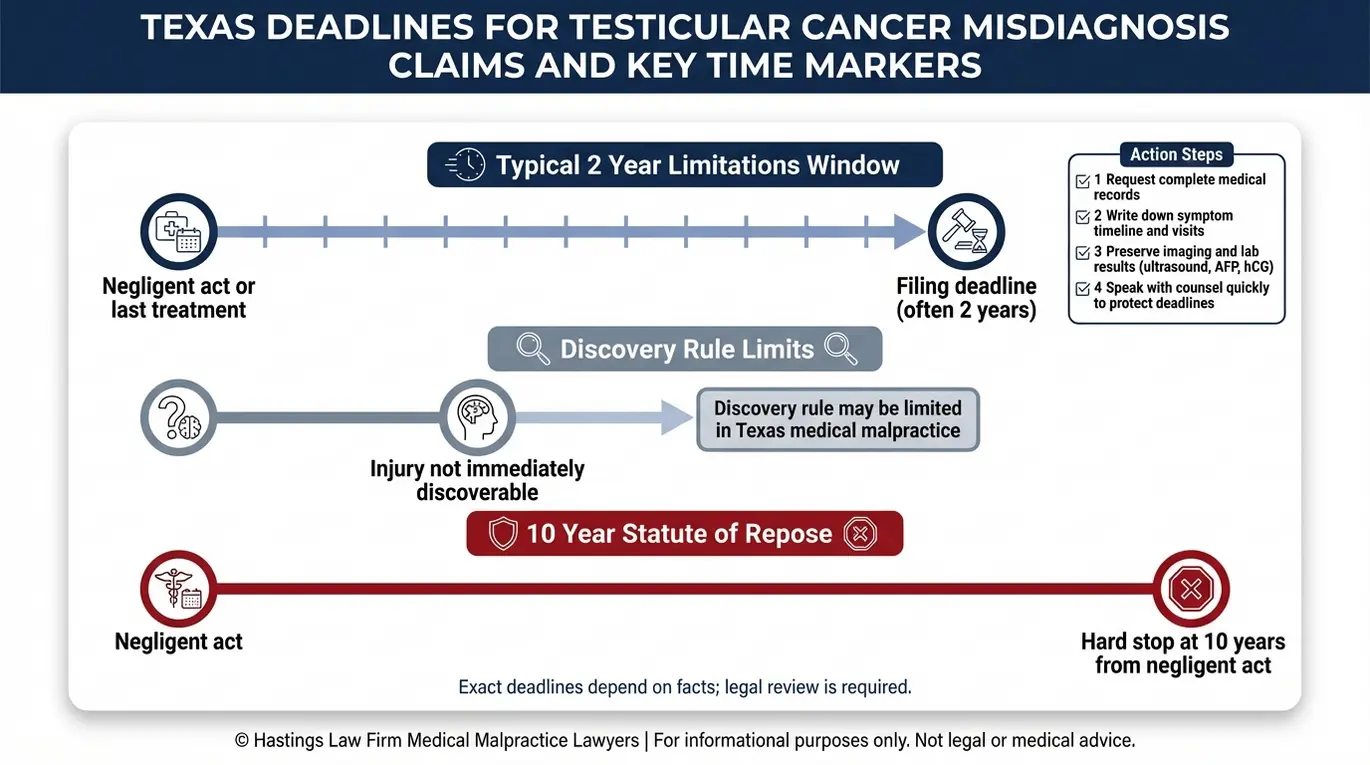
Generally, the statute of limitations for a medical malpractice claim in Texas is two years from the date of the negligent act. This timeframe is the legal window a patient has to file a lawsuit before losing the right to seek compensation.
Texas recognizes a limited version of the discovery rule, which may delay the start of the two-year period until the patient knew or should have known about the injury and its connection to the medical care received. However, this flexibility has a hard limit. The statute of repose in Texas sets an absolute 10-year outer boundary. This rule means that no claim can be filed more than 10 years after the date of the negligence, even if the error was discovered later.
These filing deadlines are unforgiving. Waiting too long can mean losing the right to pursue a claim entirely, even if the evidence of negligence is strong. If a diagnosis was potentially delayed or missed, speaking with a lawyer as early as possible protects legal rights and ensures the preservation of available evidence.
Contact the Texas Misdiagnosis Attorneys at Hastings Law Firm Today for Help
Hastings Law Firm exists for cases like this. We are a medical malpractice firm, and that is all we do. Our team includes former defense attorneys and experienced hospital nurses who previously worked for the systems they now challenge. This background helps us anticipate defense tactics and identify inconsistencies in medical charts.
If you or a loved one suffered harm because testicular cancer was missed or diagnosed too late, our lawyers are ready to review your case and explain your options. We prepare every case as if it will go to trial to ensure a firm negotiation posture. The consultation is free, confidential, and comes with no obligation. We operate on a contingency fee basis, meaning we do not collect a fee unless we recover compensation for you.
Call us today or contact us online to schedule your risk-free case evaluation.
Frequently Asked Questions About Testicular Cancer Misdiagnosis in Texas


This content was researched and written by the Hastings Law Firm editorial team, which includes attorneys, medical professionals, and experienced researchers. Our writing is informed by internal knowledge and practical experience, and we cross-check critical details against authoritative sources cited throughout. Every piece undergoes human-led fact-checking and legal review. Because legal and medical information can change, if you spot an error, please contact us. Learn more about our content standards and review process on our editorial policy page.

Gabe Sassin has focused exclusively on medical malpractice law since 2007. After spending more than a decade as a malpractice defense attorney, he knows exactly how the other side works. He has seen firsthand how healthcare providers, insurers, corporate defendants, and their legal teams think, prepare, and build their defense against claims. That knowledge works for the people who need it most today, injured patients and their families. His unique experience shapes everything he writes, giving readers a look at how these cases actually work from someone who has handled them from both sides.
