


Texas Stroke Misdiagnosis Lawyer
A missed or delayed stroke diagnosis can leave a person with permanent brain damage and long term disability, especially when early warning signs are dismissed and treatment is delayed. The risk can be higher when symptoms do not match classic stroke patterns or when age or pregnancy related factors are overlooked. Accurate triage, prompt imaging, and timely treatment are central to avoiding catastrophic outcomes, and disputes often focus on whether care met accepted protocols and whether earlier treatment would have changed the result. If you or a loved one were harmed or worse due to stroke misdiagnosis in Texas, contact Hastings Law Firm for a free, confidential case review.
Last Updated: July 27, 2026
Trusted Texas Medical Attorneys for Failure to Diagnose Stroke Claims
When a stroke is missed or misdiagnosed, the consequences can be permanent. Every minute without treatment means more brain tissue lost, and if you or a loved one suffered preventable harm because a medical provider failed to recognize the signs, you deserve answers.
At Hastings Law Firm, we focus exclusively on medical malpractice. Our founder, Tommy Hastings, is a board-certified trial lawyer who has dedicated his career to helping patients affected by medical errors. Our team of attorneys, nurse consultants, and medical experts understands how stroke misdiagnosis happens and how to hold negligent providers accountable.
If you need a Texas stroke misdiagnosis lawyer, we are here to listen. Contact us for a free, confidential case evaluation. You pay nothing unless we recover compensation on your behalf.

Common Scenarios Leading to Stroke Misdiagnosis
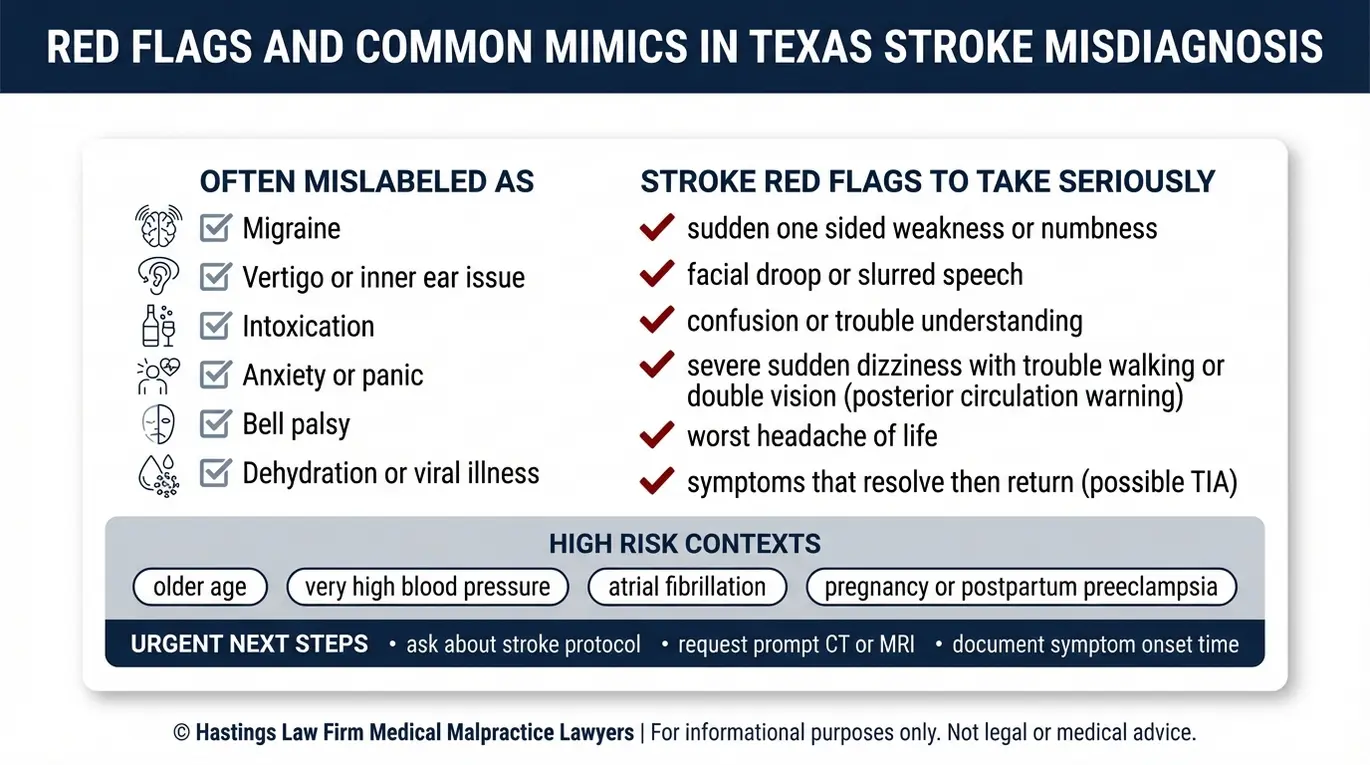
Stroke misdiagnosis often occurs when medical providers dismiss early warning signs—such as dizziness or confusion—as less severe conditions like migraines, vertigo, or intoxication, leading to a critical delay in administering clot-busting treatments. That initial misread can cause a critical delay in treatment that changes a patient’s life forever.
One reason these errors happen is cognitive bias. When an ER physician sees a younger patient complaining of a headache and dizziness, the mental shortcut may lead to a diagnosis of migraine or an inner ear problem rather than a thorough stroke workup. A study published in PMC on emergency department stroke misdiagnosis performance measures confirms that diagnostic errors in emergency settings remain a significant patient safety concern. Rushing, overcrowding, and pattern-based thinking all contribute.
Posterior circulation strokes, which affect the back of the brain rather than the areas controlling obvious motor function, are among the most frequently missed. These strokes present with dizziness, nausea, and balance problems instead of the classic one-sided weakness or facial drooping. Because the symptoms overlap with so many benign conditions, they are often categorized as stroke mimics, meaning conditions that look like something other than a stroke.
Conditions commonly confused with stroke include:
- Vertigo or inner ear infection
- Migraines with aura or “complex migraines”
- Intoxication or drug reactions
- Bell’s palsy
- Anxiety or panic attacks
- Low blood sugar
Age bias adds another layer of risk. Physicians may not consider stroke in younger adults, even when symptoms clearly warrant imaging. This includes women of childbearing age, who face unique vascular risks that are sometimes overlooked. A Transient ischemic attack (TIA) is another warning sign often ignored in these demographics.
Every one of these diagnostic errors shrinks the window of opportunity for clot-busting medication or surgical intervention. If you believe a failure to diagnose stroke caused lasting harm, speaking with a stroke misdiagnosis lawyer can help you understand what went wrong.
A qualified failure to diagnose stroke attorney can review your medical records to determine if negligence occurred. Consulting a stroke lawyer early in the process ensures that important evidence is preserved.
Pregnancy-Related Stroke Risks
Pregnant and postpartum women face an elevated risk of stroke that is frequently underestimated. Preeclampsia, a dangerous pregnancy complication involving high blood pressure and organ damage, can lead to hemorrhagic stroke if left untreated. Our team includes former hospital nurses who use their clinical background to help identify when these critical warning signs were dismissed as normal discomfort.
A Texas stroke misdiagnosis lawyer who understands these high-risk pregnancy scenarios can evaluate whether the treating physician failed to order the imaging or monitoring that the situation required.
The Medical Standard of Care: Protocols and Certifications
The standard of care for stroke requires immediate triage, rapid imaging such as a CT scan or MRI, and timely administration of tPA or mechanical thrombectomy if the patient qualifies; failure to adhere to established AHA/ASA guidelines constitutes negligence. tPA, or tissue plasminogen activator, is a clot-dissolving medication that must generally be given within a narrow time window to be effective. Mechanical thrombectomy is a procedure where a doctor uses a catheter to physically remove a blood clot from a blocked artery in the brain. When providers fail to follow established protocols, that failure can constitute negligence.
The phrase “time is brain” exists for a reason. With every minute of untreated ischemic stroke, an estimated 1.9 million neurons die. The 2026 Guideline for the Early Management of Patients With Acute Ischemic Stroke reinforces the importance of rapid evaluation and intervention. Delays at any stage, from triage to imaging to treatment, can mean the difference between recovery and permanent disability.
Hospital certification level matters as well. A Primary Stroke Center (PSC) is equipped to administer tPA and provide basic stroke care. A Comprehensive Stroke Center (CSC) offers advanced neurosurgical capabilities, including thrombectomy for large vessel occlusions. Many hospitals seek accreditation from organizations like The Joint Commission or DNV Healthcare to demonstrate their competence in these areas.
The Texas Department of State Health Services Advanced Level II Stroke Designation Guidelines set specific requirements for staffing and equipment. A facility that holds itself out as stroke-ready but fails to deliver timely care may face heightened liability. When we evaluate a potential case, the hospital’s certification level and its adherence to AHA/ASA guidelines are among the first things we examine.
A stroke malpractice lawyer must understand both the clinical timeline and the institutional obligations at play. If you suspect your care did not meet these standards, a failure to diagnose stroke lawyer can help verify whether the facility followed its own certified protocols.
The Hastings Law Firm Difference
Results matter, but what truly sets us apart is how we achieve them. Every verdict, every settlement, and every Texas courtroom victory comes from one guiding promise: To treat each client’s fight for justice as if it were our own.
This balance of skill, experience, and empathy reflects our core philosophy that justice should not only compensate the injured, but also make health care safer nationwide.

Overcoming the “Willful and Wanton” Standard in Texas Emergency Rooms
Under Texas law, proving negligence in an emergency room often requires meeting the “willful and wanton” standard, which means the plaintiff must prove the medical staff had actual, subjective awareness of an extreme degree of risk and proceeded with conscious indifference to the patient’s safety. This heightened standard comes from Texas Civil Practice and Remedies Code Chapter 74, which was enacted as part of tort reform to protect emergency physicians from ordinary negligence claims.
The logic behind it is that ER doctors make rapid, high-pressure decisions. But the practical effect is that stroke patients and their families face a steeper burden of proof when the misdiagnosis occurred in an emergency setting. Simple negligence, meaning a doctor made an error that a reasonably careful physician would not have made, is the standard in most malpractice cases.
In a Texas ER, however, you generally must prove something closer to gross negligence. This means the physician knew about a serious risk and chose not to act on it. If a patient presented with textbook stroke symptoms and the Emergency room (ER) physician failed to order imaging, that inaction may rise to the willful and wanton threshold.
There are important distinctions. The willful and wanton standard typically applies to hospital-based emergency departments. Free-standing ERs, urgent care facilities, and non-emergency encounters may be subject to the medical negligence standard. Free-standing ERs often look like hospital departments but may operate under different legal umbrellas.
Working with an experienced Texas stroke misdiagnosis lawyer matters because of these legal hurdles. Our team, which includes former defense attorneys who previously represented hospitals, understands how to build evidence that meets this higher bar. A stroke error attorney who understands these distinctions can make or break a claim. A skilled stroke negligence attorney can also identify if the care occurred in a setting where the willful and wanton standard does not apply.
How We Prove Causation in Stroke Cases
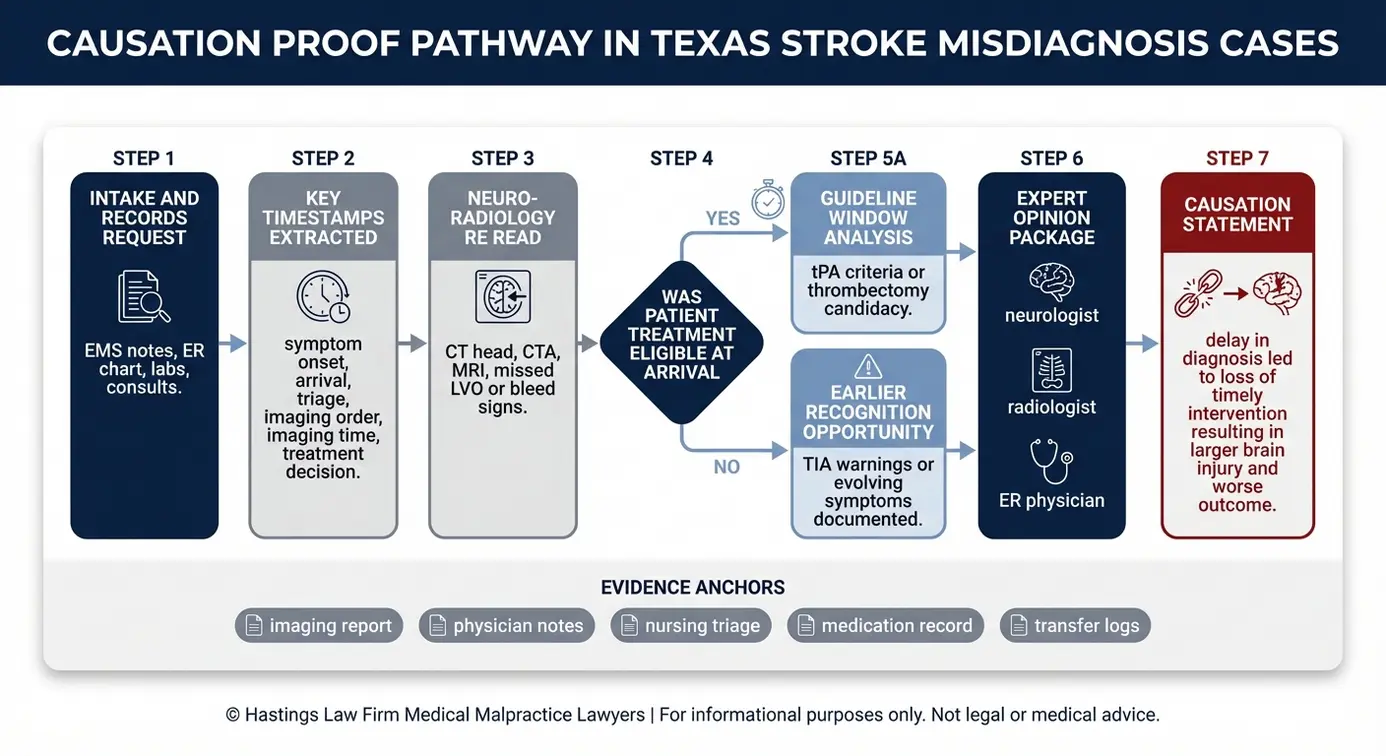
We prove causation by utilizing neuroradiology experts to re-examine imaging for missed occlusions and establishing that the patient would have recovered significantly had treatment been administered within the standard window. Causation is often the most contested element in stroke malpractice cases. It is not enough to show that a doctor made an error. We must also demonstrate that the error directly caused the brain damage. Here is how we approach it:
- Step 1: The Radiology Review. Our medical experts re-read the original CT scans and MRIs to identify findings that were missed or misinterpreted. A large vessel occlusion (LVO), which is a blockage in one of the brain’s major arteries, can sometimes be detected on initial imaging but overlooked by the reading radiologist.
- Step 2: Timeline Reconstruction. We build a minute-by-minute timeline from the patient’s “last known well” (LKW). This timeline reveals whether the patient was eligible for tPA or mechanical thrombectomy for large vessel occlusion at the time they arrived. We review all medical records to pin down exact times.
- Step 3: Expert Testimony. Board-certified neurologists and emergency medicine specialists review the case and provide opinions on what a competent physician would have done. Their testimony connects the delay to the resulting brain damage, establishing that prompt treatment would have prevented or reduced the injury.
Our national network of medical experts allows us to match each case with the right specialist. As a medical malpractice attorney team, we prepare every case as if it will go before a jury. A dedicated stroke injury lawyer knows that winning a case often comes down to the quality of the experts. A failure to diagnose stroke lawyer on our team will ensure that every piece of medical evidence supports the link between the doctor’s negligence and your injury.
Types of Strokes: Ischemic vs. Hemorrhagic
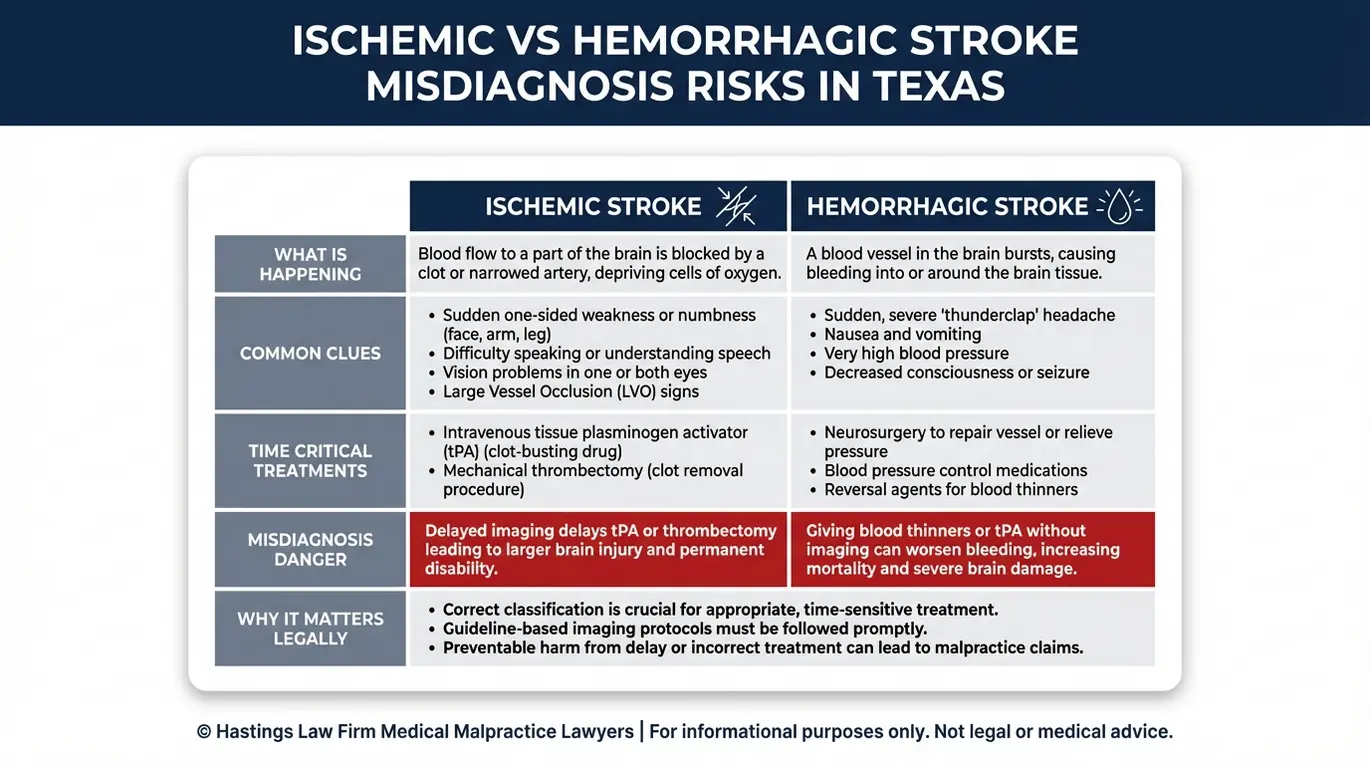
Ischemic strokes are caused by blood clots that block blood flow to the brain, while hemorrhagic strokes involve bleeding into brain tissue; the treatment for one can be fatal if applied to the other, making accurate and rapid diagnosis essential. Roughly 87% of all strokes are ischemic. These are treated with tPA to dissolve the clot or mechanical thrombectomy to physically remove it. A large vessel occlusion is a specific type of ischemic stroke that requires urgent interventional treatment.
Hemorrhagic strokes, on the other hand, are caused by a ruptured blood vessel or aneurysm. Treatment focuses on stopping the bleeding, reducing pressure in the skull, and surgical repair if necessary. Administering blood thinners to a hemorrhagic stroke patient can be catastrophic, potentially accelerating bleeding and causing fatal brain damage. Because the symptoms of both stroke types can look identical, clinical guessing is dangerous.
Imaging before treatment is required to prevent these errors. A CT scan can differentiate between ischemic and hemorrhagic stroke within minutes. When a provider skips or delays imaging and administers the wrong treatment, the consequences can be devastating.
| Stroke Type | Cause | Primary Treatment | Danger of Misdiagnosis |
|---|---|---|---|
| Ischemic | Blood clot blocking an artery | tPA (clot-busting drug) or mechanical thrombectomy | Delayed treatment leads to permanent brain damage |
| Hemorrhagic | Ruptured blood vessel or aneurysm | Surgery, pressure management, bleed control | Administering blood thinners can cause fatal bleeding |
A Texas stroke misdiagnosis lawyer evaluates whether imaging was performed promptly and whether the correct type of stroke was identified. When a stroke misdiagnosis attorney reviews Ischemic strokes, the imaging timeline is often where the breach of the standard of care becomes clear. A stroke malpractice attorney can identify if a doctor failed to rule out a bleed before administering dangerous anticoagulants.
Compensation for Catastrophic Brain Injuries
Damages in stroke cases cover lifetime medical care, rehabilitation costs, lost earning capacity, and non-economic damages for pain, suffering, and physical impairment. The financial impact of a preventable stroke injury is often staggering. Stroke survivors who suffer brain damage frequently require 24/7 nursing care, specialized rehabilitation, and adaptive equipment for years or even the rest of their lives.
Economic damages in these cases account for all of these costs, along with lost income and diminished earning capacity. A life-care planner, a professional who projects the total cost of future care, is often necessary to document the full scope of financial harm. Securing fair stroke lawsuit compensation is important for families facing economic damages.
Non-economic damages address the losses that do not come with a receipt, such as chronic pain and cognitive decline. Texas does impose statutory caps on non-economic damages in medical malpractice cases, but economic damages remain uncapped. A malpractice lawyer Texas residents trust can help maximize these claims within the legal limits.
For families who have lost a loved one, wrongful death claims allow surviving spouses, children, and parents to seek compensation for their loss. These claims cover funeral expenses and loss of financial support. A stroke injury attorney can guide families through this difficult process. Our malpractice lawyers in Texas work with medical experts and life-care planners to build a complete picture of how the injury has reshaped your future.
Contact the Texas Misdiagnosis Attorneys at Hastings Law Firm Today for Help
Time matters in stroke cases, both medically and legally. Texas law imposes strict deadlines on medical malpractice claims, and the sooner your medical records and imaging are reviewed, the stronger your case can be.
If you or a loved one suffered a preventable stroke injury because of a missed or delayed diagnosis, Hastings Law Firm is ready to help. Our team of attorneys, nurse consultants, and medical experts will review what happened and explain your legal options.
As a Texas stroke misdiagnosis lawyer team, we handle these cases on a contingency fee basis. You pay no attorney fees or costs unless we recover compensation for you. Contact us today for a free, confidential evaluation. Let us help you find the answers you deserve.
Frequently Asked Questions About Stroke Misdiagnosis in Texas


This content was researched and written by the Hastings Law Firm editorial team, which includes attorneys, medical professionals, and experienced researchers. Our writing is informed by internal knowledge and practical experience, and we cross-check critical details against authoritative sources cited throughout. Every piece undergoes human-led fact-checking and legal review. Because legal and medical information can change, if you spot an error, please contact us. Learn more about our content standards and review process on our editorial policy page.

Gabe Sassin has focused exclusively on medical malpractice law since 2007. After spending more than a decade as a malpractice defense attorney, he knows exactly how the other side works. He has seen firsthand how healthcare providers, insurers, corporate defendants, and their legal teams think, prepare, and build their defense against claims. That knowledge works for the people who need it most today, injured patients and their families. His unique experience shapes everything he writes, giving readers a look at how these cases actually work from someone who has handled them from both sides.
