


Texas Cervical Cancer Misdiagnosis Lawyer
A delayed cervical cancer diagnosis can change treatment options and intensify physical and emotional harm when warning signs are missed or test results are misread. These situations often involve breakdowns in screening, follow up, and communication, including errors tied to Pap smears and laboratory interpretation. In Texas, a claim generally depends on showing a departure from the medical standard of care and a direct link between the delay and a worse outcome. If you or a loved one were harmed or worse due to delayed cervical cancer diagnosis in Texas, contact Hastings Law Firm for a free, confidential case review.

Last Updated: July 27, 2026
Trusted Texas Medical Attorneys for Delayed Cervical Cancer Diagnosis Claims
A cervical cancer diagnosis is devastating. When that diagnosis comes later than it should have, after warning signs were missed or test results were misread, the emotional weight can feel unbearable. You may be asking whether a medical professional failed you, and whether you have legal options.
At Hastings Law Firm, we focus exclusively on medical malpractice. Founded by Tommy Hastings, who is board-certified in Personal Injury Trial Law by the Texas Board of Legal Specialization, our team understands the nuances of complex cancer litigation. Our staff of attorneys, in-house nurse consultants, and board-certified patient advocates identifies where the standard of care was violated to hold responsible parties accountable.
If you or a loved one received a late-stage cervical cancer diagnosis that you believe should have been caught sooner, a Texas cervical cancer misdiagnosis lawyer at our firm can review your case at no cost. Contact us for a free, confidential evaluation to understand your options.

Understanding Delayed Cervical Cancer Diagnosis Claims in Texas
A delayed diagnosis claim asserts that a healthcare provider failed to identify cervical cancer at a treatable stage, resulting in a worse prognosis or more aggressive treatment than would have otherwise been necessary. These claims fall under medical malpractice law in Texas, which sets the rules for how patients can seek compensation when a provider’s negligence causes harm.
Cervical cancer is one of the most treatable forms of cancer when detected early. According to the National Cancer Institute’s SEER Program, the five-year survival rate for localized cervical cancer is over 90%. At Stage I, treatment may involve a relatively minor surgical procedure. When the disease progresses undetected, patients can face chemotherapy, radiation, or a hysterectomy, treatments that carry significant physical and emotional consequences.
Understanding the difference between a known medical risk and negligence is helpful for patients. Not every missed diagnosis is malpractice, as cancer screening tools have inherent limitations. A delayed diagnosis claim requires showing that a provider failed to act the way a reasonably competent professional would have under similar circumstances.
What often matters most is the clinical progression. Cervical intraepithelial neoplasia (CIN), a precancerous condition where abnormal cells develop on the cervix’s surface, is highly manageable when identified through routine screening. The shift from Stage I disease to advanced-stage cancer can mean the difference between a straightforward procedure and months of aggressive treatment. If you suspect that gap was caused by a provider’s failure, a lawyer for cervical cancer misdiagnosis can help you evaluate whether you have a claim.
Common Medical Errors Leading to Cervical Cancer Misdiagnosis
Misdiagnosis often stems from errors in interpreting Pap smears, failing to follow up on abnormal results, or dismissing patient symptoms that warranted further investigation. These failures can occur at multiple points in the screening and diagnostic process.
A Pap smear, also called a Pap test, is a screening procedure that collects cells from the cervix to detect precancerous or cancerous changes. When this test produces a false negative, a result that incorrectly indicates no abnormality is present, the patient may go months or years without appropriate follow-up. Research published through PubMed Central on false negative results in cervical cancer screening documents the systemic causes behind these errors, including issues with sample collection, slide preparation, and human interpretation.
Common errors that can lead to a cervical cancer misdiagnosis include:
- Laboratory slide misinterpretation: A pathologist or a cytotechnologist may fail to identify abnormal cells on a Pap smear.
- Failure to order follow-up testing: When an HPV test returns positive or a Pap smear shows irregularities, the standard of care typically requires a colposcopy or biopsy.
- Communication failures: A provider may fail to inform the patient of abnormal results, or reports may never reach the physician due to systemic breakdowns.
- Ignoring persistent symptoms: Patients who report symptoms like abnormal bleeding or pelvic pain may have their concerns attributed to benign causes, delaying the diagnostic workup.
A cervical cancer misdiagnosis attorney can investigate where the breakdown occurred and identify which parties bear responsibility.
Liability for Lab and Pathology Errors
Liability in these cases may extend well beyond the treating OB-GYN. When a commercial laboratory processes the Pap smear for cervical cancer screening, that lab and its pathology staff can be held to their own standard of care. If a laboratory error caused abnormal cells to be missed on the slide, the lab itself may bear independent liability. Our team examines the full chain of care, from the provider who ordered the test to the facility that analyzed it, to determine where the standard of care was violated. As a Texas misdiagnosis lawyer experienced in these claims, we understand how to trace accountability across multiple parties.

The Hastings Law Firm Difference
Results matter, but what truly sets us apart is how we achieve them. Every verdict, every settlement, and every Texas courtroom victory comes from one guiding promise: To treat each client’s fight for justice as if it were our own.
This balance of skill, experience, and empathy reflects our core philosophy that justice should not only compensate the injured, but also make health care safer nationwide.

Symptoms That Warrant Immediate Diagnostic Testing
Persistent pelvic pain, abnormal bleeding between periods, and pain during intercourse are warning signs that should prompt a physician to order diagnostic tests rather than dismiss the symptoms.
Cervical cancer can develop without obvious early symptoms, which is why routine screening matters so much. When symptoms do appear, they deserve prompt clinical attention. Common symptoms that may indicate cervical disease include:
- Abnormal vaginal bleeding, including bleeding after intercourse or between menstrual periods
- Unusual vaginal discharge
- Persistent pelvic or lower back pain
- Pain during intercourse
- Unexplained weight loss or fatigue in later stages
According to MedlinePlus, regular screening with Pap tests and HPV testing is the most effective way to detect abnormal cells early. Human papillomavirus (HPV), a common sexually transmitted infection that can cause cervical cell changes, which is the primary risk factor for cervical cancer. HPV/Pap co-testing, a screening approach that combines a Pap smear with an HPV test, gives providers a more complete picture of a patient’s cervical health.
If a patient reported these symptoms and a provider failed to order appropriate cancer screening or diagnostic tests, that failure may support a negligence claim. Documented symptoms that went uninvestigated are often a central piece of evidence in these cases.
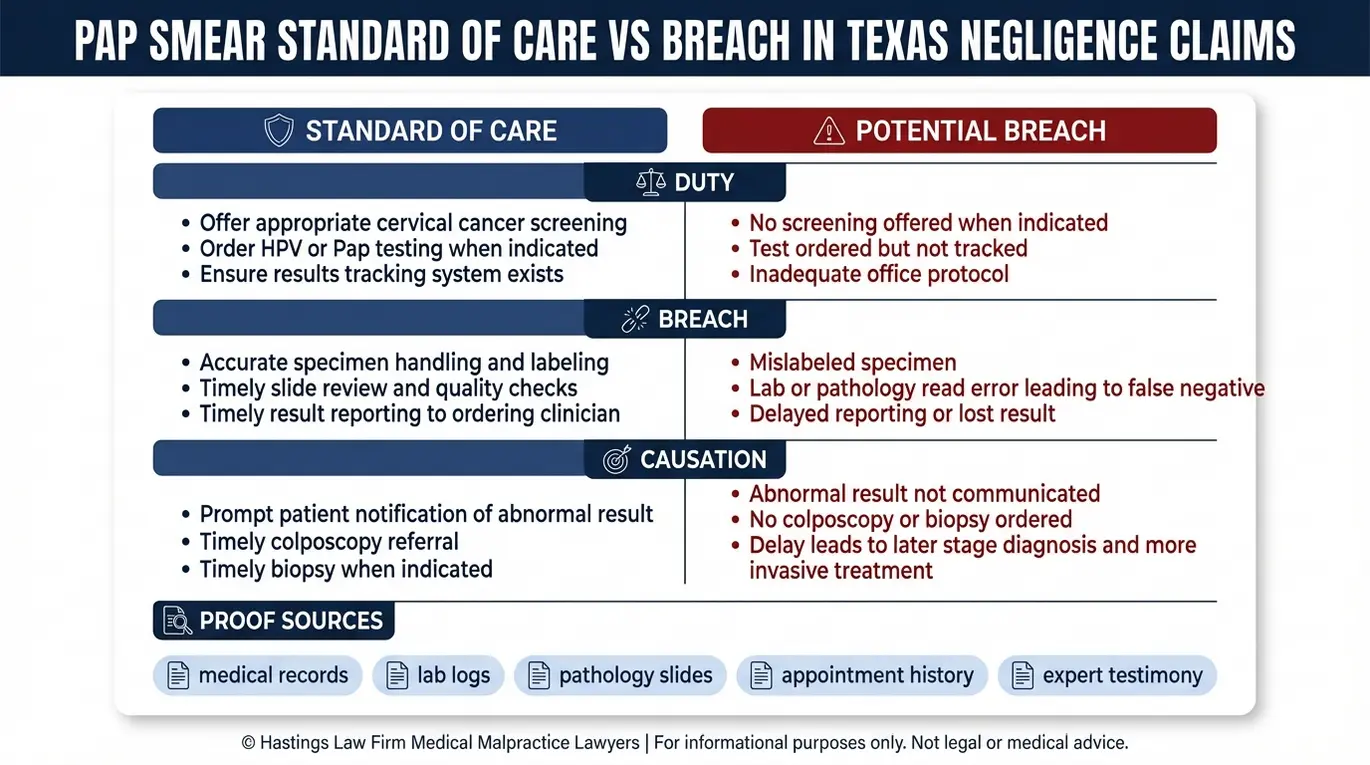
Proving Negligence: The Standard of Care for Pap Smears
To prove negligence, a patient must show the provider deviated from the accepted medical standard of care and that this deviation directly caused the cancer to progress to a more advanced stage. This requires both medical and legal evidence, supported by qualified expert testimony.
Every medical malpractice case in Texas rests on four elements:
- Duty of care: The provider had an obligation to screen the patient appropriately and follow up on results.
- Breach of the standard of care: The provider made a specific error, such as misreading a Pap smear slide or failing to order a colposcopy or biopsy.
- Causation: The delay or error directly caused the patient’s condition to worsen.
- Damages: The patient suffered measurable harm, whether physical, financial, or emotional, because of the delayed diagnosis.
Our team works with qualified medical experts to reconstruct the clinical timeline. We examine pathology slides, office visit notes, lab reports, and communication records to determine whether the standard of care was met. As a Texas cervical cancer lawyer experienced in these claims, we understand how to connect specific errors to clinical outcomes.
Texas and the “Lost Chance of Survival” Doctrine
Texas law requires the patient to prove that, more likely than not, they would have survived or experienced a better outcome if diagnosed earlier. You cannot pursue a claim based solely on a reduced percentage of survival if the original prognosis was already poor. This means causation analysis is critical; a misdiagnosis attorney familiar with Texas law can evaluate the staging data and survival statistics to determine whether the case meets this legal threshold for recovering damages.
Deadlines for Filing a Cervical Cancer Lawsuit in Texas
Generally, the statute of limitations for a medical malpractice claim in Texas is two years from the date of the negligent act. However, the discovery rule may extend this deadline in cases where the patient could not have reasonably known about the misdiagnosis sooner.
Under Texas Civil Practice and Remedies Code § 74.251, the two-year clock typically begins on the date the error occurred. Cervical cancer misdiagnosis cases present a unique timing challenge because a patient may not learn their cancer was missed until months or years later. In those situations, the discovery rule may pause the limitations period until the patient knew or should have known about the potential negligence.
There is an important hard stop known as the statute of repose. Texas imposes a 10-year statute of repose, meaning that regardless of when the misdiagnosis was discovered, no claim can be filed more than 10 years after the date of the negligent act. This absolute deadline applies even if the cancer was not found until year nine.
Texas law also requires that a pre-suit notice be served on the healthcare provider at least 60 days before filing, as outlined in Texas Civil Practice and Remedies Code § 74.051. Missing any of these deadlines can permanently bar your claim. A Texas misdiagnosis attorney can evaluate your timeline and protect your right to file.

Damages Recoverable in Cancer Misdiagnosis Cases
Patients may recover compensation for medical bills, lost wages, physical pain, and the mental anguish associated with a worsened prognosis or shortened life expectancy.
Economic damages cover the financial costs that resulted from the delayed diagnosis. This includes the expense of treatments that may not have been necessary if the cancer had been caught earlier, such as chemotherapy, radiation therapy, or a hysterectomy. Lost income and reduced earning capacity also fall into this category.
Non-economic damages address the personal toll: chronic pain, emotional suffering, loss of fertility, and diminished quality of life. Research published in PMC on cervical cancer treatment and fertility documents how aggressive cancer treatment can permanently affect a patient’s reproductive options, adding another layer of loss to an already difficult situation.
If cervical cancer misdiagnosis resulted in a patient’s death, surviving family members may pursue a wrongful death claim. These cases seek compensation for funeral expenses, loss of companionship, lost financial support, and the grief endured by the family.
Contact the Texas Misdiagnosis Attorneys at Hastings Law Firm Today for Help
You do not have to face the medical system alone. If you suspect that a delayed or missed cervical cancer diagnosis caused you or a loved one serious harm, our team is ready to listen and evaluate what happened.
Hastings Law Firm handles medical malpractice cases exclusively. Our legal team includes former defense attorneys who understand how hospitals and insurers respond to these claims, and in-house medical professionals who can analyze your records from a clinical perspective. We prepare every case as if it will go to trial, because that preparation is what drives fair outcomes.
We operate on a contingency fee basis, which means you pay no attorney fees or costs unless we recover compensation for you. Consultations are free and confidential.
A Texas cervical cancer misdiagnosis lawyer at Hastings Law Firm can help you take the first step toward understanding what went wrong. Contact us today for a risk-free case evaluation.
Frequently Asked Questions About Cervical Cancer Misdiagnosis in Texas


This content was researched and written by the Hastings Law Firm editorial team, which includes attorneys, medical professionals, and experienced researchers. Our writing is informed by internal knowledge and practical experience, and we cross-check critical details against authoritative sources cited throughout. Every piece undergoes human-led fact-checking and legal review. Because legal and medical information can change, if you spot an error, please contact us. Learn more about our content standards and review process on our editorial policy page.

Gabe Sassin has focused exclusively on medical malpractice law since 2007. After spending more than a decade as a malpractice defense attorney, he knows exactly how the other side works. He has seen firsthand how healthcare providers, insurers, corporate defendants, and their legal teams think, prepare, and build their defense against claims. That knowledge works for the people who need it most today, injured patients and their families. His unique experience shapes everything he writes, giving readers a look at how these cases actually work from someone who has handled them from both sides.
