


Texas Aortic Aneurysm Misdiagnosis Lawyer
A missed or delayed diagnosis of an aortic aneurysm can turn a treatable condition into a sudden emergency with life threatening consequences. Because symptoms can resemble less serious problems, patients may be sent home without the imaging needed to detect a rupture or dissection risk. Diagnostic errors can also involve missed warning signs in the emergency room, misread imaging, or gaps in follow up monitoring for a known aneurysm. If you or a loved one were harmed or worse due to aortic aneurysm misdiagnosis in Texas, contact Hastings Law Firm for a free, confidential case review.
Last Updated: July 27, 2026
Trusted Texas Medical Attorneys for Failure to Diagnose Aortic Aneurysm Claims
When a doctor fails to diagnose an aortic aneurysm, a dangerous bulge in the aorta (the body’s largest artery), the consequences can be catastrophic. A rupture or dissection can happen without warning, leaving patients and families facing emergency surgery, permanent injury, or the devastating loss of someone they love. If you suspect a missed or delayed diagnosis led to harm, you are not wrong for asking questions.
Hastings Law Firm focuses exclusively on medical malpractice, and our team includes in-house medical professionals who know how to identify where the standard of care broke down. Our founder, Tommy Hastings, is board-certified in personal injury trial law, a credential held by fewer than 2% of Texas lawyers. As Texas aortic aneurysm misdiagnosis lawyers, we can review your medical records, explain what should have happened, and help you understand your legal options. Contact us for a free, confidential case evaluation.

Types of Aortic Aneurysms Commonly Misdiagnosed by Physicians
An aortic aneurysm is an abnormal bulge in the wall of the aorta that can occur in the chest or abdomen and requires timely monitoring or surgical intervention to prevent fatal rupture. The aorta carries oxygenated blood from the heart to the rest of the body. When a section of that wall weakens and expands, the risk of rupture or dissection (a tear in the arterial wall) increases significantly, often leading to massive internal bleeding that can be fatal within minutes. These conditions often remain silent until they reach a critical size.
There are two primary types, and each presents its own diagnostic challenges.
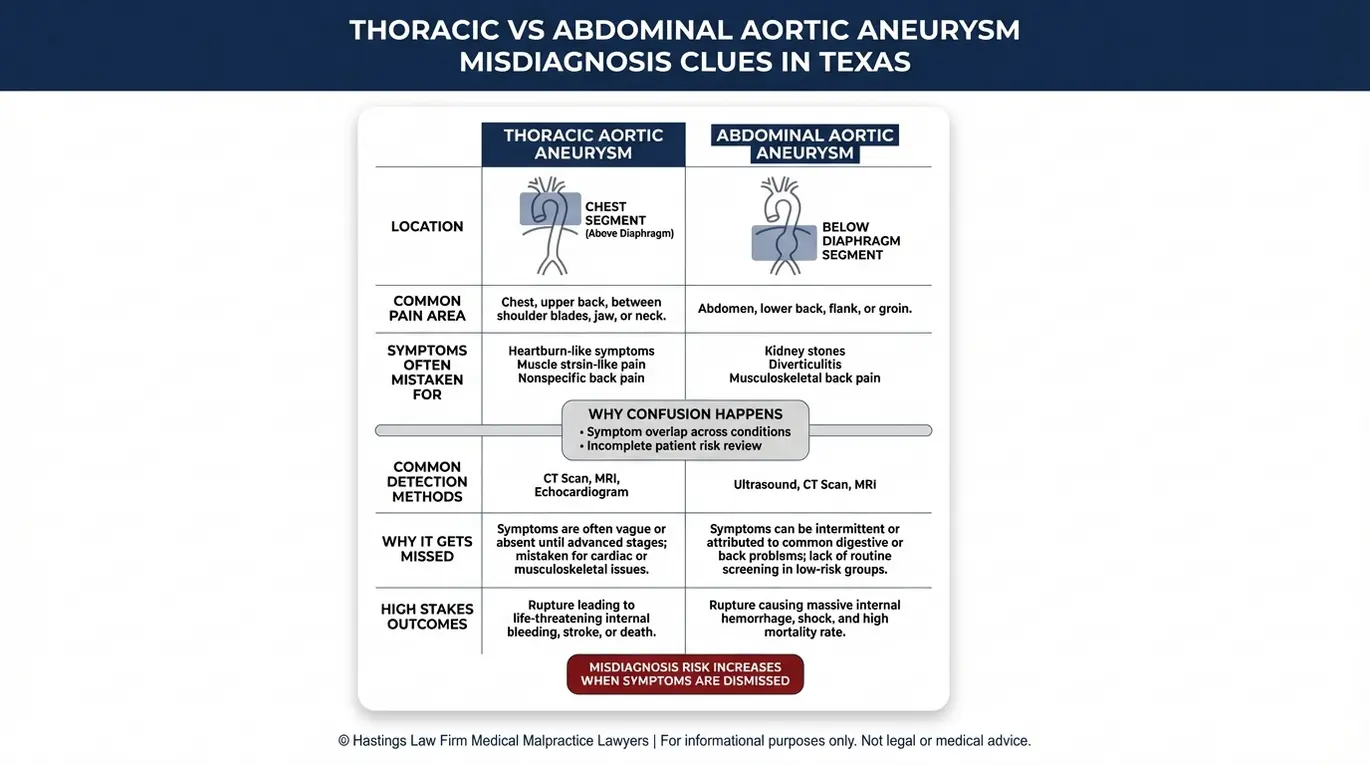
| Feature | Thoracic Aortic Aneurysm (TAA) | Abdominal Aortic Aneurysm (AAA) |
|---|---|---|
| Location | Chest (ascending or descending aorta) | Abdomen (below the diaphragm) |
| Prevalence | Less common; often linked to genetic connective tissue disorders | More common; especially in men over 65 |
| Commonly Mistaken For | Heartburn, acid reflux, musculoskeletal chest pain | Back strain, kidney stones, gastrointestinal issues |
A thoracic aortic aneurysm (TAA), an aneurysm located in the chest portion of the aorta, can be tied to inherited conditions. MedlinePlus Genetics explains that familial thoracic aortic aneurysm and dissection can run in families due to specific gene mutations. An abdominal aortic aneurysm (AAA), which forms in the lower section of the aorta, is more prevalent and carries a high risk of death when it ruptures, as noted by the Centers for Disease Control and Prevention.
Misdiagnosis often happens because the symptoms of both types closely mimic less serious conditions. A patient with a thoracic aneurysm may be told they have heartburn. A patient with an abdominal aneurysm may be sent home with a muscle relaxer. When a physician fails to consider an aneurysm in patients who present with these overlapping symptoms, the delay can prevent timely vascular surgery and prove fatal. In Texas, medical malpractice claims involving diagnostic failures are governed by Civil Practice and Remedies Code Chapter 74, and an experienced lawyer for aortic aneurysm misdiagnosis in Texas can help determine if the standard of care was met.
Warning Signs and Risk Factors Commonly Overlooked in the ER
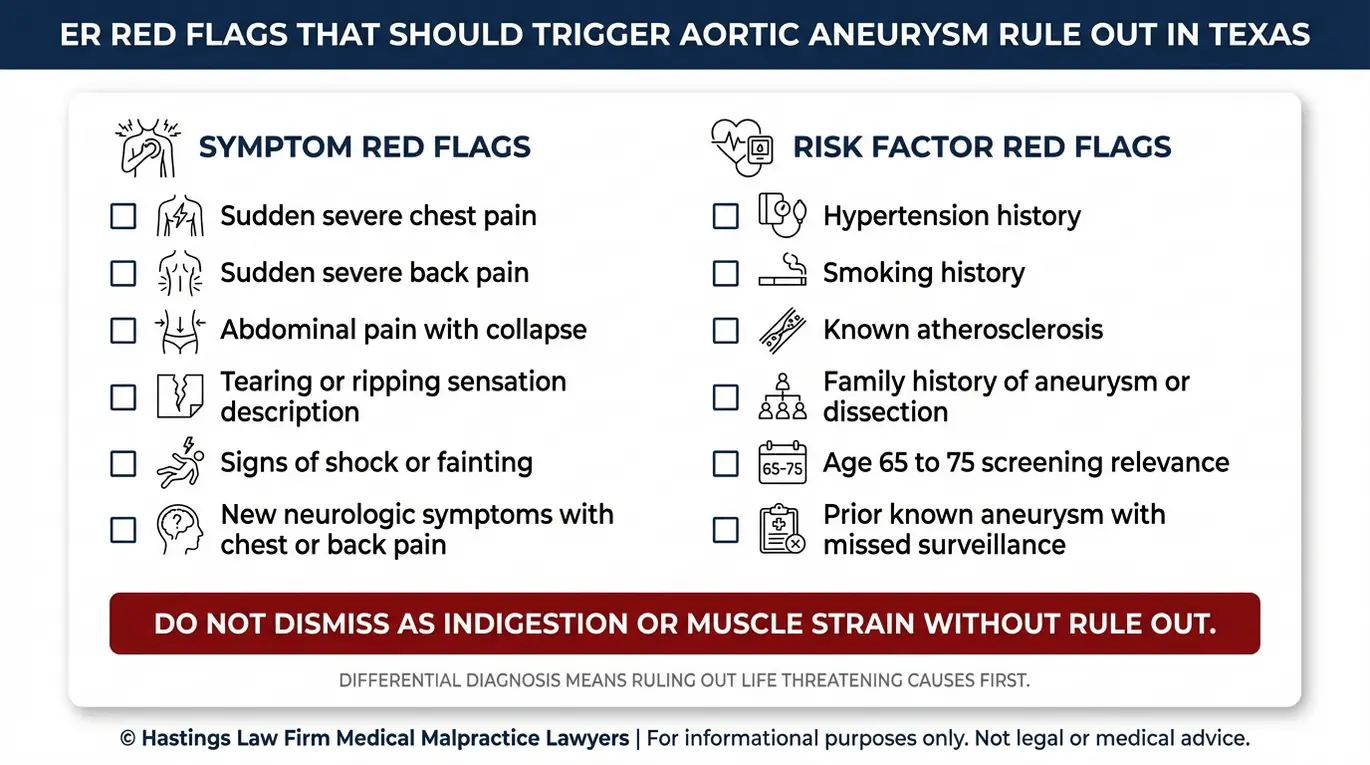
Emergency room physicians can fail to rule out aortic aneurysms in patients presenting with sudden “tearing” chest or back pain, especially when known risk factors like hypertension or a history of smoking are present. Emergency room errors often involve missing these opportunities, leading to preventable aortic disasters.
The classic warning signs of an aortic emergency include sudden, severe tearing pain in the chest or back, a pulsatile abdominal mass (a rhythmic throbbing felt in the abdomen), and signs of hypovolemic shock, which is dangerously low blood pressure caused by rapid blood loss. Stony Brook Medicine notes that aortic dissection symptoms develop suddenly and mimic conditions like heart attacks. Sometimes symptoms are attributed to indigestion or muscle issues, and patients are discharged without life-saving imaging.
An aortic aneurysm misdiagnosis attorney will look closely at if the ER team recognized the following red flags that should prompt immediate advanced testing:
- Age between 65 and 75
- History of smoking (current or past)
- High blood pressure (hypertension)
- Atherosclerosis (hardening or narrowing of the arteries)
- Family history of aortic aneurysm or connective tissue disorders
- Sudden onset of severe chest, back, or abdominal pain described as “tearing” or “ripping”
- Unexplained drop in blood pressure or signs of shock
- Known history of an existing, monitored aneurysm
When any combination of these factors is present, the standard of care generally requires the physician to act quickly and rule out the most dangerous possibility first.
Differential Diagnosis Process and Negligence in Bypassing It
Differential diagnosis, the systematic process of identifying a condition by eliminating possible causes one by one, requires ruling out life-threatening possibilities first. In a medical setting, this process ensures that doctors do not overlook fatal conditions while treating more common symptoms.
For a patient with sudden tearing pain and a history of hypertension, an aortic aneurysm or dissection should be near the top of that list. Skipping this step or stopping at a less serious explanation without confirmatory imaging can breach the standard of care. To confirm misdiagnosis, our team examines the ER records, triage notes, and physician decision-making process to evaluate if differential diagnosis was conducted appropriately or bypassed entirely.
The Hastings Law Firm Difference
Results matter, but what truly sets us apart is how we achieve them. Every verdict, every settlement, and every Texas courtroom victory comes from one guiding promise: To treat each client’s fight for justice as if it were our own.
This balance of skill, experience, and empathy reflects our core philosophy that justice should not only compensate the injured, but also make health care safer nationwide.

Can You Sue for Aortic Aneurysm Misdiagnosis or Delayed Diagnosis
Yes, you can pursue a medical malpractice lawsuit if you can show that a competent doctor would have diagnosed the condition earlier through proper screening or testing, and that the delay directly caused the rupture, dissection, or death. These cases require proof of four legal elements. Medical malpractice occurs when a healthcare professional deviates from the standard of care, causing patient harm.
Duty means the doctor had a physician-patient relationship and an obligation to provide competent care. Breach means the doctor failed to meet the accepted standard of care, such as not ordering appropriate imaging. Causation requires showing that the failure to diagnose directly led to the injury; earlier detection would have changed the outcome. Damages are the actual harms suffered, including medical costs, lost income, pain, or death.
Liability in aortic aneurysm cases can extend beyond the ER physician. Radiologists who misread imaging, primary care doctors who ignore screening guidelines for high-risk patients, and specialists who fail to recommend timely vascular surgery may all bear responsibility for medical negligence. A delayed diagnosis can lead to internal bleeding or shock. A Texas aortic aneurysm misdiagnosis lawyer evaluates the full chain of care to identify every provider whose negligence contributed to the outcome.
As a nationally recognized plaintiff trial firm focused solely on medical malpractice litigation, we have the resources to challenge large hospital systems. If the patient did not survive, the legal question often centers on if earlier diagnosis would have provided a meaningful chance of survival. Even if the condition was serious, proving that a timely intervention could have prevented the death or significantly improved the odds is a powerful basis for a claim. An aortic aneurysm malpractice lawyer experienced in these cases understands how to work with medical experts and causation analysis to establish that connection.
Establishing the Standard of Care for Diagnostic Testing and Imaging
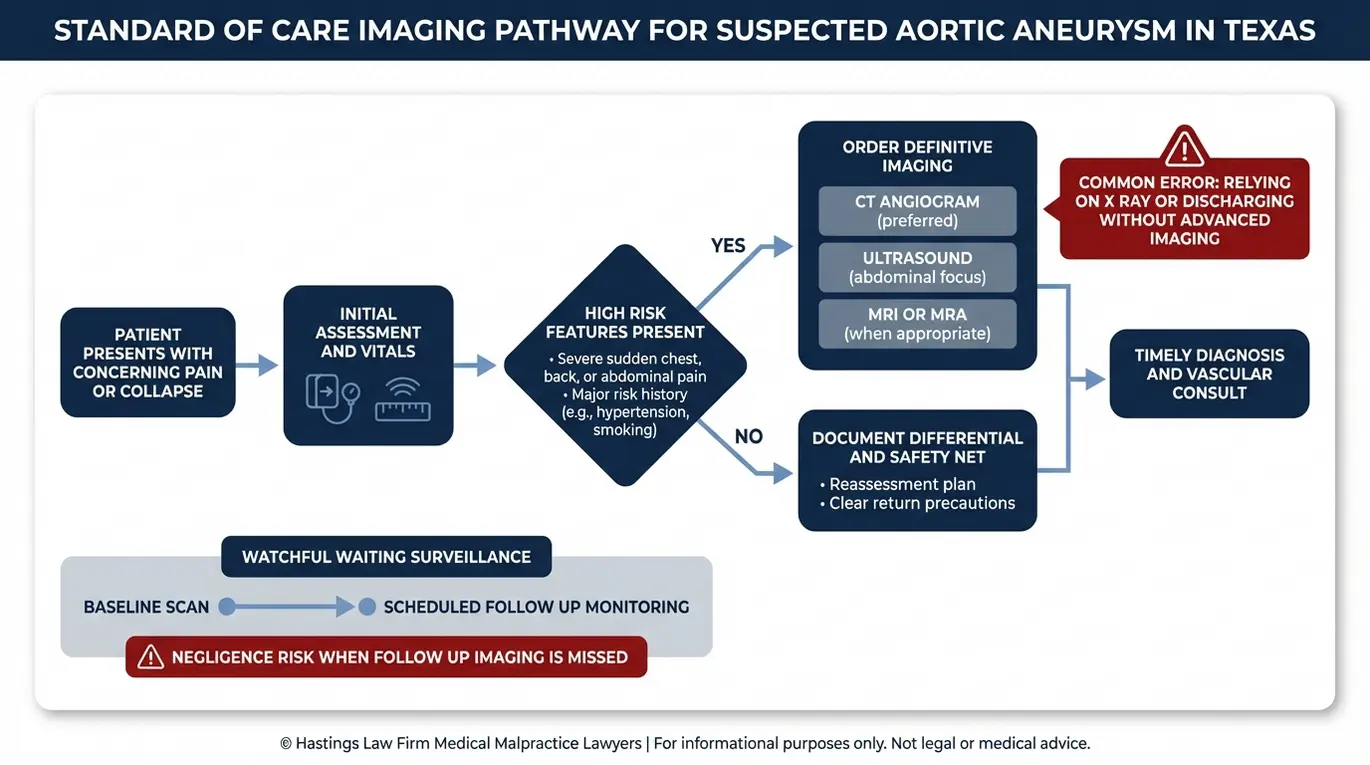
The standard of care often mandates that physicians order advanced imaging like CT scans or ultrasounds when a patient presents with specific risk factors or symptoms suggestive of aortic distress, rather than relying solely on physical exams or X-rays. A chest X-ray, while useful for many conditions, frequently lacks the resolution to identify or measure an aneurysm before it becomes an emergency.
The definitive diagnostic testing tools for detecting an aortic aneurysm include:
- CT angiogram (CTA), a specialized CT scan using contrast dye to produce detailed images of blood flow, is the gold standard. A study published in PubMed Central on diagnosis and acute management of type A aortic dissection confirms the central role of CTA in rapid and accurate diagnosis.
- MRI/MRA: Magnetic resonance imaging and angiography, used when CT is not available or when ongoing monitoring is needed without radiation exposure.
- Transesophageal echocardiogram (TEE), an ultrasound probe passed through the esophagus to image the thoracic aorta, helps when other imaging is inconclusive.
- Abdominal ultrasound: A first-line screening tool for abdominal aortic aneurysms, especially in high-risk patients.
For patients with a known aneurysm that has not yet reached the threshold for surgical repair, the standard of care typically includes scheduled surveillance imaging. The Abdominal Aortic Aneurysm Surveillance Chart from Life in the Fast Lane shows that monitoring intervals depend on aneurysm size and growth rate. When a physician skips or delays these follow-up scans, a small aneurysm can silently grow to the point of rupture. An attorney for failure to diagnose aneurysm cases will examine whether proper surveillance protocols were followed.
Recovering Damages for Aortic Dissection and Wrongful Death
Victims or their families may recover compensation for medical expenses, lost wages, pain and suffering, and in fatal cases, funeral costs and loss of companionship through a wrongful death claim. Legal damages are the financial and personal costs you can recover after an injury caused by negligence.
Damages in aortic aneurysm malpractice cases generally fall into two categories:
Economic damages cover measurable financial losses:
- Medical bills covering emergency surgery and hospitalization
- Ongoing medical treatment, rehabilitation, and follow-up care
- Lost income and diminished future earning capacity
- Funeral and burial expenses in wrongful death cases
Non-economic damages address the personal toll:
- Physical pain and suffering
- Mental anguish and emotional distress
- Loss of consortium, which compensates a spouse for the loss of companionship and support
- Loss of enjoyment of life
Aortic emergencies often result in massive bills from emergency vascular surgery, extended ICU stays, and long recoveries. When the patient does not survive, the family may lose a primary earner while also facing steep costs. Texas aortic aneurysm misdiagnosis lawyers at Hastings Law Firm work diligently with financial and medical experts to document the full impact. We ensure every aspect of your financial instability and emotional grief is calculated, so that any settlement or verdict reflects the true scope of the loss.
Contact the Texas Misdiagnosis Attorneys at Hastings Law Firm Today for Help
A missed aortic aneurysm diagnosis is often a preventable tragedy. When doctors overlook clear warning signs or fail to order the right tests, the people who pay the price are patients and their families.
Hastings Law Firm is built for cases like these. Our team includes board-certified patient advocates and former hospital nurses who understand how these medical systems work. We investigate what happened, identify where the standard of care failed, and hold the responsible parties accountable. We operate on a contingency fee basis, meaning you pay no attorney fees unless we recover compensation for you.
If you or someone in your family suffered harm because of a delayed or missed aortic aneurysm diagnosis, we encourage you to reach out. As a dedicated Texas aortic aneurysm misdiagnosis lawyer, we offer a free, confidential case evaluation. Let us review your records and help you understand what happened and what comes next. Call us today or contact us online to get started.
Frequently Asked Questions About Aortic Aneurysm Misdiagnosis in Texas


This content was researched and written by the Hastings Law Firm editorial team, which includes attorneys, medical professionals, and experienced researchers. Our writing is informed by internal knowledge and practical experience, and we cross-check critical details against authoritative sources cited throughout. Every piece undergoes human-led fact-checking and legal review. Because legal and medical information can change, if you spot an error, please contact us. Learn more about our content standards and review process on our editorial policy page.

Gabe Sassin has focused exclusively on medical malpractice law since 2007. After spending more than a decade as a malpractice defense attorney, he knows exactly how the other side works. He has seen firsthand how healthcare providers, insurers, corporate defendants, and their legal teams think, prepare, and build their defense against claims. That knowledge works for the people who need it most today, injured patients and their families. His unique experience shapes everything he writes, giving readers a look at how these cases actually work from someone who has handled them from both sides.
