


Texas Colon Cancer Misdiagnosis Lawyer
A delayed or missed colon cancer diagnosis can turn a treatable condition into a life threatening illness with more invasive treatment and lasting harm. Breakdowns can happen when symptoms are dismissed, screening results are not followed up, or pathology findings are misread. In Texas, a claim generally depends on whether care fell below the accepted standard and whether the delay caused measurable progression and worse outcomes. If you or a loved one were harmed or worse due to colon cancer misdiagnosis in Texas, contact Hastings Law Firm for a free, confidential case review.
Last Updated: July 27, 2026
Trusted Texas Medical Attorneys for Delayed Colorectal Cancer Claims
When colon cancer is caught early, outcomes are often favorable. But when a doctor fails to order the right tests or misreads the results, a treatable condition can become a life-threatening one. If you or a loved one suspect that a delayed or missed diagnosis allowed the cancer to progress, you may have grounds for a medical malpractice claim.
Colon cancer screening typically involves stool-based tests like the fecal immunochemical test (FIT) or fecal occult blood test (FOBT), which detect hidden blood in the stool. When results are abnormal, a colonoscopy, a procedure where a doctor examines the inside of the colon with a camera, should follow promptly. Breakdowns at any point in this process can cost critical time.
Founded in 2005 by board-certified trial attorney Tommy Hastings, our firm helps patients and families determine whether medical negligence occurred. Contact us for a free, confidential case evaluation to learn where things may have gone wrong.

What Constitutes Actionable Colon Cancer Misdiagnosis in Texas
Actionable misdiagnosis occurs when a physician deviates from the accepted standard of care, resulting in a delay that allows the cancer to progress to a less treatable stage. Not every diagnostic error rises to the level of malpractice. Actionable misdiagnosis is a legal term describing when a doctor’s error causes preventable harm.
The claim must meet specific legal and medical thresholds under Texas law. We look for evidence that a reasonably competent physician would have taken different steps under the same circumstances.
The Standard of Care
The standard of care is the level of treatment a reasonably competent doctor would provide under similar circumstances. For colorectal cancer, this includes following established screening guidelines, such as recommending colonoscopies beginning at age 45 or sooner when a patient reports symptoms like rectal bleeding, unexplained weight loss, or persistent changes in bowel habits.
A failure to follow these protocols can constitute medical negligence under Civil Practice and Remedies Code Chapter 74.
Causation
Proving a breach alone is not enough. The delayed diagnosis must have caused real, measurable harm. In cancer cases, this often means demonstrating that the disease progressed from an earlier, more treatable stage to a later one.
Cancer staging (the classification system from Stage I, localized, to Stage IV, metastatic spread) is central to this analysis. A Texas colon cancer misdiagnosis lawyer works with oncology experts to establish that timely action would have led to a materially better outcome.
Signs of a Missed Opportunity
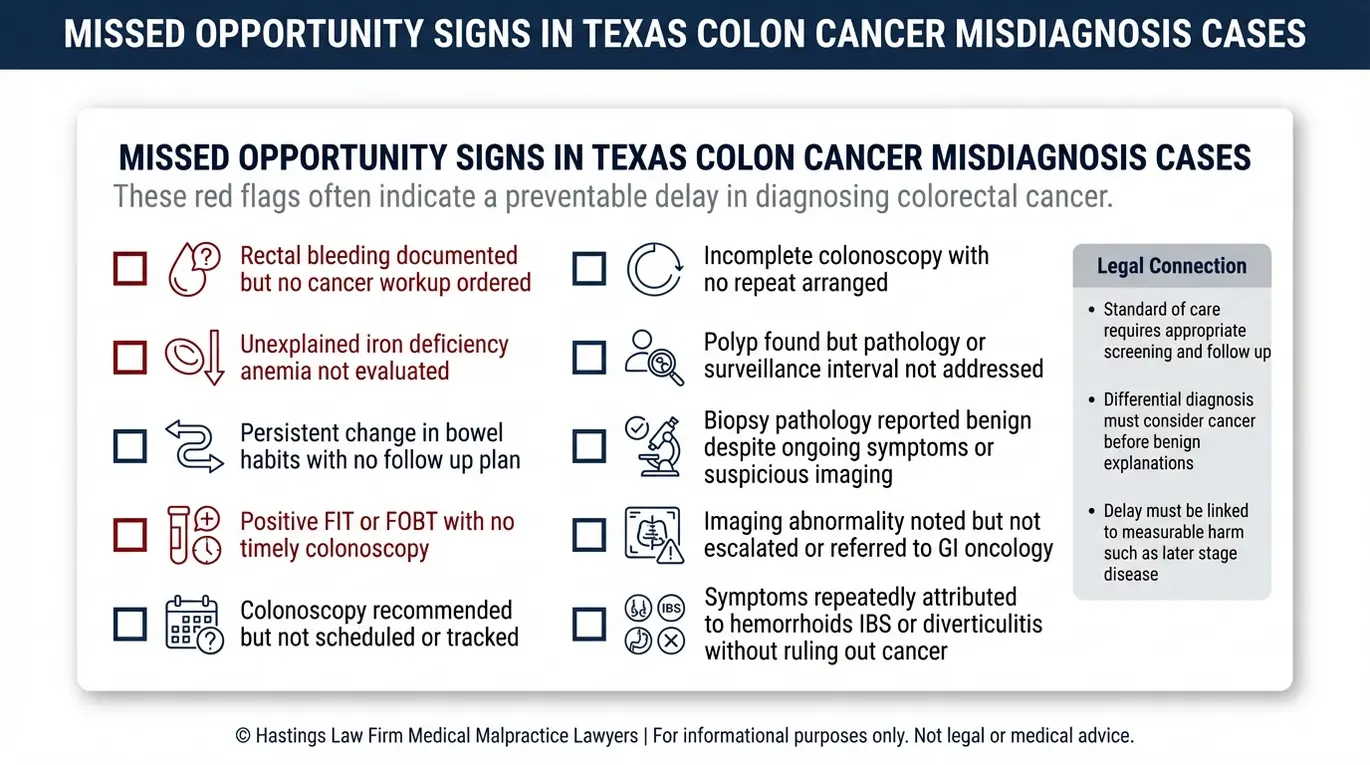
If any of the following occurred, it may indicate a breach in the standard of care:
- Symptoms like rectal bleeding or chronic abdominal pain were attributed to hemorrhoids or stress without further testing
- A positive FIT or FOBT result was never followed up with a colonoscopy
- A screening test returned a false negative, a result incorrectly showing no cancer, and no additional evaluation was pursued
- Imaging or lab results suggesting a possible malignancy were not acted upon
- A family history of colorectal cancer was documented but not factored into the diagnostic workup
Differential Diagnosis as a Legal Framework
Physicians rely on differential diagnosis, the process of identifying a condition by systematically listing all possible causes and ruling them out one by one. This is the systematic process doctors use to rule out life-threatening conditions like cancer.
When a patient presents with symptoms that overlap between cancer and benign conditions like irritable bowel syndrome (IBS) or diverticulitis, the doctor is expected to consider cancer as a possibility and take steps to exclude it. A failure to perform a proper differential diagnosis is often the central issue in a malpractice claim.
If cancer was never placed on the list of potential diagnoses, the physician may have denied the patient the chance for timely detection and treatment.
Common Medical Errors Leading to Delayed Diagnosis
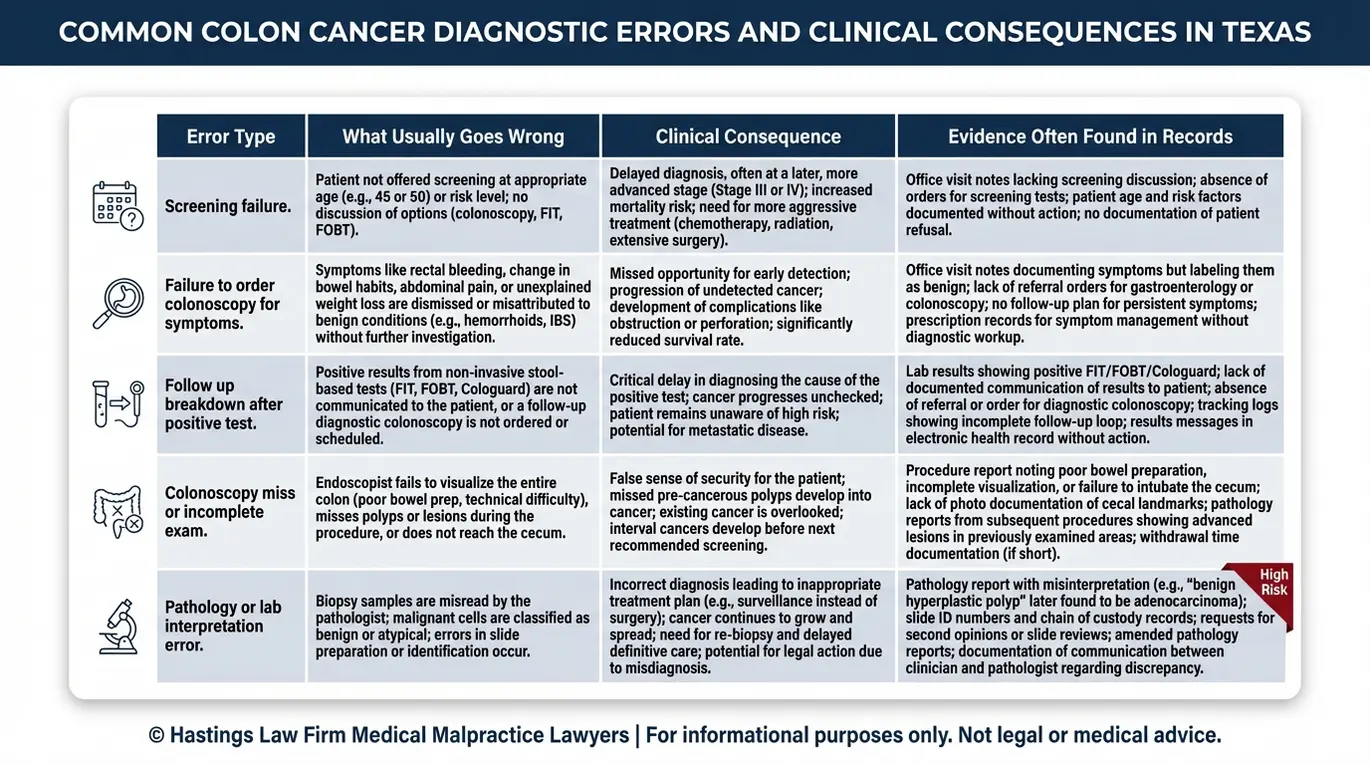
The most common errors include dismissing rectal bleeding as hemorrhoids, failing to order a colonoscopy for symptomatic patients, and pathology lab errors where a colon biopsy, tissue removed during a colonoscopy for laboratory analysis, is misread. Errors in the diagnostic process can prevent a patient from receiving life-saving treatment.
Screening Failures
Screening is meant to detect cancer or precancerous growths before symptoms appear. Errors at this stage can include missing colon polyps (adenomatous polyps, or adenomas, which are abnormal tissue growths that can become cancerous) during a colonoscopy or failing to follow up on a positive FIT or FOBT result.
According to the CDC’s guidelines on screening for colorectal cancer, timely follow-up after an abnormal result is essential to effective detection. When that follow-up does not happen, the window for early intervention can close.
Symptom Dismissal
Younger patients are especially vulnerable to misdiagnosis. Doctors may attribute persistent symptoms like blood in the stool, unexplained weight loss, or changes in bowel habits to IBS or hemorrhoids without ordering appropriate diagnostic tests.
This kind of diagnostic shortcut can delay a cancer diagnosis by months or even years. A medical provider who ignores these warning signs may be failing to meet the required standard of care.
Pathology Errors
In some cases, the right test is ordered and tissue is collected, but the lab results misidentify malignant cells as benign. A false positive can lead to unnecessary procedures, while a false reading of “normal” can create a dangerous sense of reassurance. These errors often require independent pathology review to uncover.
| Error Type | Clinical Consequence |
|---|---|
| Missed polyps during colonoscopy | Precancerous growths progress to malignancy undetected |
| No follow-up after positive FIT/FOBT | Cancer continues to develop without intervention |
| Symptoms dismissed as hemorrhoids or IBS | Diagnosis delayed by months or years |
| Pathology misread of biopsy sample | Malignant tissue classified as benign; treatment never initiated |
A Texas colon cancer misdiagnosis lawyer can work with medical experts to trace the origin of the error and determine which providers may be liable.
The Hastings Law Firm Difference
Results matter, but what truly sets us apart is how we achieve them. Every verdict, every settlement, and every Texas courtroom victory comes from one guiding promise: To treat each client’s fight for justice as if it were our own.
This balance of skill, experience, and empathy reflects our core philosophy that justice should not only compensate the injured, but also make health care safer nationwide.

Analyzing the Impact of Delays on Treatment and Survival
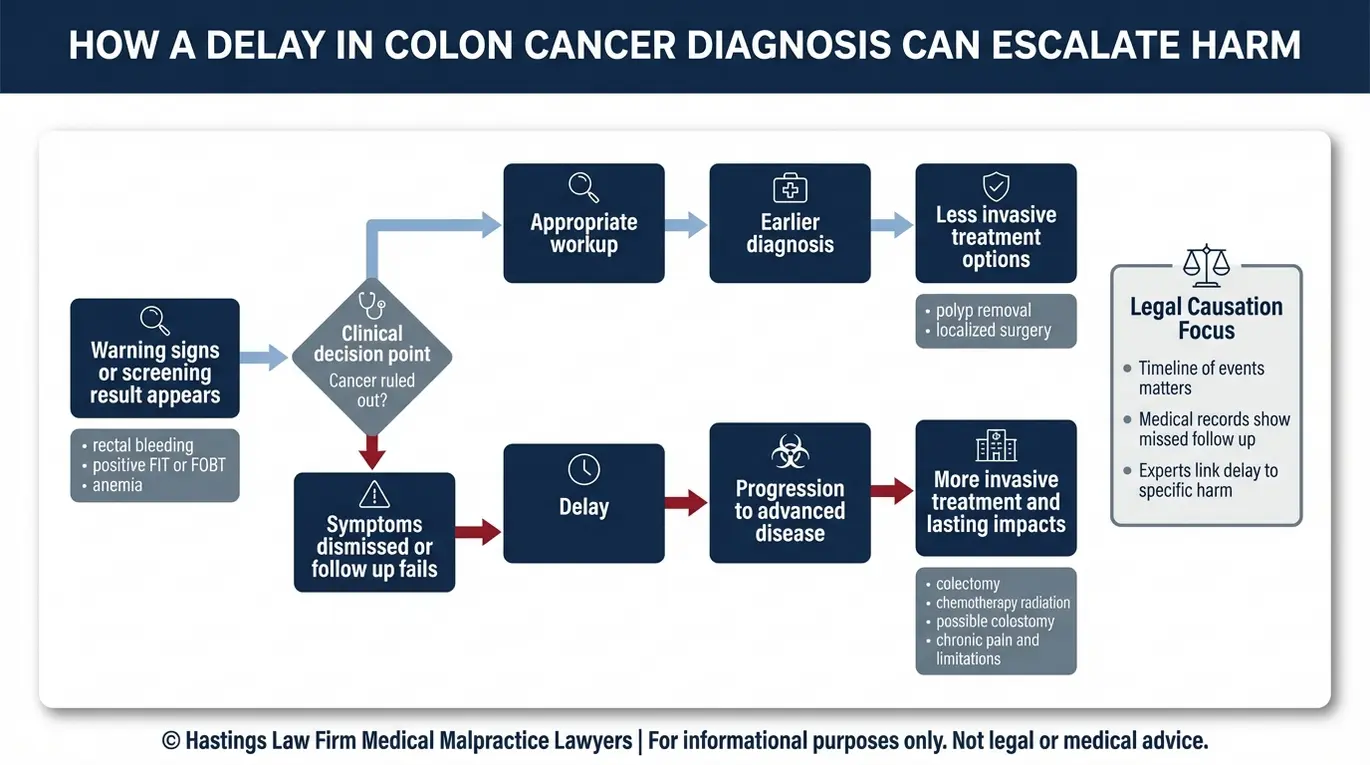
A delay in diagnosing colorectal cancer often forces patients to undergo aggressive surgeries like colectomies, the surgical removal of part or all of the colon, or permanent colostomies, a procedure rerouting waste through an opening in the abdomen, that may have been avoidable with early detection. Late-stage cancer often requires more invasive treatment and has a different medical outlook than early-stage cancer.
According to the National Cancer Institute’s SEER Cancer Statistics, the five-year survival rate for localized colorectal cancer is much higher than for cancer diagnosed at a distant stage. When a failure to diagnose pushes a patient from an early stage to an advanced one, the consequences extend far beyond additional treatment.
The specific harms and damages caused by diagnostic delays can include:
- Escalation from a simple polyp removal to major surgery, radiation, or chemotherapy
- Permanent lifestyle changes from living with a colostomy bag
- Significant pain and suffering, chronic pain, fatigue, and long-term side effects of aggressive cancer treatment
- Reduced life expectancy and diminished quality of life
- Emotional distress from learning the cancer could have been caught sooner
Proving causation in these cases requires qualified expert testimony. Under Texas Civil Practice and Remedies Code § 74.351, plaintiffs must provide an expert report from a qualified physician, such as an oncologist, who can explain how the delay changed the course of the disease.
Texas law does not recognize a pure “loss of chance” theory, so the expert must connect the delay to a specific, identifiable harm. At Hastings Law Firm, our in-house medical staff, including nurse practitioners, help build the clinical timeline needed to establish that connection. We prepare every case as though it will go before a jury.
Recoverable Damages in Texas Oncology Malpractice Cases
Patients and families affected by the compounding errors of a cancer misdiagnosis may recover compensation for past and future medical bills, lost earning capacity, physical pain, mental anguish, and in cases of gross negligence, punitive damages. Recovery is the legal process of obtaining payment for the financial losses caused by medical negligence.
Economic Damages
These cover the financial losses tied directly to the malpractice. They include the cost of additional surgeries, chemotherapy, radiation, and ongoing care that would not have been needed with a timely diagnosis.
Lost wages during treatment and reduced future earning capacity also fall into this category, threatening the family’s future financial security. There is no cap on economic damages in Texas medical malpractice cases, which is important in colorectal cancer claims where treatment costs can be high.
Non-Economic Damages
Texas law allows recovery for physical pain, mental anguish, disfigurement, and loss of enjoyment of life. However, under Texas Civil Practice and Remedies Code § 74.301, non-economic damages in medical malpractice cases are capped.
The general limit is $250,000 per claimant against all individual physicians or health care providers combined, and up to approximately $750,000 in aggregate when hospitals or other healthcare institutions are also involved.
Wrongful Death
If a patient passes away because of a delayed colon cancer diagnosis, surviving family members may pursue a wrongful death claim. These claims can include compensation for funeral and burial costs, loss of companionship, and the financial support the family has lost. A Texas colon cancer misdiagnosis lawyer can evaluate which categories of damages apply and identify every responsible party.
Contact the Texas Misdiagnosis Attorneys at Hastings Law Firm Today for Help
If you or a loved one suffered because a medical provider failed to diagnose colon cancer in a timely manner, you deserve answers. Legal help is available for those affected by a failure to diagnose cancer. Hastings Law Firm is a trial-ready firm dedicated to uncovering the truth and securing the resources you need for your future.
Our team includes in-house medical professionals and former defense attorneys who understand the methods hospitals and insurers use to evaluate these claims. We review every record, consult with qualified oncology experts, and prepare each case with the rigor of a trial-ready firm.
We operate on a contingency fee basis, meaning you pay no attorney fees or costs unless we secure a recovery for you. Your initial consultation is free and confidential.
If something feels wrong about the care you received, trust that instinct. Contact a Texas colon cancer misdiagnosis lawyer at Hastings Law Firm to discuss what happened and learn what options may be available.
Frequently Asked Questions About Colon Cancer Misdiagnosis in Texas


This content was researched and written by the Hastings Law Firm editorial team, which includes attorneys, medical professionals, and experienced researchers. Our writing is informed by internal knowledge and practical experience, and we cross-check critical details against authoritative sources cited throughout. Every piece undergoes human-led fact-checking and legal review. Because legal and medical information can change, if you spot an error, please contact us. Learn more about our content standards and review process on our editorial policy page.

Gabe Sassin has focused exclusively on medical malpractice law since 2007. After spending more than a decade as a malpractice defense attorney, he knows exactly how the other side works. He has seen firsthand how healthcare providers, insurers, corporate defendants, and their legal teams think, prepare, and build their defense against claims. That knowledge works for the people who need it most today, injured patients and their families. His unique experience shapes everything he writes, giving readers a look at how these cases actually work from someone who has handled them from both sides.
