


Texas Leukemia Misdiagnosis Lawyer
A delayed or missed leukemia diagnosis can change treatment options and outcomes, especially when early warning signs or abnormal test results are overlooked. These cases often involve questions about whether symptoms were dismissed, whether follow up testing was ordered, and whether critical lab information was communicated and acted on. The impact can be physical, emotional, and financial, with more intensive treatment and sometimes fatal outcomes. If you or a loved one were harmed or worse due to a delayed or missed leukemia diagnosis in Texas, contact Hastings Law Firm for a free, confidential case review.

Last Updated: July 27, 2026
Trusted Texas Medical Attorneys for Delayed Leukemia Diagnosis Claims
Learning that leukemia was missed or diagnosed late can leave you feeling stunned and betrayed by the very system you trusted with your health. If you or someone in your family is dealing with the fallout of a delayed or missed leukemia diagnosis, you likely have questions about what went wrong, who is responsible, and what comes next.
At Hastings Law Firm, we focus exclusively on medical malpractice cases. Our team of attorneys, nurse consultants, and in-house medical staff understands both the medical science behind leukemia and the legal framework Texas requires to hold negligent providers accountable. As a Texas Leukemia Misdiagnosis Lawyer, Tommy Hastings and our team have spent over two decades building cases that demand answers for patients and families harmed by diagnostic failures. Tommy is board-certified in personal injury trial law by the Texas Board of Legal Specialization, a distinction held by fewer than 2% of attorneys in the state.
If something doesn’t feel right about the care you or a loved one received, we can review what happened and explain your options in a free, confidential case evaluation.

Understanding Leukemia Misdiagnosis and Failure to Diagnose Claims
Leukemia misdiagnosis occurs when a healthcare provider fails to identify cancer symptoms or misinterprets diagnostic tests like a Complete Blood Count (CBC), leading to a delay in treatment that allows the disease to progress. This kind of error can delay treatment and allow the disease to progress unchecked.
Not every diagnostic error rises to the level of a legal claim. Under Texas law, a medical malpractice case requires more than a bad outcome. It requires proof that the provider breached the standard of care, the level of treatment a reasonably competent physician would have provided under similar circumstances. The question our Texas leukemia misdiagnosis attorneys evaluate, often in consultation with a hematologist or oncologist, is whether the doctor’s actions fell below what the medical community expects.
There is a distinction between two types of diagnostic errors:
- Failure to diagnose, where the leukemia was missed entirely. The provider never identified the disease, even when signs were present.
- Delayed diagnosis, an error where the condition was eventually identified, but not soon enough. The lag allowed the cancer to advance beyond a stage where less aggressive treatment may have been effective.
This distinction matters because the type of leukemia involved heavily influences how much a delay changes the prognosis. The four major types include:
- Acute Myeloid Leukemia (AML) and Acute Lymphoblastic Leukemia (ALL), fast-moving cancers where weeks or even days of delay can dramatically reduce survival odds.
- Chronic Myeloid Leukemia (CML) and Chronic Lymphocytic Leukemia (CLL), which progress more slowly, but a failure to diagnose can still allow chronic forms to enter dangerous advanced phases.
Because leukemia cases in Texas fall under the Texas Civil Practice and Remedies Code, Chapter 74.051, patients must meet specific procedural requirements before a lawsuit can proceed. A physician’s duty of care to the patient must be clearly established as the foundation of any claim.
Common Causes of Delayed Leukemia Diagnosis in Texas
Diagnostic delays often result from physicians dismissing early symptoms as viral infections, failing to order a bone marrow biopsy after abnormal blood work, or misreading flow cytometry reports. When we investigate these cases as a leukemia misdiagnosis lawyer in Texas, patterns of failure tend to emerge.
Symptom dismissal is one of the most frequent problems. Leukemia’s early signs, such as fatigue, unexplained bruising, recurring infections, and pallor, overlap with common, less serious conditions. A provider who attributes persistent symptoms to anemia or the flu without ordering further testing may be falling short of what the standard of care requires. A Complete Blood Count, a basic blood panel that measures white blood cells, red blood cells, and platelets, can reveal abnormalities that should prompt immediate follow-up with a hematologist or oncologist.
Laboratory and communication errors also contribute to diagnostic failures. Misinterpreted slides, mislabeled specimens, or a failure to communicate critical lab values back to the ordering physician can all cause dangerous delays. A bone marrow biopsy, a procedure where a sample of bone marrow is extracted and examined for cancerous cells, may never be ordered if the initial blood work results are lost or misread.
The following table illustrates how a provider’s actions may compare against what the standard of care generally requires:
| Clinical Scenario | Standard of Care | Potentially Negligent Action |
|---|---|---|
| Persistently elevated white blood cell count | Order further testing, including CBC differential and possible bone marrow biopsy | Discharge patient with antibiotics only |
| Abnormal CBC with blast cells identified | Urgent referral to a hematologist/oncologist | Repeat blood work in 3 to 6 months without referral |
| Abnormal flow cytometry results | Immediate specialist consultation and staging | Failure to communicate results to patient or ordering physician |
| Recurrent infections with unexplained fatigue | Investigate underlying hematologic cause | Attribute symptoms to stress or viral illness repeatedly |
Benchmarking Diagnostic Errors with National Data
These failures are not isolated. Research published by the National Academies Press in *Improving Diagnosis in Health Care* found that diagnostic errors are a leading contributor to patient harm nationally. This data reflects nationwide patterns of healthcare failure. The Oregon Patient Safety Commission’s Safer Dx Checklist also highlights systemic gaps in how diagnostic information is communicated and followed up. Data from the National Practitioner Data Bank (NPDB) consistently shows diagnostic errors among the most common reasons for malpractice claims, which means that patients experiencing these failures are far from alone.
Under Texas Civil Practice and Remedies Code Chapter 74, bringing a claim based on these failures requires expert witness testimony from a qualified physician who can identify exactly where the standard of care was breached and how.

The Hastings Law Firm Difference
Results matter, but what truly sets us apart is how we achieve them. Every verdict, every settlement, and every Texas courtroom victory comes from one guiding promise: To treat each client’s fight for justice as if it were our own.
This balance of skill, experience, and empathy reflects our core philosophy that justice should not only compensate the injured, but also make health care safer nationwide.

The Severe Consequences of Delayed Leukemia Treatment
A delay in diagnosing leukemia allows the cancer to advance from a treatable stage to a potentially terminal condition, often requiring more aggressive chemotherapy, stem cell transplants, or resulting in preventable death. Every week that passes without a correct diagnosis can narrow the window for effective treatment.
Clinical Staging and the Loss of Curative Options
Leukemia classification systems, including the World Health Organization (WHO) classification, a standardized framework that categorizes leukemia subtypes based on cell characteristics and genetic markers, directly determine a patient’s prognosis and treatment plan. Staging helps doctors determine how far the cancer has spread. A delay in diagnosis can shift a patient into a higher-risk classification with significantly lower survival rates.
For acute leukemias like Acute Myeloid Leukemia (AML) and Acute Lymphoblastic Leukemia (ALL), progression into a blast crisis can occur. This is a phase where immature cancer cells rapidly overwhelm the bone marrow and bloodstream. This event can transform a potentially curable condition into one with very limited treatment options. Data from the National Cancer Institute’s SEER program on Acute Lymphocytic Leukemia illustrates how survival rates vary significantly by stage at diagnosis.
As Texas leukemia misdiagnosis lawyers have seen, the consequences of a missed or late diagnosis extend across every part of a patient’s life:
- More aggressive treatment protocols: Patients may require induction chemotherapy, an intensive initial phase of treatment designed to rapidly destroy cancer cells, radiation therapy, or a hematopoietic stem cell transplant (HSCT), a procedure that replaces damaged bone marrow with healthy donor cells. These treatments carry serious risks that earlier intervention may have avoided.
- Reduced survival probability: When leukemia advances beyond its early stages, the likelihood of achieving remission drops significantly. This is the core of the causation analysis in these cases.
- Escalating financial burden: Advanced-stage cancer treatment generates exponentially higher medical bills, extended hospital stays, and prolonged inability to work. Lost wages compound over months and years.
- Wrongful death: In the most devastating cases, the delay proves fatal. Under the Texas Civil Practice and Remedies Code Chapter 71, surviving family members may pursue a wrongful death claim to recover damages for their loss.
The physical, emotional, and financial toll of a diagnostic delay is exactly what our legal and medical team evaluates when building a case for our clients.
Proving Medical Negligence in Leukemia Cases
Proving negligence requires clear evidence that a competent doctor would have diagnosed the leukemia earlier and that this delay directly caused verifiable harm or a reduced chance of survival. As a Texas leukemia misdiagnosis attorney, our firm builds these cases through a structured, step-by-step process. We use our in-house medical staff, including nurse consultants who previously worked for hospital systems, to review every detail.
Step 1: Establishing the Doctor-Patient Relationship (Duty). The first element is confirming that a formal doctor-patient relationship existed. This establishes the physician’s legal duty to provide care meeting the accepted standard. Medical records, appointment logs, and billing records all help confirm this relationship.
Step 2: Identifying the Breach. This is the core of the case. We work with qualified medical experts to pinpoint the specific error in judgment or procedure. Did the physician fail to order appropriate testing after abnormal blood work? Was a referral to a hematologist delayed?
Were flow cytometry results, a laboratory technique that analyzes cell characteristics to identify cancer subtypes, misinterpreted or ignored? The breach must be measured against what a reasonably competent physician in the same specialty would have done.
Step 3: Linking the Breach to the Injury (Causation). Identifying an error is not enough. Under the Texas Medical Liability Act, we must demonstrate that the delay more likely than not caused the patient’s injury or worsened their outcome. Expert testimony from oncologists and hematologists becomes essential at this stage. They analyze the cancer’s progression timeline and compare it against the point when a correct diagnosis should have been made.
Step 4: Calculating Damages. The final step involves documenting the full scope of harm. This includes life care plans projecting future medical needs, economic loss calculations covering lost income, and the physical and emotional suffering caused by the delay.
Overcoming the Texas Lost Chance Doctrine
Texas presents a specific legal challenge in cancer misdiagnosis cases. The Texas Supreme Court has rejected lost chance as a standalone cause of action. This means we cannot simply argue that a delay reduced the patient’s probability of survival. Instead, our leukemia malpractice lawyer team must prove that the negligence more likely than not caused the death or specific injury. Sophisticated expert analysis and meticulous case construction are required. We maintain a national network of oncology experts to support these cases.

Texas Statute of Limitations for Leukemia Malpractice Lawsuits
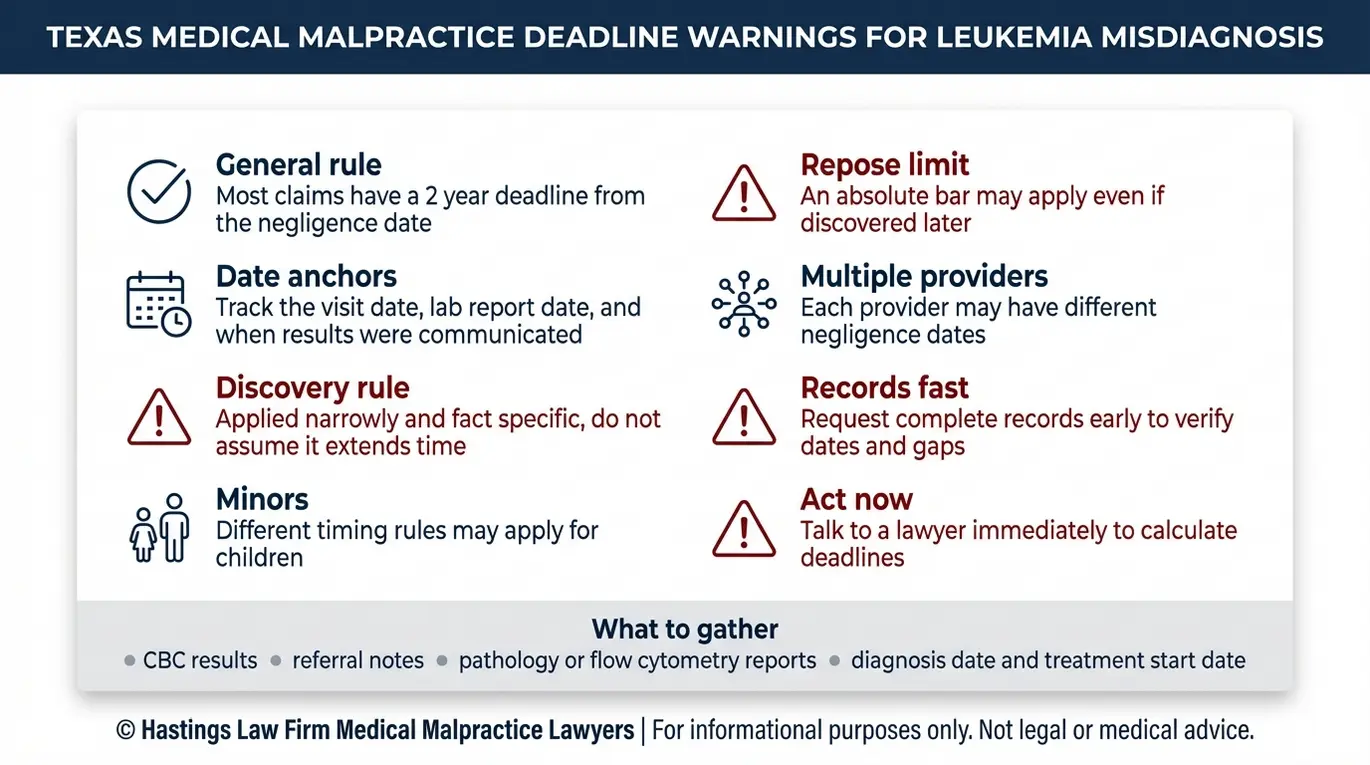
In Texas, the statute of limitations for medical malpractice is generally two years from the occurrence of the breach or tort, or from the date the medical treatment that is the subject of the claim is completed, though specific exceptions exist for minors and cases where the negligence could not have been immediately discovered.
The two-year deadline is set by Texas Civil Practice & Remedies Code § 74.251, and Texas courts enforce it strictly. Missing this window almost always means losing the right to pursue a claim entirely. Our team works quickly to identify the relevant limitations period to protect your rights.
Texas also imposes a statute of repose, which is a hard 10-year outer limit. Regardless of when the misdiagnosis was discovered, no claim can be filed more than 10 years after the date the negligence occurred. A separate provision in § 74.251(a) allows minors under the age of 12 until their 14th birthday to file a claim, but this exception applies to the two-year limitations period rather than the 10-year statute of repose.
The discovery rule may delay the start of the two-year clock in cases where the patient could not have reasonably known about the misdiagnosis at the time it occurred. However, Texas courts interpret this exception very narrowly.
⚠️ Critical Deadline Warning: Because the discovery rule is applied so strictly in Texas, determining exactly when your limitations period began requires immediate legal analysis. If you suspect a diagnostic error contributed to a leukemia diagnosis, contact an attorney as soon as possible to protect your right to file a claim.
Contact the Texas Misdiagnosis Attorneys at Hastings Law Firm Today for Help
No legal action can undo a leukemia diagnosis. But it can secure the financial resources needed for the best possible care going forward, and it can hold the providers responsible for their failures accountable so that other families are better protected.
Tommy Hastings has spent his career translating complex medical evidence into cases that demand answers. From a $3.5 million jury verdict against Kelsey-Seybold for failure to diagnose to multi-million dollar results in cases involving diagnostic failures, our firm has the medical knowledge and trial preparation to handle these claims. Our team includes former defense attorneys who understand the ‘playbook’ used by hospital insurance carriers.
Our team includes former defense attorneys who know how hospitals and insurers build their cases. We also use in-house nurse consultants who can analyze your medical records from day one. As your Texas Leukemia Misdiagnosis Lawyer, we prepare every case as if it will go to a jury.
The consultation is free. The evaluation is confidential. And you pay no fees unless we recover compensation for you. Contact Hastings Law Firm today to get the answers you deserve.
Frequently Asked Questions About Leukemia Misdiagnosis in Texas


This content was researched and written by the Hastings Law Firm editorial team, which includes attorneys, medical professionals, and experienced researchers. Our writing is informed by internal knowledge and practical experience, and we cross-check critical details against authoritative sources cited throughout. Every piece undergoes human-led fact-checking and legal review. Because legal and medical information can change, if you spot an error, please contact us. Learn more about our content standards and review process on our editorial policy page.

Gabe Sassin has focused exclusively on medical malpractice law since 2007. After spending more than a decade as a malpractice defense attorney, he knows exactly how the other side works. He has seen firsthand how healthcare providers, insurers, corporate defendants, and their legal teams think, prepare, and build their defense against claims. That knowledge works for the people who need it most today, injured patients and their families. His unique experience shapes everything he writes, giving readers a look at how these cases actually work from someone who has handled them from both sides.
