


Texas Ovarian Cancer Misdiagnosis Lawyer
A delayed or missed ovarian cancer diagnosis can lead to more advanced disease, harsher treatment, and a lasting sense that warning signs were not taken seriously. Ovarian cancer symptoms are often mistaken for less serious problems, and gender bias can contribute when pain or bloating is minimized. Misconceptions about screening, including the belief that a Pap smear detects ovarian cancer, can also delay proper testing. These situations can leave patients and families facing avoidable harm and uncertain outcomes. If you or a loved one were harmed or worse due to delayed or missed ovarian cancer diagnosis in Texas, contact Hastings Law Firm for a free, confidential case review.

Last Updated: July 27, 2026
Compassionate Texas Medical Attorneys for Delayed Ovarian Cancer Diagnosis Claims
When ovarian cancer is missed or diagnosed late, the consequences can change the course of your life or the life of someone you love. You may be dealing with a more advanced stage of disease, more aggressive treatment, and the painful question of whether earlier action could have made a difference. That question deserves a real answer.
At Hastings Law Firm, our team of attorneys, in-house nurse consultants, and medical experts focuses exclusively on medical malpractice. The firm was founded by Tommy Hastings, who is Board Certified in Personal Injury Trial Law, a distinction held by a small percentage of Texas attorneys. We are a nationally recognized trial firm that includes former defense attorneys and experienced hospital nurses on our team.
We understand both the medicine and the law behind these cases. We know how to investigate whether a doctor’s failure to act fell below the accepted standard of care. If you are looking for a Texas Ovarian Cancer Misdiagnosis Lawyer, we are here to listen, review what happened, and explain your options at no cost and with no obligation.

Why Ovarian Cancer Symptoms Are Frequently Dismissed by Physicians
Ovarian cancer is often misdiagnosed because its early symptoms are non-specific and closely mimic common gastrointestinal or gynecological conditions. This overlap often leads to misidentifying cancer as a less serious condition. This giving doctors a reason to reach for simpler explanations, sometimes without ordering the tests that could reveal something far more serious.
The “silent killer” label is misleading. Many patients experience symptoms for months, but these warning signs are often attributed to other conditions. The problem is not silence; it is that symptoms are ignored or explained away.
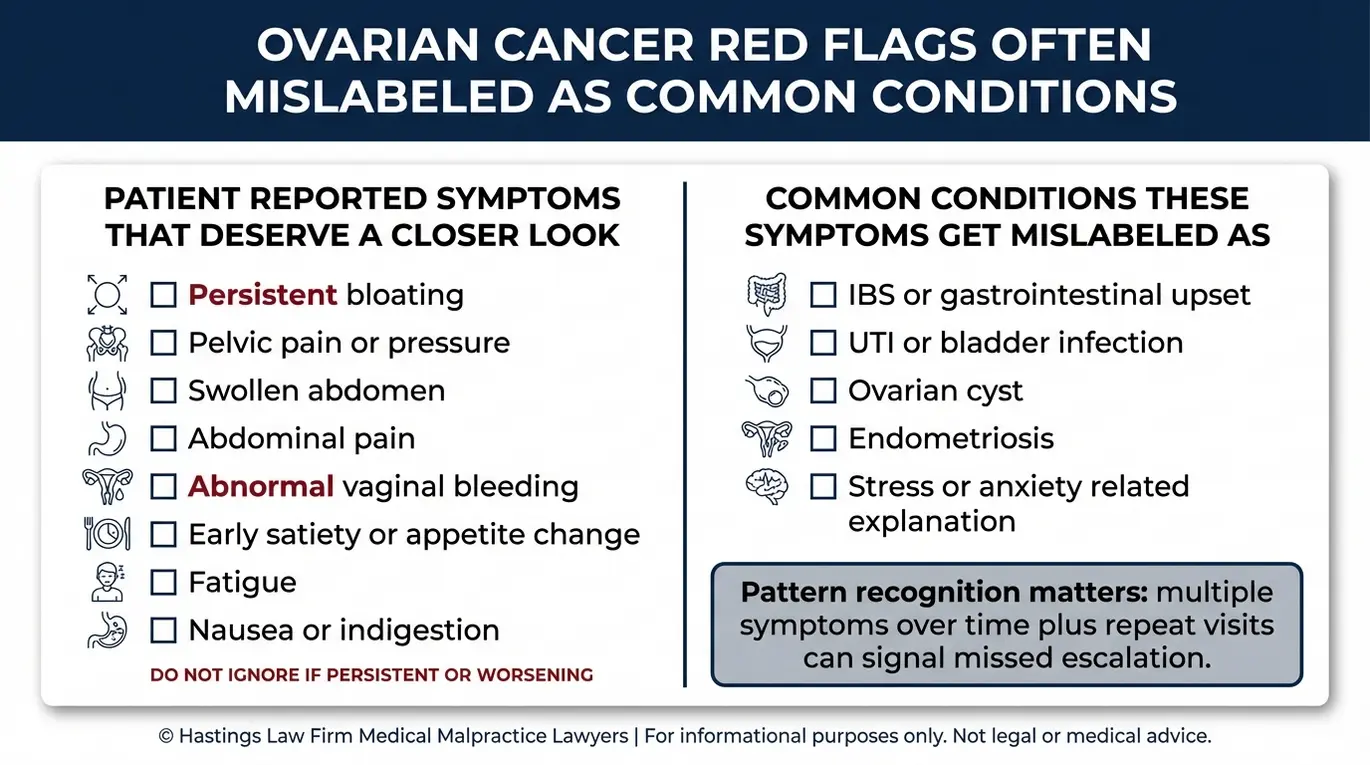
Patients frequently report persistent bloating, pelvic pain, abdominal pain, abnormal bleeding, or changes in menstrual cycles. You may also experience fatigue, nausea, indigestion, constipation, or diarrhea. A swollen abdomen may develop due to ascites, which is a buildup of fluid in the abdominal cavity. If these symptoms persist, medical standards typically require doctors to look for an underlying cause.
When a physician settles on a simpler diagnosis without ruling out an adnexal mass, or an abnormal growth near the ovary, critical time can be lost. This delay in identifying a mass can prevent early treatment. That delay may allow cancer to progress from an early, more treatable stage to one that requires aggressive intervention. Instead of proper screening, these symptoms are often quickly labeled as one of several less serious conditions:
- Irritable Bowel Syndrome (IBS)
- Urinary Tract Infections (UTI)
- Ovarian cysts
- Endometriosis
- Stress-related or anxiety-related complaints
Gender Bias in Medical Diagnostics
Research shows women’s pain is statistically more likely to be minimized or attributed to psychological factors. Complaints of pelvic pain or bloating may be dismissed as stress or related to a cycle rather than investigated. This dismissal can constitute negligence when it causes a physician to bypass the diagnostic workup required by the standard of care.
As a Texas ovarian cancer misdiagnosis attorney, we review medical records closely for signs of gender bias or instances where a patient’s reported symptoms were not taken seriously. We look for gaps in the medical timeline where concerns were raised but not addressed with diagnostic action.
Standard Diagnostic Tests and The Pap Smear Misconception
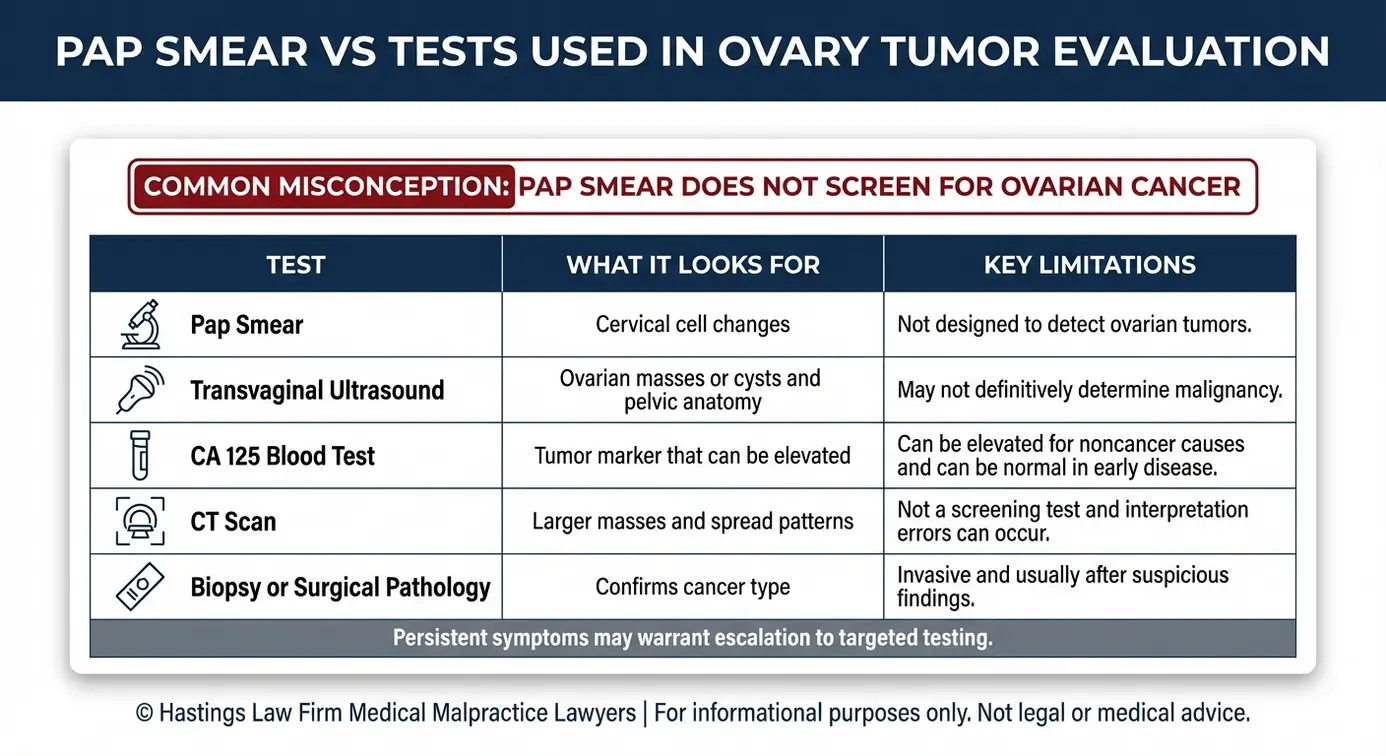
A Pap smear does not detect ovarian cancer. This is one of the most common and dangerous misconceptions in women’s healthcare, and it leads many patients to believe they have been screened for ovarian cancer when they have not. A Pap smear is a test that collects cells from the cervix and is designed to screen for cervical cancer only.
Detecting ovarian tumors requires different diagnostic tools. When a patient presents with persistent symptoms or risk factors such as a family history of ovarian or breast cancer, the standard of care may call for specific testing. These tests help identify tumors that a physical exam might miss.
According to the Centers for Disease Control and Prevention’s screening guidance on ovarian cancer, there is currently no reliable routine screening test for ovarian cancer, which makes a physician’s response to symptoms even more important.
The CA-125 blood test, which measures levels of cancer antigen 125 (a protein that can be elevated in the presence of ovarian tumors), is one of the primary tools used in evaluation. However, as detailed in research published by PubMed Central (NIH) on CA-125 and ovarian cancer, CA-125 levels can also be elevated by benign conditions. This means results must be interpreted alongside imaging and clinical findings.
The following table outlines the key diagnostic tests, what they evaluate, and their known limitations:
| Test Name | What It Detects | Limitations |
|---|---|---|
| Pap Smear | Cervical cell abnormalities (cervical cancer screening) | Does not detect ovarian cancer |
| Transvaginal Ultrasound (TVUS) | Masses, cysts, or abnormalities in the ovaries and surrounding structures | May not distinguish between benign and malignant growths |
| CA-125 Blood Test | Elevated levels of cancer antigen 125, a tumor marker | Can be elevated by endometriosis, fibroids, and other benign conditions |
| CT Scan | Tumor size, location, and potential spread to nearby organs | May miss very small or early-stage tumors |
| Biopsy | Confirms whether tissue is cancerous | Requires a tissue sample, often obtained during surgery |
A failure to diagnose ovarian cancer lawyer examines whether the treating physician ordered the appropriate tests given the patient’s symptoms, history, and risk profile, or whether critical steps were skipped entirely.
The Hastings Law Firm Difference
Results matter, but what truly sets us apart is how we achieve them. Every verdict, every settlement, and every Texas courtroom victory comes from one guiding promise: To treat each client’s fight for justice as if it were our own.
This balance of skill, experience, and empathy reflects our core philosophy that justice should not only compensate the injured, but also make health care safer nationwide.

Proving Liability When Doctors Fail to Diagnose Ovarian Cancer
Liability in a delayed or missed ovarian cancer diagnosis is established by proving that the doctor deviated from the standard of care, meaning a competent physician under similar circumstances would have ordered testing or identified the cancer sooner. In Texas, this requires showing that a doctor-patient relationship existed, that the physician failed to meet the accepted standard, and that the failure directly caused harm.
The standard of care in this context refers to the level of treatment and diagnostic diligence that a reasonably competent gynecologist, primary care physician, or specialist would have provided. When persistent complaints of bloating, pelvic pain, or abnormal bleeding are documented but no further testing is ordered, we examine whether that decision caused a breach of the standard of care.
Radiology errors are another common source of negligence in these cases. A transvaginal ultrasound (TVUS), an imaging procedure that uses a probe to visualize the ovaries and surrounding structures, may reveal an abnormality that is missed or misread by the radiologist. These subtle visual indicators require high expertise to identify correctly. False-negative imaging, where an ovarian mass is present but not identified on the scan report, can delay diagnosis by months or longer.
Systemic failures also contribute to missed diagnoses. Under Texas Civil Practice and Remedies Code Chapter 74, medical malpractice claims require pre-suit notice and expert review. Our legal and medical team investigates systemic breakdowns in communication, such as abnormal test results that were never relayed to the patient, follow-up appointments that were never scheduled, or referrals that were never made.
Liability often relies on clear evidence of these failures. The CDC’s Medical Test Checklist reinforces how important it is for both providers and patients to track and follow up on every ordered test. As an ovarian cancer malpractice lawyer in Texas, we trace these failures across every provider involved to build a clear picture of where the standard of care broke down.

Understanding the Lost Chance of Survival Doctrine in Texas
Under Texas law, patients can pursue a claim if a delayed diagnosis significantly reduced their chance of survival or forced them into more aggressive treatment than would have been necessary with timely detection. This legal theory connects the delay directly to the harm suffered.
Ovarian cancer staging is classified by the FIGO system (International Federation of Gynecology and Obstetrics). Staging describes how far the cancer has progressed. It ranges from Stage I, where cancer is confined to the ovaries, through Stage IV, where it has undergone metastasis, or the spread of cancer cells to distant organs.
According to SEER Cancer Stat Facts for Ovarian Cancer, the five-year survival rate drops significantly as the disease advances to later stages. A patient diagnosed at Stage I may require limited surgery, while a patient whose cancer has spread may face rounds of chemotherapy, radiation therapy, and far more uncertain outcomes.
Texas courts have addressed the lost chance of survival doctrine with some important limitations. As analyzed in Texas A&M University School of Law scholarship on lost chance of survival, Texas does not recognize a standalone lost chance cause of action in the traditional sense. We evaluate what the likely outcome would have been with a timely diagnosis compared to the actual outcome to build the necessary evidence.
Recoverable Damages for Cancer Misdiagnosis Victims
Patients and families affected by a delayed or missed ovarian cancer diagnosis may be entitled to several categories of compensation, depending on the specifics of their case. Compensation aims to provide the financial support needed after a medical error.
Economic damages cover measurable financial losses, including:
- Past and future medical bills for additional treatment, surgery, chemotherapy, or radiation
- Lost wages and diminished earning capacity
Non-economic damages address the personal toll of the misdiagnosis:
- Physical pain and suffering
- Physical impairment and disfigurement
- Mental anguish and loss of enjoyment of life
If a loved one died because of the delayed diagnosis, families may pursue a wrongful death claim to recover for their loss, including funeral expenses and loss of companionship.
Contact the Texas Misdiagnosis Attorneys at Hastings Law Firm Today for Help
No amount of compensation can undo a cancer diagnosis. But holding the responsible provider accountable can provide the financial security you need for treatment and recovery, and it can help prevent the same failure from happening to another patient.
Hastings Law Firm handles ovarian cancer misdiagnosis cases on a contingency fee basis, which means you pay no attorney fees or costs unless we recover compensation for you. This allows you to pursue justice without upfront financial burden.
Our team of attorneys, nurse consultants, and medical experts will review your records and identify where the standard of care may have been breached. If you or a loved one experienced a delayed or missed ovarian cancer diagnosis, contact a Texas Ovarian Cancer Misdiagnosis Lawyer at Hastings Law Firm for a free, confidential case evaluation. Let us help you find the answers you deserve.
Frequently Asked Questions About Ovarian Cancer Misdiagnosis in Texas


This content was researched and written by the Hastings Law Firm editorial team, which includes attorneys, medical professionals, and experienced researchers. Our writing is informed by internal knowledge and practical experience, and we cross-check critical details against authoritative sources cited throughout. Every piece undergoes human-led fact-checking and legal review. Because legal and medical information can change, if you spot an error, please contact us. Learn more about our content standards and review process on our editorial policy page.

Brady D. Williams is a nationally recognized medical malpractice attorney who has spent his career handling high-stakes litigation for injured patients and families across the country. Licensed in both Texas and California, Brady draws on experience from hundreds of resolved medical cases to break down complex legal and medical topics for the people who need that information most. His writing reflects the same attention to detail and commitment to clarity that he brings to every case he handles.
