


Texas Prostate Cancer Misdiagnosis Lawyer
A delayed or missed prostate cancer diagnosis can turn a treatable condition into a more advanced disease with harsher treatment and lasting physical, financial, and emotional consequences. Delays may happen when symptoms or rising PSA results are dismissed, follow up testing is not ordered, referrals are postponed, or abnormal results are not communicated. These situations often hinge on whether the care met accepted diagnostic standards and whether the delay changed the outcome. If you or a loved one were harmed or worse due to a delayed prostate cancer diagnosis in Texas, contact Hastings Law Firm for a free, confidential case review.

Last Updated: July 27, 2026
Trusted Medical Attorneys for Delayed Prostate Cancer Diagnosis Claims in Texas
A delayed prostate cancer diagnosis can change everything. What may have been a treatable condition can progress when a doctor fails to order the right tests. This can also happen when they misread results or delay a referral to a urologist, a specialist in urinary tract health. If you suspect a medical error contributed to a late or missed diagnosis, you are not alone.
Led by board-certified trial attorney Tommy Hastings, our firm focuses exclusively on medical malpractice. With more than two decades of experience, we have the specialized medical knowledge needed to handle these complex cases. Our team includes in-house nurses and former defense attorneys who know how to identify where the standard of care broke down. The consultation is free, and you pay nothing unless we recover compensation for you.

Establishing Medical Malpractice in Delayed Prostate Cancer Diagnosis
To prove malpractice for a delayed prostate cancer diagnosis, a patient must show that a doctor violated the accepted standard of care by ignoring symptoms or test results, and that this failure directly caused the cancer to advance to a less treatable stage. Establishing negligence involves comparing the physician’s actions to established medical protocols. Medical malpractice involves a professional failure that results in patient injury.
Medical malpractice claims in oncology rest on four legal elements. First is duty of care, meaning the doctor had a professional obligation to the patient. Second is breach, which occurs when the doctor’s actions fall below what a reasonably competent physician would have done under the same circumstances. Third is causation, the link between the breach and the harm the patient suffered. Fourth is damages, the actual losses, whether physical, financial, or emotional.
The standard of care is the benchmark. In the context of prostate cancer, a prudent primary care doctor or urologist who sees elevated lab results or concerning symptoms should follow established protocols. That may include ordering a prostate biopsy, a tissue sampling procedure to confirm cancer, or recommending a multiparametric MRI (mpMRI), an advanced imaging study to detect lesions. When a doctor fails to take these steps, and the cancer progresses as a result, a prostate cancer misdiagnosis attorney can help determine whether negligence occurred.
Proving causation is challenging. It is not enough to show that a doctor made an error. The legal standard requires evidence that the delay actually changed the patient’s outcome. For example, data from the National Cancer Institute’s SEER Program shows that localized prostate cancer has a near-100% five-year relative survival rate, while distant-stage disease drops sharply.
If a timely diagnosis would have caught the cancer at Stage 1 instead of Stage 3 or 4, the difference in prognosis can be the foundation of a strong claim.
Misdiagnosis vs. Delayed Diagnosis
These terms describe different ways a medical provider may fail to identify cancer correctly. Accurately identifying how the diagnosis was missed is essential for the legal strategy. A misdiagnosis happens when a doctor reaches the wrong conclusion, such as attributing symptoms to infection. Failure to diagnose means the condition was never identified. A delayed diagnosis means cancer is found late, after progressing beyond the point of effective early treatment.
Each of these scenarios can support a malpractice claim, but the legal strategy differs. In some cases, a doctor may have placed a patient on active surveillance, a monitoring approach where treatment is deferred for low-risk cancers (a related but distinct concept from watchful waiting, which involves less intensive monitoring). If the clinical picture warranted more aggressive follow-up and the doctor failed to act, that delay can cross the line from reasonable medical judgment into negligence.

Common Errors Leading to Failure to Diagnose Prostate Cancer
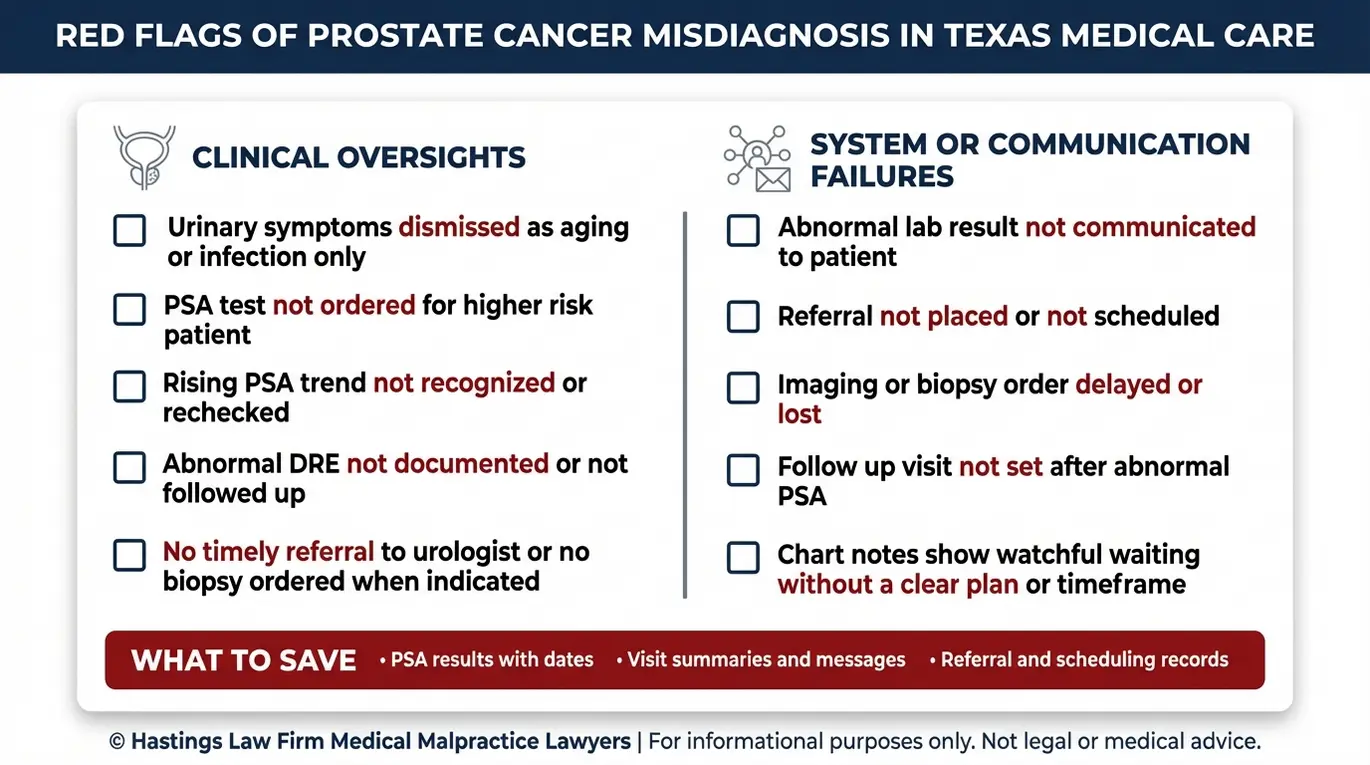
Failure to diagnose prostate cancer often stems from ignored PSA spikes, skipped physical exams, or communication breakdowns where abnormal test results never reach the patient. Diagnostic errors occur when a physician deviates from the standard testing sequence for prostate health. These mistakes represent a breakdown in the standard diagnostic process.
These errors tend to follow recognizable patterns. A Texas delayed diagnosis lawyer will look closely at the medical records to identify where the process broke down. Common failures include:
- Dismissal of symptoms. A patient reports urinary difficulty, pelvic pain, or blood in the urine, and the doctor attributes it to aging or a benign condition without further investigation.
- Testing failures. A prostate-specific antigen (PSA) test is not ordered for an at-risk patient. A biopsy, MRI, or ultrasound may be delayed despite clinical indicators.
- Skipped physical exams. A digital rectal exam (DRE), a manual examination in which a doctor feels the prostate for abnormalities, is not performed during routine physicals for men in higher-risk age groups.
- Failure to refer. A primary care physician does not send the patient to a urologist despite symptoms or lab results that call for specialist referral.
- Administrative errors. Test results are lost, misfiled, or never communicated to the patient. The National Academies’ report on Improving Diagnosis in Health Care identifies communication breakdowns as one of the most common contributors to diagnostic error across all specialties.
- Ignored PSA levels. Doctors may fail to track rising PSA levels that indicate a need for further testing.
Any one of these failures can delay a diagnosis by months or even years. A prostate cancer malpractice lawyer will trace the timeline from first symptoms or risk indicators through every appointment, test, and referral to determine whether negligence contributed to the delay.
The Hastings Law Firm Difference
Results matter, but what truly sets us apart is how we achieve them. Every verdict, every settlement, and every Texas courtroom victory comes from one guiding promise: To treat each client’s fight for justice as if it were our own.
This balance of skill, experience, and empathy reflects our core philosophy that justice should not only compensate the injured, but also make health care safer nationwide.

Diagnostic Standards and Risk Factors Doctors Must Monitor
The medical standard of care requires doctors to monitor PSA levels relative to a patient’s age and risk profile, perform digital rectal exams when indicated, and order biopsies when findings are suspicious. Physicians use these clinical tools to identify potential cancer early.
PSA testing protocols are not one-size-fits-all. Doctors should evaluate PSA velocity, the rate at which PSA levels rise over time, because a rapid increase can signal cancer even when individual readings fall within a normal range. They should also consider age-adjusted PSA reference ranges, which account for the fact that PSA levels naturally increase with age. A reading that appears “normal” for a 75-year-old may be concerning for a man in his 50s. A medical expert will review these records to determine if the standard was met.
The table below outlines key diagnostic standards a doctor must follow:
| Diagnostic Standard | Physician Duty |
|---|---|
| :— | :— |
| PSA Blood Test | Monitor PSA levels and velocity; adjust for age-specific baselines. |
| Risk Assessment | Identify high-risk patients (e.g., family history, Black men) for closer monitoring. |
| Physical Exam | Perform a digital rectal exam (DRE) to check for abnormalities. |
| Biopsy Referral | Order a biopsy or imaging when PSA or DRE findings are suspicious. |
Certain patients require closer monitoring. Men with a family history of prostate cancer carry higher risk. Black men are diagnosed at higher rates and often with more aggressive disease. The NCCN Clinical Practice Guidelines for Prostate Cancer outline specific screening recommendations based on these risk factors, and a doctor who ignores them may be falling below the standard of care.
The decision to biopsy is another critical juncture. There are situations where watchful waiting is a medically sound approach for low-risk findings. But when PSA levels are climbing, imaging shows suspicious areas, or a DRE reveals an abnormality, delaying a biopsy can allow a curable cancer to become incurable. As a Texas prostate cancer misdiagnosis lawyer, we work with qualified oncologists and urologists to evaluate whether the treating physician’s decisions were consistent with accepted medical guidelines. A lawyer for cancer misdiagnosis will examine the full clinical record to identify the exact point where the standard of care was breached.

Compensation and Damages in Prostate Cancer Misdiagnosis Cases
Patients harmed by a prostate cancer misdiagnosis can recover economic damages for medical bills and lost wages, as well as non-economic damages for pain, suffering, and physical impairment. Protecting your future financial security is a critical component of these claims. Damages represent the legal way to account for the losses a patient suffers.
A complete claim typically seeks the following types of damages:
- Economic Damages: These cover measurable financial losses, such as the cost of escalated treatment. A patient who could have been treated with targeted radiation may instead require a radical prostatectomy, the surgical removal of the prostate gland. They may also need androgen deprivation therapy (ADT), which is a hormonal treatment that suppresses testosterone to slow cancer growth. The UCSF Department of Urology documents the range of side effects these treatments carry. Damages also include lost wages and reduced earning capacity.
- Non-Economic Damages: These address the personal toll, including physical pain, mental anguish, loss of enjoyment of life, and loss of consortium.
- Wrongful Death Damages: If a delay leads to death, surviving family members can seek compensation for funeral expenses, lost financial support, and the mental anguish of losing a loved one.
As a Texas prostate cancer misdiagnosis lawyer, we help families understand the full scope of what the law allows so that no category of loss is overlooked. A medical malpractice attorney experienced in these cases will account for both immediate and long-term financial consequences.
Contact the Texas Misdiagnosis Attorneys at Hastings Law Firm Today for Help
No amount of money can undo a cancer diagnosis. But compensation can provide the resources needed for treatment, support your family’s financial security, and hold the responsible parties accountable. Many of our clients also want something else: the truth about what happened and the reassurance that it won’t happen to someone else.
Hastings Law Firm works on a contingency fee basis, which means you pay no attorney fees or costs unless we recover compensation for you. Our team of attorneys, in-house nurses, and medical consultants will review your records, identify where the standard of care may have been breached, and explain your options clearly.
If you or a loved one experienced a delayed or missed prostate cancer diagnosis in Texas, contact a Texas Prostate Cancer Misdiagnosis Lawyer at our firm for a free, confidential case evaluation. Let us help you find the answers you deserve.
Frequently Asked Questions About Prostate Cancer Misdiagnosis in Texas


This content was researched and written by the Hastings Law Firm editorial team, which includes attorneys, medical professionals, and experienced researchers. Our writing is informed by internal knowledge and practical experience, and we cross-check critical details against authoritative sources cited throughout. Every piece undergoes human-led fact-checking and legal review. Because legal and medical information can change, if you spot an error, please contact us. Learn more about our content standards and review process on our editorial policy page.

Brady D. Williams is a nationally recognized medical malpractice attorney who has spent his career handling high-stakes litigation for injured patients and families across the country. Licensed in both Texas and California, Brady draws on experience from hundreds of resolved medical cases to break down complex legal and medical topics for the people who need that information most. His writing reflects the same attention to detail and commitment to clarity that he brings to every case he handles.
