


Texas Meningitis Misdiagnosis Lawyer
Meningitis can worsen quickly, and a missed or delayed diagnosis can lead to permanent injury or fatal outcomes. Early symptoms may look like common illnesses, which can result in delayed testing and delayed treatment when urgent care is needed. The article discusses how meningitis is commonly missed in emergency settings, what diagnostic workups are typically expected when meningitis is suspected, and how delays can affect long term health and financial losses. If you or a loved one were harmed or worse due to meningitis misdiagnosis in Texas, contact Hastings Law Firm for a free, confidential case review.

Last Updated: July 27, 2026
Trusted Texas Medical Attorneys for Failure to Diagnose Meningitis Claims
Meningitis can progress from mild symptoms to life-threatening complications in a matter of hours. When a doctor mistakes those early warning signs for something less serious, the consequences can be devastating: permanent brain damage, hearing loss, amputation, or death. If you believe a healthcare provider failed to recognize or properly test for meningitis in you or a loved one, you may have grounds for a medical malpractice claim.
Meningitis takes different forms, including bacterial, viral, and fungal meningitis. Fungal meningitis is a rarer type caused by fungal organisms that most often affects people who are immunocompromised, meaning their immune systems are weakened by illness or medication. Each type demands a different level of urgency and treatment. When doctors fail to distinguish between them or delay testing altogether, the results can be catastrophic.
As a Texas meningitis misdiagnosis lawyer, Hastings Law Firm focuses exclusively on medical malpractice. Founded by Tommy Hastings, a board-certified trial attorney, our firm helps clients hold negligent providers accountable and secure their financial future. Our team of attorneys, nurse consultants, and medical experts can review what happened and explain your legal options. Contact us for a free, confidential case evaluation.

Common Signs of Meningitis that Texas Doctors Frequently Miss
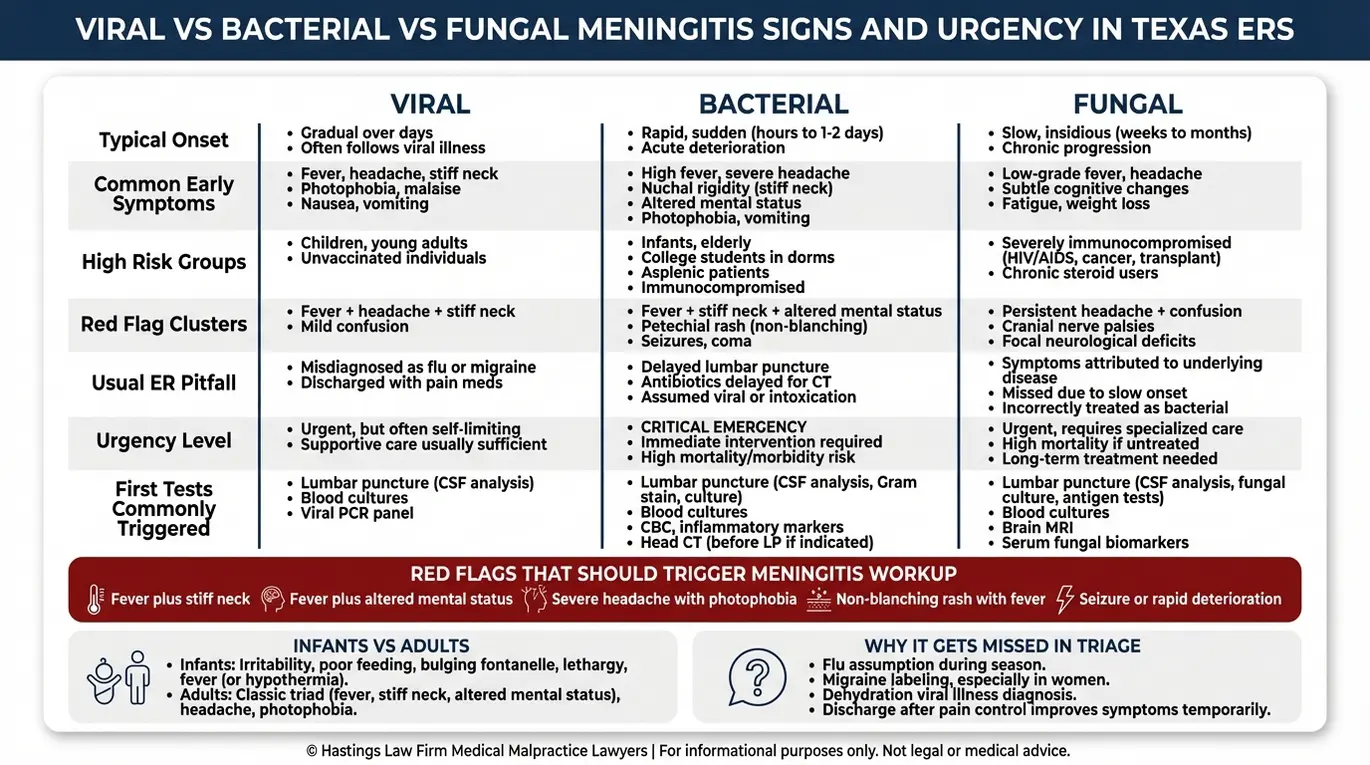
Doctors often miss meningitis by dismissing early symptoms like fever, headache, or neck stiffness as the flu, failing to order necessary diagnostic tests until the infection causes irreversible neurological damage. This pattern of misdiagnosis is especially dangerous with bacterial meningitis, which can become fatal within 24 hours without treatment.
The challenge is that early meningitis symptoms overlap with common illnesses. A patient who arrives at the emergency room with a high fever, body aches, and a headache may be triaged as a routine viral illness and sent home with fluids and rest. Bacterial meningitis, which is an aggressive infection of the membranes surrounding the brain and spinal cord, requires immediate intervention. Viral meningitis, caused by viral pathogens, is generally less severe and often resolves on its own, though it still requires proper evaluation to rule out the bacterial form.
The symptoms differ between age groups, which adds another layer of diagnostic difficulty. In adults, the classic triad of fever, stiff neck, and altered mental status should raise immediate concern.
Infants and young children may not present with neck stiffness at all. Instead, they may show a bulging fontanelle (the soft spot on an infant’s skull), irritability, poor feeding, or a high-pitched cry. When emergency room staff fail to recognize these age-specific presentations, the infection can progress to sepsis, a dangerous whole-body response to infection that can lead to organ failure.
A meningitis malpractice attorney in Texas evaluates whether the treating physician should have recognized these signs earlier and acted on them. The differences in type and urgency matter:
| Feature | Viral Meningitis | Bacterial Meningitis | Fungal Meningitis |
|---|---|---|---|
| Onset | Gradual | Rapid (hours) | Slow (days to weeks) |
| Severity | Usually mild to moderate | Life-threatening | Serious, especially in immunocompromised patients |
| Key Symptoms | Fever, headache, fatigue | High fever, stiff neck, altered mental status, rash | Headache, fever, confusion |
| Urgency | Monitor and supportive care | Immediate antibiotics required | Requires antifungal treatment |
| Population at Highest Risk | Young children, teens | Infants, elderly, college-age adults | Immunocompromised individuals |
When an ER physician treats a patient with bacterial meningitis as though they have a routine viral illness, the delay in treatment can mean the difference between full recovery and permanent harm.
Standard of Care: Required Diagnostic Steps for Meningitis Claims
The standard of care for suspected meningitis typically requires an immediate lumbar puncture (spinal tap) to analyze cerebrospinal fluid (CSF)—the clear liquid surrounding the brain and spinal cord—often preceded by a CT scan to rule out elevated intracranial pressure. This lumbar puncture (spinal tap) is the gold standard for confirming or ruling out meningitis and identifying the type of infection. A CT scan is often performed first to rule out elevated intracranial pressure, which could make a lumbar puncture unsafe.
The timing of each diagnostic step matters enormously. According to research published on the Management of Acute Bacterial Meningitis in Children, delays in diagnosis and antibiotic administration directly correlate with worse outcomes. In practice, the standard of care generally requires the following workup when meningitis is suspected:
- Blood cultures drawn immediately to identify bacteria in the bloodstream
- Broad-spectrum antibiotics started empirically (before lab confirmation) if bacterial meningitis is likely
- CT scan or MRI scan if there are signs of increased intracranial pressure or neurological deficits
- Lumbar puncture performed as soon as safely possible to analyze CSF for infection markers
- Additional labs including complete blood count, inflammatory markers, and metabolic panels
One of the most common failures we examine is the decision to delay antibiotics while waiting for imaging or test results. When a patient presents with high fever, neck stiffness, and altered mental status, the standard of care typically requires starting antibiotics immediately, even before the lumbar puncture is completed. Waiting hours for a CT scan or lab results while a bacterial infection spreads through the central nervous system can constitute a serious breach of the standard of care.
A Texas failure to diagnose meningitis lawyer reviews the medical records to map out the exact timeline: when the patient arrived, when symptoms were documented, when tests were ordered, and when treatment actually began. Under Texas Civil Practice and Remedies Code Chapter 74, medical malpractice claims require proof that the provider deviated from accepted medical standards. That timeline is often the most important piece of evidence.

The Hastings Law Firm Difference
Results matter, but what truly sets us apart is how we achieve them. Every verdict, every settlement, and every Texas courtroom victory comes from one guiding promise: To treat each client’s fight for justice as if it were our own.
This balance of skill, experience, and empathy reflects our core philosophy that justice should not only compensate the injured, but also make health care safer nationwide.

Proving Negligence in Failure to Diagnose Meningitis Cases
Proving negligence requires demonstrating that a competent physician under similar circumstances would have suspected meningitis and ordered testing, and that this failure directly caused the patient’s brain damage or death. This evaluation determines if a medical professional met the legal standard of care required in Texas.
Every medical malpractice claim in Texas is built on four legal elements to establish liability. First, duty: the doctor-patient relationship must exist, which is established when a healthcare provider agrees to evaluate or treat the patient. Second, breach: the provider deviated from the accepted standard of care, such as failing to order a lumbar puncture when symptoms warranted it. Third, causation: the delay or misdiagnosis directly led to the patient’s harm. And fourth, damages: the patient suffered measurable losses, whether physical, financial, or both.
The causation element is often the most contested. Defense attorneys will argue the outcome would have been the same regardless of when treatment started. To counter this, we work with a national network of medical experts and in-house board-certified patient advocates to establish the “time window” argument. We show that earlier antibiotic administration or diagnostic testing would have prevented the progression of the infection.
This requires a detailed medical record review and expert testimony from specialists who can explain what a reasonably competent physician would have done. This might include ordering a blood culture, which is a test to detect germs in the bloodstream, or immediately starting empiric broad-spectrum antibiotics, which are strong medications given before the specific bacteria is identified.
A Texas meningitis misdiagnosis lawyer builds this proof by reconstructing the clinical timeline and identifying every point where the standard of care required action that was not taken. Our in-house medical staff, including nurse consultants, help analyze charting inconsistencies and gaps in documentation that may reveal where the breakdown occurred.
Masking Symptoms with Narcotics in the ER
A pattern we see in these cases involves ER doctors prescribing narcotic analgesics, which are opioid-based painkillers, to patients presenting with severe headaches. While the pain relief may make the patient feel temporarily better, it can mask worsening neurological symptoms like confusion, neck rigidity, or declining consciousness. The patient may then be discharged with a diagnosis of migraine or tension headache, only to return hours later in critical condition.
This type of misdiagnosis raises serious questions about whether the emergency room physician investigated the underlying cause of the headache before treating the symptom. If the medical records show that pain medication was administered without a proper neurological workup, that decision may form the basis of a medical malpractice claim.

Compensation for Victims of Untreated Meningitis in Texas
Patients harmed by untreated meningitis may recover economic damages for lifetime medical care and lost wages, as well as non-economic damages for pain, suffering, and physical impairment, subject to Texas damage caps on non-economic recovery.
The long-term consequences of delayed meningitis treatment can be severe and permanent, particularly for immunocompromised patients. Patients who survive may face:
- Hearing loss (partial or complete) requiring cochlear implants or assistive devices
- Brain damage resulting in cognitive deficits, memory loss, or personality changes
- Seizure disorders requiring lifelong medication management
- Limb amputation caused by sepsis, a life-threatening condition in which the body’s response to infection damages its own tissues and organs
- Wrongful death when the delay proves fatal
For children who survive bacterial meningitis with significant neurological injuries, families may need a Life Care Plan. This is a detailed projection of future medical needs, therapies, adaptive equipment, and support services that the child will require over their lifetime. These plans are developed by medical and vocational experts and are essential for calculating the full scope of economic damages.
Texas law does not cap economic damages such as past and future medical expenses, lost earning capacity, and rehabilitation costs. Demonstrating the true financial burden of the injury is an important part of every case we handle.
Why Choose Hastings Law Firm for Your Meningitis Malpractice Case
Hastings Law Firm specializes exclusively in medical malpractice, using a team of board-certified attorneys and medical experts to secure high-value verdicts for patients harmed by diagnostic errors. Unlike general personal injury firms, every attorney, nurse consultant, and staff member at our firm is dedicated solely to holding negligent healthcare providers accountable.
Our team includes former defense attorneys and hospital nurses who previously worked for the systems we now challenge. This background gives us direct insight into how the other side builds its case and where their strategies are vulnerable. We also use a national network of medical experts, including infectious disease specialists, neurologists, and emergency medicine physicians, to provide objective analysis and testimony.
As a Texas meningitis misdiagnosis lawyer, we use a trial-ready approach for every case we handle. This sends a clear message to defense counsel and insurers that we will not accept less than fair value. Because we work on a contingency fee basis, you pay no attorney fees or costs unless we secure a recovery for you.
Contact the Texas Misdiagnosis Attorneys at Hastings Law Firm Today for Help
Texas law limits the time you have to file a medical malpractice claim. If meningitis was missed or diagnosed too late in you or a loved one, the evidence needed to prove what happened exists in medical records, lab results, and clinical timelines that can become harder to obtain over time.
Hastings Law Firm provides a free medical review of your case to help determine whether negligence occurred. Our in-house medical staff and attorneys will examine the records, identify where the standard of care may have been breached, and explain your options clearly.
You deserve to know what happened, and whether it should have happened at all. Call us or complete our online form to schedule your confidential, no-cost case evaluation. There is no fee unless we win.
Frequently Asked Questions About Meningitis Misdiagnosis in Texas


This content was researched and written by the Hastings Law Firm editorial team, which includes attorneys, medical professionals, and experienced researchers. Our writing is informed by internal knowledge and practical experience, and we cross-check critical details against authoritative sources cited throughout. Every piece undergoes human-led fact-checking and legal review. Because legal and medical information can change, if you spot an error, please contact us. Learn more about our content standards and review process on our editorial policy page.

Gabe Sassin has focused exclusively on medical malpractice law since 2007. After spending more than a decade as a malpractice defense attorney, he knows exactly how the other side works. He has seen firsthand how healthcare providers, insurers, corporate defendants, and their legal teams think, prepare, and build their defense against claims. That knowledge works for the people who need it most today, injured patients and their families. His unique experience shapes everything he writes, giving readers a look at how these cases actually work from someone who has handled them from both sides.
