


Texas Thyroid Cancer Misdiagnosis Lawyer
A delayed or incorrect thyroid cancer diagnosis can lead to more invasive treatment, lasting complications, and deep emotional distress. Diagnostic errors may happen when imaging is misread, a biopsy is not ordered, or pathology results are mishandled, and the harm can grow as time passes. The difference between misdiagnosis, delayed diagnosis, and failure to diagnose often shapes how responsibility is evaluated. If you or a loved one were harmed or worse due to thyroid cancer misdiagnosis in Texas, contact Hastings Law Firm for a free, confidential case review.

Last Updated: July 27, 2026
Trusted Texas Medical Attorneys for Thyroid Cancer Negligence Claims
When a doctor fails to investigate a thyroid nodule, a small growth on the thyroid gland that may or may not contain cancerous cells, the consequences can change the course of your life. A delayed or incorrect diagnosis of thyroid cancer can mean the difference between a minor procedure and aggressive treatment that affects your health for years to come.
If you or a loved one received a late or wrong thyroid cancer diagnosis, you may have grounds for a medical malpractice claim. Tommy Hastings is Board Certified in Personal Injury Trial Law by the Texas Board of Legal Specialization. As a Texas thyroid cancer misdiagnosis lawyer, he and the medical-legal team at Hastings Law Firm focus exclusively on holding negligent providers accountable. Our team includes in-house nurse consultants and former defense attorneys who know how to identify where the standard of care broke down.
We offer a free, confidential case evaluation. Contact us to review what happened and learn about your options.

Thyroid Cancer Misdiagnosis vs Delayed Diagnosis
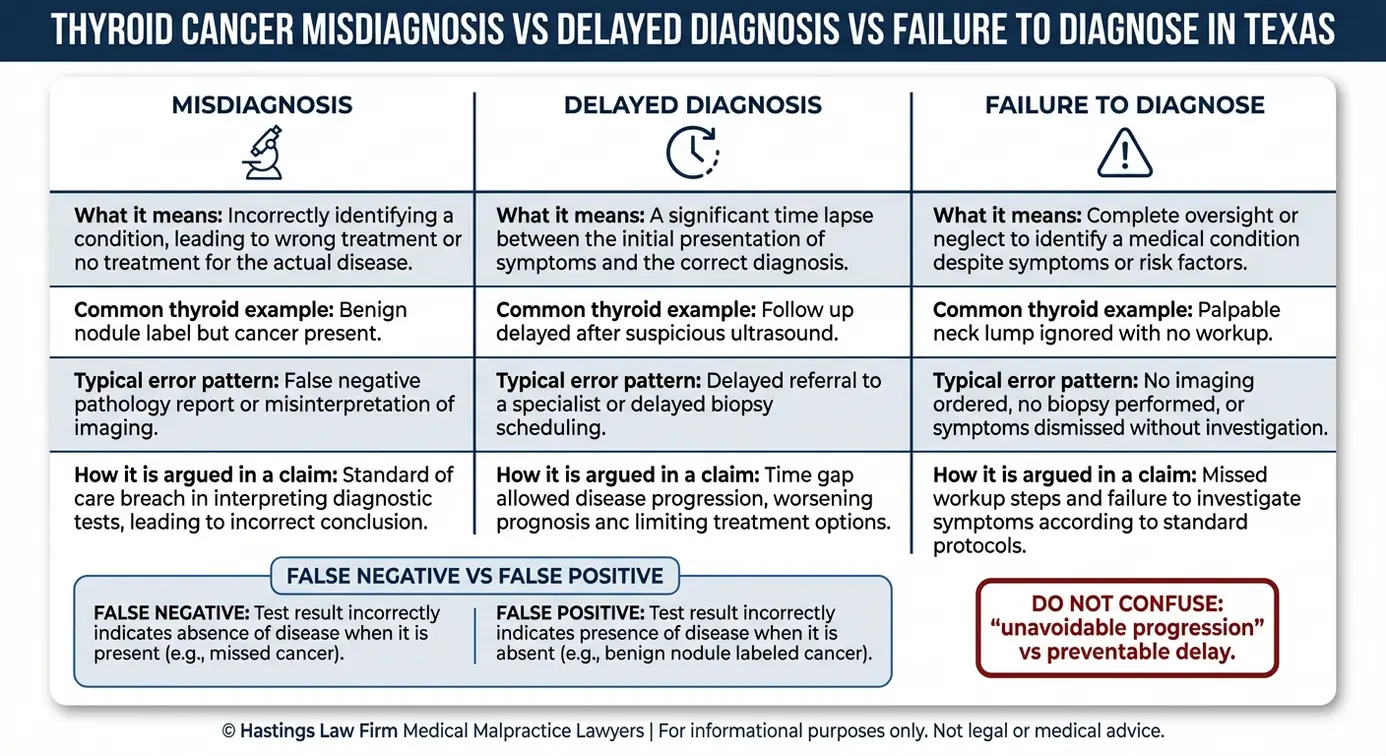
Thyroid cancer misdiagnosis occurs when a doctor incorrectly identifies cancer as a benign condition or a different illness, while delayed diagnosis involves a failure to detect the cancer until it has progressed to a more advanced stage. These legal distinctions help identify how a medical error occurred during the diagnostic process. Both can cause serious harm, but they involve different types of medical errors and different legal theories.
A false negative, a test result that incorrectly shows no cancer is present, is one of the most common forms of misdiagnosis. This can happen when a radiologist reads an ultrasound as benign or when biopsy results are misinterpreted. The patient is told they are fine and sent home while the cancer continues to grow. On the other end, a false positive, a result incorrectly suggesting cancer, can lead to unnecessary surgeries and treatments that carry their own risks.
Many patients sense that something is wrong long before they receive a correct diagnosis. A lump in the neck, difficulty swallowing, or persistent hoarseness may prompt questions that sometimes remain unaddressed. According to Columbia Surgery’s guide to thyroid nodules, most nodules are benign, but certain characteristics require further evaluation. When clinical indicators do not prompt the required workup, patients often defer to their physician’s authority rather than push back. This phenomenon, often called the White Coat Effect, is understandable, but it can cost valuable time.
Failure to diagnose is a related but distinct concept. It applies when a physician does not act on clear signs and symptoms and never initiates the diagnostic process. If a patient presents with a palpable neck mass and the doctor does not order imaging or a biopsy, that may constitute a failure to diagnose.
Texas thyroid cancer misdiagnosis attorneys evaluate which of these categories applies, because each one requires specific evidence to prove.
| Misdiagnosis | Delayed Diagnosis | Failure to Diagnose | |
|---|---|---|---|
| Definition | Cancer is identified as a different or benign condition | Cancer is eventually found, but only after it has advanced | Doctor never initiates workup despite clear signs |
| Common Example | Biopsy read as benign when malignant cells are present | Suspicious nodule monitored too long without biopsy | Palpable neck lump ignored at routine exam |
| Key Evidence | Pathology reports, imaging reviews | Timeline of visits and test delays | Medical records showing no orders for imaging or referral |
Common Causes of Thyroid Cancer Diagnostic Errors
Diagnostic errors often stem from negligence during the initial examination, such as misinterpreting ultrasound imaging, failing to order a Fine Needle Aspiration (FNA) biopsy for suspicious nodules, or mishandling pathology lab results. In cancer cases, identifying a breach in the medical process, or the standard way doctors should act, is a primary goal of our investigation. These breakdowns can occur at multiple points in the diagnostic chain.
A thyroid ultrasound is typically the first step when a nodule is detected. It is a standard diagnostic test used to evaluate the size and characteristics of thyroid nodules. If a physician fails to order an ultrasound when a patient has a palpable lump, or if a radiologist misclassifies the nodule’s features, cancer can go undetected. Research shows that larger nodules carry a higher rate of false negative biopsy results. This makes careful imaging interpretation essential in these cases, as supported by a study on false negative cytology in large thyroid nodules.
When imaging raises concern, the next step is usually a Fine Needle Aspiration (FNA) biopsy. This is a minimally invasive procedure where a thin needle extracts cells from the nodule for laboratory analysis. The 2015 American Thyroid Association Management Guidelines outline clear criteria for when an FNA should be performed based on nodule size and ultrasound characteristics. Failing to follow these guidelines can constitute a breach of the standard of care.
Common red flags our team looks for in thyroid cancer cases include:
- No ultrasound ordered despite a palpable or symptomatic thyroid nodule
- Radiologist error in categorizing a suspicious nodule as low-risk
- FNA biopsy not performed on nodules meeting size or feature thresholds
- Pathology lab misreading or mishandling biopsy specimens
- Breakdown in communication between the lab, the specialist, and the patient
- Follow-up imaging not scheduled after an inconclusive biopsy result
A thyroid cancer malpractice lawyer in Texas will trace the diagnostic timeline to determine exactly where the process failed and which providers bear responsibility.
The Hastings Law Firm Difference
Results matter, but what truly sets us apart is how we achieve them. Every verdict, every settlement, and every Texas courtroom victory comes from one guiding promise: To treat each client’s fight for justice as if it were our own.
This balance of skill, experience, and empathy reflects our core philosophy that justice should not only compensate the injured, but also make health care safer nationwide.

Consequences of Delayed Detection and Invasive Treatment
A delay in diagnosing thyroid cancer can allow the disease to spread to lymph nodes or other organs, often necessitating a total thyroidectomy and radioactive iodine treatment instead of a less invasive partial removal. The causation of damages resulting from this difference in outcomes can be dramatic.
When thyroid cancer is caught at stage I, it is often highly treatable with a localized procedure. But when a diagnosis is delayed, the cancer may undergo cervical lymph node metastasis. This means the cancer cells spread from the thyroid to the lymph nodes in the neck. At that point, treatment typically becomes far more aggressive.
A total thyroidectomy, the complete surgical removal of the thyroid gland, carries significant lifelong consequences. The patient will need daily thyroid hormone replacement medication for the rest of their life. According to a detailed analysis of thyroidectomy and its complications, risks of this surgery include damage to the parathyroid glands and injury to surrounding nerves.
The emotional weight of knowing that a less aggressive path was available, but missed because of a medical error, is real and lasting. Patients often describe feelings of anger, grief, and a deep loss of trust in the medical system.
More Invasive Treatment as Compensable Harm
A patient does not need to have a terminal prognosis to have a valid legal claim. If a timely diagnosis would have allowed for a lobectomy, preservation of partial thyroid function would be possible. If negligence led to a total thyroidectomy instead, that difference in treatment establishes liability for the aggressive surgery.
One of the most serious surgical complications is recurrent laryngeal nerve injury, which is damage to the nerve controlling the vocal cords. This can result in permanent hoarseness or vocal cord paralysis. This risk increases with more extensive surgery. When a patient suffers these outcomes because a doctor failed to act on available evidence, the impact on quality of life can support a malpractice claim.
Proving Negligence in Thyroid Cancer Cases
To prove negligence, the plaintiff must demonstrate that the doctor breached the standard of care by failing to act as a prudent specialist would have under similar circumstances, and that this breach directly caused the patient’s advanced disease or complications. Establishing medical malpractice requires showing the provider deviated from accepted medical protocols. In Texas, this process has specific legal requirements that make experienced legal counsel essential.
Under the Texas Medical Liability Act, every medical malpractice case rests on four elements. In thyroid cancer cases, each one carries unique challenges:
- Duty: The treating physician owed a duty to follow accepted diagnostic protocols. This includes the Bethesda System for Reporting Thyroid Cytopathology, a standardized classification system used to guide treatment decisions for thyroid nodules.
- Breach of Duty: We examine whether the doctor ignored established guidelines for managing thyroid nodules, failed to order appropriate tests, or misinterpreted results.
- Causation: We must prove that the breach was the proximate cause of the specific harm, not just the disease. Proximate cause means the medical error directly led to the specific injury.
- Damages: The patient suffered measurable harm, whether physical, financial, or emotional, as a direct result of the delayed or incorrect diagnosis.
Texas does not recognize “lost chance of survival” as a standalone legal theory. This means a patient cannot sue just because their chances of recovery decreased. Instead, we must establish that the negligence more likely than not caused the need for more aggressive treatment. The Texas A&M University School of Law provides an analysis of *Kramer v. Lewisville Memorial Hospital* regarding these causation challenges.
Our firm prepares every case as if it will go to trial from day one. Proving causation in cancer cases requires qualified expert witnesses and detailed medical record analysis. Our in-house medical staff and national expert network allow us to build this evidence early and thoroughly. For a lawyer for thyroid cancer misdiagnosis, the strength of the medical evidence is everything.

Texas Statute of Limitations for Thyroid Cancer Lawsuits
In Texas, the statute of limitations for medical malpractice is generally two years from the date of the negligent act, though the discovery rule or the course of treatment doctrine may extend this deadline in specific misdiagnosis scenarios. These legal deadlines determine how long a patient has to file a lawsuit. Missing these deadlines can permanently bar your claim.
The two-year clock typically starts on the date the negligent act occurred. In thyroid cancer cases, patients often do not know they were misdiagnosed until months or even years later. This occurs when the cancer is finally identified at a more advanced stage.
The discovery rule may apply in these situations. Under this exception, the limitations period begins when the patient knew or reasonably should have known that an injury occurred. For a cancer misdiagnosis case, that might be the date a second opinion revealed the original diagnosis was wrong.
Even with the discovery rule, Texas imposes an absolute 10-year statute of repose under Texas Civil Practice and Remedies Code Chapter 74. This is a final deadline that applies regardless of when you discovered the injury. The statute states that this deadline applies regardless of minority or other legal disability, making it a firm cutoff for most claims.
Because of these overlapping time limits, contacting a Texas thyroid cancer misdiagnosis lawyer as soon as you suspect an error is a vital step. Early action preserves evidence and gives your legal team the time needed to build a strong case.

Contact the Texas Misdiagnosis Attorneys at Hastings Law Firm Today for Help
Tommy Hastings and the team at Hastings Law Firm have spent nearly two decades holding healthcare providers accountable for diagnostic failures. Tommy Hastings is a 2025 inductee into ABOTA, an invitation-only organization for elite trial lawyers. You should not have to bear the physical, emotional, and financial burden of a doctor’s mistake. If thyroid cancer was missed or diagnosed late, and that delay led to more aggressive treatment or a worse prognosis, you deserve to know whether negligence played a role.
Our medical-legal team, including in-house nurse consultants and former defense attorneys, reviews every detail of your care to determine what went wrong and who is responsible.
There are no upfront costs. We work on a contingency fee basis, meaning you pay no attorney fees unless we recover compensation on your behalf. As a Texas thyroid cancer misdiagnosis lawyer, Tommy Hastings is ready to listen, investigate, and explain your options.
Contact Hastings Law Firm today for a free, confidential case evaluation.
Frequently Asked Questions About Thyroid Cancer Misdiagnosis in Texas


This content was researched and written by the Hastings Law Firm editorial team, which includes attorneys, medical professionals, and experienced researchers. Our writing is informed by internal knowledge and practical experience, and we cross-check critical details against authoritative sources cited throughout. Every piece undergoes human-led fact-checking and legal review. Because legal and medical information can change, if you spot an error, please contact us. Learn more about our content standards and review process on our editorial policy page.

Brady D. Williams is a nationally recognized medical malpractice attorney who has spent his career handling high-stakes litigation for injured patients and families across the country. Licensed in both Texas and California, Brady draws on experience from hundreds of resolved medical cases to break down complex legal and medical topics for the people who need that information most. His writing reflects the same attention to detail and commitment to clarity that he brings to every case he handles.
