


Dallas Medical Misdiagnosis Lawyer
A wrong or delayed diagnosis can take away time, treatment options, and peace of mind. When a condition is missed or mistaken, care may be delayed, the illness may progress, and the outcome can become far more serious. Some diagnostic errors happen because key information is overlooked, tests are misread, or communication breaks down, while others stem from cognitive biases that narrow a clinician’s thinking too soon. If you or a loved one were harmed or worse due to medical misdiagnosis in Dallas, Texas, contact Hastings Law Firm for a free, confidential case review.

Last Updated: July 27, 2026
Trusted Medical Attorneys for Wrong Diagnosis Claims in Dallas
When a doctor gets your diagnosis wrong, the consequences can change the course of your life. A condition that you could have treated early may progress, and treatment options that were once available may no longer be on the table. If you or a loved one has been harmed by a diagnostic error, you are not alone, and your instinct that something went wrong deserves to be taken seriously.
Founded by board-certified trial attorney Tommy Hastings, Hastings Law Firm represents patients and families affected by preventable diagnostic failures. Our team includes former defense lawyers and in-house medical professionals who understand the internal protocols and strategies healthcare systems use to defend these claims. We focus exclusively on medical malpractice litigation to ensure we understand the medicine as well as the law.
If you believe a missed or incorrect diagnosis caused harm, we can review your situation and explain your legal options at no cost.

Understanding Medical Misdiagnosis and Delayed Diagnosis Claims
Medical misdiagnosis occurs when a healthcare provider fails to accurately identify a patient’s condition, leading to incorrect treatment, delayed care, or no treatment at all, and that failure results in harm or allows the disease to progress. Not every wrong answer rises to the level of a legal claim. The distinction between a simple diagnostic mistake and actionable medical negligence depends on whether the doctor’s conduct fell below what a reasonably competent physician would have done in the same circumstances.
Diagnostic errors generally fall into a few categories. A false positive, a scenario where a doctor diagnoses a condition that isn’t actually present, can lead to unnecessary surgery, medication, or emotional distress. In a false negative, a test or evaluation fails to detect a condition that does exist, giving the patient a false sense of security while the real problem worsens. A failure to diagnose means the doctor never identifies the correct condition at all.
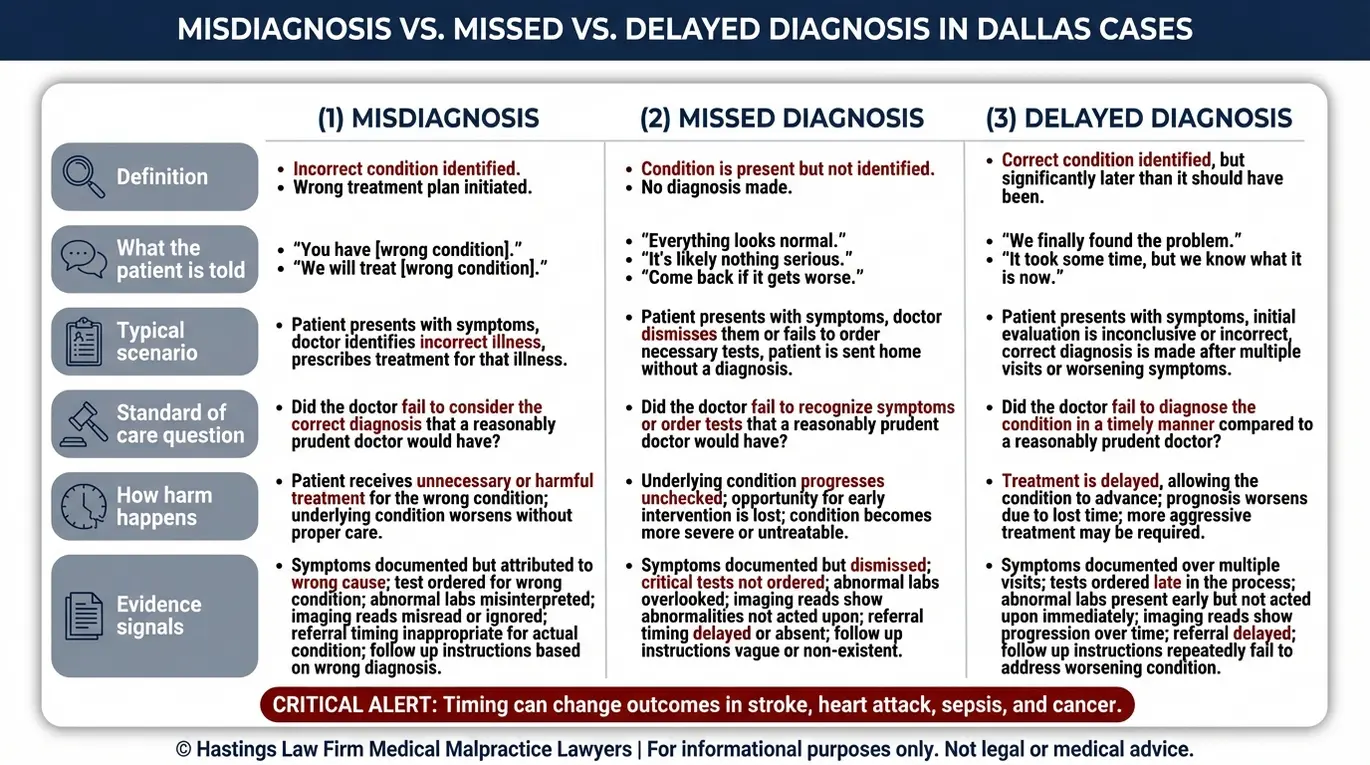
Timing matters enormously in these cases. Conditions like cancer, stroke, and heart attack are highly time-sensitive. A delayed diagnosis, where the correct condition is eventually identified but only after a critical window has passed, can mean the difference between a treatable stage and an irreversible one. A misdiagnosis attorney in Dallas will evaluate not just whether the diagnosis was wrong, but whether the delay or error changed the patient’s outcome.
The table below can help clarify the differences between these categories:
| Type | What Happened | Example | Potential Harm |
|---|---|---|---|
| Misdiagnosis | The doctor identified the wrong condition | Diagnosing a heart attack as acid reflux | Incorrect treatment; real condition untreated |
| Missed Diagnosis | The condition was never identified | Failing to detect cancer on imaging | Disease progresses without any intervention |
| Delayed Diagnosis | The correct diagnosis came too late | Identifying a stroke hours after symptom onset | Lost treatment window; worse long-term outcome |
A wrong diagnosis lawyer can help determine which category applies to your situation and whether the delay or error caused measurable harm.
The Danger of Cognitive Biases in Diagnostic Decisions
Diagnostic errors are not always caused by missing information. Sometimes, the data is right in front of the doctor, but mental shortcuts lead them astray. Cognitive biases are mental shortcuts that can lead a doctor to make the wrong diagnosis. Anchoring bias, a tendency to fixate on an initial impression and interpret all later evidence through that lens, is one of the most common cognitive traps in medicine. A doctor who decides early on that a patient’s chest pain is muscular may unconsciously dismiss test results that suggest a cardiac event.
Premature closure occurs when a healthcare provider stops considering other possibilities once they land on a diagnosis that seems to fit. This can cut the diagnostic workup short before the real condition is uncovered. These cognitive patterns do not necessarily reflect bad intentions, but when they cause a doctor to fall below the standard of care in the doctor-patient relationship, they can form the basis of a negligence claim.
Common Causes of Diagnostic Errors in Texas Healthcare Systems
Diagnostic errors often stem from systemic failures such as rushed exams, miscommunication between departments, contamination or mislabeling of lab samples, or a failure to order the right tests based on the symptoms a patient presents. These systemic failures can happen at any point in the care process, from the initial visit through follow-up in a Texas clinical setting.
Some errors occur within the hospital infrastructure. Lab specimen mislabeling, where a patient’s blood or tissue sample is mixed up or incorrectly tagged, can produce results that lead to a completely wrong conclusion. A radiology interpretation error, where a finding on imaging is missed or misread, may leave a tumor or fracture undetected. Equipment malfunctions and understaffing can compound these problems, particularly in high-volume Dallas hospitals where patient loads put pressure on every link in the chain, sometimes resulting in hospital negligence.
Other errors are cognitive. A doctor may dismiss symptoms that do not fit the initial theory, fail to screen for conditions suggested by a patient’s risk factors, or misread heart attack warning signs as indigestion. According to the National Academies’ report on Improving Diagnosis in Health Care, most people will experience at least one diagnostic error in their lifetime, contributing to significant patient harm nationwide.
Common causes a Dallas diagnostic error attorney may investigate to establish negligence include:
- Failure to order appropriate testing based on reported symptoms
- Misreading or overlooking abnormalities on X-rays, MRIs, or CT scans
- Lab sample contamination or mislabeling
- Miscommunication during shift changes or between specialists
- Dismissing patient-reported symptoms without adequate follow-up
- Inadequate screening for high-risk conditions like cancer or blood clots
A medical malpractice lawyer for misdiagnosis will look at whether any of these failures violated the accepted standard of care and directly contributed to the patient’s harm.
The Hastings Law Firm Difference
Results matter, but what truly sets us apart is how we achieve them. Every verdict, every settlement, and every Dallas courtroom victory comes from one guiding promise: To treat each client’s fight for justice as if it were our own.
This balance of skill, experience, and empathy reflects our core philosophy that justice should not only compensate the injured, but also make health care safer nationwide.

Establishing Liability for a Wrong Diagnosis in Dallas
To sue for misdiagnosis, a patient must prove a doctor-patient relationship existed, the doctor breached the accepted standard of care, and this specific breach directly caused injury or worsened the patient’s medical condition. Each of these elements must be supported by evidence in a medical malpractice case.
The standard of care is the level of treatment that a reasonably competent physician in the same specialty would have provided under similar circumstances. This is not a standard of perfection.
Medicine involves uncertainty, and not every incorrect diagnosis is negligent. The question is whether the doctor’s approach fell below what their peers would consider acceptable. A Dallas medical misdiagnosis lawyer works with qualified medical experts to define this benchmark for each case.
Causation is often the most challenging element to prove. It is not enough to show that the doctor got the diagnosis wrong. You must also demonstrate that the error made a measurable difference in the outcome. If a cancer was misdiagnosed but the same treatment would have been recommended regardless, causation may be difficult to establish. On the other hand, if the delay allowed the disease to advance from a treatable stage to a terminal one, the causal link becomes much clearer.
Many people hesitate to question their doctor’s judgment. Years of conditioning can make patients feel that challenging a medical professional is somehow inappropriate. But suing a doctor for wrong diagnosis is about accountability when the standard of care was not met. Your right to answers is protected by law, and your health information is protected under HIPAA, giving you full access to the records needed to evaluate your claim.
Navigating the Texas Medical Liability Act Requirements
Texas imposes strict pre-suit requirements on medical malpractice claims under Chapter 74 of the Civil Practice and Remedies Code. Chapter 74 sets specific rules for medical malpractice lawsuits in Texas, requiring formal notification of the healthcare provider. Before a case can move forward, the patient must provide written notice to the healthcare provider at least 60 days before filing suit.
An expert report authored by a qualified expert must also be served within 120 days after the defendant files an original answer. This report must identify the standard of care, explain how it was breached, and connect the breach to the patient’s injury. Managing these deadlines requires precision. Failing to meet them can result in dismissal, regardless of how strong the underlying claim may be. Liability for diagnostic errors requires both strong medicine and precise legal execution.

Proving Negligence Using Medical Experts and Evidence
Proving negligence requires objective medical evidence, including patient records and lab results, analyzed by qualified medical expert witnesses who can testify that the treating physician deviated from the standard of care. Without expert support, a misdiagnosis claim in Texas cannot survive.
The investigation process begins with a thorough review of the patient’s medical records. Our in-house medical staff, which includes nurse practitioners and board-certified patient advocates, examines clinical notes, lab orders, imaging studies, and communication logs to build a detailed timeline. This timeline helps identify where the diagnostic process broke down and whether the appropriate differential diagnosis, the structured process doctors use to evaluate competing possible conditions, was followed.
A medical misdiagnosis attorney then works with independent medical expert witnesses to evaluate whether the diagnostic workup, the series of tests and evaluations used to reach a diagnosis, met the standard of care. These experts prepare the formal report required by Texas law and, if necessary, provide expert testimony at trial.
Key evidence our Dallas malpractice law firm gathers and preserves includes:
- Complete medical records from all treating providers
- Imaging studies (X-rays, MRIs, CT scans) and radiology reports
- Laboratory results, pathology slides, and specimen handling logs
- Referral records and specialist consultation notes
- Internal hospital communication and shift-change documentation
- The patient’s own account of symptoms reported and responses received
Hastings Law Firm advances all costs associated with expert consultation, record retrieval, and investigation. You pay nothing unless we recover compensation for you. If you need legal help for wrong diagnosis injuries, this process is designed to remove financial barriers from the start.

Compensation and Damages Available to Misdiagnosis Victims
Victims of misdiagnosis in Texas may recover economic damages for medical bills and lost wages, as well as non-economic damages for pain, suffering, physical impairment, and disfigurement, subject to state caps. The type and amount of compensation available depends on the severity of harm and how significantly the diagnostic error altered the patient’s medical trajectory.
Economic damages cover the financial losses tied directly to the error. These include past and future medical expenses, lost wages from missed work, lost income, reduced earning capacity if the injury limits your ability to earn a living, and the cost of ongoing care or rehabilitation. Economic damages are not capped under Texas law, and they are calculated based on actual, documented financial loss.
Non-economic damages address the personal toll of the injury: pain and suffering, mental anguish, physical impairment, disfigurement, and loss of enjoyment of life. Texas does cap non-economic damages in medical malpractice cases, which limits what can be recovered in this category regardless of how severe the harm may be.
Compensation for misdiagnosis may also account for what is sometimes called loss of chance. If a delayed or wrong diagnosis reduced the patient’s likelihood of a better outcome, that diminished opportunity can factor into the damages analysis. In cases where the misdiagnosis was fatal, surviving family members may pursue wrongful death damages, including loss of companionship, lost financial support, and funeral expenses.
Every damages claim in a misdiagnosis lawsuit is built on documented evidence, which is why early investigation and record preservation are so important.
The Statute of Limitations for Medical Malpractice in Texas
In Texas, the statute of limitations for medical malpractice is generally two years from the date of the negligence, though exceptions exist for cases where the error could not have been immediately discovered. The statute of limitations is the legal deadline for filing a lawsuit. This filing deadline for misdiagnosis claims is strict, and missing it typically means losing the right to pursue your case entirely, no matter how strong the evidence may be.
There is a limited exception known as the discovery rule. If the misdiagnosis or resulting injury could not have been discovered right away, the two-year clock may begin when the patient learned, or reasonably should have learned, about the error. A delayed diagnosis of cancer, for example, may not become apparent until the disease reaches an advanced stage.
However, Texas also enforces a 10-year statute of repose under Texas Civil Practice and Remedies Code, Chapter 74. This is a hard outer deadline. Even if the error was not discoverable within that window, claims filed after 10 years are generally barred. The specific deadlines that apply to your situation are outlined in Texas Civil Practice and Remedies Code § 74.251, and an attorney can help you determine exactly where you stand.
Contact the Dallas Misdiagnosis Attorneys at Hastings Law Firm Today for Help
A misdiagnosis can take away time, treatment options, and peace of mind. A legal consultation helps you understand if medical negligence caused your injury. When a condition that could have been caught early is allowed to progress, families are left dealing with consequences that may have been entirely preventable. You deserve to know what happened and whether the care you received met the standard it should have.
Hastings Law Firm is dedicated exclusively to medical malpractice. Our team of trial attorneys, former defense counsel, and in-house medical professionals handles these cases every day. We understand how diagnostic failures happen, and we know how to build the evidence needed to hold the responsible parties accountable.
If you or a loved one was harmed by a diagnostic error in Dallas, contact us for a free, confidential case evaluation. There is no fee unless we recover compensation for you.
Frequently Asked Questions About Medical Misdiagnosis in Dallas


This content was researched and written by the Hastings Law Firm editorial team, which includes attorneys, medical professionals, and experienced researchers. Our writing is informed by internal knowledge and practical experience, and we cross-check critical details against authoritative sources cited throughout. Every piece undergoes human-led fact-checking and legal review. Because legal and medical information can change, if you spot an error, please contact us. Learn more about our content standards and review process on our editorial policy page.

Tommy Hastings, founder of Hastings Law Firm, is a board-certified personal injury trial lawyer dedicated exclusively to healthcare injury cases. Since 2001, he has represented injured patients and families in litigation against major hospital systems, pharmaceutical companies, and negligent healthcare providers nationwide. He has handled numerous high-profile cases that have drawn national media attention and resulted in multi-million dollar recoveries. He draws on that experience in his writing, helping readers understand how these cases work and what options may be available to them.
