


Texas Kidney Cancer Misdiagnosis Lawyer
A kidney cancer misdiagnosis or delayed diagnosis can lead to more aggressive treatment, higher costs, and a worsened prognosis after warning signs were missed or test results were not followed up. These cases often turn on whether the standard of care was met in ordering imaging, reviewing labs, and communicating incidental findings across providers. Accountability may involve more than one clinician or facility when breakdowns occur in reading scans or tracking results. If you or a loved one were harmed or worse due to kidney cancer misdiagnosis in Texas, contact Hastings Law Firm for a free, confidential case review.

Last Updated: July 27, 2026
Trusted Texas Medical Attorneys for Kidney Cancer Misdiagnosis Claims
A kidney cancer diagnosis can change everything. When that diagnosis comes late, after months or years of dismissed symptoms and missed test results, the emotional weight is even heavier. You trusted your doctor to listen, investigate, and act. If that trust was broken, you deserve to know whether what happened qualifies as medical malpractice.
At Hastings Law Firm, we focus exclusively on medical negligence cases. Our team includes in-house nurse consultants, former defense attorneys, and board-certified trial lawyers who understand both the medicine and the law behind these claims. As a Texas kidney cancer misdiagnosis lawyer, Tommy Hastings and his team have the experience to evaluate your situation, identify where the standard of care may have been violated, and hold the responsible parties accountable.
If you believe your kidney cancer was missed or diagnosed too late, contact us for a free, confidential case evaluation. You pay nothing unless we recover for you.

Proving Negligence in Kidney Cancer Detection
To prove negligence in a kidney cancer case, we must show that a doctor deviated from the accepted standard of care by failing to order appropriate tests, such as CT scans or ultrasounds, despite symptoms like hematuria or flank pain. Negligence occurs when a healthcare provider fails to act as a competent peer would in the same situation.
The standard of care is the level of treatment a reasonably competent physician would provide under similar circumstances. For a patient presenting with blood in the urine, that standard typically includes diagnostic imaging and follow-up testing. When a doctor ignores those steps, it can constitute a breach of duty, meaning they failed to meet their professional obligation to the patient.
According to the Microhematuria AUA/SUFU Guideline, even microhematuria, which is the presence of blood in the urine visible only under a microscope, warrants a thorough workup that may include a contrast-enhanced CT (also called a renal protocol CT, a specialized scan designed to detect kidney masses). Skipping or delaying that workup when risk factors are present can allow a tumor to grow undetected.
Expert testimony is central to proving a failure to diagnose kidney cancer. A qualified medical expert reviews the patient’s medical records, test results, and imaging history to determine what a prudent doctor should have done and when. Their opinion establishes whether the standard of care was met or violated.
The financial toll of a delayed cancer diagnosis can be severe. According to the Cancer Trends Progress Report on the Economic Burden of Cancer Care, cancer-related medical costs continue to rise, and a later-stage diagnosis often means more aggressive and expensive treatment.
Missed Red Flags We Look For:
- Blood in the urine (hematuria) dismissed as a urinary tract infection without further testing
- Persistent flank or lower back pain attributed to a muscle strain with no imaging ordered
- Abnormal lab results or urinalysis findings that were not followed up on
- Incidental findings on spinal or abdominal imaging that were not reported or investigated
- Unexplained weight loss or fatigue ignored during routine visits

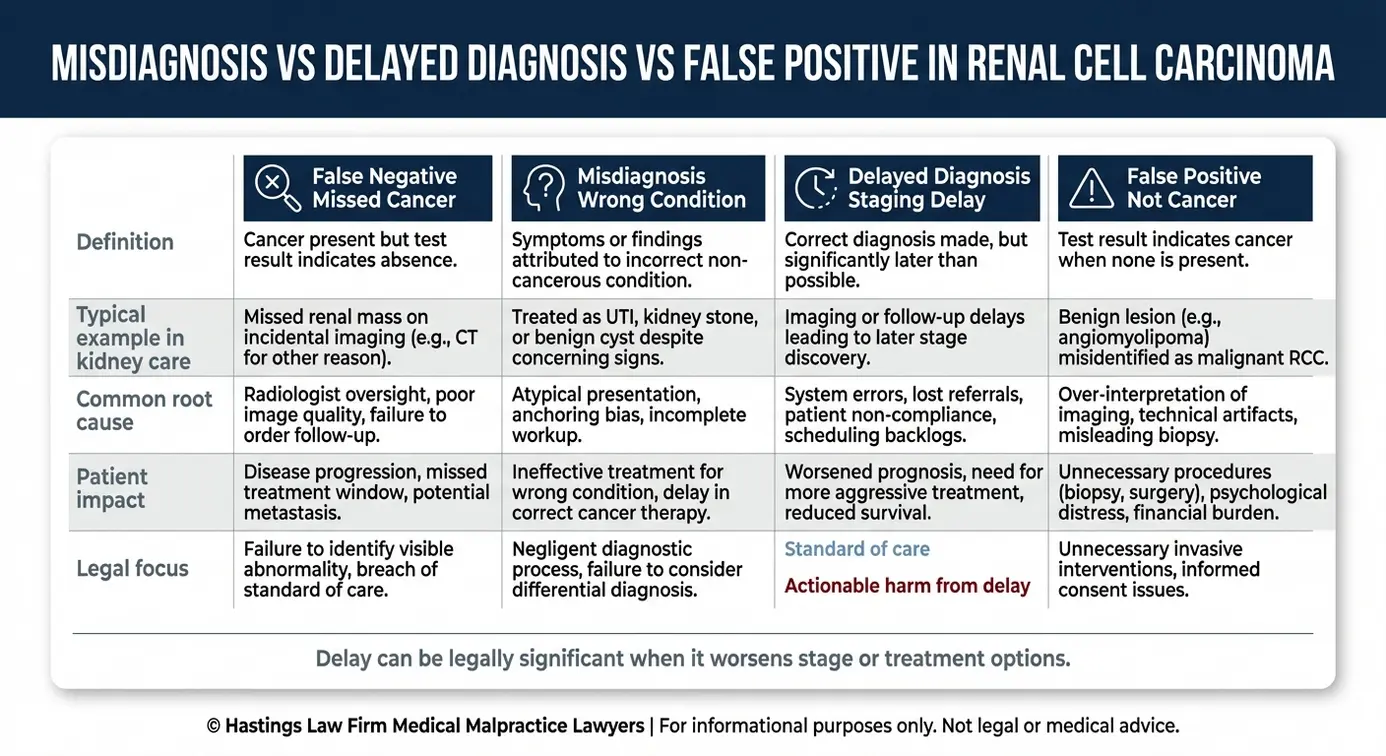
Misdiagnosis vs. Delayed Diagnosis of Renal Cell Carcinoma
Cancer misdiagnosis and delayed diagnosis are related but legally distinct. Renal cell carcinoma is the primary form of kidney cancer and requires prompt identification to improve treatment success. A misdiagnosis occurs when a condition is identified incorrectly, such as labeling a kidney tumor as a benign cyst.
A delayed diagnosis happens when a doctor fails to detect the cancer at all until it has progressed to a later, less treatable stage. Renal cell carcinoma (RCC), the most common type of kidney cancer in adults, is often curable when caught early.
According to Cancer Stat Facts from the National Cancer Institute’s SEER Program, the five-year survival rate for localized kidney cancer is significantly higher than for cancer that has spread to distant organs. Kidney cancer staging, which ranges from Stage I (confined to the kidney) through Stage IV (spread to distant sites), directly affects treatment options and outcomes.
In a delayed kidney cancer diagnosis case, the legal harm is the gap between when the cancer should have been found and when it actually was. If that gap allowed the disease to advance from a treatable stage to a more dangerous one, it may form the basis of a failure to diagnose claim. A misdiagnosis attorney in Texas will evaluate whether a correct and timely diagnosis would have led to a better outcome.
| Diagnostic Error Type | What Happened | Legal Significance |
|---|---|---|
| False Negative (Missed Entirely) | Cancer was present but not detected on imaging or testing | The delay allowed the tumor to grow or spread |
| False Positive (Wrong Diagnosis) | Patient was told they had cancer when they did not | Unnecessary treatment, emotional distress, and medical costs |
| Staging Delay | Cancer was eventually found, but at a more advanced stage | Patient lost access to less invasive, more effective treatment |
The Hastings Law Firm Difference
Results matter, but what truly sets us apart is how we achieve them. Every verdict, every settlement, and every Texas courtroom victory comes from one guiding promise: To treat each client’s fight for justice as if it were our own.
This balance of skill, experience, and empathy reflects our core philosophy that justice should not only compensate the injured, but also make health care safer nationwide.

Liability: Who Is Responsible for Missed Kidney Tumors?
Liability in a kidney cancer misdiagnosis case—and proving causation and proximate cause—often extends beyond the primary care physician. Liability refers to the legal responsibility of a party for the harm caused to a patient.
Radiologists who misread imaging scans and oncologists may be liable. Responsibility can also fall on urologists who failed to perform a renal biopsy (a procedure where tissue is removed from the kidney for analysis) or hospital systems that lost lab results.
One common scenario involves incidental findings, which are abnormalities found on imaging ordered for an unrelated reason. For example, a suspicious mass on the kidney may appear on a spine MRI, but if the radiologist does not flag it in the report, the referring doctor may never know it exists. According to a landmark report on diagnostic errors from the Institute of Medicine, highlighted by Stanford University, communication breakdowns between providers are a leading cause of missed or delayed diagnoses.
A primary care physician who dismisses symptoms without referring the patient to a urologist may also face liability. And when systemic causes, such as lost test results or fragmented electronic records, contribute to the delay, the facility itself can be held accountable. A Texas malpractice lawyer from our team investigates every link in the chain to determine where the breakdown occurred.
The Challenge of Causation in Texas
Proving liability alone is not enough. Proximate cause is the legal link showing that the error directly resulted in the patient’s injury. Texas law requires that the negligence more likely than not caused the injury, meaning the delayed diagnosis must have worsened the patient’s prognosis, or expected medical outcome.
This is different from a “lost chance of survival” theory regarding survival rate, which some states recognize but Texas generally does not. We work with oncology experts to evaluate whether the delay allowed metastasis, the spread of cancer from the kidney to other parts of the body, resulting in a worsened prognosis. If the evidence shows that earlier detection would have led to a better outcome, proximate cause can be established.
Damages: Compensation for Worsened Prognosis
Patients harmed by a delayed or missed kidney cancer diagnosis can recover compensation based on the difference in their prognosis, including the cost of more aggressive treatment, lost wages, and the physical and emotional toll of a worsened outcome. Damages represent the financial and personal losses a family suffers due to medical negligence.
Damages in a kidney cancer lawsuit settlement fall into two categories:
- Economic damages: Past and future medical expenses (including chemotherapy, radiation, and surgery that could have been avoided), lost income, and reduced earning capacity. These are not capped under Texas law and often represent the largest portion of the recovery.
- Non-economic damages: Physical pain, mental anguish, disfigurement, and loss of consortium (the impact on the relationship with a spouse or family).
If the misdiagnosis resulted in a patient’s death, the family may pursue a wrongful death claim. A survival claim can also be filed on behalf of the deceased patient’s estate for pain and suffering experienced before death. Each type of claim carries different elements, and our team evaluates which path offers the most complete recovery for your family.
Texas Laws & Deadlines for Kidney Cancer Lawsuits
Under the Texas Medical Liability Act, you generally have two years from the date of the negligent act to file a medical malpractice lawsuit. A statute of limitations is the legal deadline for filing a lawsuit. In cancer cases, the “discovery rule” may adjust this timeline because patients often do not learn about the misdiagnosis until months or years later.
According to Texas Civil Practice and Remedies Code § 74.251, the two-year statute of limitations begins when the patient knew or should have known about the injury. But Texas also enforces a strict 10-year statute of repose, which bars claims filed more than 10 years after the negligent act regardless of when the error was discovered.
There is another critical requirement under Texas Civil Practice and Remedies Code, Chapter 74. Within 120 days after the date each defendant’s original answer is filed, your attorney must serve an expert report from a qualified physician. This report must identify the standard of care, explain how it was breached, and connect that breach to the injury. Failing to meet this deadline can result in dismissal of the case.

Contact the Texas Misdiagnosis Attorneys at Hastings Law Firm Today for Help
A delayed kidney cancer diagnosis steals something that can never be recovered: time. A legal consultation helps you understand if you have a viable claim for medical malpractice. Time for earlier treatment, less invasive options, and a better chance at a full life. If your cancer was missed or misdiagnosed, you have a right to find out what went wrong.
At Hastings Law Firm, we prepare every case for trial from day one. Our medical-legal team, including in-house nurses, former defense attorneys, and a national network of oncology experts, investigates every detail of your care. As your Texas kidney cancer misdiagnosis lawyer, we handle the medical details so you can focus on your health.
Our consultations are free and confidential, and we work on a contingency fee basis, meaning you pay no attorney fees unless we win your case. Contact our medical negligence attorneys today for a risk-free case evaluation.
Frequently Asked Questions About Kidney Cancer Misdiagnosis in Texas


This content was researched and written by the Hastings Law Firm editorial team, which includes attorneys, medical professionals, and experienced researchers. Our writing is informed by internal knowledge and practical experience, and we cross-check critical details against authoritative sources cited throughout. Every piece undergoes human-led fact-checking and legal review. Because legal and medical information can change, if you spot an error, please contact us. Learn more about our content standards and review process on our editorial policy page.

Brady D. Williams is a nationally recognized medical malpractice attorney who has spent his career handling high-stakes litigation for injured patients and families across the country. Licensed in both Texas and California, Brady draws on experience from hundreds of resolved medical cases to break down complex legal and medical topics for the people who need that information most. His writing reflects the same attention to detail and commitment to clarity that he brings to every case he handles.
