


Austin Retained Medical Objects Lawyer
A retained surgical item can leave a patient facing pain, infection, and a long recovery after what should have been a routine procedure. These events are widely viewed as preventable breakdowns in operating room safety, often tied to failed counting practices, communication problems, or rushed conditions. A retained object can migrate, trigger inflammatory reactions, and lead to serious complications that sometimes require additional surgery and extended treatment. If you or a loved one were harmed or worse due to retained surgical items in Austin, Texas, contact Hastings Law Firm for a free, confidential case review.

Last Updated: July 27, 2026
Trusted Austin Medical Lawyers for Claims Involving Surgical Items Left Inside the Body
Learning that a surgical item was left inside your body can feel like a profound betrayal of trust. You went into a procedure expecting safe, professional care, and now you are dealing with pain, confusion, and questions that deserve real answers.
At Hastings Law Firm, we focus exclusively on medical malpractice. Our team includes in-house nurses, former defense attorneys, and board-certified trial advocates who understand both the medical and legal sides of retained surgical object cases. We know how to identify what went wrong, who is responsible, and what your claim may be worth.
If you or a loved one is dealing with complications from a retained foreign object after surgery in Austin, an Austin retained medical objects lawyer at our firm can review what happened and explain your options. The consultation is free, and you pay nothing unless we recover for you.

Common Types of Retained Surgical Objects in Austin Hospitals
A retained surgical object is any foreign material, such as a sponge, needle, or instrument, left inside a patient’s body after a procedure, often resulting in severe infection or organ damage. These items can take weeks or even months to diagnose.
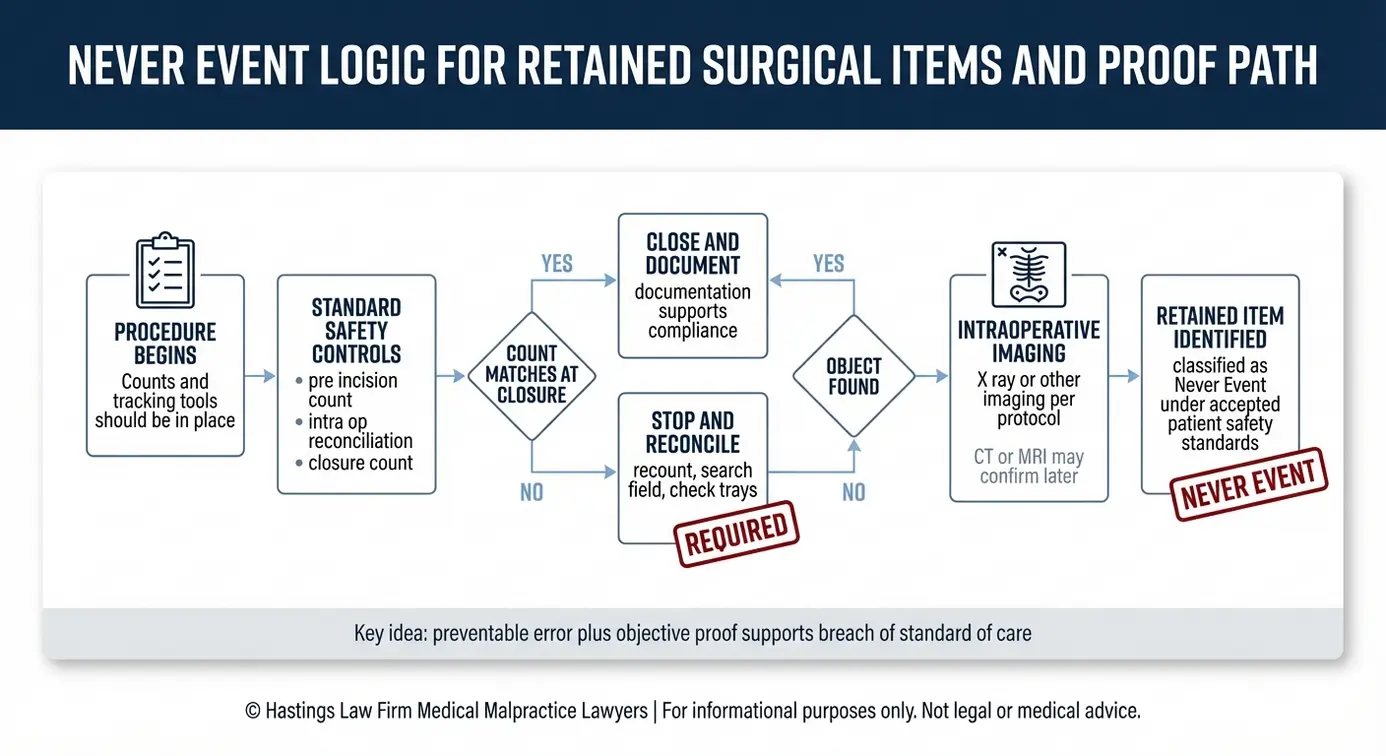
Every operating room follows what is known as a surgical count protocol, a standardized process where nurses count all sponges, instruments, and sharps before, during, and after surgery. The count is designed to confirm that nothing is left behind before the incision is closed. But these counts fail more often than most people realize. Human error, staff fatigue, emergency situations, and poor communication between team members all contribute to miscounts.
A study published in PubMed Central on retained surgical foreign bodies in Texas Medicare beneficiaries confirms that these incidents continue to occur at measurable rates, even with modern safety protocols in place.
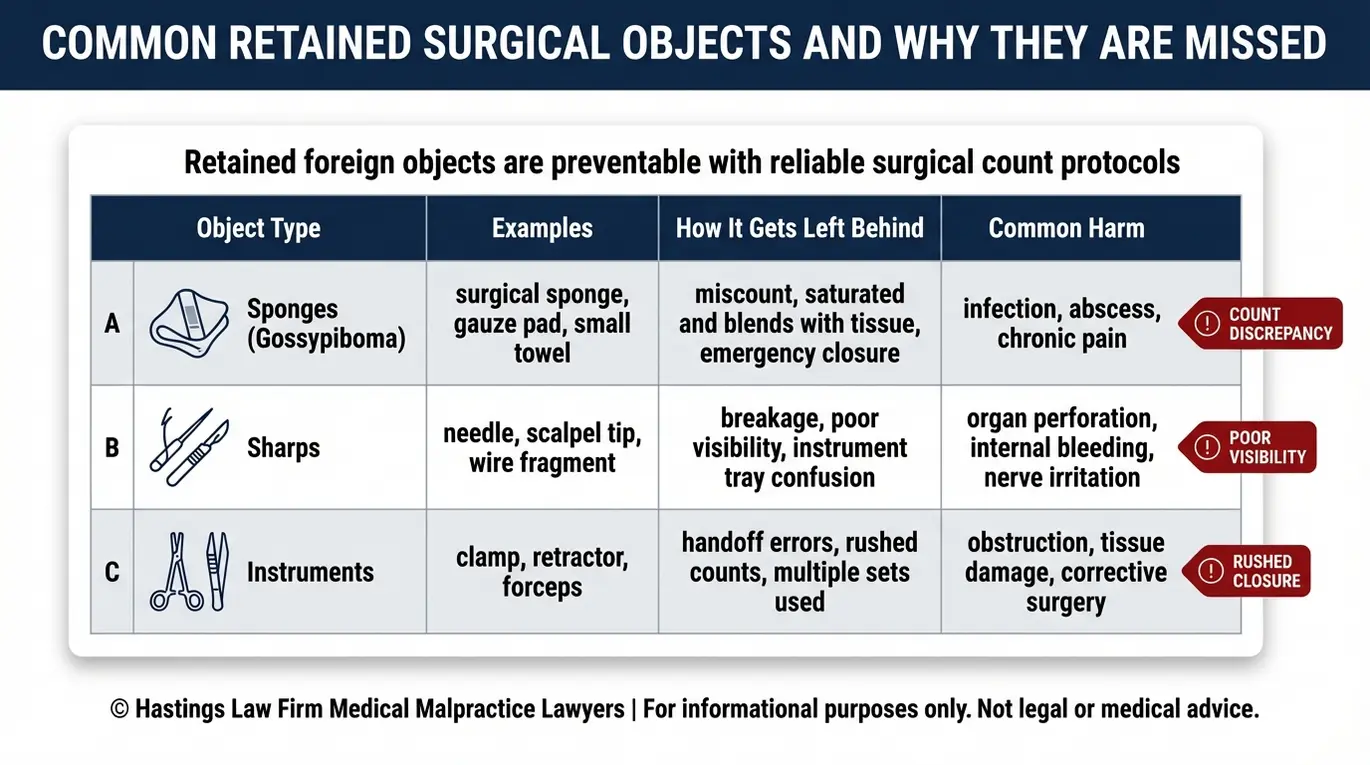
When a retained surgical item, or RSI, is left behind, it can migrate within the body and cause damage far from the original incision site. The most common types of retained surgical items, including towels, are:
- Gossypiboma (retained surgical sponges): This is the most frequently reported RSI. Surgical sponges and gauze pads can absorb fluid, swell, and become encased in tissue, making them difficult to detect without imaging.
- Sharps: Broken needles, scalpel tips, and bits of wire can lodge in tissue and cause internal bleeding or nerve damage.
- Instruments: Clamps, retractors, and forceps are occasionally left inside the surgical cavity, particularly during long or complex procedures.
These are not rare, isolated events. They are recognized failures of the standard of care, and when they happen, they often form the basis of a strong medical malpractice claim. If you suspect foreign objects left after surgery, speaking with a lawyer for retained objects or an Austin surgical error attorney can help you understand your next steps.
Health Consequences and Symptoms of Retained Foreign Objects
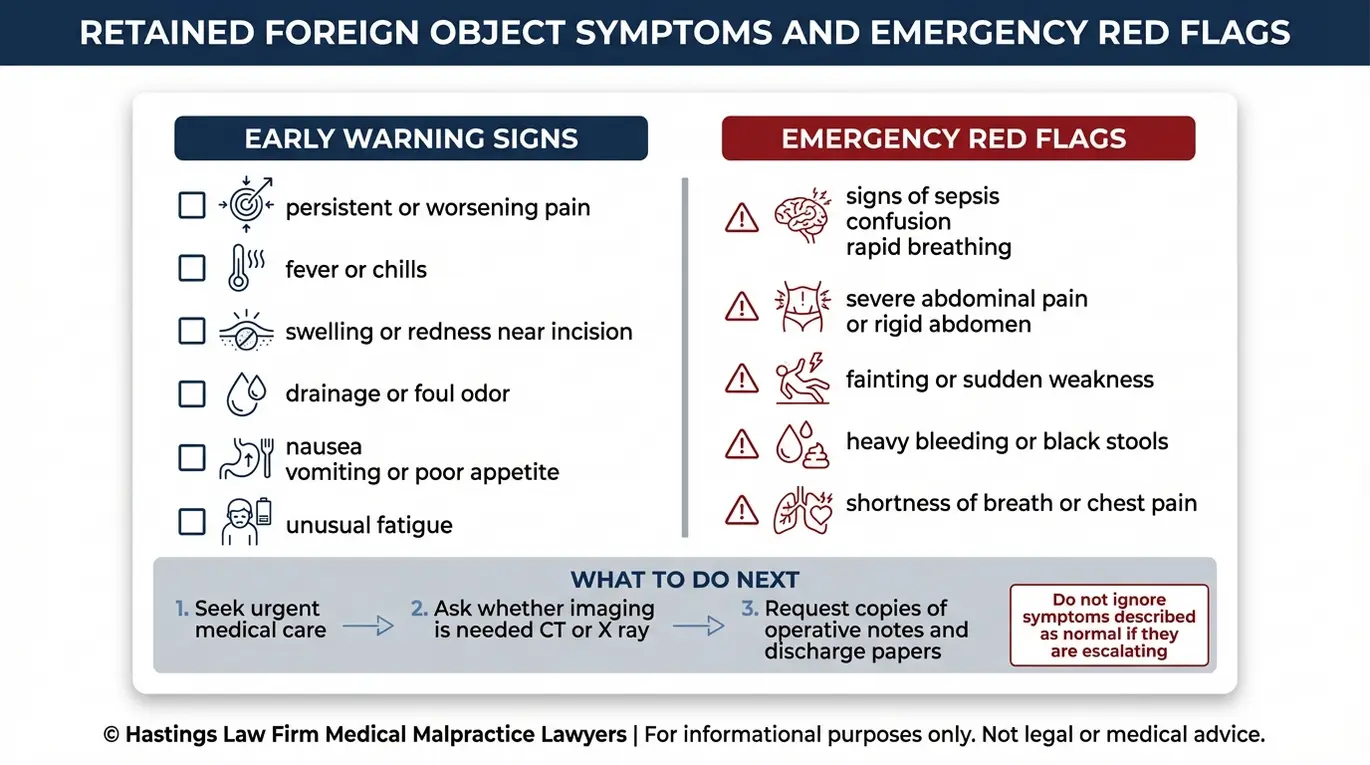
Symptoms of a retained foreign object include unexplained pain, fever, swelling at the incision site, and digestive issues, often leading to sepsis or organ perforation if not treated immediately. A retained foreign object can cause severe internal reactions and long-term health complications.
When a surgical item is left inside the body, the immune system treats it as a threat. This triggers what is known as a foreign body reaction, an inflammatory response where the body attempts to wall off or attack the object. Common symptoms of surgical errors include persistent inflammation and pain. Over time, bacteria can form a protective layer called a biofilm on the surface of the retained item, making the resulting infection resistant to antibiotics and extremely difficult to treat.
The table below outlines what patients commonly experience:
| Early Warning Signs | Severe Complications |
|---|---|
| Persistent fever | Sepsis (life-threatening infection) |
| Swelling or redness near the incision | Bowel obstruction |
| Oozing or drainage from the wound | Organ perforation |
| Unexplained abdominal or pelvic pain | Internal bleeding |
| Nausea or digestive problems | Death (in extreme cases) |
Many patients require one or more corrective surgeries to remove the retained object and repair surrounding tissue damage. Each additional procedure adds recovery time, medical costs, and physical risk. If you are experiencing these symptoms after a surgery in Austin, a medical malpractice lawyer in Austin can help connect the timeline of your injury to the procedure. An attorney can help you seek justice for an injury from retained objects.
The Hastings Law Firm Difference
Results matter, but what truly sets us apart is how we achieve them. Every verdict, every settlement, and every Austin courtroom victory comes from one guiding promise: To treat each client’s fight for justice as if it were our own.
This balance of skill, experience, and empathy reflects our core philosophy that justice should not only compensate the injured, but also make health care safer nationwide.

Liability for Retained Foreign Objects in Texas Healthcare
Liability for a retained object typically falls on the lead surgeon, the surgical nurses responsible for counts, and the hospital facility itself for failing to enforce safety protocols. Determining liability for surgical errors often reveals that more than one party shares responsibility.
The Surgeon. Under what is sometimes called the “Captain of the Ship” doctrine, the lead surgeon holds ultimate responsibility for the patient’s safety in the operating room. This includes confirming that the surgical count protocol, the process of counting all sponges, instruments, and sharps before closing, was properly completed.
The Nursing Staff. Surgical nurses are specifically tasked with performing and verifying counts throughout the procedure. A count discrepancy, meaning the final count does not match the starting count, should trigger an immediate search and imaging before the incision is closed. When that step is skipped or mishandled, the nursing team may bear direct liability.
The Hospital. Hospitals have a duty to maintain safe systems to avoid hospital negligence. Inadequate staffing, rushed surgical schedules, and failure to enforce count reconciliation policies can all contribute to a retained object event. Under Texas Civil Practice and Remedies Code § 74.051, patients must provide written notice before filing a healthcare liability claim. When suing a hospital in Austin, our firm handles this process from the start.
In Texas, retained surgical items are often among the most clear-cut forms of negligence. The object either should have been removed, or it should not have been left behind. That clarity is something our retained medical object attorney uses to build a strong foundation for your case.
Why Retained Surgical Items Are Classified as Never Events
Retained surgical items are classified as “Never Events” by the National Quality Forum because they are preventable errors that should never occur under proper medical management, indicating gross negligence. These events are considered entirely preventable when standard safety protocols are followed.
A Never Event, a serious, clearly identifiable, and preventable medical error, indicates that safety protocols were ignored. Leaving a sponge, needle, or instrument inside a patient meets all three criteria. According to the Agency for Healthcare Research and Quality (AHRQ) PSNet primer on retained surgical items, these events persist despite decades of established prevention protocols.
For patients pursuing legal help for never events, the classification helps establish a breach of the standard of care more directly than many other types of malpractice claims. Consulting a gross negligence attorney is important in these situations.
To confirm that a retained object is present, doctors use diagnostic imaging tools such as CT scans, X-rays, MRIs, and ultrasound. Many surgical sponges and gauze pads are manufactured with a radiopaque marker, a small strip visible on imaging, specifically so they can be detected if left behind. When an Austin retained medical objects lawyer brings never event lawsuits, this imaging evidence often becomes a central piece of proof.
Impact of CMS Never Event Designations on Payment
The Centers for Medicare & Medicaid Services, commonly known as CMS, classifies retained surgical items as a hospital-acquired condition, or HAC. CMS is the federal agency that oversees national healthcare programs. Under rules established by the CMS Deficit Reduction Act HAC Measures program, Medicare can refuse to reimburse hospitals for costs associated with treating conditions that result from failures in hospital protocols.
This policy is significant because it means the healthcare industry itself has formally acknowledged that these errors are unacceptable. When a hospital cannot bill a federal insurer for the consequences of its own mistake, it undercuts any argument that the retained object was an unavoidable complication. For patients pursuing legal help, this CMS designation strengthens the case that the standard of care was violated.
Recovering Compensation for Retained Object Injuries
Victims of retained object injuries can recover compensation for corrective surgery costs, lost wages, pain and suffering, and in severe cases, punitive damages for gross negligence. Legal compensation provides financial relief for both tangible and intangible losses caused by surgical errors.
Under Texas Civil Practice and Remedies Code, Chapter 74, medical malpractice damages fall into distinct categories:
- Economic damages: These cover measurable financial losses, including medical bills for corrective surgeries, hospitalization, diagnostic tests, medications, lost wages, and loss of future earning capacity.
- Non-economic damages: These account for the human cost of the injury, including physical pain and suffering, mental anguish, loss of enjoyment of life, and the erosion of trust in medical care. Texas law does cap non-economic damages in certain healthcare liability claims.
- Punitive damages: In cases involving especially reckless conduct, such as a surgical team that ignored a known count discrepancy and closed the patient anyway, a court may award punitive damages to deter similar behavior.
Every case is different, and the value of a medical malpractice settlement depends on factors like the severity of infection, the number of additional procedures required, and how the injury has affected your ability to work and live. Our economic damages lawyer works with medical and financial experts to document the full scope of harm. We can help you secure a fair Austin injury settlement and proper compensation for surgical errors.
Contact the Austin Surgical Error Attorneys at Hastings Law Firm Today for Help
A retained surgical object is not a complication. It is a preventable failure, one that the medical community itself classifies as something that should never happen. If you are living with the consequences of that failure, you deserve answers and a legal team that knows how to get them.
Hastings Law Firm treats every retained object case as if it is going to trial. Our team includes board-certified trial advocates, in-house medical professionals, and former defense attorneys who understand exactly how hospitals and insurers respond to these claims. Tommy Hastings, our founder, is a board-certified trial lawyer with over two decades of experience handling medical negligence cases.
We operate on a contingency fee basis, which means you pay no attorney fees or costs unless we secure a recovery for you. There is no financial risk in reaching out.
If you or a loved one has been harmed by a retained surgical item in Austin, contact our team for a free, confidential case evaluation. Let us review your records, identify what went wrong, and explain what options are available to you.
Frequently Asked Questions About Retained Medical Objects in Austin


This content was researched and written by the Hastings Law Firm editorial team, which includes attorneys, medical professionals, and experienced researchers. Our writing is informed by internal knowledge and practical experience, and we cross-check critical details against authoritative sources cited throughout. Every piece undergoes human-led fact-checking and legal review. Because legal and medical information can change, if you spot an error, please contact us. Learn more about our content standards and review process on our editorial policy page.

Gabe Sassin has focused exclusively on medical malpractice law since 2007. After spending more than a decade as a malpractice defense attorney, he knows exactly how the other side works. He has seen firsthand how healthcare providers, insurers, corporate defendants, and their legal teams think, prepare, and build their defense against claims. That knowledge works for the people who need it most today, injured patients and their families. His unique experience shapes everything he writes, giving readers a look at how these cases actually work from someone who has handled them from both sides.
