


Austin Prostate Surgery Error Lawyer
Prostate surgery errors can leave patients facing sudden complications, prolonged recovery, and lasting changes in urinary or sexual function. Robotic assisted procedures using the Da Vinci system add unique risks tied to limited tactile feedback, equipment problems, and the need for proper training and oversight. Some injuries can be life threatening when internal damage or infection is not recognized quickly. Understanding the difference between an accepted surgical risk and negligent care often turns on what happened in the operating room and how the hospital managed robotic privileges. If you or a loved one were harmed or worse due to a prostate surgery error in Austin, Texas, contact Hastings Law Firm for a free, confidential case review.

Last Updated: July 27, 2026
Trusted Austin Medical Attorneys for Negligent Urological Procedures
When a prostate surgery results in unexpected harm, the physical and emotional toll can be overwhelming. You may be dealing with complications that were never explained, recovery milestones that never came, or a quality of life that has drastically changed. These are not outcomes you should have to accept without question.
At Hastings Law Firm, we focus exclusively on medical malpractice. Our team includes in-house nurse practitioners and former defense attorneys who understand how hospitals operate from the inside. As an experienced Austin prostate surgery error lawyer team, we investigate what happened in the operating room, identify where the standard of care may have been breached, and build cases designed for trial from day one.
If you or a loved one experienced a serious complication during or after a prostate procedure, we are here to listen. Contact us for a free, confidential case evaluation to understand your options.

Understanding Prostate Surgery Risks and Da Vinci Robotics
Prostate surgery errors often stem from surgeon inexperience with the Da Vinci Surgical Robot, mechanical malfunctions, or a failure to convert to traditional open methods when complications arise. Understanding how these systems work, and where they can fail, is essential to recognizing whether your injury was an accepted surgical risk or the result of negligence.
A radical prostatectomy, the surgical removal of the prostate gland, is one of the most common treatments for prostate cancer. Many of these procedures are now performed as robotic-assisted laparoscopic prostatectomies (RALP), where the surgeon sits at a console and controls robotic arms that hold the surgical instruments.
The procedure is marketed as minimally-invasive, with promises of smaller incisions and faster recovery compared to traditional laparoscopic techniques. Laparoscopic surgery involves using small cameras and tools through tiny cuts in the skin. While these methods are common, they require specific training to ensure patient safety.
Mechanics of the Da Vinci Surgical System
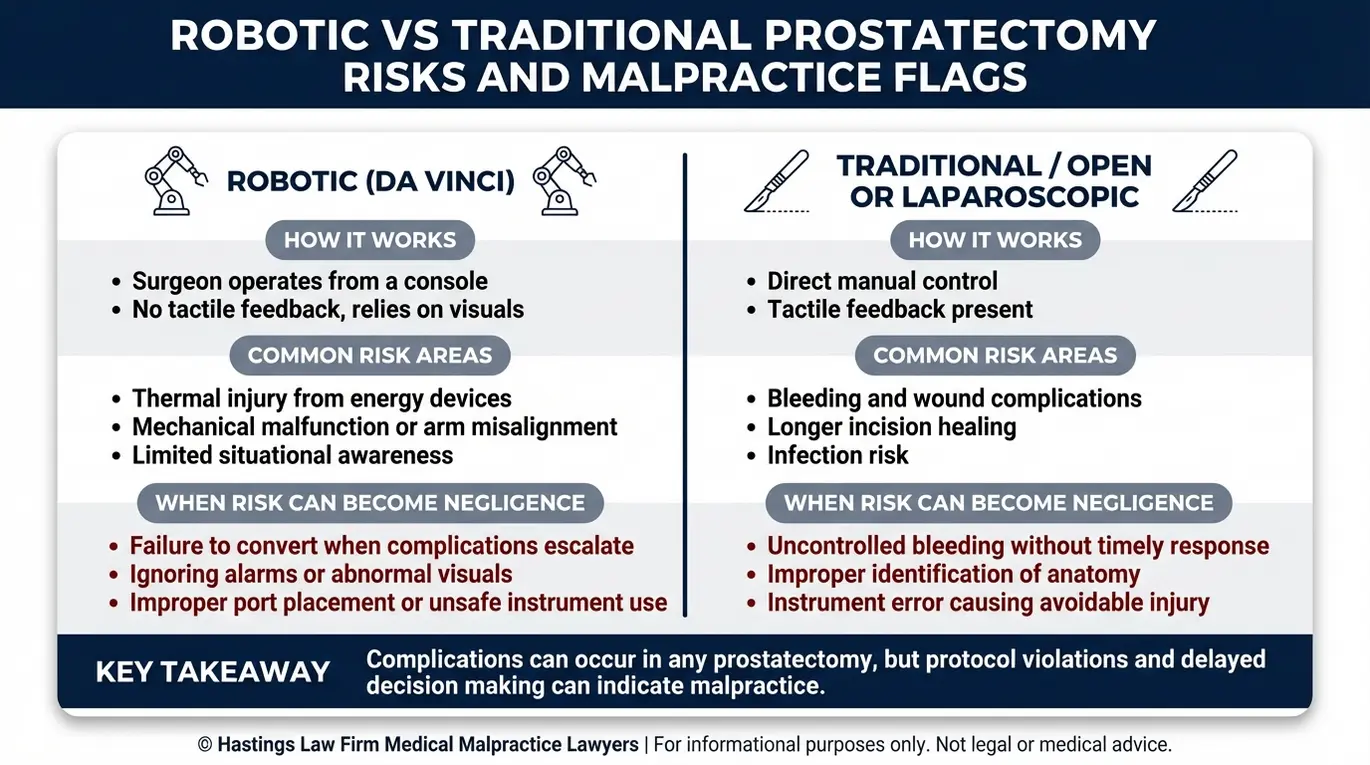
The Da Vinci Surgical System allows a surgeon to operate remotely through a viewing console rather than standing directly over the patient. The robotic arms translate the surgeon’s hand movements into precise instrument movements inside the body. A critical limitation of this technology is the absence of tactile feedback, which is the physical sense of touch that allows a surgeon to feel tissue resistance, organ density, or accidental contact.
A systematic review published by PubMed Central on tactile feedback in robot-assisted minimally invasive surgery confirms that this lack of haptic sensation remains a significant concern. Without the ability to feel what the instruments are touching, a surgeon may apply too much force, inadvertently damage nerves, or perforate nearby organs without immediately realizing it.
This sensory disconnect can increase the likelihood of surgeon errors, and when combined with potential mechanical malfunctions, creates a unique risk profile. Not every complication during prostatectomies constitutes malpractice. Surgery carries inherent risks.
The legal question is whether the surgeon’s conduct fell below the accepted standard of care. The table below outlines the general distinction.
| Factor | Traditional Open Prostatectomy | Robotic-Assisted (Da Vinci) Prostatectomy |
|---|---|---|
| Surgeon Contact | Direct hand-to-tissue contact | Remote control via console |
| Tactile Feedback | Full sensory feedback | Limited or absent |
| Incision Size | Larger incision | Smaller incisions |
| Unique Risks | Bleeding, infection, nerve damage | Burns, electrocution, mechanical failure, undetected tissue damage |
| Negligence Indicators | Deviation from surgical protocol | Inadequate training, failure to convert to open surgery, ignoring equipment warnings |
Surgeon Training Failures and Robotic Procedures
Many surgical injuries occur because hospitals allow surgeons to operate robotic systems with insufficient training, sometimes consisting of only a single day of instruction. This gap between marketing and preparation is a central issue in many robot prostate surgery lawsuit cases.
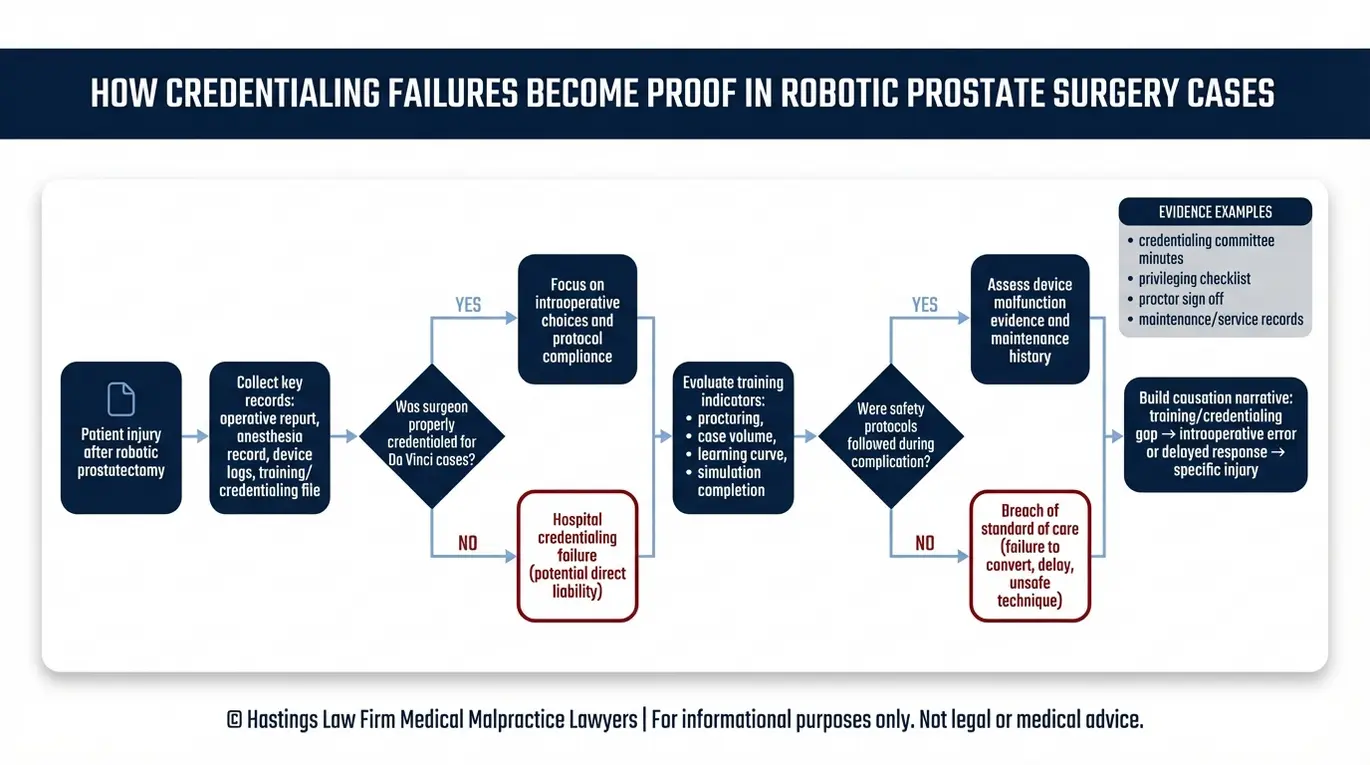
The Da Vinci system’s manufacturer, Intuitive Surgical, has faced scrutiny over claims that its training programs were reduced to as little as one day of instruction. Robotic credentialing is the process by which a hospital grants a surgeon formal privileges to use a robotic system. This often relies on proctoring requirements, where an experienced surgeon watches the new surgeon, and case volume thresholds.
In practice, those safeguards can vary widely between institutions. Common training deficiencies we investigate include:
- Surgeons performing robotic prostatectomies before completing an adequate number of supervised cases
- Hospitals granting robotic privileges without verifying independent proficiency assessments
- Lack of structured proctoring by an experienced robotic surgeon during early cases
- No formal protocol for conversion to open surgery, switching to a traditional incision, when robotic complications develop during a procedure
The U.S. Food and Drug Administration’s MAUDE adverse event database contains documented reports of Da Vinci system failures and patient injuries. These reports can be important evidence in establishing what a hospital knew, or should have known, about risks tied to robotic procedures.
When we evaluate a potential case, we examine the surgeon’s training records, the hospital’s credentialing process, and the number of robotic procedures the surgeon had completed. These details often reveal whether surgeon errors were the result of systemic failures in oversight. Proving this systemic negligence is often the key to a favorable medical malpractice judgement.
The Hastings Law Firm Difference
Results matter, but what truly sets us apart is how we achieve them. Every verdict, every settlement, and every Austin courtroom victory comes from one guiding promise: To treat each client’s fight for justice as if it were our own.
This balance of skill, experience, and empathy reflects our core philosophy that justice should not only compensate the injured, but also make health care safer nationwide.

Common Injuries From Prostatectomy Errors
Negligent prostate surgeries can result in devastating injuries, including bowel perforation, sepsis, lacerated blood vessels, and permanent loss of sexual or urinary function. Some of these complications are immediately life-threatening, while others unfold over weeks or months.
A bowel perforation, which is a hole or tear in the intestinal wall, is a dangerous complication. If unidentified, it can lead to sepsis, a potentially fatal condition in which the body’s response to infection causes life-threatening organ dysfunction. Lacerated blood vessels during the procedure can cause severe internal bleeding that requires emergency intervention.
The neurovascular bundle, which consists of the nerves and blood vessels running alongside the prostate, controls urinary continence and sexual function. Damage to these structures during surgery can cause permanent nerve damage, leading to long-term incontinence and impotence. The emotional impact of these outcomes affects every part of a patient’s life.
Robotic systems also introduce risks that are unique to the technology. According to the FDA’s evaluation of thermal effects from medical devices, instruments that generate heat during operation can cause burns and electrocutions to surrounding tissue. These thermal injuries may not be visible during the procedure and can go unrecognized until symptoms appear later.
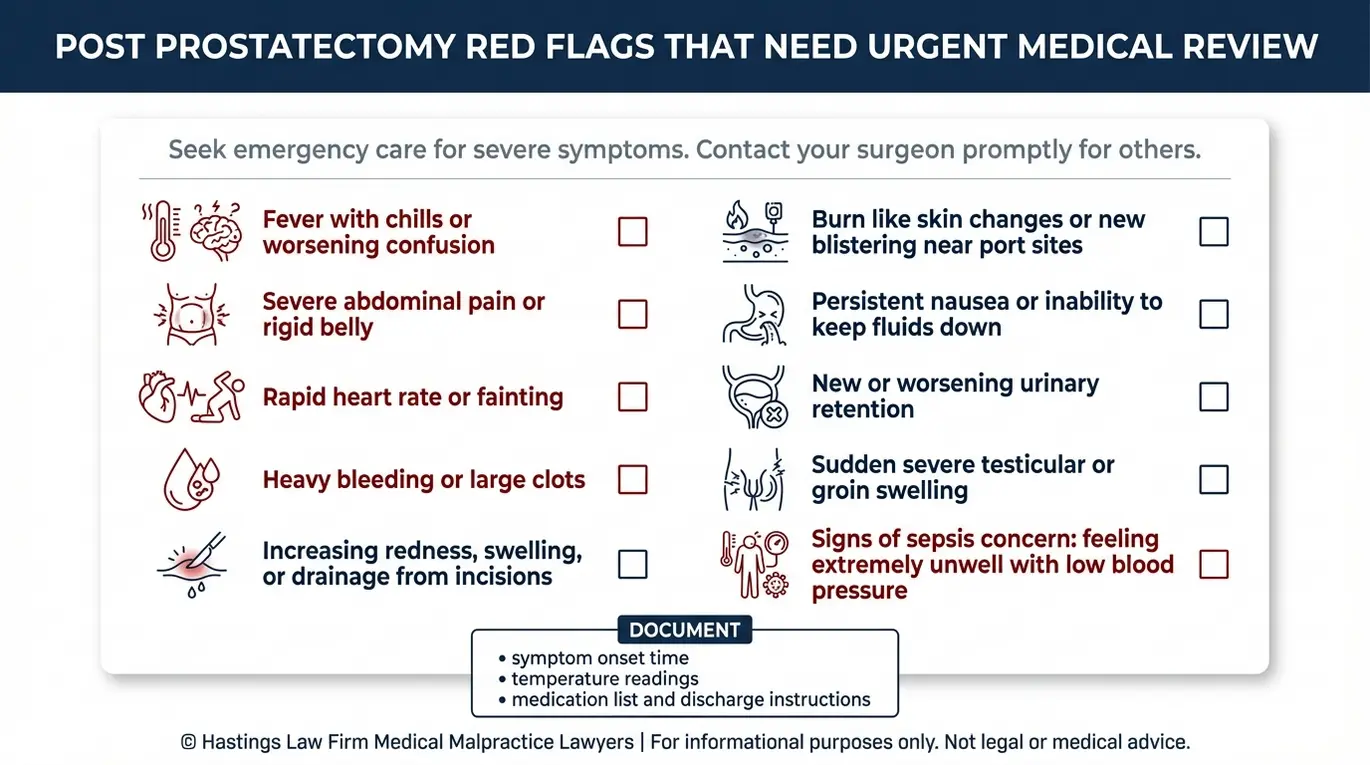
Signs that may indicate a surgical complication requiring immediate attention include:
- Persistent or worsening abdominal pain after discharge
- Fever, chills, or signs of infection at the surgical site
- Blood in urine that increases rather than improves
- Complete loss of urinary control beyond expected recovery timelines
We also look for:
- Inability to achieve any erectile function after the expected healing period
- Unexplained organ damage discovered during follow-up imaging
Outcomes of Early Robotic Surgery Lawsuits
The legal history of the Da Vinci system offers important context. One of the first robot prostate surgery lawsuits, filed by Fred Taylor, highlighted the gap between marketing and risk. While early verdicts were mixed, reports in the Manufacturer and User Facility Device Experience (MAUDE) database, the FDA’s repository for adverse events, have served as critical evidence.
These cases established that a medical malpractice judgement often hinges on surgeon training and hospital oversight rather than product defects. We examine these histories to help determine how a specific hospital managed its robotic surgery program.
Types of Compensation Available to Victims
Victims of surgical malpractice may be entitled to economic damages for medical bills and lost wages, as well as non-economic damages for pain, suffering, and physical impairment. Economic damages cover quantifiable financial losses like past and future medical expenses, rehabilitation costs, lost wages, and diminished earning capacity. For permanent injuries like chronic incontinence or impotence, calculating future damages requires a detailed projection of the ongoing care needed.
Non-economic damages address the harm that does not come with a receipt. This includes pain and suffering, loss of enjoyment of life, emotional distress, and physical impairment. When a surgical error proves fatal, surviving family members may pursue a wrongful death claim to recover these and other losses.
In rare cases involving extreme recklessness, Texas law may allow punitive damages. Under the Texas Civil Practice and Remedies Code, Chapter 74.051, specific procedural requirements apply before a medical malpractice claim can move forward. Our Austin prostate surgery error lawyers work with medical and financial experts to document every category of loss.
Contact the Austin Surgical Error Attorneys at Hastings Law Firm Today for Help
If you or a loved one suffered an injury during a prostate procedure, you deserve a team that understands both the medicine and the law behind what went wrong. Hastings Law Firm brings in-house nurse consultants, former defense attorneys, and a national network of medical experts to every case we accept.
Our firm was founded by Tommy Hastings, a board-certified trial lawyer with over 20 years of experience who is also board-certified in Personal Injury Trial Law by the Texas Board of Legal Specialization. Tommy is a 2025 inductee into ABOTA, an invitation-only organization for elite trial lawyers. We prepare every case as if it is going to trial to give our clients a stronger position during negotiations.
There is no cost to speak with us. We charge no fees unless we recover compensation for you under a contingency fee basis. Call our Austin office or complete our online form for a free, confidential case review. We are ready to listen to your story and help you find the answers you are looking for.
Frequently Asked Questions About Prostate Surgery Error in Austin


This content was researched and written by the Hastings Law Firm editorial team, which includes attorneys, medical professionals, and experienced researchers. Our writing is informed by internal knowledge and practical experience, and we cross-check critical details against authoritative sources cited throughout. Every piece undergoes human-led fact-checking and legal review. Because legal and medical information can change, if you spot an error, please contact us. Learn more about our content standards and review process on our editorial policy page.

Gabe Sassin has focused exclusively on medical malpractice law since 2007. After spending more than a decade as a malpractice defense attorney, he knows exactly how the other side works. He has seen firsthand how healthcare providers, insurers, corporate defendants, and their legal teams think, prepare, and build their defense against claims. That knowledge works for the people who need it most today, injured patients and their families. His unique experience shapes everything he writes, giving readers a look at how these cases actually work from someone who has handled them from both sides.
