


Austin Organ Puncture or Perforation Lawyer
A punctured or perforated organ during surgery can turn a planned procedure into a medical crisis with severe pain, infection, and life threatening complications. These injuries often involve missed warning signs, delayed recognition in the operating room, or inadequate follow up when symptoms worsen after discharge. Understanding how perforations happen and why timely diagnosis matters can help patients and families make sense of what went wrong and what harms may follow. If you or a loved one were harmed or worse due to organ puncture or perforation in Austin, Texas, contact Hastings Law Firm for a free, confidential case review.

Last Updated: July 27, 2026
Trusted Austin Medical Attorneys for Surgical Negligence
When a routine procedure results in a punctured or perforated organ, the physical pain is only part of what follows. There is confusion, fear, and the unsettling feeling that something went wrong that should not have. If you or a loved one is dealing with the aftermath of a surgical injury, you deserve clear answers about what happened and whether it should have been prevented.
Hastings Law Firm focuses exclusively on medical malpractice. Our team includes experienced trial attorneys, former defense lawyers, and in-house medical professionals who know how to identify where the standard of care broke down. As a dedicated Austin organ puncture or perforation lawyer, we prepare every case as if it is going to trial, because that preparation is what drives fair results.
If you suspect a surgical error caused your injury, we are here to review what happened and explain your options at no cost and with no obligation.

Common Causes of Organ Perforation in Austin Surgical Centers
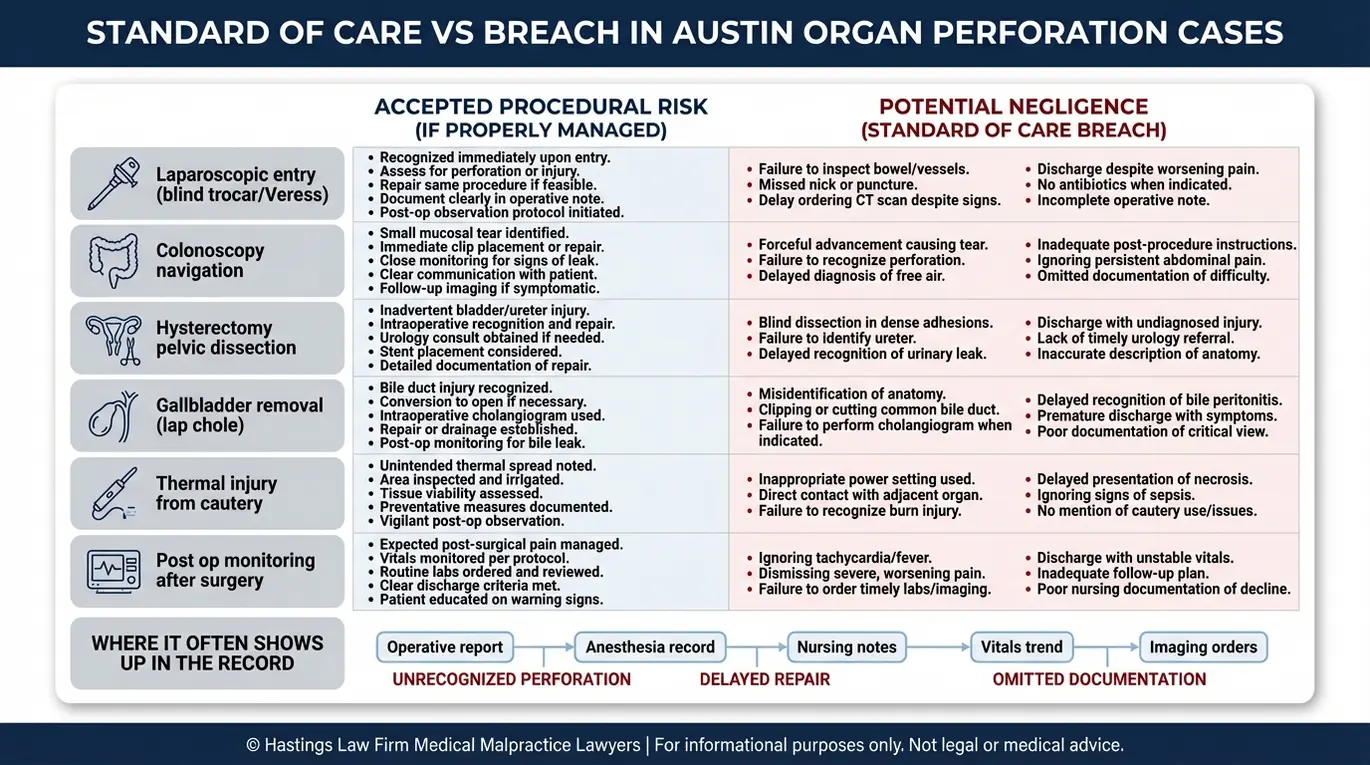
Organ perforation typically occurs during invasive and diagnostic medical procedures when a surgeon accidentally nicks or punctures an adjacent organ, most commonly affecting the bowel, bladder, or uterus during laparoscopic surgeries. An organ perforation, which is a hole or tear through the wall of an organ, differs slightly from a puncture in that it implies a full-thickness breach, but both terms describe injuries that can lead to serious, life-threatening complications.
Many of these injuries happen during what is called “blind entry.” In laparoscopic surgery, the surgeon inserts a trocar, a sharp, pointed instrument used to create small incisions for camera and tool access, into the abdomen before the camera is active. During those initial moments, the surgeon is working without direct visualization. If the instrument is angled incorrectly or inserted with too much force, nearby organs can be pierced.
A legal distinction exists here. An accidental nick during a difficult procedure is not automatically malpractice. The standard of care, meaning the level of treatment a reasonably competent surgeon would provide under similar circumstances, accounts for known risks. Where negligence often arises is when the surgeon fails to recognize the injury during the procedure, does not inspect surrounding tissue, or does not repair the damage before closing.
Several procedures carry a higher risk of organ perforation:
- Laparoscopic hysterectomy: The uterus sits close to the bladder and bowel, and trocar insertion or electrosurgical tools can injure adjacent structures.
- Colonoscopy: A study published in PubMed Central on iatrogenic colonic perforation during colonoscopy confirms that perforation remains a recognized complication, particularly during polyp removal or when working through sharp turns in the colon.
- Gallbladder removal (laparoscopic cholecystectomy): The bile duct and liver are in close proximity, and surgical errors during dissection can cause bile leaks or direct organ damage.
- Endoscopy: Upper GI procedures can perforate the esophagus or stomach, especially during biopsy or dilation.
As Austin organ perforation attorneys, we review operative reports, nursing notes, and equipment logs to determine whether the injury resulted from a preventable lapse in surgical technique or post-operative monitoring.
Identifying Critical Complications After Surgical Errors
If left untreated, a puncture allows toxic fluids to leak into the abdomen, rapidly leading to severe infection, peritonitis, sepsis, and potential organ failure. Understanding this timeline is essential, as the difference between a recoverable complication and a catastrophic outcome often comes down to hours.
When an organ like the bowel is perforated, its contents spill into the peritoneum. This thin membrane lines the abdominal cavity, and leakage there causes intra-abdominal contamination. This process, potentially combined with internal bleeding, triggers intense inflammation.
Without surgical repair, the infection spreads. Peritonitis can progress to sepsis, which the Centers for Disease Control and Prevention defines as the body’s extreme and life-threatening response to an infection. Sepsis can cause organ failure and death if not treated aggressively with antibiotics and surgery.
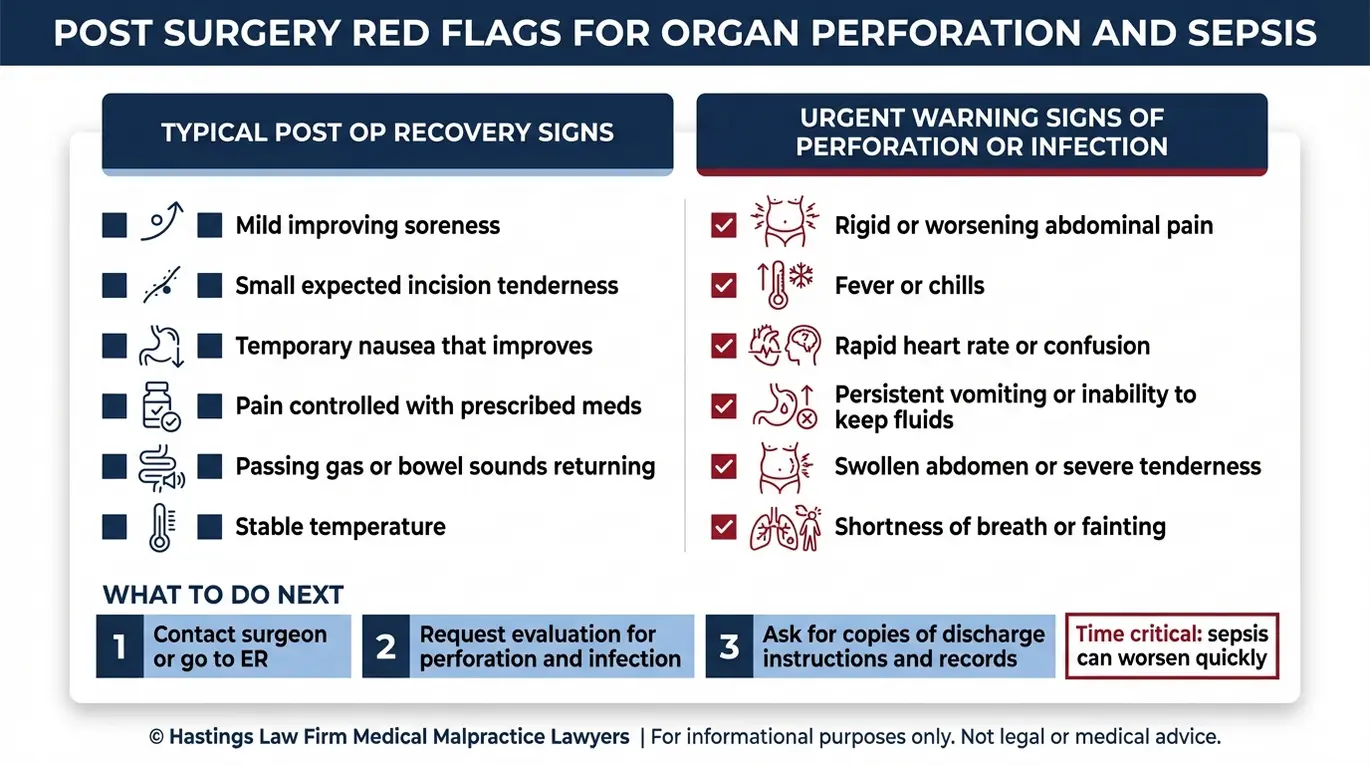
Early signs of perforation often mimic expected post-operative discomfort. Knowing the difference matters:
| Normal Post-Op Recovery | Warning Signs of Perforation |
|---|---|
| Mild, improving soreness at incision sites | Severe or worsening abdominal pain |
| Low-grade temperature that resolves in 24–48 hours | Fever above 101°F, especially after initial improvement |
| Some bloating or gas pain | Rigid, distended, or tender abdomen |
| Gradual return of appetite | Nausea, vomiting, inability to eat |
| Stable vital signs | Rapid heart rate, low blood pressure, confusion |
The CDC’s sepsis signs and symptoms resource outlines key red flags that warrant immediate medical attention, including shivering, extreme pain, clammy skin, and confusion.
The Silent Threat of Concealed Malpractice
Some of the most harmful cases involve occult perforation, which is a surgical nick or tear that goes undiagnosed for days and stays hidden from immediate view. In some situations, a surgeon may notice an error but fail to document it, or a patient’s escalating pain is dismissed as normal recovery.
Medical teams must recognize peritoneal signs, the clinical indicators of abdominal contamination such as guarding, rigidity, and rebound tenderness. When a patient presents with these symptoms and the care team delays imaging, the window for safe intervention closes. A lawyer for organ puncture injuries can help determine if the medical team breached their duty of care, transforming a surgical error into medical malpractice.
The Hastings Law Firm Difference
Results matter, but what truly sets us apart is how we achieve them. Every verdict, every settlement, and every Austin courtroom victory comes from one guiding promise: To treat each client’s fight for justice as if it were our own.
This balance of skill, experience, and empathy reflects our core philosophy that justice should not only compensate the injured, but also make health care safer nationwide.

Establishing Liability for Punctured Organs Under Texas Law
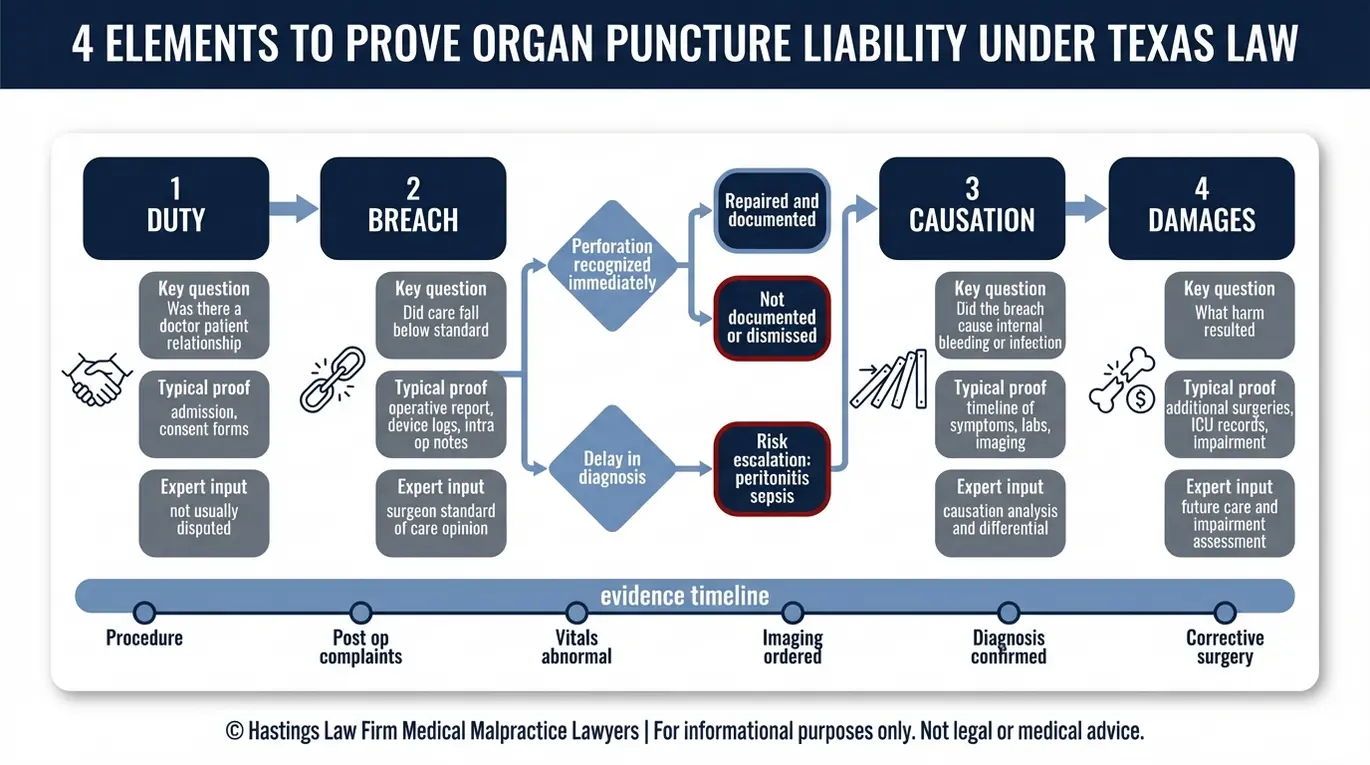
Establishing liability requires proving that the surgeon deviated from the accepted standard of care, directly causing the injury, often through the testimony of qualified medical experts. Under the Texas Civil Practice and Remedies Code Chapter 74, medical malpractice claims follow a structured legal framework that requires specific proof at each stage.
Here is how we build these cases step by step:
- Duty: A doctor-patient relationship must exist. Once a surgeon agrees to perform your procedure, they accept a legal duty of care to treat you according to accepted medical standards.
- Breach: We must show that the surgeon’s actions fell below the standard of care. This could mean an improper trocar insertion, failure to inspect surrounding tissue, or ignoring post-operative warning signs. A qualified medical expert reviews the operative report, imaging, and clinical notes to identify the specific deviation.
- Causation: The breach must be directly linked to the injury. For example, if the surgeon perforated the bowel and failed to detect it, and the patient developed sepsis as a result, the chain of causation connects the error to the harm.
- Damages: The patient must have suffered measurable harm warranting compensation, including medical costs, lost income, pain, or diminished quality of life.
As an Austin surgical injury lawyer, our team works with nationally recognized medical experts who can explain to a jury exactly where the procedure went wrong and why it should not have happened. Our in-house nurse consultants review charting details and surgical timelines that are often overlooked, giving us a clearer picture of what occurred in the operating room.
Representation for organ punctures requires both medical fluency and litigation experience. Our former defense attorneys know how hospitals and insurers build their arguments, and we use that insight to anticipate and counter those strategies from the start.
Shared Responsibility and Defective Equipment
Not every perforation is caused by the surgeon’s hand. In some cases, the instrument itself may be at fault, meaning liability could lie with the manufacturer rather than the doctor. A colonoscope, the flexible camera-equipped tube used during a colonoscopy, can malfunction. Robotic-assisted surgery, where a surgeon controls mechanical arms through a console, introduces additional failure points if the defective medical equipment responds unpredictably or has known defects.
When a device contributes to the injury, the manufacturer may share liability alongside the surgical staff. Hospital negligence can also be a factor if nursing or monitoring teams failed to track the patient’s post-operative condition or delayed escalation when symptoms worsened. We investigate every potential source of responsibility to ensure accountability is properly assigned.
Recovering Compensation for Surgical Perforation Victims
Patients who suffer organ perforation of the bowel, intestines, liver, stomach, bladder, or uterus due to medical malpractice may recover economic damages for medical bills and lost wages, as well as non-economic damages for pain, suffering, and physical impairment. The financial toll of these injuries is often staggering. Corrective procedures like an exploratory laparotomy, an open surgical procedure to locate and repair internal damage, or a bowel resection, the surgical removal of a damaged section of intestine, can require extended ICU stays and months of recovery.
Economic damages typically include emergency treatment costs, follow-up surgeries, rehabilitation, prescription medications, and income lost during recovery. Non-economic damages account for chronic pain, emotional distress, scarring, and the lasting impact on daily life.
If a perforation leads to uncontrolled sepsis and death, families may pursue wrongful death damages under Texas Civil Practice and Remedies Code Section 74.303. These claims address funeral costs, loss of companionship, and the financial support the family has lost.
Contact the Austin Surgical Error Attorneys at Hastings Law Firm Today for Help
If you or someone you love suffered a serious injury from a surgical perforation, Hastings Law Firm is ready to help you find answers. Our team of attorneys, nurse consultants, and medical experts will review your records, identify what went wrong, and build a case designed for trial if that is what it takes to secure the compensation you deserve.
We work on a contingency fee basis, which means you pay no attorney fees or costs unless we recover for you. As a trusted Austin organ puncture attorney, board-certified trial lawyer Tommy Hastings and his team have the experience, resources, and commitment to stand with you against even the largest hospital systems.
Contact us today for a free, confidential case evaluation. Let us help you take the first step toward answers, accountability, and the financial security you need to move forward.
Frequently Asked Questions About Organ Puncture or Perforation in Austin


This content was researched and written by the Hastings Law Firm editorial team, which includes attorneys, medical professionals, and experienced researchers. Our writing is informed by internal knowledge and practical experience, and we cross-check critical details against authoritative sources cited throughout. Every piece undergoes human-led fact-checking and legal review. Because legal and medical information can change, if you spot an error, please contact us. Learn more about our content standards and review process on our editorial policy page.

Gabe Sassin has focused exclusively on medical malpractice law since 2007. After spending more than a decade as a malpractice defense attorney, he knows exactly how the other side works. He has seen firsthand how healthcare providers, insurers, corporate defendants, and their legal teams think, prepare, and build their defense against claims. That knowledge works for the people who need it most today, injured patients and their families. His unique experience shapes everything he writes, giving readers a look at how these cases actually work from someone who has handled them from both sides.
