


Austin Unnecessary Surgery Lawyer
Unnecessary surgery can leave lasting physical harm and deep emotional distress, especially when patients feel dismissed or misled about whether an operation was truly needed. A poor outcome alone does not mean malpractice, but a procedure performed without a valid clinical reason can point to negligence and, in extreme situations, gross negligence. These cases often turn on whether diagnostic findings supported surgery, whether conservative options were considered, and whether records match the stated justification. If you or a loved one were harmed or worse due to unnecessary surgery in Austin, Texas, contact Hastings Law Firm for a free, confidential case review.

Last Updated: July 27, 2026
Trusted Austin Malpractice Attorneys for Unneeded Medical Procedures
Learning that a surgery you underwent may not have been medically necessary can leave you questioning everything about your care. That feeling of being dismissed or doubted by the very professionals you trusted, sometimes called medical gaslighting, is more common than most people realize. We understand what you are going through, and we can help you find answers.
At Hastings Law Firm, we focus exclusively on medical malpractice, and we understand how deeply this kind of betrayal affects patients and their families. Our team of attorneys, nurse consultants, and former defense lawyers investigates these cases from day one with the goal of uncovering what actually happened. If you are looking for an Austin unnecessary surgery lawyer who can help you get answers, we welcome the chance to review your situation in a free, confidential consultation and explain your options.

Defining Unnecessary Surgery and Medical Fraud in Texas
Unnecessary surgery occurs when a medical professional performs an invasive procedure that is not supported by standard medical protocols or patient diagnosis, often resulting in harm without benefit. In legal terms, the procedure is considered unnecessary when it falls outside what the standard of care requires, meaning the level of treatment a reasonably competent physician would have provided under similar circumstances.
Not every poor surgical outcome means the surgery should not have happened. Complications are a known risk of any operation, and a bad result alone does not establish medical malpractice. The critical distinction is between a recognized risk that materialized during an otherwise appropriate procedure and a surgery that had no valid clinical reason to be performed at all. When a procedure lacks medical necessity, the accepted clinical criteria that justify performing a surgery based on the patient’s symptoms, test results, and diagnosis, the entire operation may represent a breach of duty and a form of medical negligence.
Fee-for-service payment models, where providers are compensated based on the volume of procedures performed, can create pressure that may influence surgical decision-making. When that pressure leads to patients undergoing operations they did not need, the consequences can include chronic pain and permanent injury. In extreme cases where clinical safety standards are bypassed, this conduct may rise to the level of gross negligence.
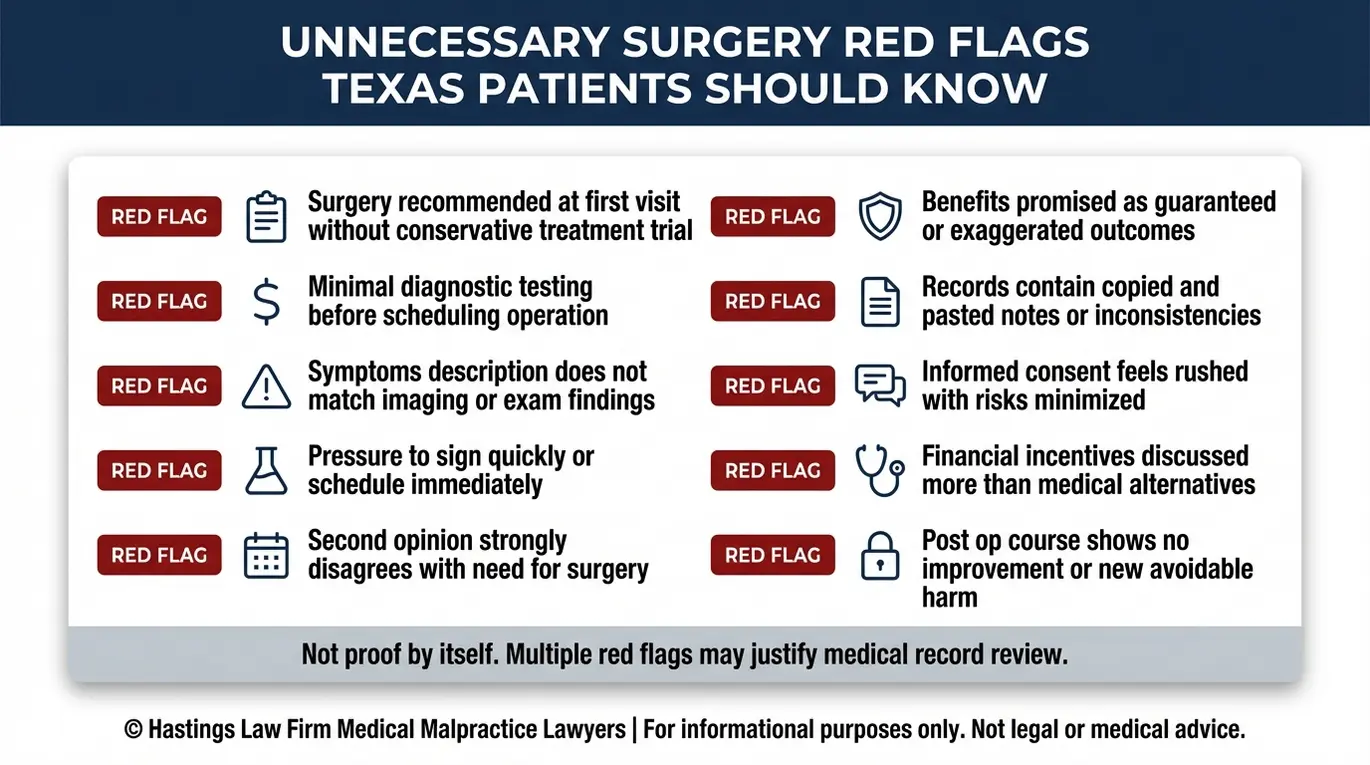
Red flags that may indicate a surgery was unnecessary:
- You were not offered or informed about non-surgical treatment alternatives before the procedure was recommended
- Pre-operative diagnostic tests did not clearly support the need for surgery
- A second physician later questioned whether the procedure was warranted
- The surgeon recommended surgery after a brief evaluation with minimal diagnostic workup
- You experienced complications or worsening symptoms from a procedure that produced no measurable benefit
- Your medical records contain inconsistencies between your reported symptoms and the surgical justification documented
Proving a Procedure Was Medically Unnecessary
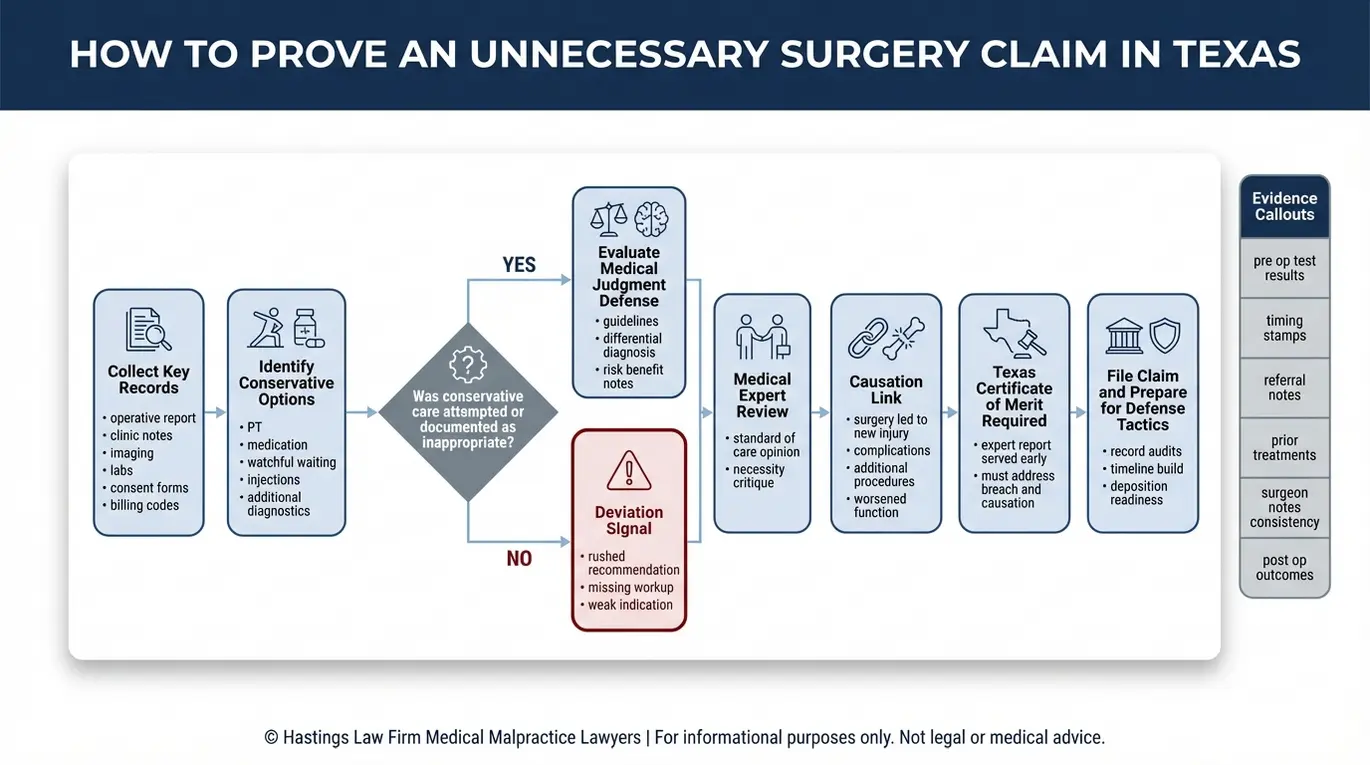
Proving a surgery was unnecessary requires clear evidence that a reasonable physician under similar circumstances would have pursued conservative treatment, non-invasive options such as physical therapy, medication, or monitoring, instead of performing an invasive operation. Building this evidence is a structured process, and it begins well before any lawsuit is filed.
Expert testimony is the foundation of these cases. Texas law requires that a qualified medical expert review the facts to establish the applicable duty of care and confirm that the surgeon deviated from the accepted standard of care to establish a legal claim. This is not optional. Under Civil Practice and Remedies Code Chapter 74, a patient must serve an expert report, a written report from a credentialed medical expert, within 120 days after each defendant’s original answer is filed. The expert report must explain how the provider’s actions fell below the standard of care and how that failure caused harm, establishing causation.
Our team works with a national network of medical specialists who review the clinical picture objectively. They evaluate whether the clinical indication for surgery, the specific medical reason documented to justify the procedure, actually supported an invasive approach.
Gathering this evidence is important because medical records do not always tell the whole story initially. Our legal team meticulously compares the electronic metadata, nursing logs, and the surgeon’s operative report to identify discrepancies that suggest an attempt to cover up a lack of medical necessity. This forensic approach often reveals that the patient’s condition did not actually meet the criteria for surgery.
| Evidence Type | What It Reveals |
|---|---|
| Pre-operative imaging and lab results | Whether diagnostic findings supported the need for surgery |
| Medical records and physician notes | Whether conservative management was considered or attempted |
| Operative report (the surgeon’s detailed account of the procedure) | Whether the surgical findings matched the pre-operative diagnosis |
| Referral and consultation records | Whether a second opinion was sought or recommended |
| Billing and scheduling records | Whether patterns suggest procedures were performed without sufficient clinical justification |
At Hastings Law Firm, our in-house nurse consultants and Board Certified Patient Advocates assist in analyzing these records and identifying gaps or inconsistencies that outside experts can then evaluate. This medical-legal collaboration is central to how we build a case.
The Hastings Law Firm Difference
Results matter, but what truly sets us apart is how we achieve them. Every verdict, every settlement, and every Austin courtroom victory comes from one guiding promise: To treat each client’s fight for justice as if it were our own.
This balance of skill, experience, and empathy reflects our core philosophy that justice should not only compensate the injured, but also make health care safer nationwide.

Liability for Surgeons and Hospitals Performing Needless Operations
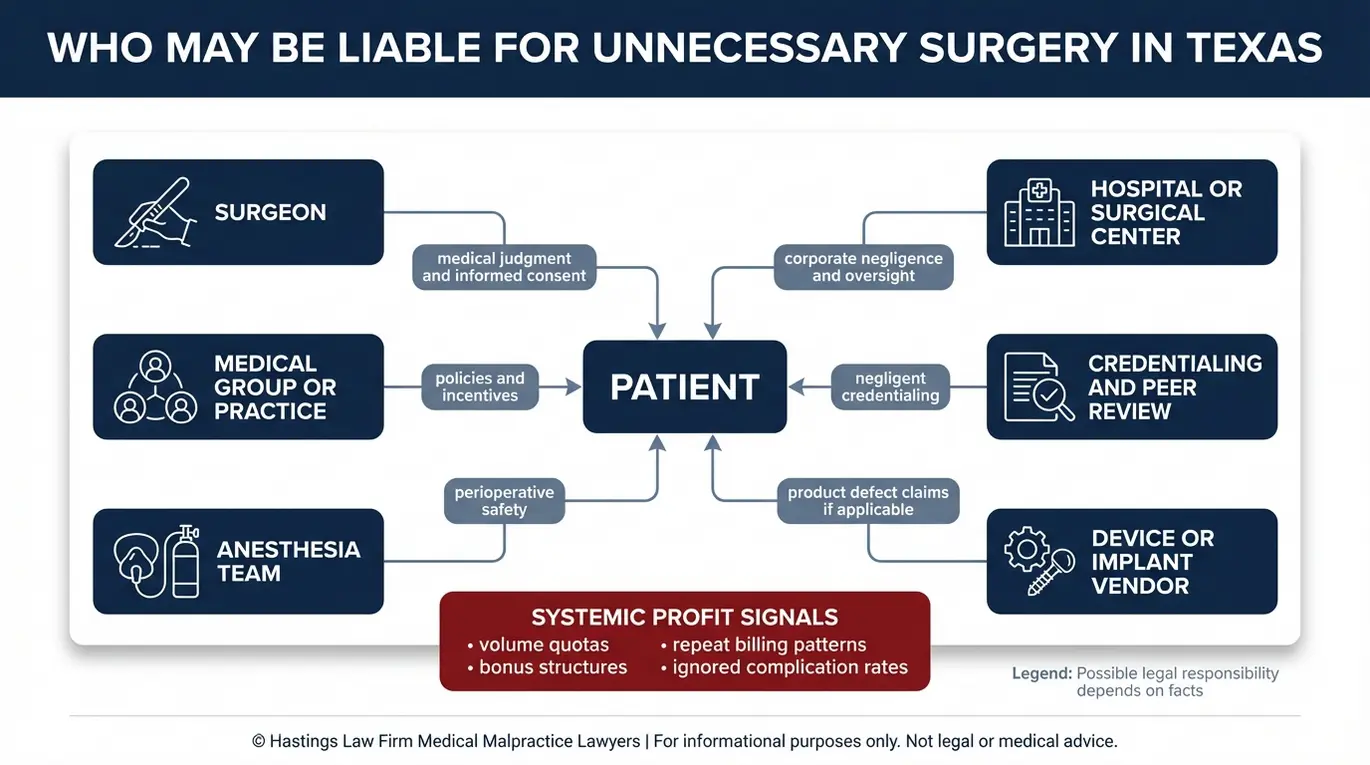
Liability can extend beyond the operating surgeon to include hospitals that incentivize high surgical volume and medical groups that prioritize revenue over patient safety standards. The surgeon who made the decision to operate is typically the first party examined in these medical malpractice cases. If the evidence shows that a competent physician in the same specialty would not have recommended surgery under those circumstances, the surgeon may be liable for the resulting harm. We analyze every detail to identify all liable parties.
Hospitals have an independent legal duty to credential and monitor the physicians who practice within their facilities. Hospital credentialing and privileging, the process by which a hospital verifies a surgeon’s qualifications and grants permission to perform specific procedures, is a critical safeguard. When a hospital fails to act on warning signs, such as elevated complication rates or patient complaints, it may be liable under a theory of hospital negligence or corporate negligence for negligent credentialing. The Agency for Healthcare Research and Quality (AHRQ) Patient Safety Network highlights the importance of reporting and tracking patient safety events as a safeguard against institutional failures.
Fee-for-service incentives, payment structures that compensate based on the number of procedures performed, can create environments where surgical volume is encouraged. When institutional policies contribute to patients receiving care they did not need, the facility itself may share liability alongside the individual surgeon.
Our team includes former defense attorneys who previously represented hospitals in medical liability cases. That background gives us direct insight into how institutions respond to these claims and where the evidence of systematic failure is most likely to be found.
Steps to Take After Suspecting a Fraudulent or Unnecessary Operation
Patients should immediately secure a second opinion from an unaffiliated doctor and request a complete copy of their unedited medical records before notifying the original surgeon of their suspicions. If you suspect a surgery you underwent was not medically necessary, the steps you take now can significantly affect your ability to pursue a claim later. Acting early helps ensure the preservation of evidence that matters most.
Steps to take, in order:
- Request your complete, unedited medical records. Contact the facility’s medical records department in writing and ask for your full chart, including operative reports, the detailed surgeon’s account of the procedure, and pre-operative evaluations. Under Texas law, you have the right to obtain these records, and the Texas Medical Board outlines reasonable fees for copies. Making this request promptly helps ensure the records are preserved in their original form.
- Seek an independent second opinion. Schedule a consultation with a physician who has no affiliation with the surgeon or facility that performed your procedure. An independent second opinion, a clinical evaluation by an unaffiliated doctor, can provide an objective assessment of whether the surgery was warranted based on your condition.
- Document your symptoms and recovery. Keep a written log of your physical symptoms, pain levels, emotional state, and any new medical treatments or complications since the surgery.
- Consult with a medical malpractice attorney. Bring your records and second opinion to a legal team experienced in surgical malpractice. Schedule a free legal consultation with a medical malpractice attorney to determine whether your experience meets the legal threshold for a claim.
What not to do:
- Do not discuss the surgery, your suspicions, or your potential legal claim on social media. Posts and messages can be discovered by defense attorneys and used to undermine your case.
- Do not confront the surgeon of your suspicions before securing your records and legal counsel. Early notification could prompt changes to your care documentation.
Compensation for Victims of Unnecessary Surgical Procedures
Texas law allows victims to recover economic damages for medical bills and lost wages alongside non-economic damages for the physical pain, disfigurement, and mental anguish caused by the procedure. Patients may be entitled to compensatory damages, which are intended to make the injured party whole. The specific categories of compensation depend on the nature and extent of the harm.
Economic damages cover the verifiable financial losses you can document:
- The cost of the unnecessary surgery itself
- Expenses for revision surgery, the corrective procedures needed to address complications from the original operation
- Ongoing medical treatment, rehabilitation, and prescription costs
- Lost wages and diminished earning capacity if the injury affects your ability to work
Non-economic damages address the personal toll:
- Physical pain and suffering during recovery and beyond
- Emotional distress and mental anguish, including the psychological impact of undergoing a procedure you did not need
- Disfigurement or permanent physical limitation resulting from the surgery
Under Texas Civil Practice and Remedies Code § 74.301, non-economic damages in medical malpractice cases are subject to statutory caps. These caps limit recovery for intangible losses but do not apply to economic damages, which have no statutory ceiling. In rare cases of gross negligence, punitive damages may also be awarded to punish the wrongdoer, though these are rarer in medical malpractice.
In cases involving death caused by an unnecessary procedure, families may pursue a wrongful death claim to recover funeral expenses and loss of companionship. An unnecessary surgery lawyer in Austin can help you understand which categories of compensation apply to your specific situation and how to document them effectively.
Statute of Limitations for Unnecessary Surgery Claims in Austin
In Texas, medical malpractice claims must generally be filed within two years from the date of the negligent act, though specific exceptions such as fraudulent concealment may apply. Missing this deadline can permanently bar your right to pursue compensation, regardless of the strength of your case. Understanding the filing deadline and strict time limit is essential to protecting your legal rights.
However, unnecessary surgery cases often involve a unique problem: the patient may not realize the procedure was unjustified until months after it was performed. In some circumstances, such as when a provider actively conceals the wrongdoing, Texas law may toll or delay the start of the limitations period. Because the availability of these exceptions is narrow and fact-specific, consulting with an attorney early is critical to determining whether any tolling provisions apply to your situation.
There is an absolute outer boundary. Texas imposes a statute of repose that generally bars medical malpractice claims filed more than 10 years after the date of the negligent act. This 10-year rule acts as an absolute bar, meaning that even if you discover the error much later, you likely cannot sue. Because these deadlines are strict and fact-specific, consulting an attorney early gives you the best chance of preserving your legal options.
Contact the Austin Surgical Error Attorneys at Hastings Law Firm Today for Help
If you believe you or a loved one underwent a surgery that was not medically necessary, your pain and your questions deserve to be taken seriously. Being subjected to an operation you did not need is a violation of the trust you placed in your medical team, and you have every right to seek the truth about what happened.
Hastings Law Firm represents patients and families exclusively in medical malpractice cases. Our team is led by Tommy Hastings, a board-certified trial attorney, 2025 ABOTA inductee, and Texas Super Lawyer since 2013. With in-house nurse consultants, former defense attorneys, and a national network of medical experts, we have the resources to investigate what went wrong and help you understand your legal options.
We operate on a contingency fee basis, which means you pay no attorney fees or costs unless we recover compensation for you. Your consultation is free and confidential. Contact us today to share what happened.
Frequently Asked Questions About Unnecessary Surgery in Austin
What is the typical timeline of a surgical malpractice lawsuit in Texas?
A surgical malpractice lawsuit typical timeline usually spans 18 to 24 months to resolve. The process begins with a mandatory investigation and expert review period, followed by civil litigation phases including discovery and mediation. Settlement negotiations can resolve many cases before trial, though some require full trial preparation to achieve a fair result.
What are the specific legal challenges in proving an unnecessary surgery claim?
The primary legal challenges involve overcoming the “medical judgment” defense, where the surgeon argues the procedure was a valid option at the time. Success requires expert testimony to prove a breach of duty and clear evidence that conservative treatment was ignored.
Are there caps on damages in Texas medical malpractice cases?
Yes, Texas law has specific caps on damages for non-economic losses. Under § 74.301, non-economic damages are limited to $250,000 against all physicians or individual providers combined, and up to $500,000 against all health care institutions combined, for a maximum aggregate of $750,000 when claims involve both physicians and multiple institutions. However, there is no cap on economic damages like medical bills or lost wages.
What common defenses do surgeons use in unnecessary surgery lawsuits?
Surgeons often use common defenses such as “informed consent,” arguing the patient agreed to the risks, or “medical necessity” based on subjective symptom reporting. We counter this by analyzing medical records for inconsistencies and using standard of care guidelines to prove the operation was unjustified.
What specific types of surgeries are most commonly considered unnecessary?
Procedures commonly considered unnecessary often include high-volume operations like spinal fusions, cardiac stents, and knee arthroscopies. These are often performed when less invasive options such as physical therapy or medication would have been sufficient to treat the patient’s condition.
# FOUNDER BIO – TOMMY HASTINGS
Professional Profile
Tommy Hastings is a board-certified trial lawyer and the founder of Hastings Law Firm. With over two decades of experience, he is recognized as one of the nation’s leading authorities on medical malpractice litigation. Tommy has dedicated his career to giving a voice to patients silenced by medical error, dangerous drugs, and unsafe medical products; viewing every case as an opportunity to enforce accountability and improve patient safety standards.
Credentials & Distinctions
- Board Certified in Personal Injury Trial Law by the Texas Board of Legal Specialization (achieved by <2% of Texas attorneys).
- 2025 Inductee into ABOTA (American Board of Trial Advocates), an invitation-only organization for elite trial lawyers.
- Multi-Million Dollar Advocates Forum Member.
- Texas Super Lawyer Since 2013 (Top 5% of attorneys in the state).
- Course Director for the State Bar of Texas 2024 Medical Torts Seminar.
- Juris Doctorate from the University of Houston Law Center.
Career Highlights & Impact
Tommy established his reputation early, securing a multi-million-dollar verdict within three months of licensure. He is known for his ability to translate complex medical concepts into persuasive narratives for juries.
- $19.5 million settlement for a teenager with a neurological injury
- $18 million settlement involving a defective and contaminated medication
- $10 million verdict against operators of a pill mill, a national first against a “pill mill” (overprescribing)
- $8 million ICU monitoring failure settlement in Dallas for a man that suffered severe neurological injuries
- $7 million birth injury settlement in Houston that secured a little girl’s future
- $3.5 million jury verdict against Kelsey-Seybold for failure to diagnose a blood clot on behalf of a decorated firefighter
Personal Philosophy
Tommy believes that medical malpractice law is about more than compensation; it is about prevention. His practice is driven by the belief that holding negligent providers accountable is the only way to ensure that the same tragedy does not happen to another family.

This content was researched and written by the Hastings Law Firm editorial team, which includes attorneys, medical professionals, and experienced researchers. Our writing is informed by internal knowledge and practical experience, and we cross-check critical details against authoritative sources cited throughout. Every piece undergoes human-led fact-checking and legal review. Because legal and medical information can change, if you spot an error, please contact us. Learn more about our content standards and review process on our editorial policy page.

Gabe Sassin has focused exclusively on medical malpractice law since 2007. After spending more than a decade as a malpractice defense attorney, he knows exactly how the other side works. He has seen firsthand how healthcare providers, insurers, corporate defendants, and their legal teams think, prepare, and build their defense against claims. That knowledge works for the people who need it most today, injured patients and their families. His unique experience shapes everything he writes, giving readers a look at how these cases actually work from someone who has handled them from both sides.
