


Texas Unnecessary Surgery Lawyer
Unnecessary surgery can leave a patient coping with complications, ongoing pain, and a lasting loss of trust in medical care. A key issue is whether the decision to operate was supported by the diagnosis and accepted medical protocols, rather than whether a properly recommended procedure simply had a poor outcome. These cases often turn on what the medical records show about testing, alternatives, and informed consent, and whether the surgery went beyond what was authorized. If you or a loved one were harmed or worse due to unnecessary surgery in Texas, contact Hastings Law Firm for a free, confidential case review.

Last Updated: July 27, 2026
Trial-Ready Legal Representation for Surgical Negligence in Texas
Learning that a surgery you went through may not have been medically necessary is a deeply unsettling experience. Beyond the physical recovery, there is often a sense of betrayal, a feeling that the trust you placed in your doctor was not honored. You may be left with surgical complications, ongoing pain, and more questions than answers.
You are not wrong for questioning what happened. And you do not have to sort through it alone.
At Hastings Law Firm, we focus exclusively on medical malpractice. Our team includes former defense attorneys, in-house nurse consultants, and board-certified trial lawyers who understand both the medicine and the law behind these cases. When a surgeon operates without proper medical justification, that decision can be the basis of a serious legal claim.
If you believe you or a loved one underwent an operation that was not medically necessary, a Texas unnecessary surgery lawyer at our firm can review your records and explain your options. Contact us for a free, confidential case evaluation.

Defining Unnecessary Surgery Under Texas Medical Liability Law
Unnecessary surgery, often referred to as a non-indicated procedure, occurs when a medical provider performs an invasive operation that is not supported by the patient’s diagnosis or standard medical protocols. A non-indicated procedure is one where the clinical evidence did not justify the risks of surgical intervention.
This is different from a surgery that was properly recommended but resulted in a bad outcome. Complications can happen even when the right decision was made. The legal question is whether the surgery should have been performed at all.
Under Texas law, the foundation of a malpractice claim is a violation of the standard of care, the level of treatment a reasonably competent surgeon would have provided under similar circumstances. When Texas unnecessary surgery lawyers investigate these cases, the central issue is whether a qualified peer would have looked at the same medical evidence and still chosen to operate.
Common Procedures Involving Surgical Overtreatment
Certain high-revenue procedures, such as spinal fusions, stent placements, and hysterectomies, are statistically more likely to be performed unnecessarily due to financial incentives or defensive medicine practices. While financial incentives can contribute to overtreatment, the focus of any legal claim is whether the decision to operate was supported by the patient’s actual condition. A Texas surgical malpractice lawyer can help determine if negligence occurred.
Orthopedic and Neurological Surgery. Spinal fusions, a surgical procedure that permanently joins two or more vertebrae, are among the most frequently questioned operations. A study published in the National Library of Medicine on unnecessary spine surgery highlights the ongoing challenge of surgical overtreatment in spinal care. In many cases, conservative treatment such as physical therapy, medication, or injections was never attempted before surgery was scheduled.
Cardiac Procedures. Coronary stent placement, a procedure where a small tube is inserted to hold open a blocked artery, can be lifesaving during an active heart attack. For patients with stable angina who respond to medication, stenting may offer no additional benefit. This unnecessary intervention can expose patients to surgical complications, including infection and blood clots.
Gynecological Surgery. Hysterectomies performed when less invasive alternatives were available, or cesarean sections scheduled for convenience rather than medical necessity, are areas where an attorney for unnecessary surgery frequently sees questionable decision-making. These operations involve the removal of the uterus or surgical delivery of a baby and should only occur when medically indicated.
Modern Diagnostics and Precautionary Surgeries
Advanced imaging technology like CT scans and MRIs can sometimes reveal incidentalomas, harmless abnormalities that appear on scans but pose no actual threat. When these findings lead to aggressive surgical removal rather than monitoring, the result can be a misdiagnosis and a procedure the patient never needed, such as precautionary appendectomies that are not actually inflamed. An attorney will examine the medical records to determine liability and whether the imaging truly supported surgical intervention or whether the findings were misinterpreted.
| Procedure Type | Common Justification | When It May Be Unnecessary |
|---|---|---|
| Spinal Fusion | Chronic back pain, disc degeneration | Physical therapy and medication were never tried |
| Coronary Stent | Blocked artery, chest pain | Patient had stable angina manageable with medication |
| Hysterectomy | Fibroids, abnormal bleeding | Conservative options were not explored |
| Appendectomy | Imaging abnormality | Finding was an incidentaloma, not actual inflammation |
The Hastings Law Firm Difference
Results matter, but what truly sets us apart is how we achieve them. Every verdict, every settlement, and every Texas courtroom victory comes from one guiding promise: To treat each client’s fight for justice as if it were our own.
This balance of skill, experience, and empathy reflects our core philosophy that justice should not only compensate the injured, but also make health care safer nationwide.

Distinguishing Negligence from Medical Battery
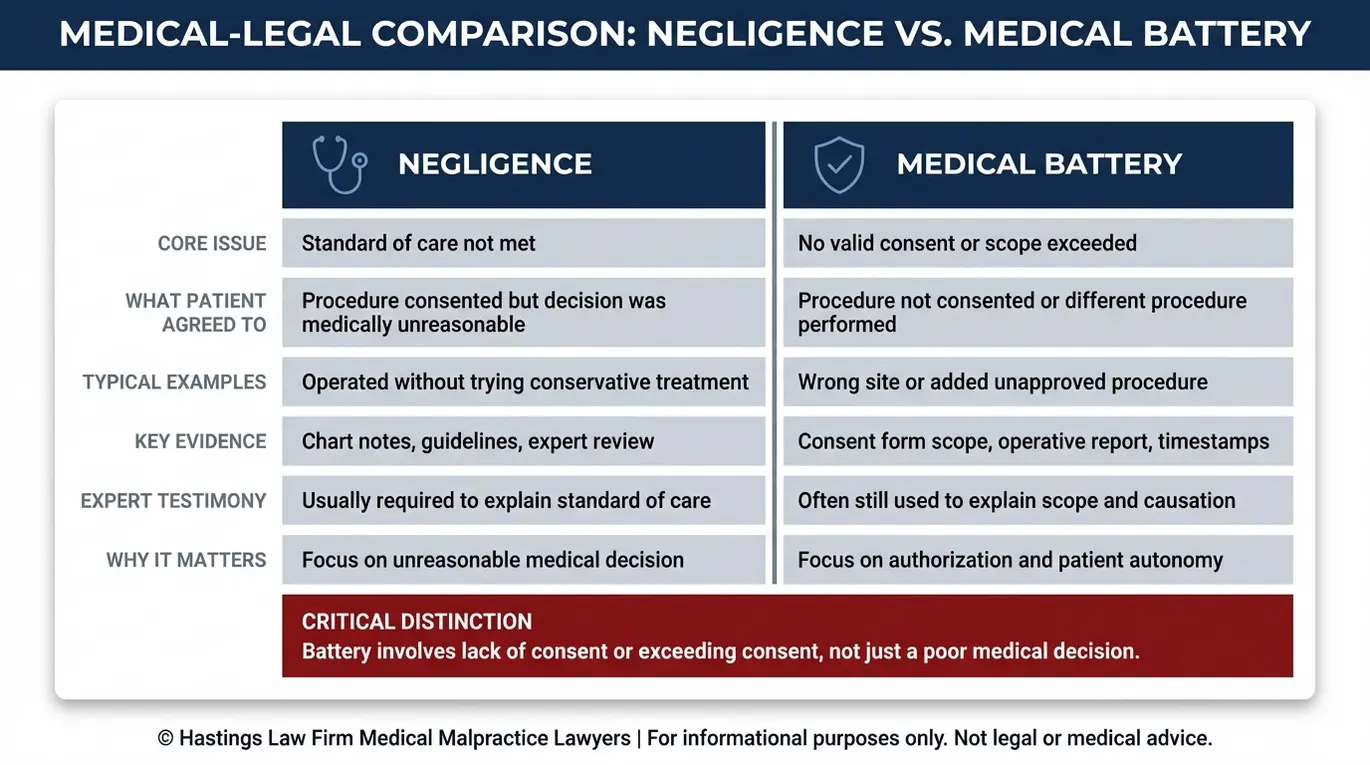
While negligence involves a failure to adhere to the standard of care, medical battery occurs when a doctor performs a procedure completely without the patient’s informed consent or extends a surgery beyond what was authorized.
Informed consent means your doctor explained the risks, benefits, and alternative treatments before you agreed to the procedure. Under Texas law, the Texas Medical Disclosure Panel maintains specific lists of procedures and the risks that must be disclosed. If a surgeon failed to inform you of nonsurgical alternatives, or did not explain material risks, your consent may not have been legally valid.
Medical battery is a more direct violation. It can apply when a surgeon operates on the wrong body part, removes an organ without authorization, or performs an additional procedure you never agreed to. For a lawyer for unnecessary surgery, distinguishing between these two legal theories is critical because each carries different evidentiary requirements and can affect liability and the damages you may recover.
Identifying Valid Claims and Warning Signs
A valid claim often exists if a second opinion reveals conservative treatment was never offered, or if post-operative reviews show the pathology did not match the pre-surgical diagnosis. Conservative treatment, meaning nonsurgical approaches like physical therapy, medication, or monitoring, should typically be attempted first.
Not every difficult surgical outcome means the procedure was unjustified. But certain patterns can signal that something went wrong with the decision to operate. An unnecessary surgery attorney in Texas will evaluate whether any of the following red flags are present in your case.
Warning signs that may indicate a non-indicated procedure:
- The surgeon recommended surgery after a single visit, without ordering complete diagnostic testing
- Alternative treatments such as medication, therapy, or watchful waiting were never discussed
- A second opinion from an independent specialist contradicted the recommendation for surgery
- Post-surgical pathology did not match the pre-operative diagnosis, suggesting a misdiagnosis
- The surgeon had a pattern of performing high volumes of the same procedure
- You were pressured to schedule surgery quickly, with little time to consider your options
If any of these apply to your experience, speaking with a medical malpractice lawyer can help you understand whether you have grounds for a claim.

Proving Liability Through Expert Testimony
Texas law requires objective proof that a prudent physician would not have performed the surgery under the same circumstances, which must be established through the testimony of qualified medical experts.
Under Chapter 74.351 of the Texas Civil Practice and Remedies Code, a plaintiff must serve an expert report within 120 days after each defendant’s original answer is filed. This report must be written by a qualified expert witness who identifies the applicable standard of care, explains how the defendant surgeon deviated from it, and establishes how that deviation caused harm. Failure to meet this deadline can result in dismissal of the case.
As Texas unnecessary surgery lawyers, we work with a national network of board-certified medical experts who review the patient’s complete medical records. These experts compare the documented clinical findings against accepted diagnostic criteria and national treatment guidelines to determine whether the surgery was medically justified. The medical record itself is often the most powerful piece of evidence, because it shows what the doctor knew, what tests were ordered, and what alternatives were considered before the decision to operate. An unnecessary surgery malpractice attorney builds the case around this documented timeline. The expert witness clarifies the medicine and establishes the legal standards required to prove negligence to a jury.
The Role of Financial Incentives in Surgical Errors
Systemic pressures, including fee-for-service models and kickbacks from medical device manufacturers, can incentivize surgeons to recommend invasive procedures over less profitable conservative treatments. While our firm does not speculate about individual motives, we do investigate whether financial structures may have influenced treatment decisions.
The fee-for-service model, a payment system where providers are compensated per procedure rather than for patient outcomes, can reward higher surgical volume. Under this structure, a surgeon who operates earns significantly more than one who recommends physical therapy instead of a costly spinal fusion or medication. This creates a structural incentive that lawyers for surgical errors must examine carefully.
Defensive medicine, the practice of ordering tests or procedures primarily to reduce legal liability rather than to treat the patient, can also lead to operations that were not clinically necessary.
Device Manufacturer Pressure and Kickbacks
In some cases, unnecessary surgeries are connected to relationships between surgeons and medical device manufacturers. When a surgeon receives financial benefits for using a particular implant or device, the recommendation to operate may not be driven purely by clinical need. These arrangements can raise liability questions and, in certain circumstances, may involve whistleblower protections under federal law.
Damages Recoverable for Non-Indicated Procedures
Victims of unnecessary surgery may recover compensation for medical bills, lost wages during recovery, pain and suffering, and the long-term impact of surgical complications. These damages fall into two primary categories, and in rare cases, a third.
Economic damages cover the measurable financial impact of the unnecessary procedure:
- Cost of the original surgery and any revision surgeries required to correct complications
- Medical bills for follow-up care, rehabilitation, and medication
- Lost wages during recovery
- Lost earning capacity if the injury limits your ability to work long-term
Economic damages can also include future medical expenses if the surgical error leads to lifelong care needs, ensuring you are not financially burdened by the mistake.
Non-economic damages address losses that do not carry a specific price tag:
- Pain and suffering from the surgery and its aftermath
- Chronic pain, nerve damage, or other lasting surgical complications
- Scarring or disfigurement
- Loss of enjoyment of life and psychological distress
Punitive damages are available in rare cases where the evidence shows gross negligence or intentional misconduct. A Texas unnecessary surgery lawyer will evaluate your situation to determine the full extent of what you may be entitled to recover if you sue for unnecessary surgery.
Texas Statute of Limitations for Filing Suit
In Texas, the general statute of limitations for medical malpractice is two years from the date of the negligence, though specific exceptions may apply based on when the injury was discovered. Missing this deadline typically means losing the right to file a claim, regardless of how strong the evidence may be.
Texas also imposes a 10-year statute of repose, which acts as an absolute outer boundary for liability. Under Texas Civil Practice and Remedies Code Section 74.251, no medical malpractice claim may be brought more than 10 years after the date of the alleged act, even if the injury was not discovered until later.
Because unnecessary surgery cases often involve delayed recognition of the harm, time is a critical factor. Medical records can be altered, memories can fade, and key evidence can be lost. Consulting with medical malpractice attorneys as soon as you suspect a problem gives your legal team the best opportunity to preserve the evidence needed to build your case. The full text of these requirements is outlined in Texas Civil Practice and Remedies Code Chapter 74.
Steps to Take After a Non-Indicated Procedure
If you suspect you underwent an unnecessary operation, immediately request your complete medical records, seek a second opinion from an independent specialist, and contact a specialized malpractice attorney to preserve your rights. Here is what we recommend:
- Request your complete medical records immediately. Under Texas law, you have the right to obtain copies of your records. The Texas Medical Board outlines the process for requesting them. Securing these records early helps ensure they are preserved in their original form and prevents any potential tampering or loss of critical evidence.
- Seek a second opinion from an independent specialist. A second opinion, an evaluation by a doctor who has no connection to your original surgeon, can confirm whether the procedure was medically justified. Choose a physician at a separate practice or health system.
- Do not confront the surgeon directly. While it is natural to want answers, direct confrontation can compromise your legal position. Let your attorney handle communications with the medical provider.
- Consult with a Texas unnecessary surgery lawyer. A board-certified trial lawyer experienced in surgical malpractice can evaluate your records, connect you with a qualified expert witness, and advise you on whether a claim is viable. At Hastings Law Firm, you can contact our medical malpractice firm for a free case review with no obligation.
Contact the Texas Surgical Error Attorneys at Hastings Law Firm Today for Help
If you have been harmed by a surgeon’s decision to operate without clear medical justification, you deserve honest answers about what happened and what comes next.
Hastings Law Firm is not a general practice firm, and we are not a settlement mill. We are trial lawyers who handle nothing but medical malpractice litigation. Our team includes former hospital defense attorneys, in-house nurse consultants, and a national network of medical experts, all working together to determine exactly what went wrong and who should be held accountable.
Founded by Tommy Hastings, a board-certified trial attorney (a distinction held by less than 2% of Texas lawyers) and Texas Super Lawyer since 2013, our firm is dedicated to securing the full compensation patients and families need after medical negligence. We prepare every case as though it is going to trial, because that level of preparation is what gets results.
There are no upfront costs. We work on a contingency fee basis, meaning you pay nothing unless we recover compensation for you. If you or a loved one may have undergone an unnecessary procedure, call us today or request a free, confidential case evaluation online. Let us help you find the answers you deserve.
Frequently Asked Questions About Unnecessary Surgery in Texas


This content was researched and written by the Hastings Law Firm editorial team, which includes attorneys, medical professionals, and experienced researchers. Our writing is informed by internal knowledge and practical experience, and we cross-check critical details against authoritative sources cited throughout. Every piece undergoes human-led fact-checking and legal review. Because legal and medical information can change, if you spot an error, please contact us. Learn more about our content standards and review process on our editorial policy page.

Gabe Sassin has focused exclusively on medical malpractice law since 2007. After spending more than a decade as a malpractice defense attorney, he knows exactly how the other side works. He has seen firsthand how healthcare providers, insurers, corporate defendants, and their legal teams think, prepare, and build their defense against claims. That knowledge works for the people who need it most today, injured patients and their families. His unique experience shapes everything he writes, giving readers a look at how these cases actually work from someone who has handled them from both sides.
