


Austin Robotic Surgery Malpractice Lawyer
Robotic assisted surgery can offer precision, but it also introduces unique risks when equipment fails or a surgical team is not fully prepared. Injuries can occur when instruments burn tissue, puncture organs, or damage blood vessels, and some complications may not be obvious until symptoms worsen. Limited tactile feedback at the console and uneven training standards can make errors harder to prevent and harder to recognize in time. If you or a loved one were harmed or worse due to robotic surgery malpractice in Austin, Texas, contact Hastings Law Firm for a free, confidential case review.
Last Updated: July 27, 2026
Trusted Austin Medical Attorneys for Surgical Robot Injury Claims
If you or a loved one suffered an unexpected injury during robotic-assisted surgery, you may question whether your care met medical standards. This procedure involves a surgeon operating from a computer console to control robotic instruments inside your body. That doubt is valid, and you deserve answers.
Robotic surgical systems are powerful tools, but they do not eliminate human error or equipment failure. When something goes wrong, determining what happened and who is responsible requires medical knowledge and legal experience. As an Austin Robotic Surgery Malpractice Lawyer, we focus exclusively on medical negligence, a commitment our founder Tommy Hastings established in 2005.
If you believe a surgical robot procedure led to serious harm, we can review what happened and explain your options during a free, confidential case evaluation.

Common Injuries Caused by Robotic Surgical Errors
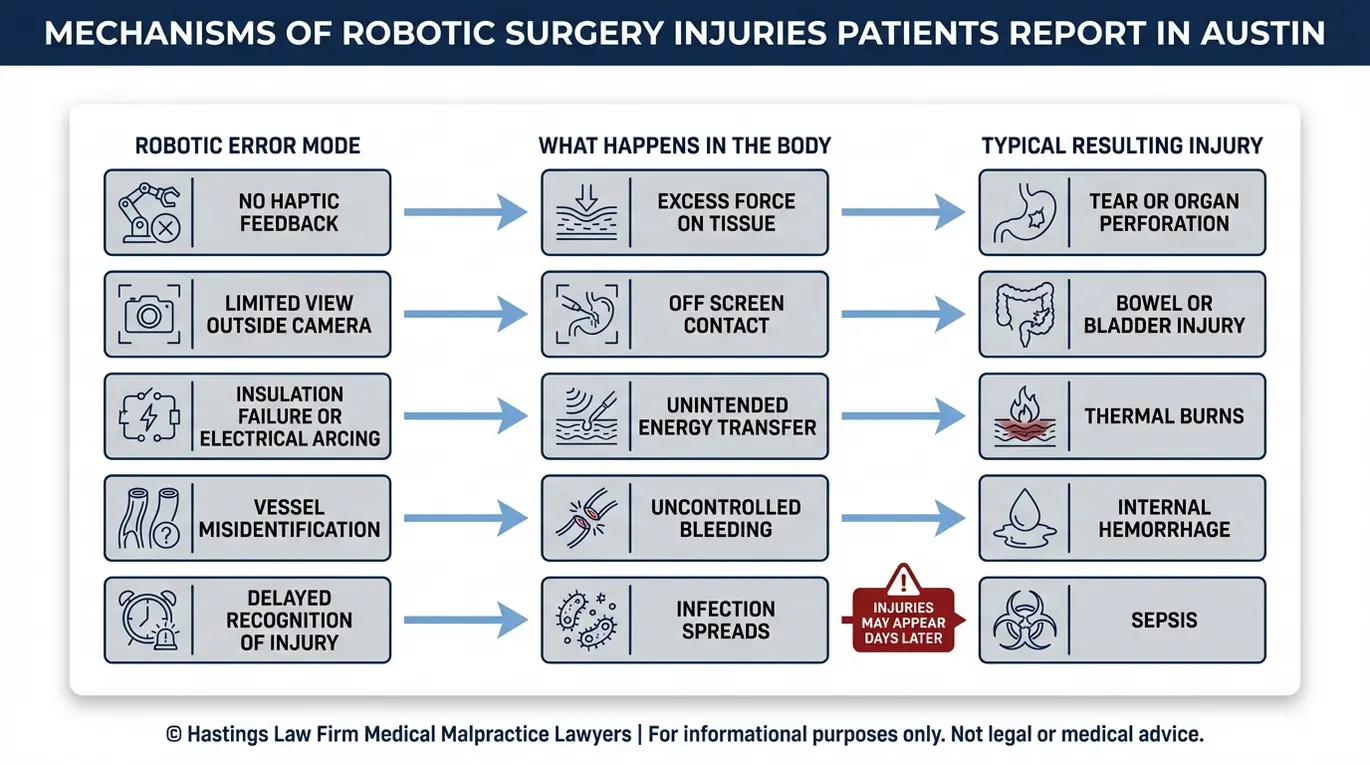
Robotic surgical errors often result in distinct injuries such as thermal burns from uninsulated instruments, organ perforation outside the camera’s view, and severed blood vessels leading to internal hemorrhage. A robotic surgery injury occurs during a procedure using automated tools directed by a surgeon. These injuries differ from traditional surgical complications because the surgeon operates from a console several feet away from the patient, without haptic feedback, the tactile sensation that allows a surgeon to feel tissue resistance, pressure, or tension.
That loss of touch changes everything. Without it, a surgeon may apply too much force to delicate tissue or fail to detect that an instrument has contacted a structure outside the camera’s field of view. Research published through PubMed Central on complications in laparoscopic and robotic-assisted surgery has documented the range of device-related injuries associated with these procedures.
Common injuries linked to robotic surgical errors, often involving platforms like the da Vinci Surgical System, include:
- Organ perforation: Accidental puncture of the bowel, bladder, or ureter that may not be detected during the procedure
- Thermal burns: Caused by electrical arcing, which occurs when stray electrosurgical energy escapes from a damaged or improperly insulated instrument and burns surrounding tissue
- Internal bleeding: Crushed or severed blood vessels that can lead to hemorrhage requiring emergency intervention
- Nerve damage: Compression or severing of nerves due to improper instrument positioning
- Delayed sepsis and infection: Many of these injuries are not immediately apparent and may go undetected for days, allowing infection to spread. Sepsis is a life-threatening reaction to an infection.
Our team in Austin can help determine whether the injury you experienced resulted from a preventable error during the procedure. An experienced lawyer knows that patients are often discharged before symptoms develop, meaning harm only becomes clear once a serious complication like sepsis has already taken hold. Our in-house medical staff, which includes former hospital nurses, reviews surgical records and operative reports to identify exactly when and how the injury occurred.
The Hidden Danger of Inadequate Surgeon Training
Many robotic surgery injuries occur not because the machine failed, but because the surgeon had inadequate training, sometimes allowed to operate after completing only a brief simulation course rather than extensive proctored surgeries, where a qualified instructor supervises the surgeon during live procedures. Surgeon training refers to the specialized education and practice hours required to operate robotic equipment safely.
The da Vinci Surgical System has a well-documented learning curve. This means there is a minimum number of procedures a surgeon must perform before reaching a reliable level of proficiency. Some studies suggest this threshold may be 150 cases. Yet hospital credentialing and privileging, the internal process by which a hospital grants a surgeon permission to use robotic equipment, often fall well below the accepted standard of care.
Silver Cross Hospital’s recommended questions to ask your surgeon before a robotic procedure include asking how many robotic surgeries they have completed. Patients are rarely told how limited their surgeon’s robotic experience may be.
| Training Factor | Traditional Surgery | Robotic Surgery |
|---|---|---|
| Tactile feedback | Direct hand-to-tissue sensation | None at the console |
| Supervised training pathway | Structured residency with years of proctored cases | Varies widely; some hospitals require minimal simulation hours |
| Proficiency benchmarks | Established through residency and board requirements | No uniform FDA-mandated standard |
| Emergency conversion readiness | Standard part of surgical training | Often undertrained; surgeon may struggle to convert to open surgery if complications arise |
Specific Surgeon Training Benchmarks and Deficiencies
The FDA does not regulate how much surgeon training a professional must complete before using a robotic surgical system on a patient. That responsibility falls to individual hospitals, and the standards vary dramatically. Some institutions require only a handful of supervised cases. Others may accept a manufacturer-led simulation course as sufficient.
This gap creates real risk. If a complication develops mid-procedure and the surgeon cannot safely convert to open surgery, a standard manual technique used to manage emergencies, the risk of surgeon error increases. We investigate exactly how much training a surgeon had at the time of the procedure and whether the hospital’s credentialing process was adequate. Medical malpractice cases involving robotic surgery often turn on this question of preparation.
The Hastings Law Firm Difference
Results matter, but what truly sets us apart is how we achieve them. Every verdict, every settlement, and every Austin courtroom victory comes from one guiding promise: To treat each client’s fight for justice as if it were our own.
This balance of skill, experience, and empathy reflects our core philosophy that justice should not only compensate the injured, but also make health care safer nationwide.

Identifying Liability in Robotic Surgery Cases
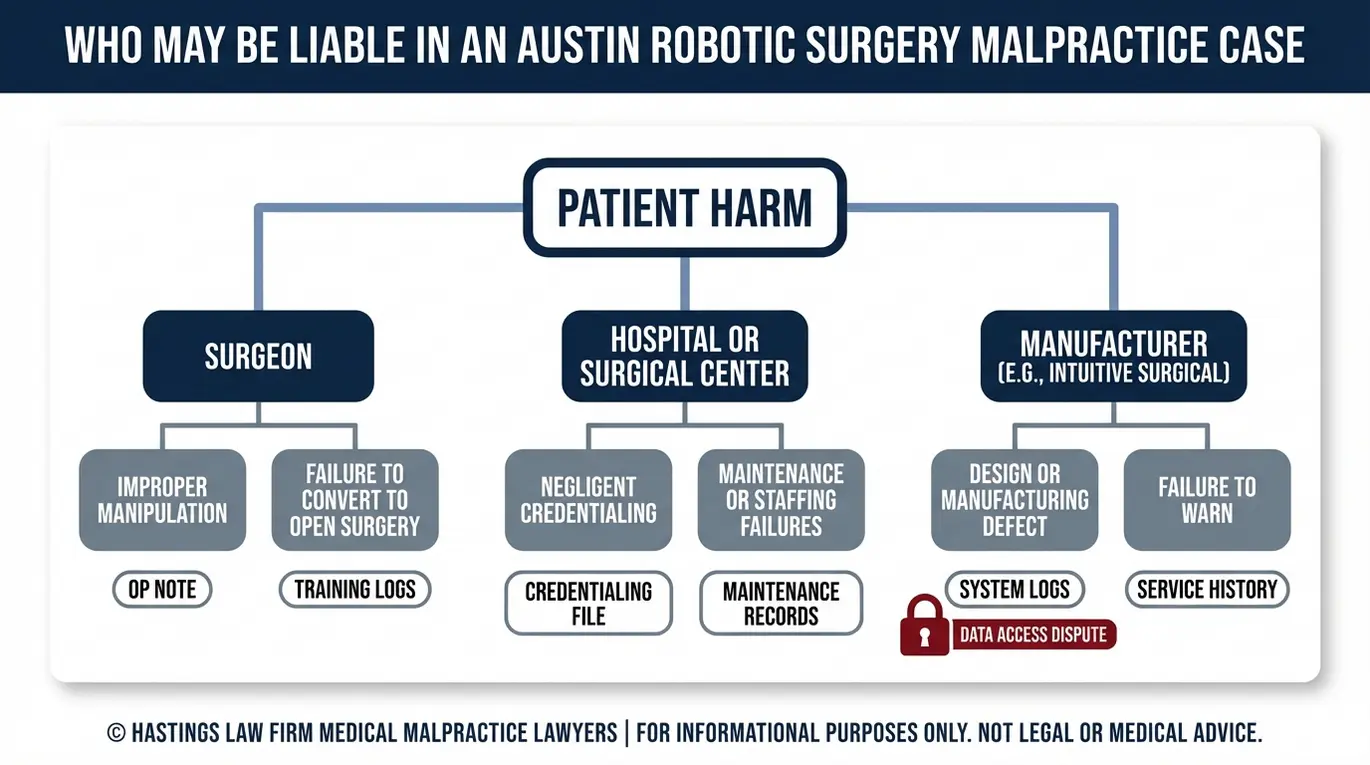
Liability in robotic surgery cases may extend beyond the surgeon to include the hospital for negligent credentialing or the device manufacturer, such as Intuitive Surgical, if a mechanical defect or software glitch caused the injury. Liability identifies who is legally responsible for the damages caused by a medical error. Identifying the liable party requires a careful investigation into the facts surrounding the procedure.
The Surgeon. If a surgeon made errors during manipulation of the robotic arms, failed to recognize a complication, or lacked the training to respond appropriately, the surgeon may be negligent. We examine the operative report, the surgeon’s training history, and expert analysis to evaluate these claims.
The Hospital. Hospitals have a duty to verify that surgeons using robotic systems are properly trained and credentialed. They are also responsible for maintaining the equipment. If a hospital allowed an undertrained surgeon to operate or failed to follow maintenance protocols, it may share responsibility.
The Manufacturer. The da Vinci Surgical System (dVSS), manufactured by Intuitive Surgical, can experience instrument insulation failure. This is where a crack or defect in the protective coating of a surgical instrument allows electrical current to escape and burn tissue the surgeon cannot see. Under Texas Civil Practice and Remedies Code, Chapter 82, product liability claims against manufacturers require proof that the product was defective or that the manufacturer failed to provide adequate warnings.
The Battle for Data Transparency and System Logs
One of the most important pieces of evidence in a robotic surgery case is the system’s electronic data logs, sometimes called the “black box” logs. These robotic system event logs record instrument movements, error codes, power settings, and system alerts generated during the procedure. They can reveal whether an equipment malfunction occurred, whether the system issued warnings the surgical team may have ignored, or whether the timeline of events matches the surgeon’s account.
Obtaining this data is rarely simple. Manufacturers often resist producing it, citing proprietary protections. A lawyer experienced in these cases knows how to compel disclosure through discovery and preserve this evidence before it is overwritten or destroyed.
Proving Negligence and Recovering Compensation
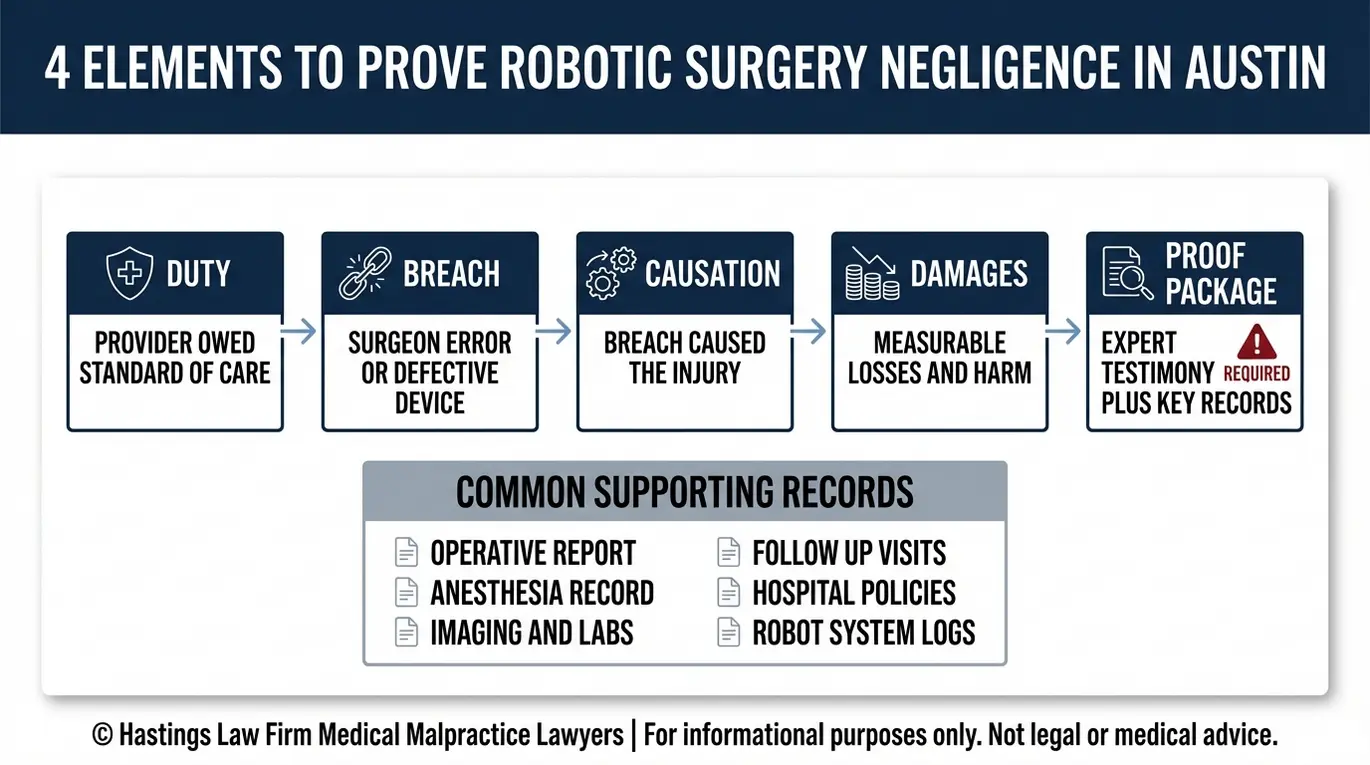
To secure compensation, a patient must prove through expert testimony that the surgeon breached the standard of care or that the device was defective, directly causing damages. Proving negligence involves showing that a medical professional failed to meet the accepted standard of care. We build this case by pairing medical records and system data with expert testimony from qualified robotic surgeons who can explain what should have happened.
Texas law does place limits on certain types of recovery. Under the Civil Practice and Remedies Code, Section 74.301, noneconomic damages in medical malpractice cases are capped. This makes it essential to document the full scope of economic harm.
Damages an Austin lawyer may pursue in a robotic surgery claim include:
- Past and future medical expenses, including corrective surgeries and rehabilitation
- Lost income and diminished earning capacity
- Pain, suffering, and mental anguish
- Physical impairment and disfigurement
- Loss of consortium for spouses
- Wrongful death damages if a loved one did not survive
Our team investigates each case from the outset as if it will go to a jury. We meticulously gather medical records and secure expert opinions to build the evidence needed to pursue full and fair compensation through settlement or verdict.
Contact the Austin Surgical Error Attorneys at Hastings Law Firm Today for Help
If you or a loved one was harmed during a robotic surgical procedure, Hastings Law Firm is ready to help you find out what happened and whether you have a valid claim. Our firm is led by Tommy Hastings, a board-certified trial lawyer who has dedicated his career to representing patients silenced by medical error. We bring a trial-ready approach to every case, preparing from day one with the medical and legal expertise these cases demand.
Your initial consultation is free and confidential. It is led by a patient advocate who will listen to your experience and help determine next steps. We handle cases on a contingency fee basis, meaning you pay no attorney fees unless we recover compensation for you.
Time to file a claim in Texas is limited. Contact us today to schedule your risk-free case evaluation and take the first step toward getting the answers you deserve.
Frequently Asked Questions About Robotic Surgery Malpractice in Austin


This content was researched and written by the Hastings Law Firm editorial team, which includes attorneys, medical professionals, and experienced researchers. Our writing is informed by internal knowledge and practical experience, and we cross-check critical details against authoritative sources cited throughout. Every piece undergoes human-led fact-checking and legal review. Because legal and medical information can change, if you spot an error, please contact us. Learn more about our content standards and review process on our editorial policy page.

Gabe Sassin has focused exclusively on medical malpractice law since 2007. After spending more than a decade as a malpractice defense attorney, he knows exactly how the other side works. He has seen firsthand how healthcare providers, insurers, corporate defendants, and their legal teams think, prepare, and build their defense against claims. That knowledge works for the people who need it most today, injured patients and their families. His unique experience shapes everything he writes, giving readers a look at how these cases actually work from someone who has handled them from both sides.
