


Texas Medical Amputation Lawyer
An unnecessary amputation can follow preventable breakdowns in medical care, leaving lasting effects on mobility, independence, work, and emotional well being. These cases often involve missed warning signs after surgery, delayed treatment of infection, or serious surgical mistakes that compromise blood flow and tissue health. Understanding what went wrong often depends on a clear timeline and careful review of clinical documentation and specialist input. If you or a loved one were harmed or worse due to unnecessary amputation from medical negligence in Texas, contact Hastings Law Firm for a free, confidential case review.

Last Updated: July 27, 2026
Trusted Texas Medical Attorneys for Unnecessary Amputation Claims
Losing a limb to a preventable medical error changes everything. Your mobility, your independence, your ability to work, and your sense of self can all be altered in ways that are difficult to fully describe. If you or a loved one experienced an amputation that should never have happened, the weight of that loss is something we take seriously.
At Hastings Law Firm, we focus exclusively on medical malpractice. Founded by board-certified trial lawyer Tommy Hastings, our firm focuses on medical malpractice and building every case for trial. Our team of attorneys, nurse consultants, and medical staff has the clinical knowledge and litigation experience to investigate whether negligence caused the loss of your limb. As Texas medical amputation lawyers, we understand the medical complexity behind these cases and the life-altering consequences they carry.
If you believe a medical error led to an unnecessary amputation, we can review what happened and explain your legal options at no cost to you.

Common Medical Errors Leading to Preventable Amputation
Medical malpractice leading to amputation often stems from failures in vascular monitoring, untreated infections, or surgical errors that compromise blood flow to a limb. Medical malpractice occurs when a healthcare provider fails to follow the standard of care, which is the accepted level of treatment for a patient. When any of these breakdowns occur and go uncorrected, healthy tissue can deteriorate rapidly, sometimes leaving amputation as the only remaining option.
These are not random complications; they are often instances of wrongful amputation where the medical team failed to act. In many cases, the warning signs were present but either overlooked or not acted on in time. Texas amputation malpractice lawyers investigate whether the medical team met the standard of care, the accepted level of treatment a reasonably competent professional would have provided under similar circumstances. Preventing an unnecessary amputation requires vigilance that is sometimes lacking in busy hospital environments.
Here are some of the most common errors that can lead to wrongful amputation:
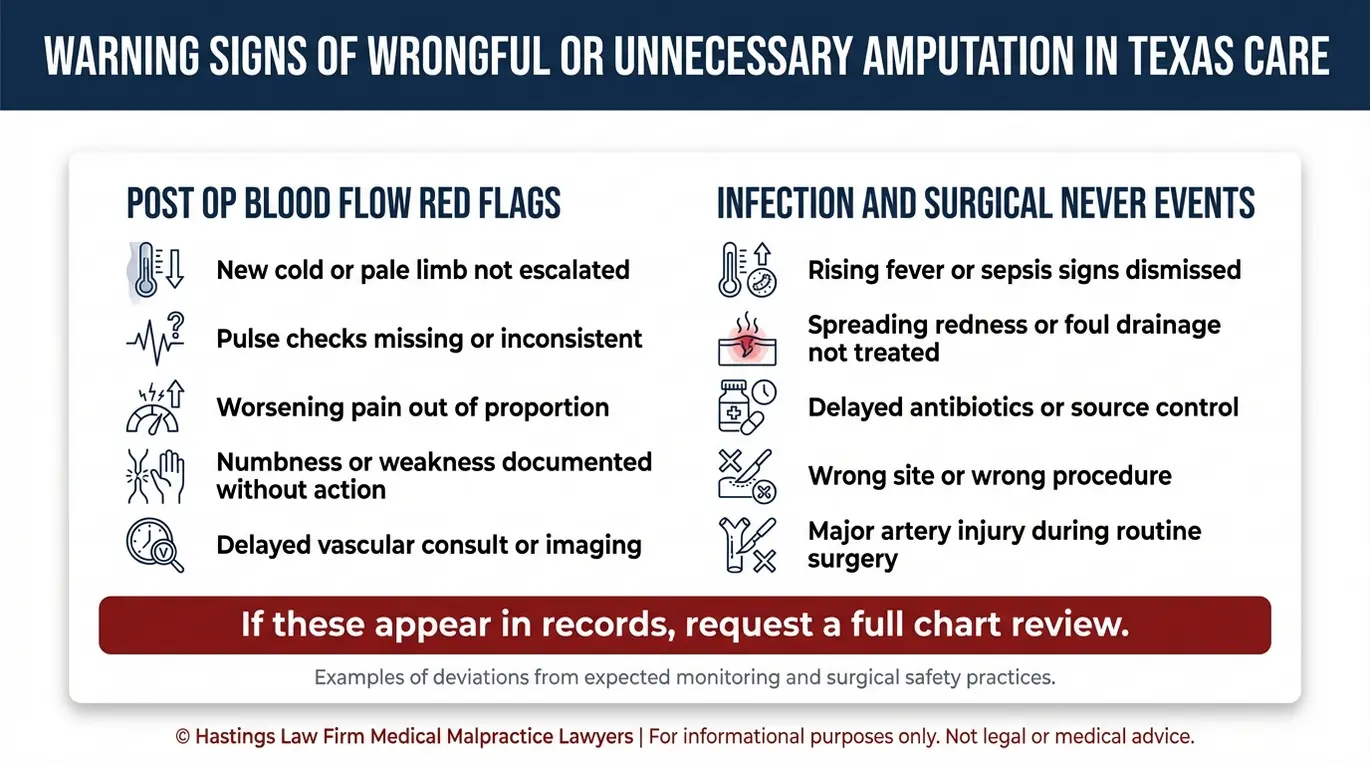
- Failure to monitor blood flow after surgery. After orthopedic or vascular procedures, medical teams are expected to regularly check circulation in the affected limb. A cold extremity, absent pulse, or increasing pain can signal acute limb ischemia, a sudden loss of blood flow to the limb. If these signs go unrecognized, the resulting tissue death, known as necrosis, may make amputation unavoidable.
- Untreated or misdiagnosed infections. What starts as a localized wound infection can escalate to gangrene or sepsis if it is not properly identified and treated. Infections are sometimes dismissed as minor, and that delay can mean the difference between saving a limb and losing it. Clinicians must recognize systemic signs of infection early to prevent the spread of bacteria that destroys tissue and bone.
- Surgical errors, including wrong-site surgery. Wrong-site surgery, the error of operating on the incorrect limb or body part, is a catastrophic failure of protocol. Operating on the wrong limb or accidentally severing a major blood vessel during a routine procedure are considered “never events,” errors so serious they should never occur under any circumstance. According to research published through the Agency for Healthcare Research and Quality’s Patient Safety Network (PSNet), wrong-site surgery continues to occur despite established safety protocols, pointing to breakdowns in verification procedures.
- Undiagnosed blood clots. Thrombosis, the formation of a blood clot within a blood vessel, can silently cut off circulation to a limb. If a clot is not detected and treated promptly, the prolonged lack of blood flow destroys surrounding tissue.
Post-Operative Vascular Monitoring Failures
One of the most preventable causes of unnecessary amputation is the failure to catch vascular compromise in the hours and days following surgery. After procedures involving bones, joints, or blood vessels, nursing staff and physicians are expected to perform regular neurovascular checks. These assessments look for changes in skin color, temperature, sensation, and the strength of the pulse in the affected limb.
When a limb becomes cold, pale, or pulseless, those are urgent signs of acute limb ischemia, a rapid decrease in lower limb blood flow. The window to restore blood flow is narrow. If the care team does not act quickly, tissue damage progresses to necrosis, or permanent tissue death, and once enough tissue has died, amputation may become the only option.
Our team, which includes former hospital nurses, knows exactly what these vascular monitoring protocols require and where charting often falls short. We examine whether pulse checks were documented at proper intervals, whether abnormal findings triggered the appropriate response, and whether the surgical team was notified in time to intervene. When these steps are missed, it constitutes negligence.
Gathering Evidence to Prove Unnecessary Limb Loss
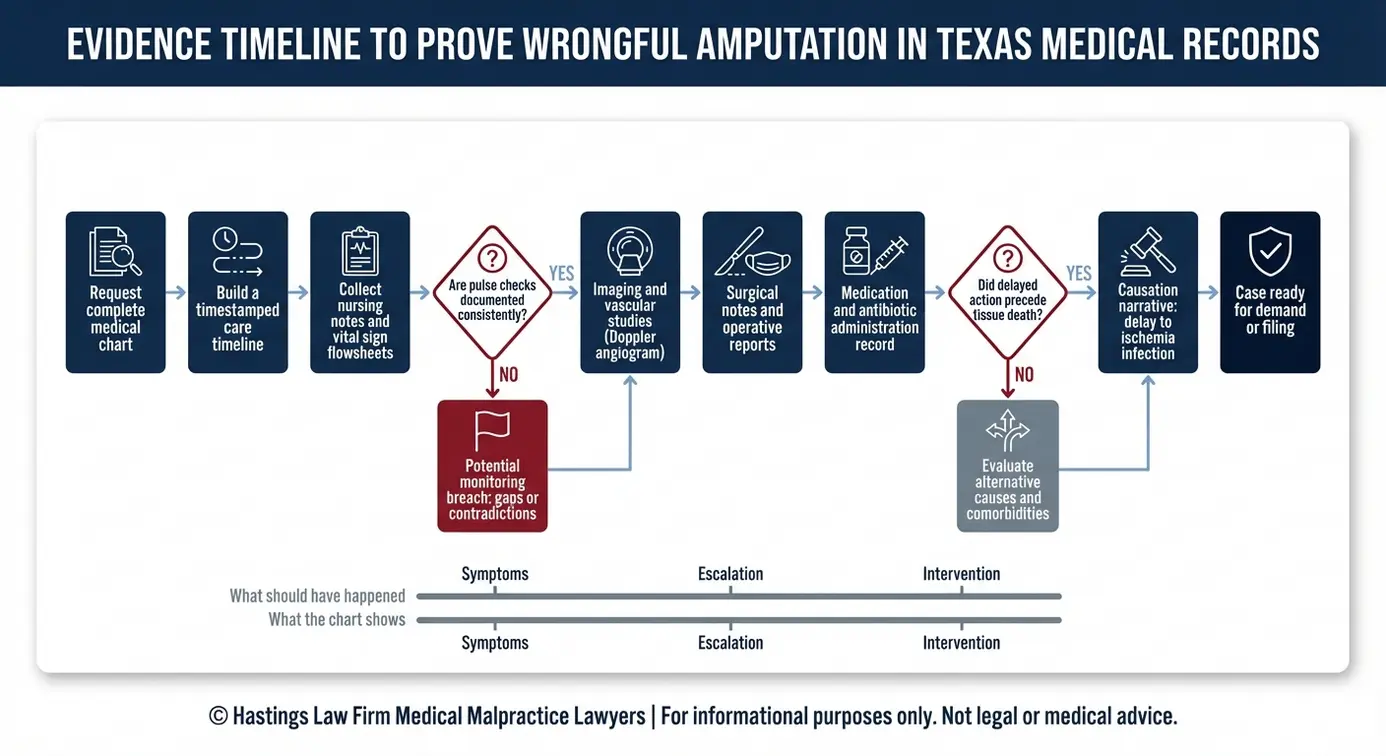
Proving wrongful amputation requires a comprehensive audit of medical records, specifically vascular studies, nursing logs, and surgical notes that document the timeline of tissue deterioration. A vascular study is a medical test used to check the health and function of blood vessels. The goal is to establish exactly when the standard of care was breached and whether earlier intervention could have saved the limb.
This timeline is the backbone of any amputation malpractice case. We need to pinpoint the moment care fell below the accepted standard and then determine whether the injury had already become irreversible at that point, or whether timely action could have changed the outcome. In cases of delayed diagnosis or misdiagnosis, this distinction is critical; if the limb could have been saved when the first symptoms appeared, the delay is primary evidence of malpractice.
Here are some of the critical documents a medical amputation attorney in Texas will examine in a comprehensive audit:
- Nursing notes and vital signs records to identify gaps in pulse checks or signs of deteriorating circulation that were not escalated
- Surgical reports to confirm exactly what was done during the procedure and whether any complications were noted
- Doppler ultrasound results, a non-invasive imaging test that measures blood flow through vessels, to determine whether vascular compromise was identified or missed
- Angiograms, imaging studies that use contrast dye to visualize blood vessel blockages, to confirm whether blood flow was evaluated before the decision to amputate
- Lab results and culture reports that may reveal an infection was present long before it was treated
- Communication logs between nurses, surgeons, and consulting physicians to see whether concerns were raised or ignored
Inconsistencies in charting are especially telling. If pulse checks stop appearing in the nursing notes during a critical window, or if documented findings do not match the clinical outcome, those gaps can become powerful evidence. An expert witness will review these records to confirm that the standard of care was violated. Our in-house medical staff reviews these records line by line, identifying the discrepancies that defense teams hope no one will notice.
The Hastings Law Firm Difference
Results matter, but what truly sets us apart is how we achieve them. Every verdict, every settlement, and every Texas courtroom victory comes from one guiding promise: To treat each client’s fight for justice as if it were our own.
This balance of skill, experience, and empathy reflects our core philosophy that justice should not only compensate the injured, but also make health care safer nationwide.

Using Medical Experts to Validate Amputation Claims
Texas law requires expert testimony to establish that a competent doctor would have acted differently, making credible medical witnesses essential to the success of an amputation claim. Under Texas Civil Practice and Remedies Code § 74.401, expert witnesses in medical malpractice cases must be qualified practitioners in the relevant field of medicine. Under Texas law, these experts help prove that medical negligence caused the injury.
An expert’s role begins with defining the standard of care: the level of care a prudent physician should have provided under the same circumstances. This comparison is necessary to show that a medical error occurred. In amputation cases, that often means ordering a stat vascular consult, an urgent evaluation by a specialist to assess blood flow and determine whether revascularization, a procedure to restore circulation to the threatened limb, was possible.
The expert must also draw a direct line between the specific error and the outcome. It is not enough to show that a mistake was made. The testimony must demonstrate that the delay, misdiagnosis, or surgical error is what caused the amputation, not the underlying disease or injury alone.
Defense teams will almost always present their own experts arguing the amputation was inevitable regardless of what the treating physicians did. Countering that narrative takes preparation.
As an experienced amputation lawyer for medical negligence, our firm works with a national network of vascular surgeons, orthopedic specialists, and infectious disease experts. These specialists speak credibly about what alternative treatments were available and when the window for saving the limb closed. Because we prepare every case as though it will go before a jury, our experts are selected for their clinical credentials and their ability to communicate clearly regarding Chapter 74. Chapter 74 refers to the specific Texas statutes that govern medical malpractice claims.
Compensation for Victims of Medical Amputation Errors
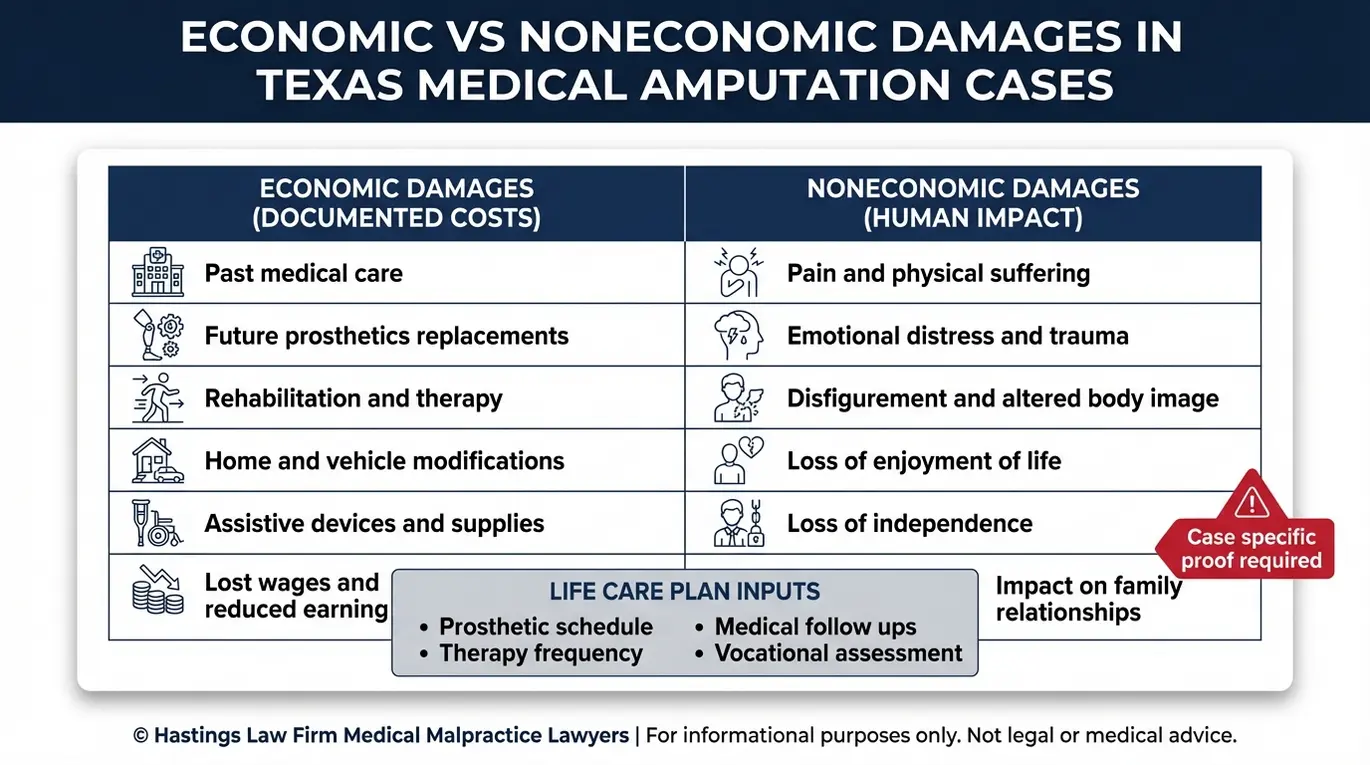
Victims of wrongful amputation are entitled to compensation for both immediate medical costs and lifetime damages, including prosthetics, home modifications, and loss of earning capacity. Most cases involve seeking economic damages, which cover the actual financial losses a patient faces after an injury. Because the effects of an amputation extend across every area of a person’s life, the full scope of damages in these cases is significant.
A prosthetic limb, also called a prosthesis, is not a one-time expense. Most prosthetics need to be replaced every three to five years, and each replacement can cost tens of thousands of dollars. Rehabilitation, physical therapy, and occupational therapy may also be ongoing needs for years after the initial surgery. Many patients also experience phantom limb pain, a condition where the brain continues to perceive pain or sensation in the limb that is no longer there, which can require specialized medical treatment.
The financial impact extends well beyond medical bills. Losing a limb can reduce or eliminate a person’s ability to continue working in their chosen profession. A construction worker, a nurse, a mechanic, or anyone whose job requires full physical capability may face a permanent reduction in earning capacity. We also consider the costs of necessary home modifications, such as widening doorways or installing ramps, and vehicle adaptations that allow for independent transport.
| Economic Damages | Non-Economic Damages |
|---|---|
| Past and future medical expenses | Physical pain and suffering |
| Prosthetic devices and replacements | Emotional distress and mental anguish |
| Rehabilitation and physical therapy | Loss of enjoyment of life |
| Lost wages and lost earning capacity | Disfigurement and physical impairment |
| Home and vehicle modifications | Loss of consortium (for spouses) |
Role of Life Care Planners
Calculating the true cost of living with an amputation requires more than adding up current medical bills. These planners help determine the future financial needs of a patient after a serious injury. Our firm works with life care planners and vocational experts who evaluate the full range of a client’s future needs. These professionals create detailed, evidence-based projections that account for every anticipated expense: prosthetic replacements, follow-up surgeries, mental health care, assistive devices, home modifications, and any career retraining that may be necessary.
A Texas medical malpractice attorney for amputation relies on these expert assessments to present a precise, defensible figure to the jury or during settlement negotiations. Without this level of detail, insurance carriers will argue that future costs are speculative. With it, we can demonstrate exactly what our client will need for the rest of their life.
Why You Need a Trial-Ready Amputation Attorney
Hospitals and insurance carriers aggressively defend amputation claims; hiring a firm that prepares every case for trial forces them to negotiate fairly or face a jury. The stakes in these cases are high, and defense teams know it. Hiring a firm that prepares every case for trial from the beginning forces the other side to negotiate fairly or face a jury.
At Hastings Law Firm, our trial-ready approach means we begin building the evidence, retaining experts, and developing the litigation strategy on day one. We do not wait to see if a case might settle before doing the hard work. That level of preparation sends a clear message to defense counsel that we are not looking for a quick resolution at our client’s expense, often leading to a more favorable settlement offer.
Litigating an amputation malpractice case requires substantial resources. Expert witnesses, life care planners, medical illustrators, and extensive discovery all come at a cost. An amputation malpractice law firm must have the financial capacity to invest in these cases fully, so our clients are never at a disadvantage. With former defense attorneys on our team, we also have direct insight into how hospitals and their insurers build their defense, which allows us to anticipate and counter those strategies early.
Contact the Texas Surgical Error Attorneys at Hastings Law Firm Today for Help
No one should have to live with the loss of a limb because of a preventable medical error. If you suspect that negligence played a role in your amputation or the amputation of someone you love, you deserve answers.
As a trusted Texas medical amputation lawyer, Hastings Law Firm offers free, confidential case evaluations led by our medical and legal team. We will review your records, help you understand what may have gone wrong, and explain whether you have a path to recovery.
You pay nothing unless we win your case. There is no financial risk in reaching out, and the information you gain could make all the difference. Contact us today to take the first step.
Frequently Asked Questions About Medical Amputation in Texas


This content was researched and written by the Hastings Law Firm editorial team, which includes attorneys, medical professionals, and experienced researchers. Our writing is informed by internal knowledge and practical experience, and we cross-check critical details against authoritative sources cited throughout. Every piece undergoes human-led fact-checking and legal review. Because legal and medical information can change, if you spot an error, please contact us. Learn more about our content standards and review process on our editorial policy page.

Gabe Sassin has focused exclusively on medical malpractice law since 2007. After spending more than a decade as a malpractice defense attorney, he knows exactly how the other side works. He has seen firsthand how healthcare providers, insurers, corporate defendants, and their legal teams think, prepare, and build their defense against claims. That knowledge works for the people who need it most today, injured patients and their families. His unique experience shapes everything he writes, giving readers a look at how these cases actually work from someone who has handled them from both sides.
