


Texas Wrong Patient Surgery Malpractice Lawyer
Written by: Hastings Law Firm | Reviewed by: Brady D. Williams | Updated: July 27, 2026
Wrong patient surgery is a preventable medical error that can leave someone facing unnecessary procedures, added complications, and lasting emotional trauma. These events often stem from breakdowns in patient identification, communication during hand offs, or electronic record mix ups that allow a team to proceed without proper verification. Because the procedure was not needed or consented to, the harm can feel like a profound violation of trust and bodily autonomy, with anxiety about future care. If you or a loved one were harmed or worse due to wrong patient surgery malpractice in Texas, contact Hastings Law Firm for a free, confidential case review.

Trusted Texas Medical Attorneys for Wrong Patient Surgery Negligence Claims
What You Should Know About Surgery on Wrong Patient Negligence Claims in Texas:
- Harm can be severe when a person undergoes an unnecessary operation that was intended for someone else.
- Emotional distress can be significant after a wrong patient procedure because it can feel like a violation of bodily autonomy and trust.
- Liability disputes may be narrower in wrong patient surgery events because operating on the wrong person is treated as a Never Event.
- Recovery options can be lost if the filing deadline is missed even when negligence appears clear.
- Compensation can include medical expenses, lost wages, pain and suffering, and emotional distress when negligence causes injury.
- Additional damages may be available when conduct is especially reckless such as ignoring multiple safety checkpoints.
- Hospital responsibility can be a central issue because liability may depend on employment relationships and hospital level safety failures.
- Preventable causes can drive accountability findings when identification and verification steps are skipped such as wristband checks and two identifier confirmation.
- Evidence can be harder to secure later because operating room video, equipment logs, and staff communications may be lost or overwritten.
- Record accuracy can be disputed when electronic charting errors or audit trail changes affect what the care team relied on.

A Healthcare Focused Law Firm
If you or someone you love underwent surgery that was meant for a different patient, the confusion and anger you feel right now are completely understandable. This type of error should never happen. It raises serious questions about how the surgical team identified and verified their patient before making the first incision.
Texas wrong patient surgery malpractice cases involve preventable failures in basic safety protocols. When those protocols break down, patients are left dealing with injuries, emotional trauma, and a deep loss of trust in their medical providers.
At Hastings Law Firm, our team of attorneys and nurse consultants focuses exclusively on medical malpractice. We can review what happened, explain your options, and help you understand whether you have a case. Contact us for a free, confidential evaluation.
Defining Wrong Patient Surgery Malpractice in Texas Hospitals
Wrong patient surgery is a distinct form of medical negligence classified as a “Never Event,” meaning a surgical procedure was performed on someone other than the intended patient because of identification failures. Medical negligence occurs when a healthcare provider fails to meet the accepted standard of care.
Founded by board-certified trial attorney Tommy Hastings in 2005, our firm focuses exclusively on holding providers accountable for these departures from safety. We represent patients who feel betrayed by the system and work to find the truth about what happened during their care.
Never Event: A term introduced by the National Quality Forum to describe errors so serious and preventable that they should never occur in a healthcare setting.
A Sentinel Event, an unexpected occurrence flagged by the Joint Commission involving death or serious harm, requires an immediate investigation.
When surgery is performed on the wrong patient, the breach of the standard of care, the level of treatment a reasonably competent medical team would provide under similar circumstances, is typically self-evident. In legal terms, proving this breach is the first hurdle in a claim. Unlike many malpractice cases where experts debate complex medical decisions or whether the provider’s actions were reasonable, wrong patient surgery malpractice leaves little room for that argument. The error itself, operating on a person who did not consent to or require that procedure, tells the story of negligence.
According to the Agency for Healthcare Research and Quality’s Patient Safety Network (PSNet), wrong patient and wrong site surgeries remain a persistent safety concern despite decades of prevention efforts.
Beyond the physical harm, these errors carry a profound psychological weight. Patients who trusted a hospital to care for them often feel betrayed by the system that was supposed to protect them. That emotional toll, the loss of trust, and the anxiety about future medical care constitute a real part of the damage surgery on the wrong patient causes. Patients often require therapy to cope with the violation of their bodily autonomy.
Common Causes of Surgery on the Wrong Patient
Most wrong patient surgeries result from communication breakdowns, failure to follow the Universal Protocol, or bypassing patient verification steps like wristband scanning. The Universal Protocol is the mandatory safety checklist for all surgical teams. It requires pre-procedure verification, surgical site marking, and a final time-out before every operation.
Two-identifier verification, confirming the patient’s name and date of birth, is the most basic safeguard in this process. When any part of this chain is skipped or rushed, the risk of mistaken identity surgery increases dramatically. The most common breakdowns in Texas wrong patient surgery malpractice cases include:
- Patient identification failures: Staff ignore or misread wristbands, skip barcode scanning, or fail to confirm identity using two separate identifiers before the patient enters the operating room.
- Communication errors during hand-offs: Critical information is lost or distorted as the patient moves between pre-op, anesthesia, and the surgical team.
- Electronic health record (EHR) mix-ups: Digital charting errors where one patient’s file is opened under another patient’s name, leading the surgical team to rely on the wrong medical history and operative plan.
- Systemic throughput pressure: High patient volume and tight scheduling can push staff to cut corners on verification steps that feel routine but exist for exactly this reason.
The Office of the National Coordinator for Health Information Technology (HealthIT.gov) has published safety guidance specifically addressing patient identification risks in electronic systems, underscoring how common these digital errors have become.
The Role of Systemic Pressure in Surgical Errors
When hospitals prioritize speed and patient turnover, safety protocols are often the first thing to suffer. Operating rooms running back-to-back procedures under tight schedules create an environment where a time-out may be shortened or treated as a formality rather than a genuine safety check. These systemic pressures do not excuse the error, but they help explain how a mistake this serious can happen in a modern hospital.
The Hastings Law Firm Difference
Results matter, but what truly sets us apart is how we achieve them. Every verdict, every settlement, and every Texas courtroom victory comes from one guiding promise: To treat each client’s fight for justice as if it were our own.
This balance of skill, experience, and empathy reflects our core philosophy that justice should not only compensate the injured, but also make healthcare safer nationwide.

Types of Surgical Errors Involving Patient Misidentification
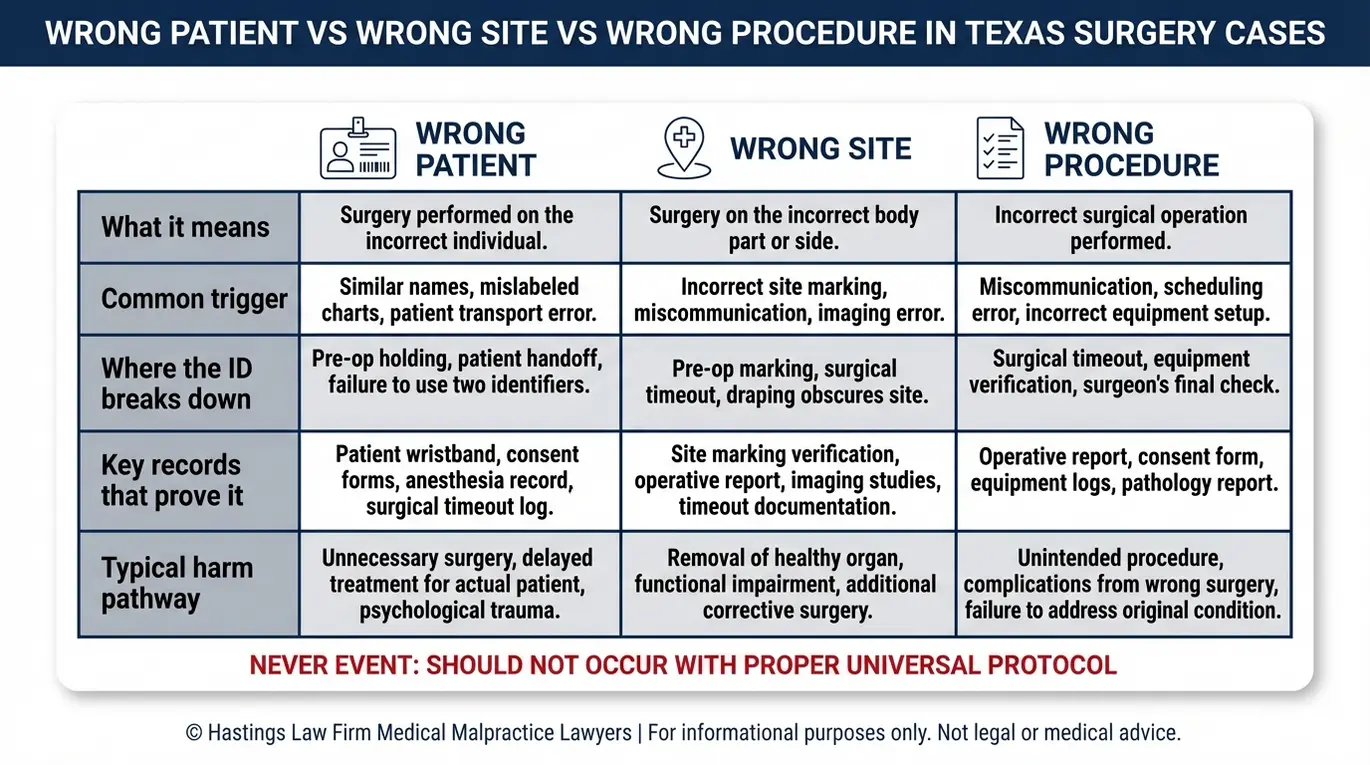
These errors range from performing an invasive procedure on the entirely wrong patient to wrong site surgery, a scenario where the procedure is performed on the wrong body part, often because of chart mix-ups. Electronic health records (EHR) are the digital versions of a patient’s medical history, and mistakes in these files often lead to misidentification.
| Error Type | What Happens | How It Typically Occurs |
|---|---|---|
| Wrong Patient Surgery | Patient A receives a procedure intended for Patient B | Identity verification failures, wristband errors, EHR chart swap, where one patient’s electronic file is mistakenly opened or merged with another’s |
| Wrong Site Surgery | Correct patient, but the procedure is done on the wrong body part or side | Site marking errors, contradictory laterality notes in the chart |
| Wrong Procedure | Correct patient, but an entirely different operation is performed | Consent form mix-ups, scheduling errors, miscommunication between teams |
In some Texas wrong patient surgery malpractice cases, the error involves a complete identity swap. One patient is taken to an operating room and given another patient’s surgery entirely. In others, the mistake is more subtle but equally harmful. Biopsy or lab specimen mix-ups, for example, can lead to devastating consequences.
A healthy patient may undergo unnecessary treatment, including major surgery, based on pathology results that actually belonged to someone else. Such oversights constitute clear wrong patient negligence. Gender-based wrong patient errors represent some of the most alarming examples of malpractice. When a procedure specific to one sex is initiated on a patient of the opposite sex, it signals a failure so fundamental that the surgical team did not look at the person on the table.
Steps to Take After Discovering a Wrong Patient Procedure
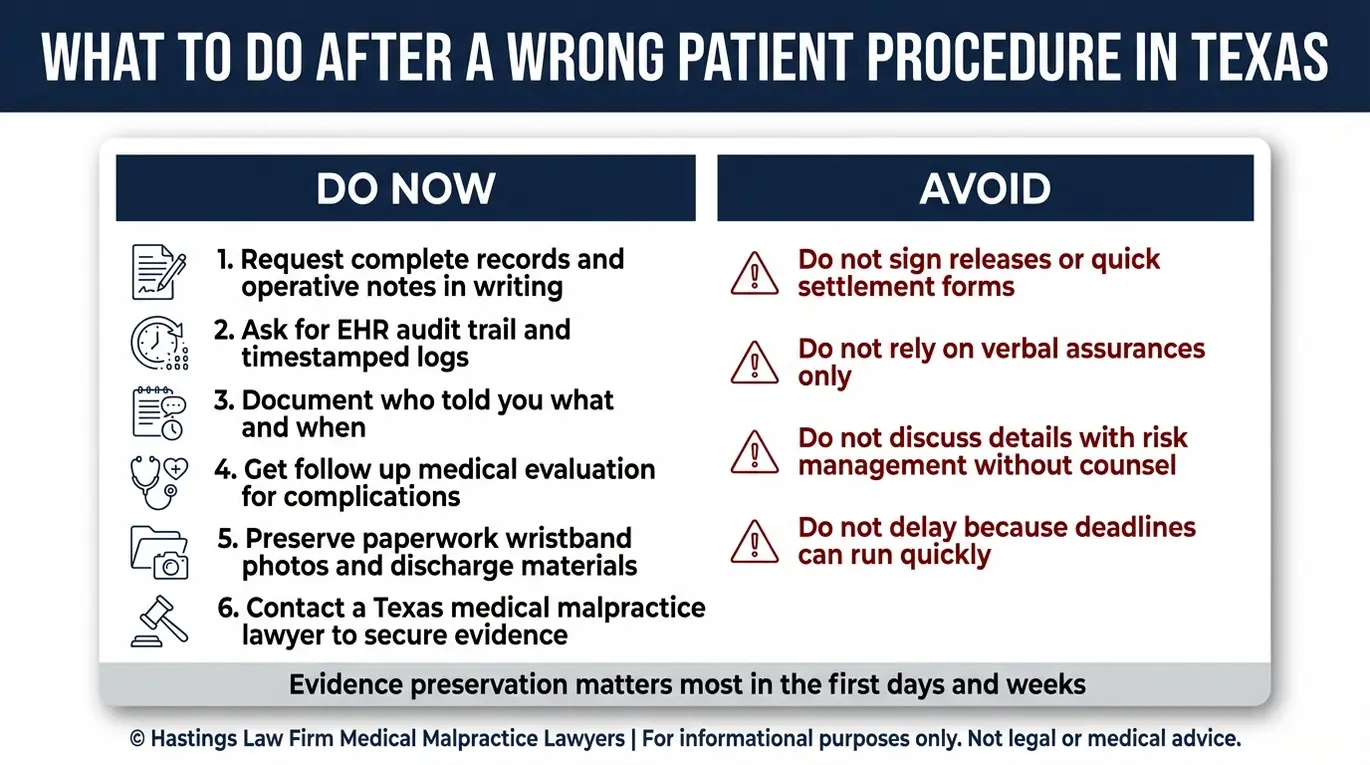
Victims should immediately request their full medical records, refuse to sign any liability waivers or settlement offers from the hospital risk management team, and contact a malpractice attorney for evidence preservation. Operative notes are the detailed medical reports that document who was present and what occurred during surgery. Following these steps helps protect your health and your legal rights:
- Request your complete medical records right away. Under Texas law, patients have the right to access their medical records, including operative notes. Requesting these records quickly helps preserve the original documentation in the medical chart before any changes occur. Electronic health records contain audit trails that can show if entries were altered after the fact.
- Do not sign anything from the hospital’s risk management team. After a serious error, hospital administrators or risk managers may approach you with forms, waivers, or early settlement offers. They may attempt to mislead you or minimize the error to protect the hospital’s interests. You are not obligated to sign any of these. Politely decline until you have spoken with an attorney.
- Do not provide recorded statements. You may be asked to describe what happened or to agree to a recorded conversation. Anything you say could be used later to minimize the hospital’s responsibility.
- Contact a Texas wrong patient surgery malpractice attorney as soon as possible. Early legal representation matters because critical evidence, such as operating room video, equipment logs, and staff communications, may be lost or overwritten if not preserved through a formal legal hold. The sooner your attorney acts, the stronger your wrong patient malpractice claim will be when suing for wrong patient surgery.
Proving Liability for Wrong Patient Operations Under Texas Law
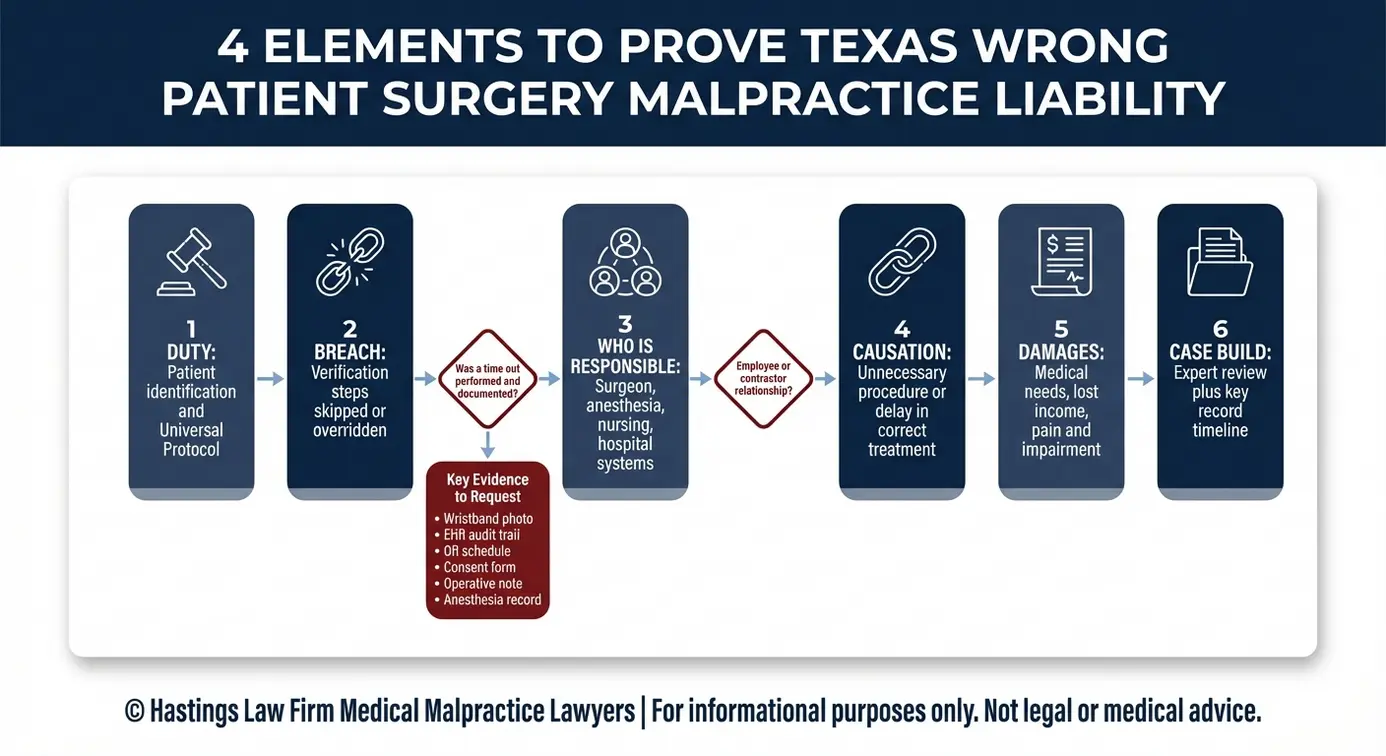
Liability is proven by demonstrating that the surgical team breached the Universal Protocol and the standard of care, directly causing harm to the patient through negligence. In a Texas wrong patient surgery malpractice case, this analysis follows four connected elements: duty, breach, causation, and damages.
Duty and Breach are the core concepts used to determine if a provider failed a patient. Every member of the surgical team owes a duty of care to correctly identify the patient via pre-procedure verification before any procedure begins. Because wrong patient surgery is classified as a Never Event, establishing the breach is often more straightforward than in other malpractice cases.
Nurse Responsibility. Our team, which includes nurse practitioners and Board Certified Patient Advocates, reviews every detail to determine if the staff failed to advocate for safety. Nurses have an independent duty to verify patient identity and to speak up if something does not match. Under Texas law, registered nurses are expected to exercise professional judgment. The Texas Board of Nursing’s Scope of Practice guidelines make clear that nurses carry their own legal obligation to the patient.
Causation. The unnecessary surgery must be directly linked to specific harm. Causation is the direct cause of the injury and is the legal requirement to show that the medical error led to the damage. This includes new injuries caused by the procedure itself, complications from anesthesia, or delayed treatment for the patient’s actual condition.
Damages. Proving negligence in wrong patient surgery can support claims for medical expenses, lost wages, pain and suffering, and emotional distress. In cases involving especially reckless conduct, such as ignoring multiple safety checkpoints, punitive damages may also be available as an element of liability for wrong patient errors. Our team reviews operating room logs and builds the medical and legal foundation for each element.
Statute of Limitations for Wrong Patient Surgery Claims
In Texas, the wrong patient surgery statute of limitations generally gives patients two years from the date of the surgery to file a claim. Missing this deadline almost always means losing the right to seek compensation, regardless of how clear the negligence was.
Texas does recognize a discovery rule, which can extend this timeline if the error was concealed or not immediately apparent. The discovery rule allows the clock to start when the patient should have reasonably known about the error. However, in most wrong patient surgery cases, the mistake is discovered quickly, so the statute of limitations standard two-year clock typically applies.
There are limited exceptions. Claims involving minors may be paused until the child reaches a certain age. Cases involving patients who were incapacitated at the time of the error may also qualify for an extension.
Warning: Texas imposes a hard outer limit of ten years, after which no medical malpractice claim can be filed regardless of when the error was discovered.
Because filing a wrong patient malpractice suit also requires a pre-suit notice letter and a qualified expert report, strict legal deadlines mean waiting too long can make it impossible to meet all requirements in time. Early legal consultation is the safest approach for your wrong patient surgery malpractice claim.
How Texas Hospitals Should Prevent Wrong Patient Errors
Prevention requires strict adherence to the Joint Commission’s Universal Protocol, including mandatory time-outs, dual-identifier verification, and site marking with patient involvement. A surgical time-out is a mandatory pause where the entire operating team confirms the patient identity and procedure aloud.
The Universal Protocol has three core steps. First, a pre-procedure verification confirms the right patient, the right procedure, and the right site using documents, imaging, and patient input. Second, the surgical site is physically marked by the provider performing the procedure, ideally with the patient’s active participation. Third, a surgical time-out, a deliberate pause taken by the entire operating room team immediately before the first incision, is conducted aloud to confirm details.
One underappreciated risk involves contradictory site marking. An “X” placed on a body part may mean “wrong side, do not cut here” to one team member and “operate here” to another. The National Center for Biotechnology Information (NCBI) notes that standardized marking systems are essential to patient safety and wrong patient surgery prevention.
Barcode scanning, the use of electronic scanners to match a patient’s wristband to their medical record, adds another layer of verification. Patients themselves can also help by confirming their identity and procedure when asked and by speaking up if any detail seems incorrect.
Contact the Texas Surgical Error Attorneys at Hastings Law Firm Today for Help
Surgery on the wrong patient is a violation of fundamental medical safety standards. If this happened to you or someone in your family, you deserve answers and a legal team that understands exactly how to get them.
As a board-certified specialist in Personal Injury Trial Law, Tommy Hastings ensures every case is trial-ready. At Hastings Law Firm, our attorneys, nurse consultants, and medical staff work exclusively on medical malpractice cases. We have the medical knowledge and litigation experience to investigate Texas wrong patient surgery malpractice claims thoroughly and identify every responsible party.
We work on a contingency fee basis, which means you pay no attorney fees unless we recover compensation for you. Your initial consultation is free and confidential. A contingency fee arrangement allows you to pursue justice without upfront legal costs.
If you are ready to talk about what happened, contact our wrong patient surgery lawyers today. We will review your situation, explain your legal options, and help you take the first step forward.
Frequently Asked Questions About Wrong Patient Surgery Malpractice in Texas


This content was researched and written by the Hastings Law Firm editorial team, which includes attorneys, medical professionals, and experienced researchers. Our writing is informed by internal knowledge and practical experience, and we cross-check critical details against authoritative sources cited throughout. Every piece undergoes human-led fact-checking and legal review. Because legal and medical information can change, if you spot an error, please contact us. Learn more about our content standards and review process on our editorial policy page.

Brady D. Williams is a nationally recognized medical malpractice attorney who has spent his career handling high-stakes litigation for injured patients and families across the country. Licensed in both Texas and California, Brady draws on experience from hundreds of resolved medical cases to break down complex legal and medical topics for the people who need that information most. His writing reflects the same attention to detail and commitment to clarity that he brings to every case he handles.
