


Texas Laparoscopic Surgery Error Lawyer
Laparoscopic surgery is often described as less invasive, but preventable mistakes can still cause severe harm or worse. Distinguishing a known complication from a breach of the standard of care often turns on what happened during the procedure and how quickly problems were recognized and treated. Common concerns include poor visualization, injuries during instrument entry, delayed response to bleeding or infection, and failure to convert to open surgery when safety requires it. If you or a loved one were harmed or worse due to laparoscopic surgery errors in Texas, contact Hastings Law Firm for a free, confidential case review.
Last Updated: July 27, 2026
Trial-Ready Legal Representation for Surgical Injuries in Texas
Laparoscopic surgery is often presented as a safer, less invasive alternative to traditional open procedures. When it goes well, patients benefit from smaller incisions, shorter recovery times, and less pain. But when a surgeon makes a preventable error during one of these procedures, the consequences can be severe, sometimes life-threatening.
If you or a loved one experienced a serious complication after a laparoscopic procedure, you may be wondering whether what happened was a known risk or the result of a medical mistake. That distinction matters, and it is not always easy to sort out on your own. A Texas laparoscopic surgery error lawyer can review your medical records, consult with qualified surgical experts, and help you understand whether negligence may have contributed to your injury.
At Hastings Law Firm, our team includes in-house nurse consultants and former defense attorneys who know how to identify surgical errors that others might overlook. We use this unique background to anticipate defense tactics and identify charting inconsistencies. If something doesn’t feel right about your care, we encourage you to reach out for a free, confidential case evaluation so we can help you find answers.

What Constitutes Laparoscopic Surgery Malpractice in Texas
Laparoscopic malpractice occurs when a surgeon deviates from the accepted standard of care during a minimally invasive procedure, resulting in preventable harm such as organ perforation, vascular injury, or failure to diagnose post-operative complications.
The standard of care is the level of treatment a reasonably competent surgeon with similar training would provide under the same circumstances. In laparoscopic and keyhole surgery, that standard includes specific safety protocols: ensuring proper visualization of the surgical field, using safe techniques during trocar insertion (the placement of narrow, pointed instruments through small incisions to access the abdomen), and maintaining a controlled pneumoperitoneum, which is the inflation of the abdomen with gas to create working space for the camera and instruments.
Our firm has focused exclusively on medical negligence litigation since 2005. This specialization allows our team to identify patterns of error that general firms might miss. Under Texas Civil Practice and Remedies Code Chapter 74, medical negligence claims require proof that the surgeon’s conduct fell below accepted medical standards and directly caused the patient’s injury.
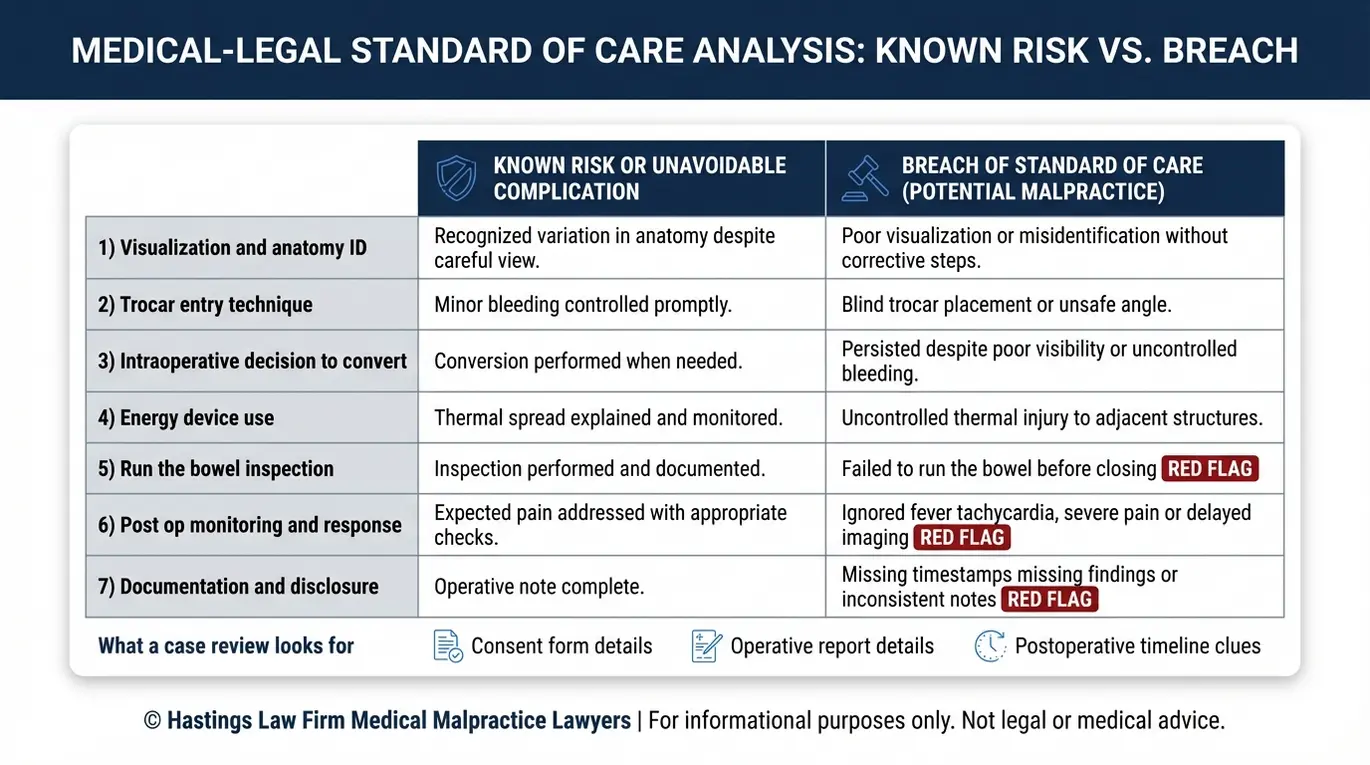
Not every bad outcome is malpractice. Surgery carries inherent risks, and patients consent to those risks before the procedure. The legal question a laparoscopic surgery error attorney evaluates is whether the injury resulted from a known complication or a breach of the standard of care.
| Factor | Known Complication | Potential Negligence |
|---|---|---|
| Pre-surgical disclosure | Risk was explained and patient gave informed consent | Risk was not disclosed, or the specific error was not a standard risk of the procedure |
| Surgeon conduct | Proper technique was followed; complication occurred despite reasonable care | Deviation from accepted surgical protocols or safety steps |
| Detection and response | Complication was identified and treated promptly during or after surgery | Injury was missed, ignored, or treatment was delayed |
| Training and experience | Surgeon was qualified and experienced with the specific procedure | Surgeon lacked adequate training or attempted a procedure beyond their skill level |
Common Errors During Laparoscopic Procedures
The most frequent errors involve accidental perforation of the bowel or blood vessels during trocar entry, mistaking anatomy due to poor visualization, and burning adjacent tissues with electrosurgical tools.
These errors can happen across a range of minimally invasive procedures, but certain patterns appear consistently in cases handled by a surgical error lawyer:
- Bowel or organ perforation: A trocar or surgical instrument nicks the intestine or another organ. If not detected and repaired immediately, even a small perforation can lead to peritonitis, a dangerous abdominal infection, or sepsis.
- Bile duct injury: A bile duct injury, which is damage to the drainage system of the gallbladder, is one of the most well-documented risks during laparoscopic cholecystectomy (gallbladder removal). According to NCBI’s clinical overview of bile duct injuries, these injuries often result from misidentification of the biliary anatomy. Surgeons are expected to achieve what is known as the critical view of safety (CVS), a specific dissection technique that clearly identifies the cystic duct and artery before any cutting or clipping occurs.
- Visualization errors: The surgeon operates by viewing the abdominal cavity through a laparoscope, a small camera inserted through one of the incisions. Misreading the anatomy on screen, whether due to poor camera angle, fogging, or inadequate pneumoperitoneum, can lead to cutting the wrong structure entirely.
- Retained foreign objects: Surgical instruments, sponge fragments, or clips left inside the body after the procedure.
- Wrong-site surgery: Operating on the wrong organ or the wrong side of the body.
A lawyer for laparoscopic errors works with medical experts to determine whether the surgeon followed established safety protocols and whether the injury could have been prevented. If you suspect negligence, a Texas laparoscopic surgery error lawyer can help investigate the details of your procedure.
Failure to Run the Bowel and Detect Perforations
One of the most telling signs of surgical negligence involves the failure to “run the bowel.” A bowel run is a safety step where the surgeon visually inspects the length of the intestine before closing to check for nicks, burns, or other damage that may have occurred during the procedure.
A bowel perforation, a puncture in the intestinal wall that goes undetected at the time of surgery, can cause contents to leak into the abdominal cavity. This often leads to peritonitis and severe infection, sometimes not presenting symptoms until hours or days after the patient has been discharged.
When a surgical error lawyer reviews these cases, we examine whether post-operative monitoring was adequate and whether the surgeon completed this inspection before closing. This investigation helps determine if the injury was a preventable mistake.
The Hastings Law Firm Difference
Results matter, but what truly sets us apart is how we achieve them. Every verdict, every settlement, and every Texas courtroom victory comes from one guiding promise: To treat each client’s fight for justice as if it were our own.
This balance of skill, experience, and empathy reflects our core philosophy that justice should not only compensate the injured, but also make health care safer nationwide.

Liability When Surgeons Fail to Convert to Open Surgery
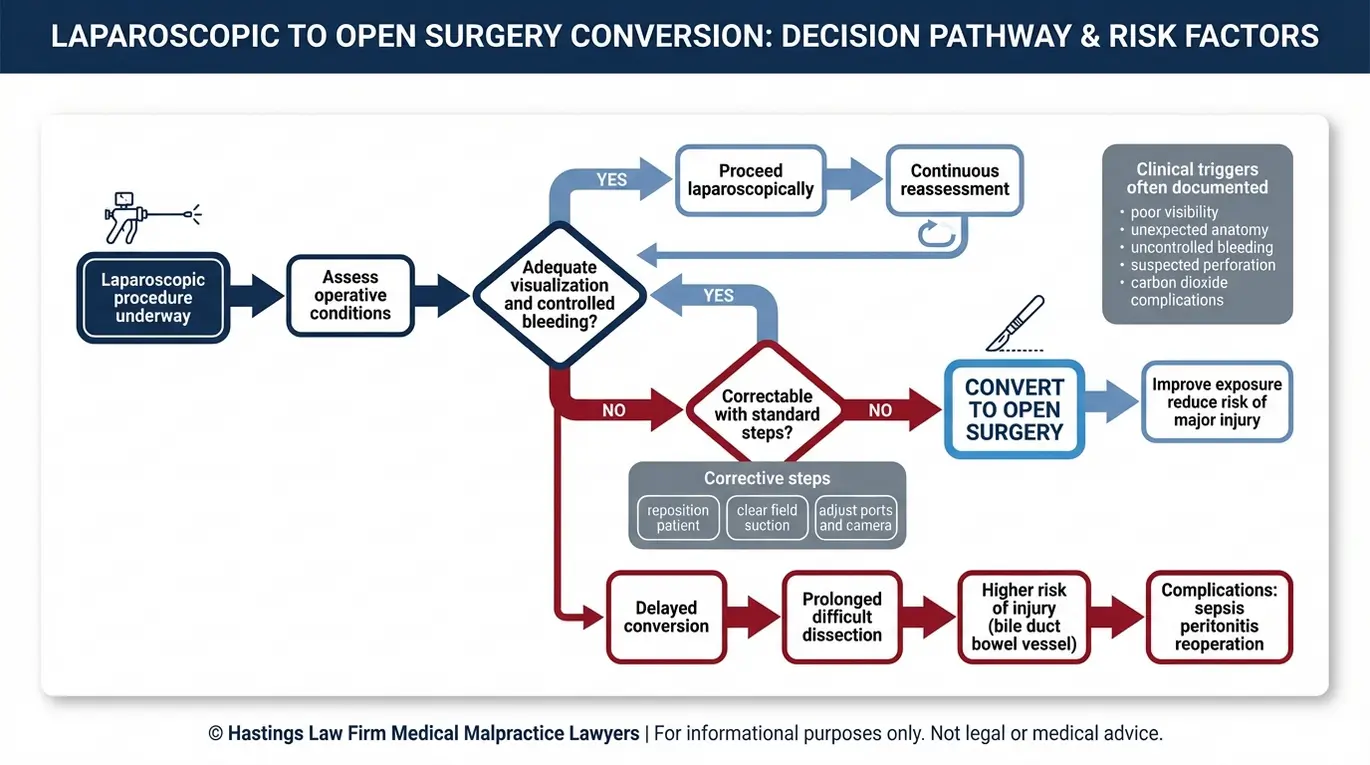
Liability arises if a surgeon persists with a laparoscopic approach despite poor visibility, excessive bleeding, or anatomical complications that demand an immediate switch to a traditional open incision to ensure patient safety.
A conversion to open surgery involves a surgeon moving from the laparoscopic approach to a traditional larger incision to fix complications or gain better visibility. This choice is a recognized safety measure. The choice to continue with a laparoscopic approach when conditions change or visibility is compromised can result in severe injury.
The standard of care generally requires conversion when the surgeon cannot safely complete the procedure through the laparoscope. According to the NCBI’s review of complications of laparoscopic surgery, delayed conversion is a documented source of preventable surgical injuries.
Prolonged laparoscopic procedures also carry their own risks. The carbon dioxide gas used to inflate the abdomen and create the pneumoperitoneum can cause complications if insufflation continues too long. A CO2 gas embolism, a condition where gas enters the bloodstream, is rare but potentially fatal.
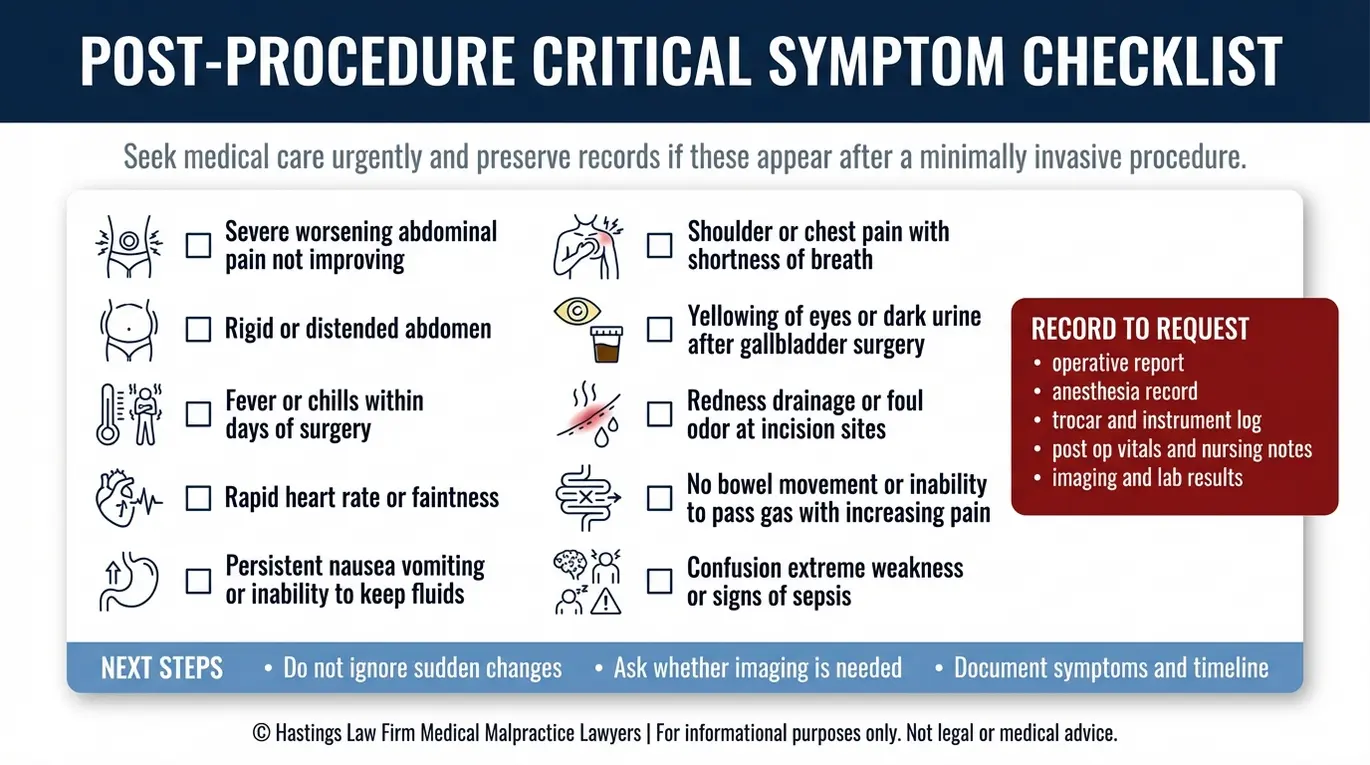
A laparoscopic malpractice lawyer evaluates whether the operative timeline, the surgeon’s documented observations, and the decision-making process reflect reasonable clinical judgment. When post-operative signs of infection, such as fever, escalating pain, or abdominal distension, are ignored after a difficult procedure, that delay in diagnosis can compound the original surgical error. These failures to act when conditions deteriorate create additional grounds for a Texas laparoscopic surgery error lawyer to pursue a medical negligence claim.
Compensation for Victims of Botched Minimally Invasive Surgery
Victims may recover damages for additional surgeries, prolonged hospital stays (ICU), lost wages, permanent impairment, and non-economic damages like physical pain and mental anguish.
Economic damages cover the measurable financial costs caused by the error:
- Emergency treatment and ICU care for complications like sepsis or peritonitis
- Corrective or reconstructive surgeries
- Extended rehabilitation and follow-up care
- Lost income during recovery, including reduced future earning capacity
Non-economic damages address the personal toll of the injury:
- Chronic pain and physical suffering, including pain and suffering from complications
- Mental anguish and emotional distress, particularly when a procedure described as “routine” results in a life-altering injury
- Loss of enjoyment of life or loss of consortium
Establishing causation is critical in these claims. Tommy Hastings, who is Board Certified in Personal Injury Trial Law by the Texas Board of Legal Specialization and has over 20 years of experience, founded our firm to ensure injured patients have the expertise needed to prove that a specific error directly resulted in the damages claimed.
In cases where the surgical error proves fatal, families may pursue wrongful death claims to recover funeral expenses, loss of financial support, and loss of companionship. A Texas laparoscopic surgery error lawyer can help identify every category of harm and build a case that reflects the full scope of what your family has endured.
Contact the Texas Surgical Error Attorneys at Hastings Law Firm Today for Help
Medical errors remain the third leading cause of preventable death in the United States, and patients who are harmed by surgical negligence deserve honest answers about what went wrong.
At Hastings Law Firm, we focus exclusively on medical malpractice litigation. Our team, which includes board-certified trial attorneys, in-house nurse consultants, and former defense lawyers, prepares every case from day one as though it is going to trial. This strategic preparation allows us to negotiate from a position of strength and hold negligent providers accountable.
Our staff includes experienced hospital nurses and former defense counsel who previously worked for the systems we now challenge. This insight helps us interpret hospital protocols and identify inconsistencies in medical records. We are committed to ensuring your voice is heard throughout the process.
If you or a loved one suffered a serious injury during or after a laparoscopic procedure, we are here to help you understand your options. Consultations are free and confidential, and you pay no attorney fees unless we recover compensation on your behalf.
Contact a Texas laparoscopic surgery error lawyer at Hastings Law Firm today for a risk-free case evaluation with one of our Board Certified Patient Advocates.
Frequently Asked Questions About Laparoscopic Surgery Error in Texas


This content was researched and written by the Hastings Law Firm editorial team, which includes attorneys, medical professionals, and experienced researchers. Our writing is informed by internal knowledge and practical experience, and we cross-check critical details against authoritative sources cited throughout. Every piece undergoes human-led fact-checking and legal review. Because legal and medical information can change, if you spot an error, please contact us. Learn more about our content standards and review process on our editorial policy page.

Brady D. Williams is a nationally recognized medical malpractice attorney who has spent his career handling high-stakes litigation for injured patients and families across the country. Licensed in both Texas and California, Brady draws on experience from hundreds of resolved medical cases to break down complex legal and medical topics for the people who need that information most. His writing reflects the same attention to detail and commitment to clarity that he brings to every case he handles.
