


Texas Perfusionist Malpractice Lawyer
Written by: Hastings Law Firm | Reviewed by: Gabe Sassin | Updated: July 27, 2026
Perfusionist negligence during cardiac surgery can cause catastrophic harm when the heart lung machine is not managed safely. Errors in oxygenation, blood flow, anticoagulation, or response to alarms can lead to permanent brain injury, stroke, organ failure, or worse. Responsibility can be disputed when the perfusionist is employed by a hospital, a contracted group, or a freelancer, and equipment problems can raise separate product issues. Records such as perfusion logs and device data can be central to understanding what happened. If you or a loved one were harmed or worse due to perfusionist negligence in Texas, contact Hastings Law Firm for a free, confidential case review.

Top Rated Legal Representation for Bypass Negligence in Texas
What You Should Know About Heart Bypass Machine Operator Negligence Claims in Texas:
- Catastrophic outcomes can follow quickly when perfusion management errors disrupt oxygen delivery or blood flow during bypass.
- Liability can be disputed because the perfusionist may be tied to a hospital, an independent group, or a contract arrangement.
- Recovery options can change when harm is linked to equipment failure rather than operator error.
- Hospital responsibility can be a central issue when hiring, supervision, or known safety problems are alleged.
- Compensation can be limited for non economic harms in Texas even when medical and wage losses remain recoverable.
- Wrongful death claims may be available when a perfusionist error results in death.
- Case viability can be affected if key surgical data is lost, since perfusion logs and device records may be overwritten or hard to obtain.
- Disputes over causation are common when the defense attributes the injury to pre existing heart disease rather than a bypass error.
- Proof often depends on detailed operative documentation such as perfusion logs, anesthesia records, and the surgeon operative report.
- FDA adverse event reports and product recalls can matter when a bypass system problem is part of the alleged harm.

A Healthcare Focused Law Firm
When someone you love suffers a catastrophic injury during heart surgery, the shock can be overwhelming. You trusted the surgical team with a life, and something went terribly wrong. One member of that team you may not have heard much about is the perfusionist, the specialist responsible for operating the machine that keeps blood flowing and oxygenated while the surgeon works on the heart. If a perfusionist’s error caused brain damage, organ failure, or death, your family may have a valid medical malpractice claim.
At Hastings Law Firm, we focus exclusively on medical malpractice. Our team includes in-house medical professionals and former defense attorneys who understand exactly how hospitals and insurers respond to these claims. If you need a Texas perfusionist malpractice lawyer, we are here to review what happened and explain your legal options at no cost and no obligation.
Understanding Perfusionist Negligence During Cardiac Surgery
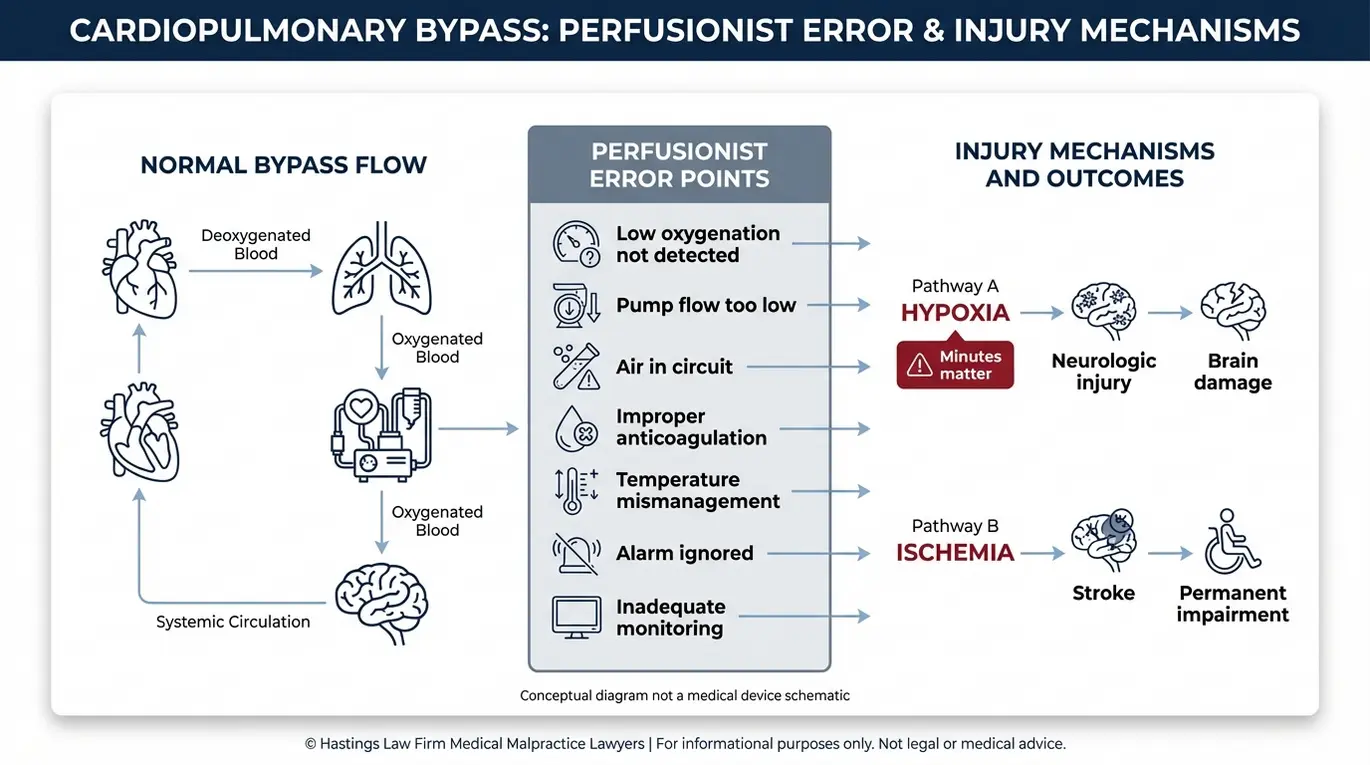
Perfusionist negligence occurs when a Certified Cardiovascular Perfusionist (CCP) fails to meet the standard of care while operating a heart-lung machine, causing preventable harm such as oxygen deprivation, air embolisms, or dangerous blood management errors.
During cardiac surgery, a heart-lung machine, or cardiopulmonary bypass (CPB) system, circulates and oxygenates the patient’s blood. The perfusionist monitors flow rates, gas exchange, and anticoagulation, as noted by McGovern Medical School at UTHealth Houston. A single lapse in attention or technique can result in catastrophic harm within minutes. A cardiac surgery malpractice lawyer understands how to identify these critical breaches in care.
The two most dangerous consequences of perfusionist error are hypoxia and ischemia. Hypoxia, the deprivation of adequate oxygen to the body’s tissues, and ischemia, the restriction of blood flow to tissue, can both cause permanent brain damage or neurologic injury. Research published by PubMed Central analyzing over 580,000 cardiac surgery patients confirms that stroke remains a significant risk factor in these procedures. A bypass negligence attorney can help families investigate whether errors in perfusion management contributed to these outcomes.
One important distinction is whether the harm resulted from equipment failure or operator error. A defective pump may point toward a product liability claim. When a CCP overlooks alarm warnings or miscalculates flow rates, that is negligence by a perfusionist, and it requires a specific legal approach. A Texas perfusionist error lawyer must be able to identify which scenario applies to build the correct case.
Common Perfusion Errors Leading to Liability
The most frequent errors cited by a perfusionist negligence lawyer include:
- Air embolism introduction: Allowing air bubbles to enter the bypass circuit can cause a stroke if the bubbles reach the patient’s brain.
- Improper anticoagulation management: Failing to maintain correct heparin levels can lead to dangerous blood clotting or uncontrolled bleeding during the procedure.
- Pump flow miscalculation: Setting incorrect flow rates may deprive the brain and organs of adequate blood supply, leading to permanent injury.
- Alarm fatigue or ignored warnings: Becoming desensitized to repeated machine alerts can result in alarm fatigue, causing a failure to respond to critical changes in patient status.
- Failure to communicate with the surgical team: Not reporting significant changes in perfusion data prevents the surgeon or anesthesiologist from responding to crises.
Medical experts can trace each of these errors through the surgical record. A perfusionist malpractice attorney will work with qualified medical experts to determine exactly where the standard of care was breached. These technical errors often form the basis of a negligence claim against the surgical team.
Determining Liability in Heart Bypass Machine Cases
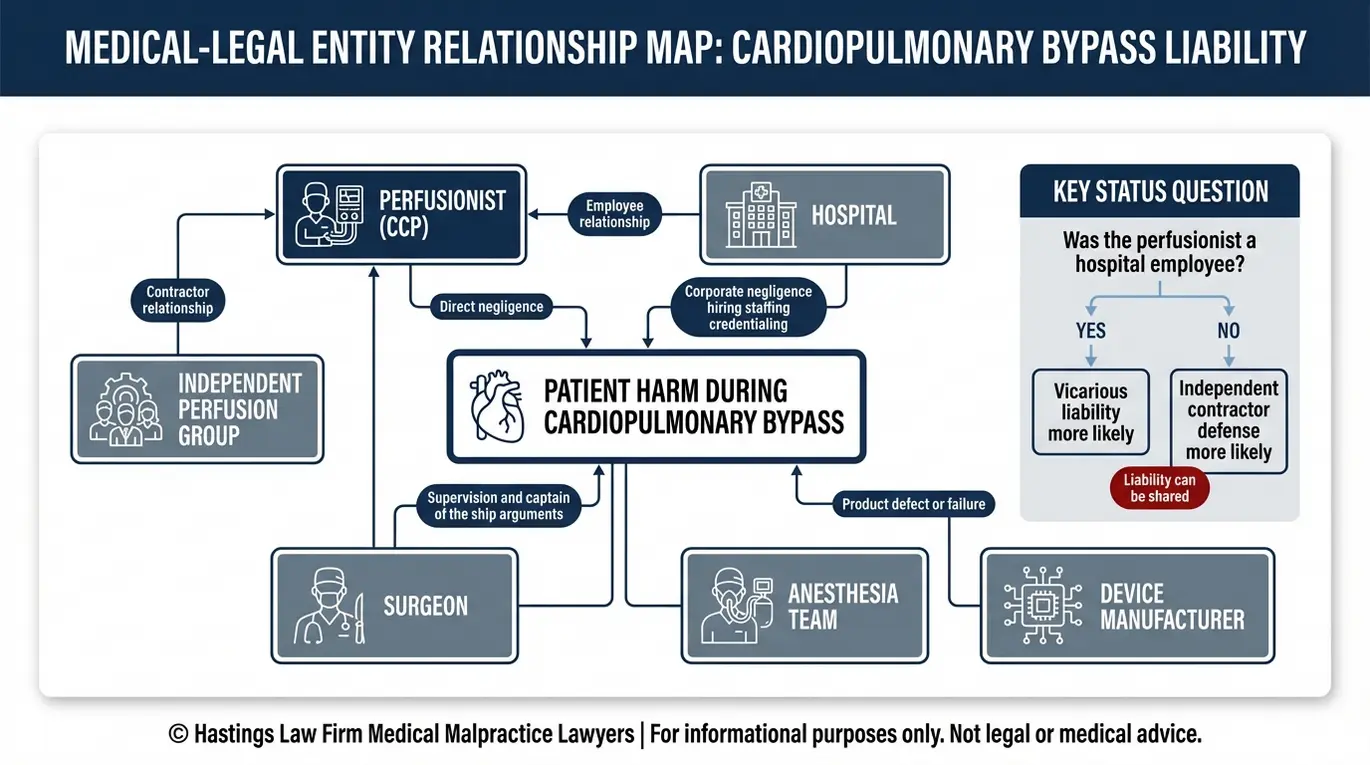
Liability in perfusion cases is complex because the perfusionist may be a direct hospital employee, a member of an independent medical group, or a contracted freelancer, which alters who must be named in the lawsuit. Determining who is responsible is a key step in building a case after a surgical error. Suing a perfusionist requires identifying the correct employer to ensure full recovery.
The Captain of the Ship Doctrine
In some jurisdictions, the lead surgeon can be held responsible for the actions of everyone in the operating room. While this doctrine has been largely rejected in Texas, liability may still depend on the degree of the surgeon’s control over the perfusion team. A medical negligence lawyer can assess how these reporting lines affect your potential recovery.
Hospital Negligence
Hospitals have a duty to properly hire and supervise the surgical team. If a facility did not address a pattern of prior incidents, causing injury or wrongful death, the hospital itself may bear direct liability. The FDA’s MAUDE Adverse Event database documents reported perfusion system failures. These records help show if a facility knew about recurring equipment or staffing problems.
The Independent Contractor Defense
Hospitals frequently argue that the perfusionist was an independent contractor to limit their liability. An experienced malpractice counsel can challenge this defense through theories like vicarious liability. A Texas heart surgery lawyer evaluates how much control the hospital exercised over the specialist.
| Factor | Hospital Employee | Contracted Perfusion Group |
|---|---|---|
| Who is sued? | Hospital is directly liable | Both the contracting group and potentially the hospital |
| Hospital’s defense | Respondeat superior applies | “Independent contractor” defense attempted |
| How liability is established | Standard employer liability | Ostensible agency, corporate negligence, or credentialing failures |
| Insurance coverage | Hospital’s malpractice policy | Contractor’s own policy; hospital policy may also apply |
Identifying every responsible party early is important for establishing causation. Suing a perfusionist alone may leave significant sources of recovery on the table.
The Hastings Law Firm Difference
Results matter, but what truly sets us apart is how we achieve them. Every verdict, every settlement, and every Texas courtroom victory comes from one guiding promise: To treat each client’s fight for justice as if it were our own.
This balance of skill, experience, and empathy reflects our core philosophy that justice should not only compensate the injured, but also make healthcare safer nationwide.

Securing Evidence and Expert Testimony for Trial
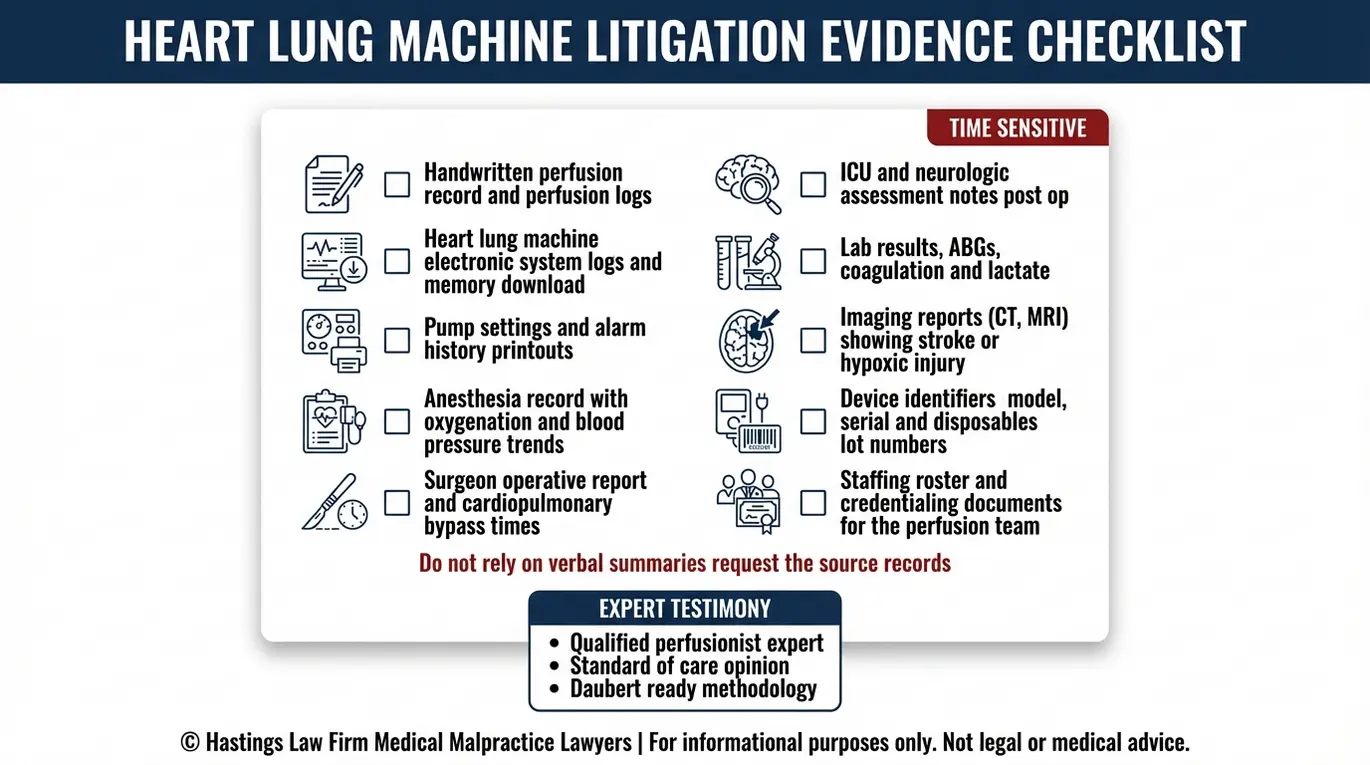
Proving a perfusionist malpractice claim starts with securing the physical perfusion logs and digital data from the bypass machine as early as possible, because these records provide the minute-by-minute timeline of oxygenation levels, pump speeds, and temperature readings that establish whether the standard of care was met. Gathering these documents allows us to reconstruct the timeline of the procedure and identify errors.
The “Black Box” of Surgery
Perfusion logs are critical evidence because they are the handwritten or printed records maintained by the CCP during surgery. They document every adjustment, alarm, and communication. A bypass injury attorney will secure these logs immediately to identify any gaps that may indicate negligence.
System Data Recovery
Securing system logs is important, specifically device logs. These are digital records of pump speeds, pressure readings, and alarm events. This data is often overwritten if not preserved. Under federal HIPAA regulations outlined by HHS.gov, patients can access records, but device data requires a specific legal demand. A Texas perfusionist malpractice lawyer will issue preservation letters to prevent data loss.
Essential evidence to secure includes:
- Handwritten and digital perfusion logs from the CCP
- Raw system data and device logs from the heart-lung machine
- The anesthesia record and surgeon’s operative report
- Pre-operative and post-operative imaging (CT, MRI)
- Hospital credentialing files for the perfusionist
- Any FDA adverse event reports or product recalls related to the equipment used
Expert Witnesses
Texas requires medical malpractice cases to meet the Texas Rules of Evidence. A surgical error counsel ensures the perfusionist expert we retain is qualified to explain to a jury precisely how the CCP’s conduct fell below the accepted standard.
Overcoming Causation Challenges in High-Risk Patients
Defense attorneys often argue that the patient’s pre-existing heart condition caused the injury. Under the “eggshell plaintiff” doctrine, a negligent party takes the patient as they find them. Hypoxia and ischemia must be linked directly to the error. An experienced perfusion data legal expert works to close the analytical gap between the error and the injury.
Recoverable Damages Under Texas Medical Liability Law
Patients harmed by perfusion errors can recover economic damages for lifetime medical care and lost wages, as well as non-economic damages for pain and suffering, though Texas law places statutory caps on certain categories of recovery. Compensation in these cases addresses both physical injury and financial loss.
Economic vs. Non-Economic Damages
Economic damages cover measurable financial losses, such as past and future medical expenses and lost wages. These damages are not capped in Texas. Non-economic damages cover pain, suffering, and mental anguish. Texas law caps these damages at $250,000 against all individual health care providers and $250,000 per health care institution. Your cardiac malpractice damages strategy must account for these limits.
Life Care Plans
For patients left with permanent brain damage, calculating the true cost of future care is important. Maximizing compensation for bypass injury requires working with life care planners. They project the full scope of medical needs, including therapy and full-time caregiving.
Wrongful Death
When a perfusionist’s negligence results in death, surviving family members may bring a wrongful death claim. A wrongful death attorney can guide the family through the Texas Civil Practice and Remedies Code Chapter 74 requirements. A perfusionist negligence settlement in these cases must account for lost financial support and loss of companionship.
Contact the Texas Surgical Error Attorneys at Hastings Law Firm Today for Help
If someone in your family suffered a catastrophic brain injury or died during heart surgery, and you believe a perfusionist’s error may be to blame, you do not have to face the hospital’s legal team alone. Contact a cardiac negligence lawyer immediately.
Hastings Law Firm is a nationally recognized Houston medical malpractice firm led by Tommy Hastings. Our team includes in-house medical staff and former defense lawyers who understand how the other side builds their case. We prepare every case for trial to help our clients find the answers they deserve.
As your Texas perfusionist malpractice lawyer, we will secure the surgical logs, consult with qualified perfusion experts, and build the evidence your family needs. There is no fee unless we recover compensation for you.
Contact our perfusionist malpractice attorneys today for a free, confidential case evaluation. Let us help you find the answers you deserve.
Frequently Asked Questions About Perfusionist Malpractice in Texas


This content was researched and written by the Hastings Law Firm editorial team, which includes attorneys, medical professionals, and experienced researchers. Our writing is informed by internal knowledge and practical experience, and we cross-check critical details against authoritative sources cited throughout. Every piece undergoes human-led fact-checking and legal review. Because legal and medical information can change, if you spot an error, please contact us. Learn more about our content standards and review process on our editorial policy page.

Gabe Sassin has focused exclusively on medical malpractice law since 2007. After spending more than a decade as a malpractice defense attorney, he knows exactly how the other side works. He has seen firsthand how healthcare providers, insurers, corporate defendants, and their legal teams think, prepare, and build their defense against claims. That knowledge works for the people who need it most today, injured patients and their families. His unique experience shapes everything he writes, giving readers a look at how these cases actually work from someone who has handled them from both sides.
