


Texas Hernia Surgery Lawyer
Hernia repair is often expected to be routine, but serious complications can follow when a surgical error occurs or a mesh implant fails. Patients may face persistent pain, infection, bowel obstruction, repeat operations, and growing medical costs that disrupt daily life and recovery. These cases often turn on whether harm came from surgeon negligence, a defective device, or both, including problems tied to informed consent. If you or a loved one were harmed or worse due to hernia repair malpractice in Texas, contact Hastings Law Firm for a free, confidential case review.
Last Updated: July 27, 2026
Trusted Texas Medical Attorneys for Hernia Repair Malpractice Claims
Hernia repair is one of the most common surgeries performed in the United States, and most patients expect a routine recovery. A hernia repair is a surgical procedure to fix a protrusion of tissue through a weak spot in the muscle. When complications arise from a surgeon’s error or a defective mesh implant, the physical and financial consequences can upend your life. Chronic pain, repeat operations, and mounting medical bills create a burden no one should carry alone.
As a Texas hernia surgery lawyer team that focuses exclusively on medical malpractice and defective medical device claims, Hastings Law Firm understands both the medicine and the law behind these cases. Our in-house medical staff and former defense attorneys review the surgical records, identify what went wrong, and determine who is responsible. If you or a loved one experienced serious complications after a hernia procedure, we offer a free, confidential case evaluation to explain your options and help you understand what happened.

Liability in Hernia Operations Involving Surgeon Negligence or Defective Mesh
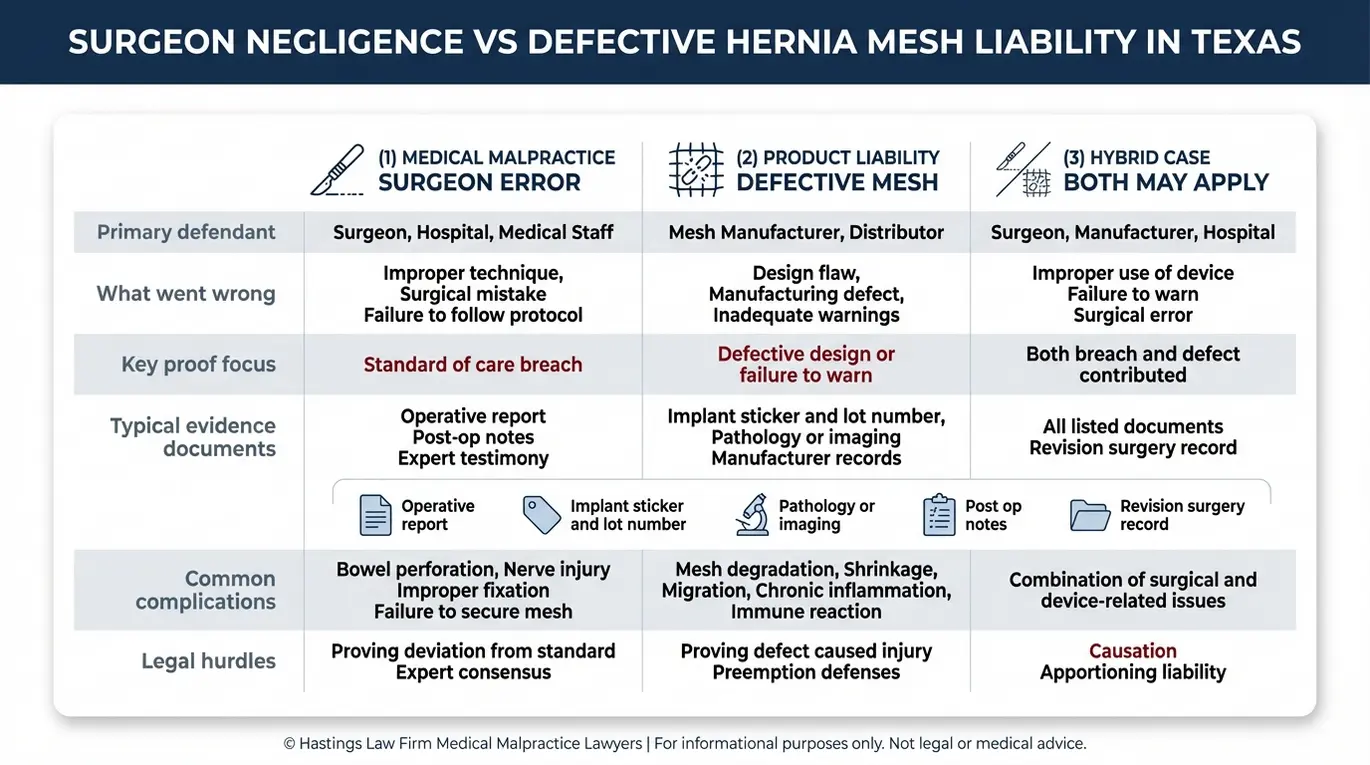
Liability in hernia surgery cases typically falls under either medical malpractice, where the surgeon violates the standard of care during the procedure, or product liability, where the mesh implant itself is defectively designed or manufactured. Identifying the cause of injury helps determine which legal path to follow, such as medical malpractice for human error or product liability for device defects. Finding the source of the injury involves identifying whether the harm came from human error that results in medical malpractice or a failure of the device involved. In some situations, both theories apply to the same case.
Surgeon Negligence
A hernia repair can go wrong when a surgeon makes a preventable error during the operation. This negligence involves a failure to follow the medical standards that keep patients safe. Examples include perforating the bowel with a surgical instrument, cutting or compressing nerves, or failing to secure the mesh properly to the abdominal wall. These errors fall under medical malpractice because the surgeon’s conduct fell below the standard of care that a reasonably competent surgeon would have provided under similar circumstances.
Proving this requires a detailed reconstruction of the surgery itself, including operative reports, anesthesia records, and post-operative notes. Our hernia surgery attorneys work with qualified surgical experts to evaluate exactly what happened in the operating room.
Product Liability
Some cases have nothing to do with the surgeon’s skill. Instead, the mesh device itself is the problem. Product liability is a legal area focusing on harm caused by defective consumer or medical goods.
Polypropylene mesh (PP mesh), a synthetic plastic material commonly used in hernia repairs, has been linked to degradation, migration, and mesh erosion (where the material wears through surrounding tissue) in some patients. When a medical device causes harm because of a design or manufacturing flaw, the manufacturer can be held liable under product liability law, a legal track separate from malpractice. One FDA MAUDE Adverse Event Report for the Bard Perfix Plug Surgical Mesh documents the type of serious post-implant complications that can support these claims.
The Hybrid Case
In certain situations, a patient’s injuries involve both a defective product and a surgeon who failed to warn the patient about the known risks of that specific device. If a doctor implanted a mesh with documented safety concerns and did not discuss those risks as part of informed consent, both the manufacturer and the physician may share liability. Informed consent means your doctor explained the risks and you agreed to the treatment. A Texas hernia surgery lawyer experienced in both malpractice and product claims can identify every responsible party.
| Factor | Surgeon Error (Malpractice) | Product Failure (Product Liability) |
|---|---|---|
| Cause of Harm | Surgical mistake during the procedure | Defective design or material in the mesh |
| Defendant | Surgeon and/or hospital | Device manufacturer |
| Legal Theory | Violation of the standard of care | Defective product placed into the market |
| Key Evidence | Operative reports, expert testimony | Device testing data, FDA reports, recall history |
| Hybrid Scenario | Surgeon failed to warn about known device risks, combining both theories |
Understanding Hernia Repairs and Common Surgical Risks
A hernia occurs when an organ or fatty tissue squeezes through a weak spot in a surrounding muscle or fascia, commonly treated via open or laparoscopic repair often utilizing surgical mesh to reinforce the abdominal wall. A hernia repair involves returning the tissue to its proper place. Most procedures use some form of surgical mesh to reduce the chance the hernia comes back.
The Procedure
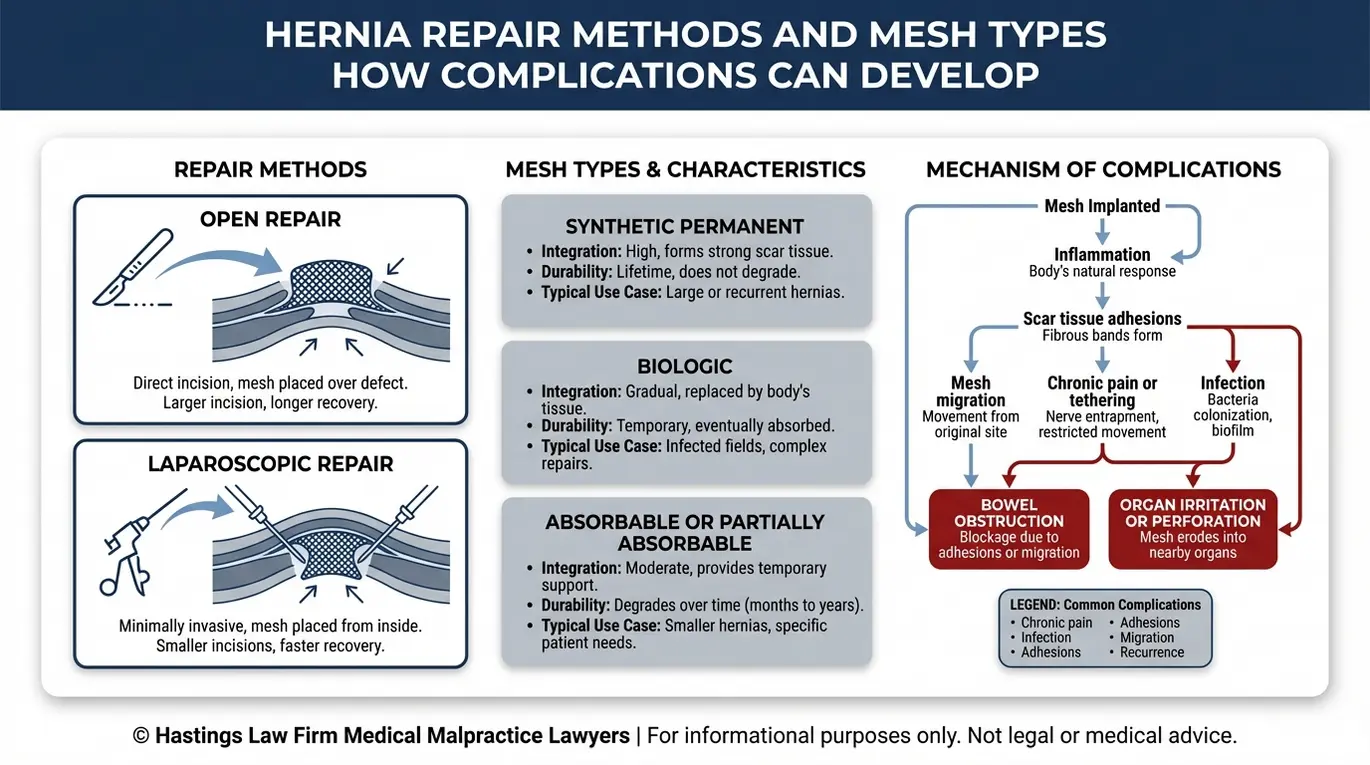
In an open repair, the surgeon makes a single incision near the hernia site, repositions the tissue, and patches the area. In a laparoscopic approach, the surgeon uses several small incisions and a camera to guide the repair. Both methods frequently involve placing mesh over or under the weakened tissue.
Both surgical approaches aim to strengthen the abdominal wall to prevent further tissue protrusion. According to the Baylor College of Medicine’s hernia surgery patient education materials, mesh-based repairs have become the standard because they significantly lower recurrence rates compared to suture-only closures.
Types of Mesh
Not all mesh is the same. The material used can directly affect a patient’s risk of complications:
- Synthetic mesh is made from manufactured materials like polypropylene and is designed to be a permanent implant that stays in the body indefinitely (non-absorbable).
- Biologic mesh is derived from animal or human tissue and is intended to be gradually absorbed and replaced by the patient’s own tissue over time.
- Absorbable synthetic mesh breaks down in the body after a set period, offering temporary reinforcement while natural tissue heals.
The FDA’s guidance on surgical mesh used for hernia repair notes that while mesh reduces recurrence, it introduces its own set of risks, and certain products have been subject to recalls or voluntary market withdrawals due to safety concerns.
Foreign Body Response and Mesh Rejection Mechanisms
When any foreign material is placed inside the body, the immune system may react to it. This is called a foreign body response, the biological process where the body identifies the mesh as a threat and attacks it with inflammation. Over time, that chronic inflammation can produce dense scar tissue known as adhesions, which are bands of fibrous tissue that bind organs or tissues together abnormally.
In some patients, this inflammatory cycle leads to mesh migration (the device shifting from its original placement), mesh erosion, infection at the implant site, or persistent pain that does not respond to treatment. These complications may appear weeks, months, or even years after the original surgery, which is one reason a hernia surgery lawyer’s involvement often begins long after the initial procedure.
The Hastings Law Firm Difference
Results matter, but what truly sets us apart is how we achieve them. Every verdict, every settlement, and every Texas courtroom victory comes from one guiding promise: To treat each client’s fight for justice as if it were our own.
This balance of skill, experience, and empathy reflects our core philosophy that justice should not only compensate the injured, but also make health care safer nationwide.

Signs of a Botched Hernia Surgery or Mesh Failure
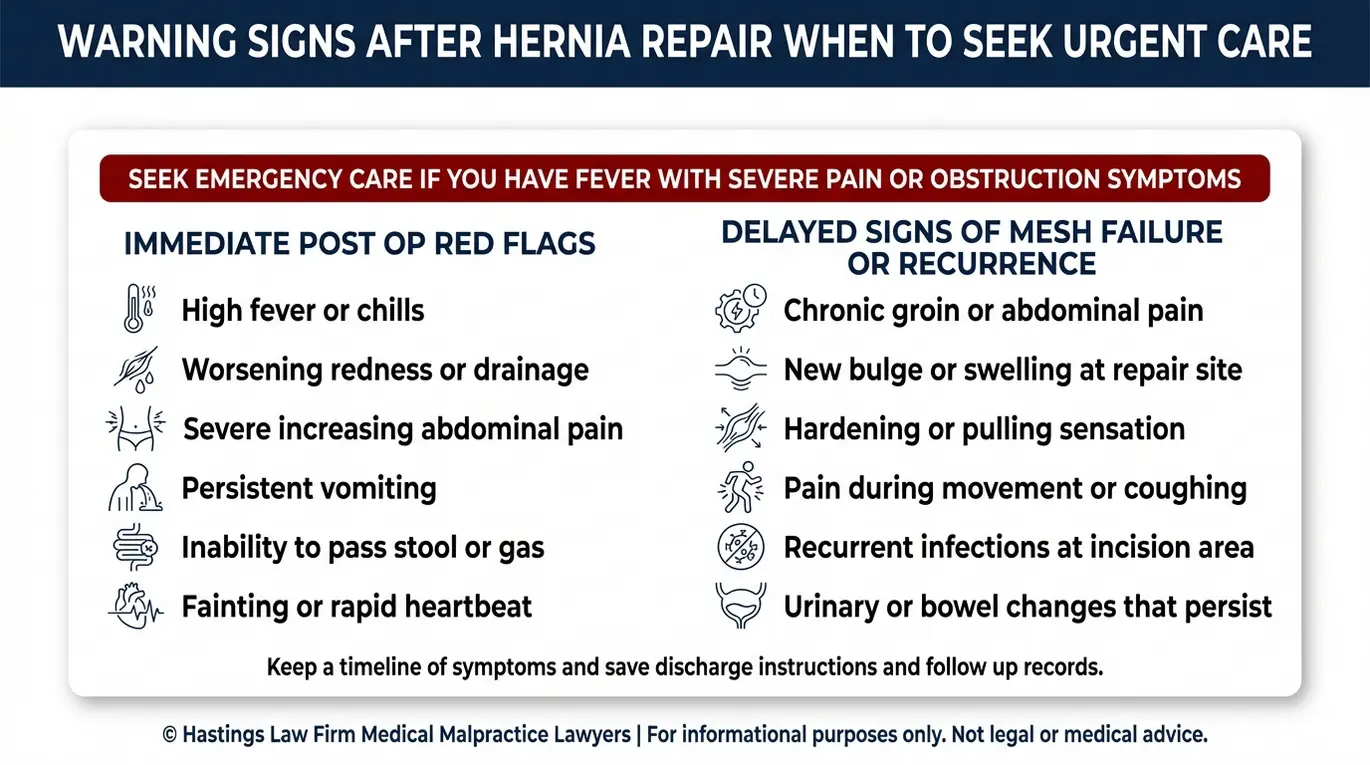
Signs of a failed hernia surgery include chronic pain at or near the surgical site, high fever indicating infection, inability to pass stool due to bowel obstruction, or visible bulging suggesting recurrence or mesh migration. A mesh failure can lead to significant internal damage that requires immediate medical attention. Some symptoms appear immediately, while others develop gradually over months or years.
Immediate vs. Delayed Symptoms
Certain complications show up right away. A bowel nicked during surgery, for example, can cause severe abdominal pain, fever, and signs of sepsis within hours or days. Other problems, like mesh migration (where the implant shifts away from its original position) or organ perforation (where the mesh erodes into a nearby organ such as the bladder or intestine), may not become apparent until well after the patient has been discharged.
According to discharge guidance from MedlinePlus on inguinal hernia repair, patients should watch for specific warning signs during recovery. Long-term mesh degradation can produce symptoms that build so slowly they are initially dismissed as normal post-surgical discomfort.
Symptom Checklist
Watch for these warning signs after hernia repair surgery:
- Persistent or worsening pain at the repair site beyond the expected recovery period
- Fever, redness, or drainage from the incision suggesting infection
- Nausea, vomiting, or inability to pass gas or stool, which may indicate bowel obstruction
- A new or returning bulge near the surgical site
- Pain during urination or bowel movements, which can signal mesh erosion into surrounding organs
- Abdominal swelling or tenderness that worsens over time
Revision Surgery as Evidence
When a patient requires a second operation, known as revision surgery (a corrective procedure to remove or replace a failed mesh implant), it is often one of the strongest indicators that something went wrong the first time. A revision surgery is a follow-up procedure used to address complications from a previous operation.
Whether the cause was improper surgical technique or a defective product, the need for additional surgery carries its own medical risks and adds significant cost. If you are experiencing any of these symptoms, speaking with a Texas hernia surgery lawyer can help you determine whether your complications point to negligence or device failure.
Eligibility and Time Limits for Filing a Hernia Lawsuit in Texas
To file a lawsuit, a patient must prove that a specific surgical error or defective device caused their injury within the applicable Texas filing deadlines. For health care liability claims, Texas Civil Practice and Remedies Code § 74.251 generally requires suit to be filed within two years from the date of the negligent act or omission, or the completion of the treatment giving rise to the claim. These legal deadlines vary based on the specific circumstances of your medical care. Under Texas Civil Practice and Remedies Code Chapter 16, the general statute of limitations for personal injury claims is two years.
The Discovery Rule
Hernia mesh cases often present a timing challenge. A patient may not realize their mesh is defective until years after implantation, when symptoms of migration or erosion finally appear. Texas law accounts for this through the discovery rule, which allows the two-year clock to start on the date the patient knew or reasonably should have known the injury was caused by the device or surgical error, rather than the date of the original surgery.
Statute of Repose
Even with the discovery rule, Texas Civil Practice and Remedies Code Chapter 74 imposes a hard deadline known as the statute of repose. For medical liability claims, this generally bars lawsuits filed more than ten years after the date of the act or omission that gives rise to the claim, regardless of when the patient discovered the harm. This makes early legal consultation essential.
Individual Lawsuits vs. Class Actions
Many hernia mesh claims are filed as individual lawsuits rather than class actions. A class action groups many plaintiffs together with a shared settlement, which often results in smaller individual payouts. Our firm typically files individual cases so that each client’s specific medical expenses, lost income, and pain are evaluated on their own merits. A hernia surgery lawyer in Texas can handle these issues for you and advise which path makes the most sense based on your circumstances.
- Statute of Limitations: Generally two years from the date of the negligent act or omission, or completion of treatment.
- Discovery Rule: May extend the filing deadline if the defect was not immediately discoverable.
- Statute of Repose: A strict ten-year deadline from the date of the act or omission, barring most claims filed after this period.
Recoverable Damages for Hernia Surgery Injuries
Victims of negligent hernia surgery can recover economic damages for medical bills and lost wages, as well as non-economic damages for physical pain, mental anguish, and physical impairment. The specific value of a claim depends on the severity of the injury and its long-term effects. Calculating these losses requires a thorough review of medical billing and future care needs.
Economic damages cover measurable financial losses. These include the cost of the original procedure, any revision surgery (also known as corrective surgery to repair or remove a failed mesh), hospital stays, medications, physical therapy, and future care. Lost wages and reduced earning capacity also fall into this category. Data from the Healthcare Cost and Utilization Project (HCUP) can help quantify the true cost of inpatient procedures when building a damages model.
Non-economic damages address the human toll. Chronic pain from mesh complications, the anxiety of facing another surgery, and the disruption to daily life and relationships are all compensable. In hernia mesh cases, pain and suffering often represents the largest portion of the compensation because of the ongoing, debilitating nature of the symptoms.
Punitive damages may be available in cases where a manufacturer knew the mesh was defective and continued selling it. These damages are designed to punish gross negligence and deter similar conduct. A Texas hernia surgery lawyer can evaluate whether the facts of your case support a claim for punitive damages.
Contact the Texas Surgical Error Attorneys at Hastings Law Firm Today for Help
Complications from hernia surgery can leave you dealing with pain, uncertainty, and growing medical costs. You may not know whether the surgeon made an error, the mesh was defective, or both. That is exactly what our team investigates.
Hastings Law Firm brings together board-certified trial attorneys, in-house medical professionals, and former defense counsel who understand how hospitals and device manufacturers respond to these claims. Founded by Tommy Hastings, who is board-certified in Personal Injury Trial Law, our firm focuses on medical malpractice to secure full compensation for patients. We prepare every case as if it is going to trial, and that preparation gives us strength whether we are negotiating a settlement or presenting evidence to a jury.
If you or a loved one suffered serious complications after a hernia repair, contact an experienced Texas hernia surgery lawyer at our firm for a free, confidential case evaluation. We work on a contingency fee basis, which means you pay nothing unless we recover compensation on your behalf. Let us help you find the answers you deserve.
Frequently Asked Questions About Hernia Surgery in Texas


This content was researched and written by the Hastings Law Firm editorial team, which includes attorneys, medical professionals, and experienced researchers. Our writing is informed by internal knowledge and practical experience, and we cross-check critical details against authoritative sources cited throughout. Every piece undergoes human-led fact-checking and legal review. Because legal and medical information can change, if you spot an error, please contact us. Learn more about our content standards and review process on our editorial policy page.

Gabe Sassin has focused exclusively on medical malpractice law since 2007. After spending more than a decade as a malpractice defense attorney, he knows exactly how the other side works. He has seen firsthand how healthcare providers, insurers, corporate defendants, and their legal teams think, prepare, and build their defense against claims. That knowledge works for the people who need it most today, injured patients and their families. His unique experience shapes everything he writes, giving readers a look at how these cases actually work from someone who has handled them from both sides.
